Pharmacists Provided Medication Therapy Management: A Patients Ally - - PowerPoint PPT Presentation

pharmacist s provided medication therapy management a
SMART_READER_LITE
LIVE PREVIEW

Pharmacists Provided Medication Therapy Management: A Patients Ally - - PowerPoint PPT Presentation

Pharmacists Provided Medication Therapy Management: A Patients Ally Against Chronic Diseases Presented by: Kisha Gant, PharmD, BCACP, BCGP, BCPS Clinical Coordinator, Pharmacy Slidell Memorial Hospital Continuing Education This Live


slide-1
SLIDE 1

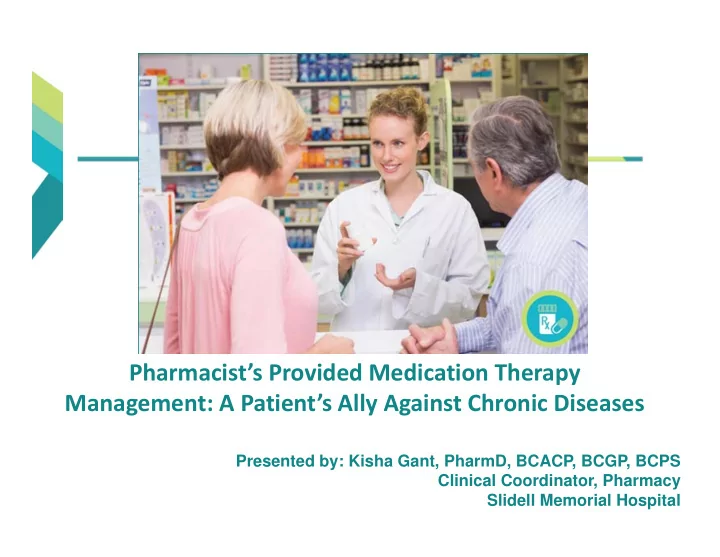
Pharmacist’s Provided Medication Therapy Management: A Patient’s Ally Against Chronic Diseases

Presented by: Kisha Gant, PharmD, BCACP, BCGP, BCPS Clinical Coordinator, Pharmacy Slidell Memorial Hospital
slide-2
SLIDE 2
slide-3
SLIDE 3

Continuing Education

  • This Live series activity, Well-Ahead Louisiana Provider

Education Network Webinar Series, from 04/26/2018 - 04/26/2019, has been reviewed and is acceptable for credit by the American Academy of Family Physicians. Physicians should claim only the credit commensurate with the extent of their participation in the activity. The session titled “Pharmacist’s Provided Medication Therapy Management: A Patient’s Ally Against Chronic Diseases” has been approved for 1.0 AAFP Prescribed credits.

slide-4
SLIDE 4
  • Kisha Gant, PharmD, BCACP, BCGP, BCPS

Meet the Expert

slide-5
SLIDE 5

Affiliations

  • I have the following affiliations to disclose:

– American Society of Consultant Pharmacists (ASCP)

  • Medication Safety & Transitions of Care (MSTOC)
  • Workgroup. 2017 – Present

– MSTOC Toolkit Update Subgroup Leader. 2017 – Present

  • Educational Advisory Council. 2017 – Present
  • Government Affairs Committee. 2017 – Present

– American Pharmacists Association (APhA) Alternate Delegate. 2017 – 2018

  • New Business Committee. 2017 – 2018
slide-6
SLIDE 6

https://bit.ly/2vQoCEJ

slide-7
SLIDE 7

Objectives

  • 1. Define Medication Therapy Management

(MTM) and its components.

  • 2. Identify financial opportunities to sustain

your MTM service.

  • 3. Discuss strategies to promote your MTM

services.

  • 4. List business, clinical, quality improvement,

and other MTM resources.

slide-8
SLIDE 8

Question #1

Which one of the following is a patient‐centric document containing a list of actions for the patient to use in tracking his/her progress for self‐ management?

  • A. Personal Medication Record (PMR)
  • B. Medication Adherence Form
  • C. Medication‐Related Action Plan (MAP)
  • D. Discharge Summary
slide-9
SLIDE 9

Question #2

Which one of the following are MTM‐specific billing codes?

  • A. 99605, 99606, 99607
  • B. 99211, 99212, 99213
  • C. 99201, 99202, 99203
  • D. G0108, G0109, G0110
slide-10
SLIDE 10

Question #3

You are ready to began providing MTM services. Which one of the following is/are methods to promote your service?

  • A. Bag Stuffers
  • B. Face‐to‐Face
  • C. Letters
  • D. All of the above
slide-11
SLIDE 11

Question #4

There is only one available training program for pharmacists to learn how to provide MTM services.

  • A. True
  • B. False
slide-12
SLIDE 12

MEDICATION THERAPY MANAGEMENT (MTM)

slide-13
SLIDE 13

Why MTM?

  • People visit pharmacies on avg 35 times per yr
  • Pharmacists are the MED EXPERTS
  • Every $1 spent on MTM = up to $4 saved on
  • verall health care costs
  • 29% of adults take 5 or more meds
  • Pharmacist‐provided MTM = improvements in

A1C, BP, & LDL

  • U.S. spends $3.5 billion on extra medical costs

that result from ADEs

  • 125,000 deaths per year due to nonadherence

www.pharmacytimes.com/publications/directions‐in‐ pharmacy/2014/august2014/pharmacists‐as‐influencers‐of‐patient‐adherence‐ http://www.pharmacist.com/toolkit‐marketing‐mtm‐prescribers N Engl J Med. 2005;353:487‐489 Patterns of medication use in the United States, 2006 Exploring Pharmacists Role in a Changing Healthcare Environment

  • IOM. Preventing Medication Errors: Quality Chasm Series.2006
slide-14
SLIDE 14

What is MTM ?

Distinct service or group of services that

  • ptimize therapeutic outcomes for individual

patients and are independent of, but can occur in conjunction with, the provision of a medication product

J Am Pharm Assoc (2003) 2008 May‐Jun;48(3):341–53

slide-15
SLIDE 15

JCPP Definition

Now called “Medication Management Services” A spectrum of patient‐centered, pharmacist‐provided, collaborative services that focus on medication appropriateness, effectiveness, safety, and adherence with the goal of improving health outcomes.

JCPP Patient Care Process Workgroup’s Recommended Revisions to the Profession’s Medication Therapy Management Definition

slide-16
SLIDE 16

MTM Requirements

  • Patient‐specific & individualized services or sets of

services provided directly by a pharmacist

  • Face‐to‐face interaction between the patient &

pharmacist as the preferred method of delivery

  • Opportunities for pharmacists & other qualified

healthcare providers to identify patients who should receive MTM

  • Payment for MTM consistent with contemporary

provider payment rates that are based on the time, clinical intensity, & resources required

  • Processes to improve continuity of care, outcomes, &
  • utcome measures

J Am Pharm Assoc (2003) 2008 May‐Jun;48(3):341–53

slide-17
SLIDE 17

Who Needs MTM?

Patients who have:

  • Experienced transitions of care
  • Changed medication regimens or insurance

coverage

  • Multiple chronic conditions, providers, or meds
  • History of nonadherence
  • Limited health literacy
  • Desire to reduce healthcare costs
  • High‐risk meds

J Am Pharm Assoc (2003) 2008 May‐Jun;48(3):341–53

slide-18
SLIDE 18

MTM Components

  • 1. Medication Therapy Review (MTR)
  • 2. Personal Medication Record (PMR)
  • 3. Medication‐Related Action Plan (MAP)
  • 4. Intervention &/or Referral
  • 5. Documentation & Follow‐Up

J Am Pharm Assoc (2003) 2008 May‐Jun;48(3):341–53

slide-19
SLIDE 19

Medication Therapy Review (MTR)

Systematic process of collecting patient‐specific information, assessing medication therapies to identify medication‐related problems, developing a prioritized list of medication‐ related problems, & creating a plan to resolve them

J Am Pharm Assoc (2003) 2008 May‐Jun;48(3):341–53

slide-20
SLIDE 20

https://bit.ly/2KehDZm

slide-21
SLIDE 21

Personal Medication Record (PMR)

Comprehensive record of the patient’s medications (prescription & nonprescription medications, herbal products, and other dietary supplements)

J Am Pharm Assoc (2003) 2008 May‐Jun;48(3):341–53

slide-22
SLIDE 22

Personal Medication Record (PMR)

  • Pt name
  • Pt birth date
  • Pt phone number
  • Emergency contact info (Name,

relationship, phone number)

  • Primary care physician (Name

& phone number)

  • Pharmacy/pharmacist (Name &

phone number)

  • Allergies (e.g., What allergies

do I have? What happened when I had the allergy or reaction?)

  • Other medication‐related

problems (e.g., What medication caused the problem? What was the problem I had?)

  • Date last updated
  • Date last reviewed by the

pharmacist, physician, or other healthcare professional

  • Patient’s signature
  • Healthcare provider’s signature
  • For each medication, inclusion of

the following:

– Medication (e.g., drug name and dose) – Indication (e.g., Take for…) – Instructions for use (e.g., When do I take it?) – Start date – Stop date – Ordering prescriber/contact information (e.g., doctor) – Special instructions

J Am Pharm Assoc (2003) 2008 May‐Jun;48(3):341–53

slide-23
SLIDE 23

Personal Medication Record (PMR)

J Am Pharm Assoc (2003) 2008 May‐Jun;48(3):341–53

slide-24
SLIDE 24

Personal Medication Record (PMR)

J Am Pharm Assoc (2003) 2008 May‐Jun;48(3):341–53

slide-25
SLIDE 25

Medication‐Related Action Plan (MAP)

Patient‐centric document containing a list of actions for the patient to use in tracking progress for self‐management.

J Am Pharm Assoc (2003) 2008 May‐Jun;48(3):341–53

slide-26
SLIDE 26
  • Name
  • PCP (Name & Number)
  • Pharmacy/Pharmacist (Pharmacy/Pharmacist

Name & Number)

  • Date MAP Prepared
  • Action Steps: “What I need to do...”
  • Notes: “What I did and when I did it...”
  • Appt info for follow‐up with pharmacist

Medication‐Related Action Plan (MAP)

J Am Pharm Assoc (2003) 2008 May‐Jun;48(3):341–53

slide-27
SLIDE 27

Medication‐Related Action Plan (MAP)

J Am Pharm Assoc (2003) 2008 May‐Jun;48(3):341–53

slide-28
SLIDE 28

Intervention and/or Referral

Pharmacist provides consultative services & intervenes to address medication‐related problems; when necessary, the pharmacist refers the patient to a physician or other healthcare professional

J Am Pharm Assoc (2003) 2008 May‐Jun;48(3):341–53

slide-29
SLIDE 29

Intervention and/or Referral

Examples of situations necessitating referral include:

– Pt may exhibit problems discovered during the MTR that may require referral for evaluation & diagnosis – Pt may require education to help him/her manage chronic diseases – Pt may require monitoring for high‐risk meds (e.g., warfarin, phenytoin, methotrexate)

J Am Pharm Assoc (2003) 2008 May‐Jun;48(3):341–53

slide-30
SLIDE 30

Documentation & Follow‐Up

MTM services are documented in a consistent manner, & a follow‐up MTM visit is scheduled based on the patient’s medication‐related needs, or the patient is transitioned from one care setting to another

J Am Pharm Assoc (2003) 2008 May‐Jun;48(3):341–53

slide-31
SLIDE 31

Documentation & Follow‐Up

J Am Pharm Assoc (2003) 2008 May‐Jun;48(3):341–53

slide-32
SLIDE 32

Why Document?

  • Facilitate communication between pharmacist & pt’s other

healthcare professionals regarding recommendations intended to resolve or monitor actual or potential medication‐related problems

  • Improve pt care & outcomes
  • Enhance continuity of pt care among providers & care settings
  • Ensure compliance with laws & regulations for maintenance of pt

records

  • Protect against professional liability
  • Capture services provided for justification of billing or

reimbursement (e.g., payer audits)

  • Demonstrate value of pharmacist‐provided MTM services
  • Demonstrate clinical, economic, & humanistic outcomes

J Am Pharm Assoc (2003) 2008 May‐Jun;48(3):341–53

slide-33
SLIDE 33

J Am Pharm Assoc (2003) 2008 May‐Jun;48(3):341–53

slide-34
SLIDE 34

http://www.pharmacist.com/medication‐therapy‐management‐services

slide-35
SLIDE 35

FINANCIAL OPPORTUNITIES

slide-36
SLIDE 36

Billing for MTM

  • National Provider (NPI) Number

– https://nppes.cms.hhs.gov/NPPES

  • Make a list of itemized services once fees are

determined

  • Be familiar with billing codes
  • Identify payors & execute contracts

http://www.pharmacist.com/sites/default/files/files/mtm_analyzing_costs_tools.pdf

slide-37
SLIDE 37

MTM Billing Codes

99605

  • MTM provided by a pharmacist, individual, face‐

to‐face with pt, initial 15 minutes, with assessment, & intervention if provided; initial 15 minutes, new patient 99606

  • Initial 15 minutes, established patient

99607

  • Each additional 15 minutes (List separately in

addition to code for the primary service)

http://www.pstac.org/services/mtms‐codes.html

slide-38
SLIDE 38

Types of MTM Services

  • 1. Targeted Interventions (15 min)
  • 2. Comprehensive Medication (45 – 60 min)

– Face‐to‐face

  • 3. Targeted Medication Reviews (15 min)

http://www.mckesson.com/blog/leveraging‐medication‐therapy‐management‐for‐independent‐pharmacies/

slide-39
SLIDE 39

MTM Code Examples

https://www.accp.com/docs/positions/misc/CMM%20Resource%20Guide.pdf

slide-40
SLIDE 40

Superbill

slide-41
SLIDE 41

MTM Tech Services

slide-42
SLIDE 42

PROMOTING YOUR MTM SERVICES

slide-43
SLIDE 43

MTM Promotion

  • Improve pt outcomes
  • Decrease med errors
  • Promote pt self‐management
  • Improve coordination & continuity of care
  • Improved quality metrics
  • APhA. Talking Points for Describing MTM and Its Benefits
slide-44
SLIDE 44

Sample MTM Flyer

http://www.pharmacist.com/sites/default/files/files/mtm_promo_flyr_other_hc_providers.pdf

slide-45
SLIDE 45

MTM Promotion to Prescribers

APhA Toolkit for Marketing MTM to Prescribers – Members Only

  • (http://www.pharmacist.com/toolkit‐marketing‐mtm‐prescribers)

1. Getting in the Door 2. Sample Elevator Speeches 3. Tips for Communicating with Prescribers 4. Talking Points on MTM and its Benefits 5. Need for MTM 6. Motivational Interviewing Tactics 7. Sample PowerPoint Presentation 8. Overcoming Challenges 9. Sample Medication Change Fax Template

  • 10. Sample Medication Class Fax Template
  • 11. Sample MTM Flyer
slide-46
SLIDE 46

https://www.stepsforward.org/modules/embedded‐pharmacists

slide-47
SLIDE 47

MTM Promotion to Pts

Passive Approaches

  • Letters
  • Bag Stuffers

Active Approaches

  • Fact‐to‐Face
  • Telephone

J Am Pharm Assoc (2003). 2015 Mar‐Apr;55(2):178‐81

https://elearningindustry.com/wp‐content/uploads/2017/02/is‐no‐significant‐difference‐ bad‐for‐edtech‐research.png

slide-48
SLIDE 48

MTM Promotion to Pts

Accepted

  • Potential cost savings
  • Review of med efficacy
  • Pharmacist’s expert opinion
  • Med education

Declined

  • Comfortable with meds
  • Services already provided

by their pharmacist

J Am Pharm Assoc (2003). 2015 Mar‐Apr;55(2):178‐81

https://cdn.shopify.com/s/files/1/1061/1924/files/Thi nking_Face_Emoji.png?9898922749706957214

slide-49
SLIDE 49

MTM Promotion to Payors

http://www.pharmacist.com/sites/default/files/files/mtm_promo_flyr_health_plans.pdf

slide-50
SLIDE 50

BUSINESS, CLINICAL, QUALITY IMPROVEMENT, & OTHER MTM RESOURCES

slide-51
SLIDE 51

Business

  • Getting Your MTM Business Started

– http://www.pharmacist.com/getting‐your‐mtm‐ business‐started

  • Pharmacist Services Technical Advisory Coalition.

Medication Therapy Management Service Codes

– http://www.pstac.org/services/mtms‐codes.html

  • American Pharmacists Association. Billing Primer:

A Pharmacist’s Guide to Outpatient Fee‐for‐ Service Billing

– Free for members

slide-52
SLIDE 52

Clinical

  • Board Certified Medication Therapy Management Specialist

(BCMTMS)

– https://www.nbmtm.org/

  • APhA’s Delivering Medication Therapy Management Services

– http://www.pharmacist.com/certificate‐training‐programs

  • PowerPak CE Pharmacist Certificate Program in Medication Therapy

Management

– http://www.powerpak.com/mtm/

  • MTM Certificate Program for Pharmacy Technicians

– http://www.powerpak.com/mtmpht10/

  • Clinical Pharmacy Intervention and ADE pADE Documentation Form,

HRSA Final Version

– http://pharmweb.usc.edu/MedicationManagement/Packages/Clinical _Pharmacy_Intervention_and%20ADE_pADE_data_collection%20_for m_HRSA_final_version.docx

slide-53
SLIDE 53

Quality Improvement

  • Pharmacist Clinical Services Performance

Evaluation

– http://www.pharmacist.com/sites/default/files/fil es/mtm_pharmacist_clinical_services.pdf

slide-54
SLIDE 54

Other Resources

  • Health Literacy Tools for Providers of Medication Therapy

Management

– https://www.ahrq.gov/professionals/quality‐patient‐ safety/pharmhealthlit/mtm.html

  • American Society Consultant of Pharmacists (ASCP) Medication

Safety During Transitions of Care (MSTOC): A Toolkit for Senior Care Pharmacist

– http://www.ascp.com/default.asp?page=mstoctool

  • Patient Centered Primary Care Collaborative (PCPCC) The Patient‐

Centered Medical Home: Integrating Comprehensive Medication Management to Optimize Patient Outcomes RESOURCE GUIDE

– https://www.accp.com/docs/positions/misc/CMM%20Resource%20G uide.pdf

slide-55
SLIDE 55

https://bit.ly/2FjE3o6

slide-56
SLIDE 56

Question #1

Which one of the following is a patient‐centric document containing a list of actions for the patient to use in tracking his/her progress for self‐ management?

  • A. Personal Medication Record (PMR)
  • B. Medication Adherence Form
  • C. Medication‐Related Action Plan (MAP)
  • D. Discharge Summary
slide-57
SLIDE 57

Question #2

Which one of the following are MTM‐specific billing codes?

  • A. 99605, 99606, 99607
  • B. 99211, 99212, 99213
  • C. 99201, 99202, 99203
  • D. G0108, G0109, G0110
slide-58
SLIDE 58

Question #3

You are ready to began providing MTM services. Which one of the following is/are methods to promote your service?

  • A. Bag stuffers
  • B. Face‐to‐Face
  • C. Letters
  • D. All of the above
slide-59
SLIDE 59

Question #4

There is only one available training program for pharmacists to learn how to provide MTM services.

  • A. True
  • B. False
slide-60
SLIDE 60

References

  • American Pharmacists Association. Toolkit for Marketing Medication

Therapy Management (MTM) to Prescribers: Medication Adherence Statistics to Support Need for Pharmacist‐Provided MTM. Available at http://www.pharmacist.com/members‐only‐file/MTMPrescriberToolkit‐ 05‐AdherenceStats.pdf. Accessed April 15, 2018.

  • American Pharmacists Association. Toolkit for Marketing Medication

Therapy Management (MTM) to Prescribers: Talking Points for Describing MTM and Its Benefits. Available at http://www.pharmacist.com/members‐

  • nly‐file/MTMPrescriberToolkit‐04‐TalkingPoints.pdf. Accessed April 15,

2018.

  • American Pharmacists Association and the National Association of Chain

Drug Stores Foundation. Medication therapy management in pharmacy practice: core elements of an MTM service model (version 2.0) J Am Pharm Assoc (2003) 2008 May‐Jun;48(3):341–53. Epub: 2008/07/04. Accessed March 9, 2018.

  • Centers for Disease Control and Prevention. Medication Safety Program:

Medication Safety Basics. Available at https://www.cdc.gov/medicationsafety/basics.html. Accessed April 15, 2018.

slide-61
SLIDE 61

References

  • Chen S. Clinical Pharmacy Intervention and ADE pADE Documentation

Form, HRSA Final Version. Available at http://pharmweb.usc.edu/MedicationManagement/Packages/Clinical_Ph armacy_Intervention_and%20ADE_pADE_data_collection%20_form_HRSA _final_version.docx. Accessed April 17, 2018.

  • Choe HM, Standiford CJ. Brown MT. American Medical Association.

Embedding Pharmacists into the Practice. Available at https://www.stepsforward.org/modules/embedded‐pharmacists. Accessed April 16, 2018.

  • Exploring Pharmacists Role in a Changing Healthcare Environment. Avalere

Health, LLC. 2014. Available at http://avalere‐health‐ production.s3.amazonaws.com/uploads/pdfs/1400680820_05212014‐ Exploring_Pharmacists_Role_in_a_Changing_Healthcare_Environment.pdf . Accessed April 15, 2018.

slide-62
SLIDE 62

References

  • Huet AL, Frail CK, Lake LM, Snyder ME. Impact of passive and active

promotional strategies on patient acceptance of medication therapy management services. J Am Pharm Assoc (2003). 2015;55(2):178‐81

  • Institute of Medicine Committee on Identifying and Preventing Medication
  • Errors. Preventing Medication Errors: Quality Chasm Series. Washington,

DC: The National Academies Press, 2006.

  • Joint Commission of Pharmacy Practitioners. JCPP Patient Care Process

Workgroup’s Recommended Revisions to the Profession’s Medication Therapy Management Definition. 2018. Available at https://jcpp.net/wp‐ content/uploads/2017/12/Agenda‐Item‐3‐A2‐Pt‐Care‐Proc‐Workgroup‐ Recom‐Revisions‐to‐the‐Professions‐Medication‐Therapy‐Management‐ Definition.pdf. Accessed April 16, 2018.

  • McKesson. Leveraging Medication Therapy Management for Independent
  • Pharmacies. Available at http://www.mckesson.com/blog/leveraging‐

medication‐therapy‐management‐for‐independent‐pharmacies/. Accessed April 15, 2018.

slide-63
SLIDE 63

References

  • Moose J, Branham A Pharmacists as influencers of patient adherence.

Pharmacy Times website. www.pharmacytimes.com/publications/directions‐in‐ pharmacy/2014/august2014/pharmacists‐as‐influencers‐of‐patient‐ adherence‐. Published August 21, 2014. Accessed April 15, 2018.

  • Osterberg L, Blaschke T. Adherence to medication. N Engl J Med.

2005;353:487‐489.

  • Pharmacist Services Technical Advisory Coalition. Medication Therapy

Management Service Codes. Available at http://www.pstac.org/services/mtms‐codes.html. Accessed April 15, 2018.

  • Slone Epidemiology Center at Boston University. Patterns of medication

use in the United States, 2006. Available at https://www.bu.edu/slone/files/2012/11/SloneSurveyReport2006.pdf. Accessed April 15, 2018.

slide-64
SLIDE 64

Questions ???

https://goo.gl/images/OAmkAK

slide-65
SLIDE 65

THANK YOU!