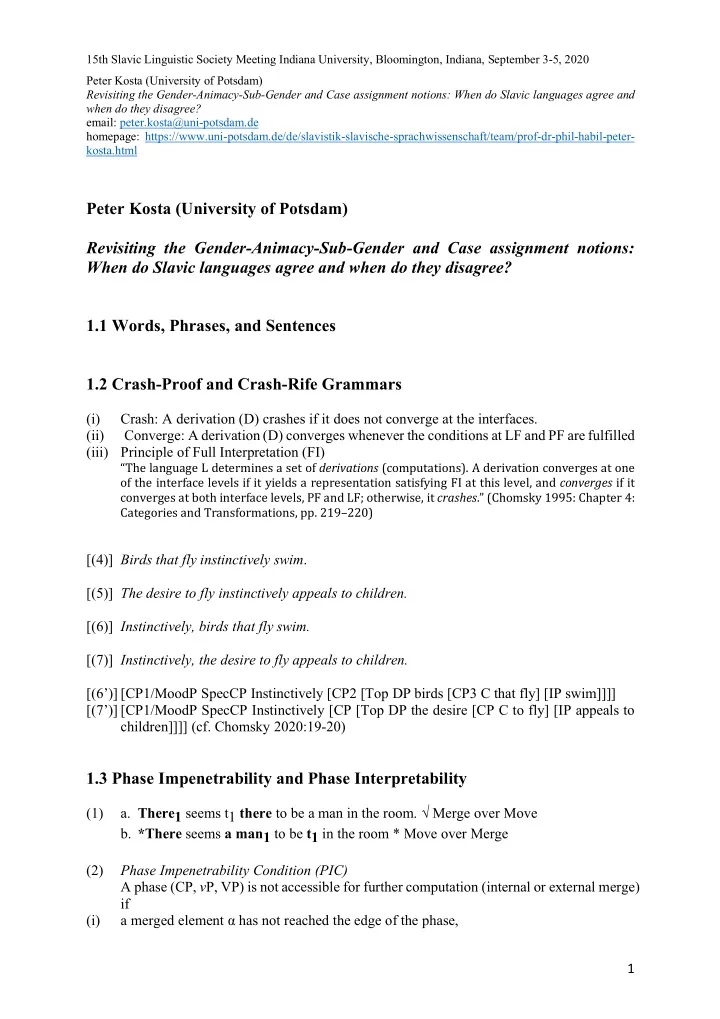
SLIDE 1 15th Slavic Linguistic Society Meeting Indiana University, Bloomington, Indiana, September 3-5, 2020 Peter Kosta (University of Potsdam) Revisiting the Gender-Animacy-Sub-Gender and Case assignment notions: When do Slavic languages agree and when do they disagree? email: peter.kosta@uni-potsdam.de homepage: https://www.uni-potsdam.de/de/slavistik-slavische-sprachwissenschaft/team/prof-dr-phil-habil-peter- kosta.html
1
Peter Kosta (University of Potsdam) Revisiting the Gender-Animacy-Sub-Gender and Case assignment notions: When do Slavic languages agree and when do they disagree? 1.1 Words, Phrases, and Sentences 1.2 Crash-Proof and Crash-Rife Grammars
(i) Crash: A derivation (D) crashes if it does not converge at the interfaces. (ii) Converge: A derivation (D) converges whenever the conditions at LF and PF are fulfilled (iii) Principle of Full Interpretation (FI)
“The language L determines a set of derivations (computations). A derivation converges at one
- f the interface levels if it yields a representation satisfying FI at this level, and converges if it
converges at both interface levels, PF and LF; otherwise, it crashes.” (Chomsky 1995: Chapter 4: Categories and Transformations, pp. 219–220)
[(4)] Birds that fly instinctively swim. [(5)] The desire to fly instinctively appeals to children. [(6)] Instinctively, birds that fly swim. [(7)] Instinctively, the desire to fly appeals to children. [(6’)] [CP1/MoodP SpecCP Instinctively [CP2 [Top DP birds [CP3 C that fly] [IP swim]]]] [(7’)] [CP1/MoodP SpecCP Instinctively [CP [Top DP the desire [CP C to fly] [IP appeals to children]]]] (cf. Chomsky 2020:19-20)
1.3 Phase Impenetrability and Phase Interpretability
(1)
- a. There1 seems t1 there to be a man in the room. √ Merge over Move
- b. *There seems a man1 to be t1 in the room * Move over Merge
(2) Phase Impenetrability Condition (PIC) A phase (CP, vP, VP) is not accessible for further computation (internal or external merge) if (i) a merged element α has not reached the edge of the phase,
SLIDE 2
15th Slavic Linguistic Society Meeting Indiana University, Bloomington, Indiana, September 3-5, 2020 Peter Kosta (University of Potsdam) Revisiting the Gender-Animacy-Sub-Gender and Case assignment notions: When do Slavic languages agree and when do they disagree? email: peter.kosta@uni-potsdam.de homepage: https://www.uni-potsdam.de/de/slavistik-slavische-sprachwissenschaft/team/prof-dr-phil-habil-peter- kosta.html
2 (ii) the interfaces PF or LF cannot interpret the phi-/wh-features of α[φ]if α in a phase {α[φ] {β[•]}} has not reached an edge phase position. (3) Principle of Phase Interpretability (PPI) The formal features (φ/EPP/wh-) of an element α of a phase π are interpretable at LF, iff they are valued at PF (4) The visibility condition for valuation (UG principle) An element α of an element LEX is valued, iff: It is labeled either at the edge XP or YP or moved/adjoined cyclically to (i) Agree position (φ of the category [Lex_ φ]) or (ii) Case position (which is always a A-position) (iii) Expletive position1
1.3.1 Gender and Animacy Declension and Agreement Classes
(5) Ivan poprosil ètogo očen‘ umnogo studenta, [CP TP vP VP]
1 (i) φ of the category [Lex_ φ] = AGREE; (ii) Case of the category [Lex_Case] = struc- tural case, (iii) an Expletive is
valued at the Edge of a Phase by EPP by assumption.
SLIDE 3
15th Slavic Linguistic Society Meeting Indiana University, Bloomington, Indiana, September 3-5, 2020 Peter Kosta (University of Potsdam) Revisiting the Gender-Animacy-Sub-Gender and Case assignment notions: When do Slavic languages agree and when do they disagree? email: peter.kosta@uni-potsdam.de homepage: https://www.uni-potsdam.de/de/slavistik-slavische-sprachwissenschaft/team/prof-dr-phil-habil-peter- kosta.html
3
SLIDE 4 15th Slavic Linguistic Society Meeting Indiana University, Bloomington, Indiana, September 3-5, 2020 Peter Kosta (University of Potsdam) Revisiting the Gender-Animacy-Sub-Gender and Case assignment notions: When do Slavic languages agree and when do they disagree? email: peter.kosta@uni-potsdam.de homepage: https://www.uni-potsdam.de/de/slavistik-slavische-sprachwissenschaft/team/prof-dr-phil-habil-peter- kosta.html
4 In Russian, this category of grammatically animated nouns is grammatically encoded only for the domain of humans and animals (but not for plants or heavenly bodies, etc.), but it is important to understand the category of Animacy in two ways:
- as a purely classifying category of grammar (so-called Declension or Agreement Classes in
Slavic) (Corbett 1982, 1991, forthcoming) but in Ket Animacy is sensitive to Case Marking and Morphology of the Verb (cf. Kosta DFG-Project);
- as a semantically motivating category (motivated by the reference of the objects).
SLIDE 5
15th Slavic Linguistic Society Meeting Indiana University, Bloomington, Indiana, September 3-5, 2020 Peter Kosta (University of Potsdam) Revisiting the Gender-Animacy-Sub-Gender and Case assignment notions: When do Slavic languages agree and when do they disagree? email: peter.kosta@uni-potsdam.de homepage: https://www.uni-potsdam.de/de/slavistik-slavische-sprachwissenschaft/team/prof-dr-phil-habil-peter- kosta.html
5 Table1: Overview of the relation between Gender, Animacy and the Category of Male Person in Nouns (NPs) and Numerals (NumPs) Quote: “The grammaticalized expression of animacy and personhood correlates with such referential features as definiteness, and the strength of expression of animacy/person-hood may correlate inversely with the strength of expression of definiteness. The correlation of animacy/personhood with sex-based gender and grammatical number may be complex and even counter-intuitive. The core expression of animacy in Slavic is GA case syncretism, which, in its core usage, occurs in the singular of certain paradigms of masculine-gender words. All Slavic languages that have retained a fully articulated case system have retained GA syncretism in the masculine singular of nouns referring to animate beings. The Eastern South Slavic languages (Macedonian, Bulgarian) fall outside the general Slavic pattern. Slavic GA syncretism has generally (with the partial exception of Slovak) arisen as a replacement for older NA syncretism. GA syncretism occurs in agreeing forms in the absence of GA syncretism in the head, if the head is eligible for animacy marking on grounds of (masculine) gender and (animate) reference but is morphologically ineligible for GA syncretism (a-stem noun
SLIDE 6 15th Slavic Linguistic Society Meeting Indiana University, Bloomington, Indiana, September 3-5, 2020 Peter Kosta (University of Potsdam) Revisiting the Gender-Animacy-Sub-Gender and Case assignment notions: When do Slavic languages agree and when do they disagree? email: peter.kosta@uni-potsdam.de homepage: https://www.uni-potsdam.de/de/slavistik-slavische-sprachwissenschaft/team/prof-dr-phil-habil-peter- kosta.html
6 paradigm). Different Slavic languages show a variety of extensions of animacy/personhood marking beyond the masculine singular, creating typologically diverse and sometimes complex morphosyn- tactic patterns.” (Klenin 2009: 152).
1.3.2 The Structure of Noun Phrase or Determiner Phrase in Slavic 1.3.3 Pronominalization and (Dis-)Agreement
(9) Sp1 - Dlaczego wymyłeś swoją filiżankę, a nie mój kubek? Why did you wash your cupF and not my cupM? Sp2 - No jakże, wymyłem przecież jego, a nie ją. //
- Well, I washed him, not her. //
- No jakże, wymyłem przecież *go, a nie *ją
(10) Pomogłem mu go sprzedać. I helped him (Peter) it/him (a cup or a slave) to sell.
SLIDE 7
15th Slavic Linguistic Society Meeting Indiana University, Bloomington, Indiana, September 3-5, 2020 Peter Kosta (University of Potsdam) Revisiting the Gender-Animacy-Sub-Gender and Case assignment notions: When do Slavic languages agree and when do they disagree? email: peter.kosta@uni-potsdam.de homepage: https://www.uni-potsdam.de/de/slavistik-slavische-sprachwissenschaft/team/prof-dr-phil-habil-peter- kosta.html
7
1.3.4 Numerals and Animacy
SLIDE 8 15th Slavic Linguistic Society Meeting Indiana University, Bloomington, Indiana, September 3-5, 2020 Peter Kosta (University of Potsdam) Revisiting the Gender-Animacy-Sub-Gender and Case assignment notions: When do Slavic languages agree and when do they disagree? email: peter.kosta@uni-potsdam.de homepage: https://www.uni-potsdam.de/de/slavistik-slavische-sprachwissenschaft/team/prof-dr-phil-habil-peter- kosta.html
8 (14) a. Пришли *три / *четыре умные студента There came3PL three /four intelligent students
студентов пришло (There) FourNomSgCollNeutr. studentsGenPlM came_3Ps.Sg.Pret. A group of four students came
SLIDE 9
15th Slavic Linguistic Society Meeting Indiana University, Bloomington, Indiana, September 3-5, 2020 Peter Kosta (University of Potsdam) Revisiting the Gender-Animacy-Sub-Gender and Case assignment notions: When do Slavic languages agree and when do they disagree? email: peter.kosta@uni-potsdam.de homepage: https://www.uni-potsdam.de/de/slavistik-slavische-sprachwissenschaft/team/prof-dr-phil-habil-peter- kosta.html
9
1.4 Mixed Gender Agreement in Russian DPs
SLIDE 10
15th Slavic Linguistic Society Meeting Indiana University, Bloomington, Indiana, September 3-5, 2020 Peter Kosta (University of Potsdam) Revisiting the Gender-Animacy-Sub-Gender and Case assignment notions: When do Slavic languages agree and when do they disagree? email: peter.kosta@uni-potsdam.de homepage: https://www.uni-potsdam.de/de/slavistik-slavische-sprachwissenschaft/team/prof-dr-phil-habil-peter- kosta.html
10
1.4.1 Gender
SLIDE 11
15th Slavic Linguistic Society Meeting Indiana University, Bloomington, Indiana, September 3-5, 2020 Peter Kosta (University of Potsdam) Revisiting the Gender-Animacy-Sub-Gender and Case assignment notions: When do Slavic languages agree and when do they disagree? email: peter.kosta@uni-potsdam.de homepage: https://www.uni-potsdam.de/de/slavistik-slavische-sprachwissenschaft/team/prof-dr-phil-habil-peter- kosta.html
11
1.4.2 Gender Assignment Systems 1.4.3 Gender Agreement 1.5 Theoretical Background on DP-Internal Agreement 1.5.1 DP Structure
SLIDE 12
15th Slavic Linguistic Society Meeting Indiana University, Bloomington, Indiana, September 3-5, 2020 Peter Kosta (University of Potsdam) Revisiting the Gender-Animacy-Sub-Gender and Case assignment notions: When do Slavic languages agree and when do they disagree? email: peter.kosta@uni-potsdam.de homepage: https://www.uni-potsdam.de/de/slavistik-slavische-sprachwissenschaft/team/prof-dr-phil-habil-peter- kosta.html
12
SLIDE 13 15th Slavic Linguistic Society Meeting Indiana University, Bloomington, Indiana, September 3-5, 2020 Peter Kosta (University of Potsdam) Revisiting the Gender-Animacy-Sub-Gender and Case assignment notions: When do Slavic languages agree and when do they disagree? email: peter.kosta@uni-potsdam.de homepage: https://www.uni-potsdam.de/de/slavistik-slavische-sprachwissenschaft/team/prof-dr-phil-habil-peter- kosta.html
13
1.5.2 Location of Gender in the Nominal Phrase
(28) a. DP > NumP > GenP > NP
- b. DP [Person] > NumP [Number] > NP [Gender]
1.5.3 Interpretability of Gender 1.5.4 Agree and Feature Sharing
SLIDE 14 15th Slavic Linguistic Society Meeting Indiana University, Bloomington, Indiana, September 3-5, 2020 Peter Kosta (University of Potsdam) Revisiting the Gender-Animacy-Sub-Gender and Case assignment notions: When do Slavic languages agree and when do they disagree? email: peter.kosta@uni-potsdam.de homepage: https://www.uni-potsdam.de/de/slavistik-slavische-sprachwissenschaft/team/prof-dr-phil-habil-peter- kosta.html
14
2.1 Hybrid Nouns
SLIDE 15
15th Slavic Linguistic Society Meeting Indiana University, Bloomington, Indiana, September 3-5, 2020 Peter Kosta (University of Potsdam) Revisiting the Gender-Animacy-Sub-Gender and Case assignment notions: When do Slavic languages agree and when do they disagree? email: peter.kosta@uni-potsdam.de homepage: https://www.uni-potsdam.de/de/slavistik-slavische-sprachwissenschaft/team/prof-dr-phil-habil-peter- kosta.html
15
2.2 Previous Proposals That Distinguish Concord and Predicate Agreement
SLIDE 16
15th Slavic Linguistic Society Meeting Indiana University, Bloomington, Indiana, September 3-5, 2020 Peter Kosta (University of Potsdam) Revisiting the Gender-Animacy-Sub-Gender and Case assignment notions: When do Slavic languages agree and when do they disagree? email: peter.kosta@uni-potsdam.de homepage: https://www.uni-potsdam.de/de/slavistik-slavische-sprachwissenschaft/team/prof-dr-phil-habil-peter- kosta.html
16
2.3 Concord vs. Index Agreement (Wechsler and Zlatić 2000, 2003) 2.4 Multiple Levels of φ-Feature Interpretation (Sauerland 2004)
(42) φP > DP
SLIDE 17 15th Slavic Linguistic Society Meeting Indiana University, Bloomington, Indiana, September 3-5, 2020 Peter Kosta (University of Potsdam) Revisiting the Gender-Animacy-Sub-Gender and Case assignment notions: When do Slavic languages agree and when do they disagree? email: peter.kosta@uni-potsdam.de homepage: https://www.uni-potsdam.de/de/slavistik-slavische-sprachwissenschaft/team/prof-dr-phil-habil-peter- kosta.html
17
- 4. Assignment Strategies
- 4. 1 Semantics, Morphology and Syntax in Slavic
4.2 Further Evidence for Animacy in Word Formation: Possessives in Czech and and Compounds in German
SLIDE 18
15th Slavic Linguistic Society Meeting Indiana University, Bloomington, Indiana, September 3-5, 2020 Peter Kosta (University of Potsdam) Revisiting the Gender-Animacy-Sub-Gender and Case assignment notions: When do Slavic languages agree and when do they disagree? email: peter.kosta@uni-potsdam.de homepage: https://www.uni-potsdam.de/de/slavistik-slavische-sprachwissenschaft/team/prof-dr-phil-habil-peter- kosta.html
18
SLIDE 19
15th Slavic Linguistic Society Meeting Indiana University, Bloomington, Indiana, September 3-5, 2020 Peter Kosta (University of Potsdam) Revisiting the Gender-Animacy-Sub-Gender and Case assignment notions: When do Slavic languages agree and when do they disagree? email: peter.kosta@uni-potsdam.de homepage: https://www.uni-potsdam.de/de/slavistik-slavische-sprachwissenschaft/team/prof-dr-phil-habil-peter- kosta.html
19
SLIDE 20 15th Slavic Linguistic Society Meeting Indiana University, Bloomington, Indiana, September 3-5, 2020 Peter Kosta (University of Potsdam) Revisiting the Gender-Animacy-Sub-Gender and Case assignment notions: When do Slavic languages agree and when do they disagree? email: peter.kosta@uni-potsdam.de homepage: https://www.uni-potsdam.de/de/slavistik-slavische-sprachwissenschaft/team/prof-dr-phil-habil-peter- kosta.html
20
- 5. Further Perspectives of Research and Exploration of Gender and Animacy
Explorations into Human Mind: Indigenous Languages of Canada, Australia, Cook Islands and Siberia from the Perspective of Evolution and Proto- Grammars: Carrier, Barngarla, Maori and Ket
In the period from 1 April to 30 September 2017, I had my research semester, and from August 4th to September 5th, I have been invited professor at the chair of linguistics and endangered languages at the University of Adelaide, South Australia by invitation of the chair holder Prof. Ghil’ad Zuckermann to whom I owe so much that I can’t even describe it with words. Together with him and the indigenous people, I have been learning and studying the indigenous languages of Barngarla (Peninsula Eyre, Port Lincoln, last speaker has been registered in the 50es of the 20. century) and Kaurna (the language spoken at Adelaide Plains in South Australia in 19. and past century, - the last speaker was a woman known as Ivaritji or Amelia Taylor, who died in 1929 (cf. Amery 2016:1)). Part of my research concerning the human mind and language faculty has been deeply influenced and modified by the intensive study of the indigenous “aboriginal” languages of Australia and the culture of this indigenous population – the only real Australians which would have deserved to be called Australians because they lived in Australia many years before it has been discovered, colonized and long before the white men have exploited, killed and violated Australians and committed the same crimes on them as he did some centuries before on the indigenous people of the Americas after its discovery by Columbus and
- thers. The data of the mentioned languages have been taken and documented during my stay in Australia in order to complete
the 11. chapter of this book. This chapter deals with the fundamental question of the theory of language to what extent human cognition is equipped with very general universal properties for language faculty so that cultural and possibly grammatically coded peculiarities can be traced back to these, or whether the variation and the linguistic diversity of human grammars (more as 7000 worldwide), and the fact that there are very grammar-specific grammatical categories in all languages, suggests, however, the old idea of Humboldt's thought about the diversity of the human race and the inner language form. Today, Sapir / Whorf's relativity hypothesis, which is surely no longer viable, continues to flourish and ignites the discussion of recursivity and language specificity (Noam Chomsky vs. Dan Everett (with Nicolas Evans and Steven Levinson)) Very extreme is the cultural hypothesis represented in the works of Dan Everett: Daniel Everett, in his new book, presents the human languages as tools which are only used to describe the linguistic researches in the Amazon basin if they are understood as cultural products. At first sight, this is not a novelty: the fact that culture, from religion to technology, in vocabulary, and in the metaphors of a language, is obvious. But Everett goes further: For him too, the grammar is a product of the living conditions, the values and the global perception of a society, even into the details of inflection and sentence building. The great structural differences between the language systems reflect the diversity of cultural worlds. In this way, Everett argues against a naturalistic conception of language as represented by prominent linguists such as Noam Chomsky and Stephen Pinker. For them, language is essentially not a socially shaped tool but a neurobiologically anchored "instinct" that causes children in a normal linguistic environment their mother tongue grows by itself. All languages are then based on the same universal grammar, almost a Lego box, which provides the same kit for each language. Only which stones are selected and how they are put together varies within certain limits. The seemingly enormous differences between the languages turn out to be superficial phenomena, Arabic, Latin, or German shrinking into dialects of one and the same world
- language. Exceptionally complex and surprisingly simple Even though Everett does not deny that speech is anchored in the
- brain. But he does not see an autonomous language center at work here, but a bundle of general cognitive skills, which, among
- ther things, also enable language and are distributed over very different brain regions. These competences include the
detection of causalities, the processing of fast sequences, the differentiation of forms and background, and the ability to get into the minds of others. A key role for Everett is the "intentionality" - under which he understands the ability to use signs to relate to
- them. So stimulating Everett's wanderings through the different areas of language and cognitive research - too much remains
unconnected and too much on the surface. Moreover, he neglects many peculiarities of the child's language acquisition, which are now extensively researched. The crucial source of knowledge from which Everett's anti-universalist thrust feeds is his decades-long field research on the language of the Pirahã, a few hundred members of the people at a tributary of the Amazon. He devoted his book on "The Happiest People" published three years ago in German. Everett had come to the Pirahã as an evangelical missionary. He lost his Christian faith in the course of time, but he remained a linguist and became one of the very few connoisseurs of this
- language. What was revealed to him in the course of the years was a language which, although extraordinarily complex, has
very complex word structures and intonations, but which is surprisingly simple in other respects, and which has elementary gaps
SLIDE 21 15th Slavic Linguistic Society Meeting Indiana University, Bloomington, Indiana, September 3-5, 2020 Peter Kosta (University of Potsdam) Revisiting the Gender-Animacy-Sub-Gender and Case assignment notions: When do Slavic languages agree and when do they disagree? email: peter.kosta@uni-potsdam.de homepage: https://www.uni-potsdam.de/de/slavistik-slavische-sprachwissenschaft/team/prof-dr-phil-habil-peter- kosta.html
21
from the point of view of European languages. It is very good to study indigenous languages; on the one hand, this leads to new insights into the nature and the peculiarities of grammatical categories; on the other hand, it will be seen that these categories, so exotic they might appear, can be easily compared to many similar categories in many languages of different origin and structure and thus are not unexpected. In the course of this chapter, we will introduce some new insights into the conceptualization of grammar in indigenous languages and
- ur main focus will be the category of Gender, Case, Animacy in nominal phrases on one hand, and Agreement Classes and
verbal classes (including modality, aspectuality and tense). The last section of this chapter will be devoted to the problem of word order in different indigenous languages.
The last remaining speakers of Ket reside in the north of Russia’s Krasnoyarsk province along the river Yenisei and its tributaries. Over the past decades, the number of Kets has been constantly decreasing: according to the census of 2010, there are 1219 people who reported themselves as ethnic Kets (cf. the census of 2002, which reports 1494 people). The overall sociolinguistic situation is characterized by the lack of monolingual speakers and the predominance of Russian in all spheres of
- communication. Speaking from the recent fieldwork experience, the
present-day number of more or less competent speakers in all of the Ket dialects combined does not exceed 50 people. The average age of the majority of these speakers is over 60 years; people under 40 do not speak the language at all (cf. Nefedov 2015: 5). At present, the largest number of these fluent speakers reside in the village of Kellog; they speak the Southern Ket dialect. Ket nouns belong to either animate or inanimate class. The animate class is further subdivided into masculine and feminine; inanimate corresponds to
- neuter. The class membership is not overtly expressed (except for nouns
containing lexical roots ɨk- / hik- ‘male-’ and haŋ- / qim- ‘female-’, e.g. ɨgbes ‘he-hare’, háŋbes ‘she-hare’) and can be identified by several means: ́ the form of verb-internal agreement markers (Figure 1), predicate concord suffixes (Figure 2) or relational morphemes (Figure 3). Figure 1 illustrates verbal positions containing agreement markers for the 3rd person. As can be seen positions P4 and P3 contain markers for a specific animacy class only, animate and inanimate, respectively. Inanimate markers in positions P8 and P6 are identical to the feminine
SLIDE 22 15th Slavic Linguistic Society Meeting Indiana University, Bloomington, Indiana, September 3-5, 2020 Peter Kosta (University of Potsdam) Revisiting the Gender-Animacy-Sub-Gender and Case assignment notions: When do Slavic languages agree and when do they disagree? email: peter.kosta@uni-potsdam.de homepage: https://www.uni-potsdam.de/de/slavistik-slavische-sprachwissenschaft/team/prof-dr-phil-habil-peter- kosta.html
22
subclass markers. Markers in P1 are identical for all classes. Position P-1 contains a plural marker for animate subjects marked in P8 only. Some verbs also contain a special affix d which seems to be connected with animacy since it is present in verbs with animate objects/patients, but lacking with inanimate ones. Predicate concord suffixes attach to adjectives and adverbials. They reflect person, number, and class of the sentence subject. These suffixes are pronominal in origin. Figure 2 below shows the shapes of predicate suffixes for the 3rd person attested in Ket. The class membership distinction in Ket is only partly based on real-world biology (cf. Werner 1994). Nouns denoting human beings exhibit no unexpected class membership. However, both animate classes contain names for lifeless things like heavenly bodies and natural phenomena, as well for animals and plants. Assigning class membership to non-human
- bjects is connected with the culture internal beliefs of Kets: if a
biologically inanimate phenomenon is perceived as active or moving (e.g. the sun), it is usually considered animate (cf. Kotorova 2008). The more culturally relevant or economically important a thing, an animal or a plant is, the more often it ends up assigned to masculine class (Georg 2007: 90).
SLIDE 23 15th Slavic Linguistic Society Meeting Indiana University, Bloomington, Indiana, September 3-5, 2020 Peter Kosta (University of Potsdam) Revisiting the Gender-Animacy-Sub-Gender and Case assignment notions: When do Slavic languages agree and when do they disagree? email: peter.kosta@uni-potsdam.de homepage: https://www.uni-potsdam.de/de/slavistik-slavische-sprachwissenschaft/team/prof-dr-phil-habil-peter- kosta.html
23
A number of nouns in Ket belong to common gender class. These are nouns denoting both human beings, e.g., kɛˀt ‘person (m/f)’, dɨlj ‘child (m/f)’ and nouns denoting animals, e.g., qɔj ‘bear (m/f)’, bεˀsj ‘hare (m/f)’. ̀ To common gender class also belong nominalizations from action nominals made with the help of the suffix -s’, e.g. tarj ‘beating’ > tarsj ‘the
- ne (m/f) who beats / the one (m/f) who is beaten / something (n) the one
beats with’. Nominalizations made from finite verb forms are assigned the last membership of its subject: durɛnsj du8-den0-s 3sg.m8-cry0-nmlz ‘A cry- baby (m)’
Kosta, Peter (2020): The Syntax of Meaning and the Meaning of Syntax. Minimal Computations and Maximal Derivations in a Label-/Phase-Driven Generative Grammar of Radical Minimalism. Berlin, Bern, Bruxelles, New York, Oxford, Warszawa, Wien: Peter Lang (Potsdam Linguistic Investigations vol. 31).