Petaluma River Bacteria and Nutrients TMDL: Stakeholder Meeting - - PowerPoint PPT Presentation

petaluma river bacteria and nutrients tmdl stakeholder
SMART_READER_LITE
LIVE PREVIEW

Petaluma River Bacteria and Nutrients TMDL: Stakeholder Meeting - - PowerPoint PPT Presentation

Petaluma River Bacteria and Nutrients TMDL: Stakeholder Meeting Farhad Ghodrati & Kevin Lunde June 28, 2017 Overview Problem Definition Solution (TMDL Plan) Project Scope Impairment Assessment (Bacteria, Nutrients)

slide-1
SLIDE 1

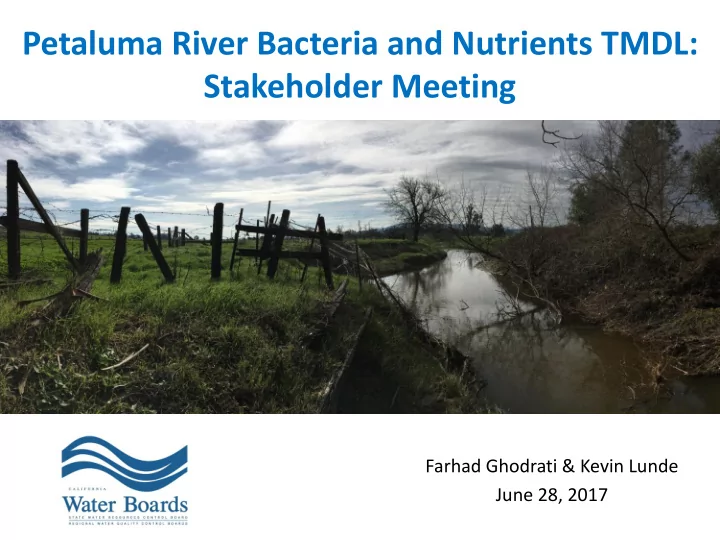
Petaluma River Bacteria and Nutrients TMDL: Stakeholder Meeting

Farhad Ghodrati & Kevin Lunde June 28, 2017

slide-2
SLIDE 2

Overview

  • Problem Definition
  • Solution (TMDL Plan)
  • Project Scope
  • Impairment Assessment (Bacteria, Nutrients)
  • Identified Pollution Sources
  • Public Engagement

2

slide-3
SLIDE 3

Problem: Excess Bacteria and Nutrients

  • River is listed as “impaired” for:

– bacteria (1976) – nutrients (1986)

  • Does not meet water quality

standards

  • Beneficial uses (BUs) of River not

protected  “Impairment”

*This is not a photo of the Petaluma River 3

slide-4
SLIDE 4

Relevant Beneficial Uses of Petaluma River

BU  Specific uses of water

  • Water recreation
  • Wildlife habitat
  • Cold & warm freshwater habitat
  • Fish spawning
  • Estuarine habitat
  • Rare & endangered species habitat

4

slide-5
SLIDE 5

Solution: Take Actions to Improve Water Quality

  • TMDLs (“Total Maximum Daily Loads”):

– Water quality improvement plans – Evaluate impairment – Identify pollution sources – Set maximum pollutant limit – Devise a plan of action to remedy the water quality impairment

5

slide-6
SLIDE 6

Petaluma River Bacteria and Nutrients TMDL Project Scope

  • Addresses bacteria & nutrients impairments
  • Sources of bacteria and nutrients are similar

Petaluma River Impairments Status Bacteria this project Nutrients this project Diazinon region-wide TMDL in place Trash stormwater permit Sediment later date Nickel (at the mouth only) later date

6

slide-7
SLIDE 7

Geographic Scope

  • Project covers the entire

Petaluma River watershed (150 square mile)

  • Includes all tributaries,

e.g., San Antonio Creek

  • Tribs are connected to

and discharge pollution into River

7

slide-8
SLIDE 8

Impairment Assessment: How is the water quality now?

  • Need to evaluate current

status of impairments

  • Recent and adequate data

are needed

  • Started bacteria and

nutrients monitoring (2015)

8

slide-9
SLIDE 9

Bacteria and Nutrients Monitoring Overview

  • Sampling schedule:

– Winter, spring and summer 2015 & 2016 – Winter 2017

  • Constituents:

– Bacteria (5 times per season) – Nutrients (once per season) – Algae (Spring 2016) – DO & pH (Spring 2016)

  • 18 sites:

– Perennial and non-perennial streams – Tidal and non-tidal sections of the River

9

slide-10
SLIDE 10

Petaluma River Sample Sites

10

slide-11
SLIDE 11

Bacteria Impairment Assessment

  • Fecal Indicator Bacteria (FIB)

– Indicate presence of fecal pollution – Suggests potential presence of pathogenic organisms

– E. coli, Enterococcus

  • Source-Specific Fecal Bacteria

– Bacteroides bacteria – “DNA fingerprinting” – Identifies specific source of pollution – human, horse, dog, ruminant (cow, deer, elk…)

11

slide-12
SLIDE 12

Bacteria Water Quality Standards

  • Geometric mean: for five samples within a 30-day period
  • Single sample maximum: for individual samples
  • Impairment: >16% exceedance of these standards (California Listing Policy)

12

Indicator Standard Geometric Mean (per 100 mL) Single Sample Maximum (per 100 mL) Enterococcus (estuarine & fresh water) 30 110

  • E. coli

(fresh water only) 100 320

slide-13
SLIDE 13
  • Significant exceedances of geomean standard
  • Higher in wet season than dry season (2016)

0% 20% 40% 60% 80% 100%

Winter 2015 Spring 2015 Summer 2015 Winter 2016 Spring 2016 Summer 2016

% Exceedances

Percent Exceedances of E. coli Geometric Mean Standard By Season

Impairment Threshold

slide-14
SLIDE 14

Mean of E. coli Single Sample values By Sampling Station (2015-2016)

  • All stations exceed standard
  • Main stem and San Antonio Creek stations show higher levels

14

500 1000 1500 2000 2500 3000 3500

  • E. Coli Concentration

Standard

slide-15
SLIDE 15

Enterococcus Geometric Mean Values Winter 2017 (five events)

  • Enterococcus sampling in tidal section of main stem
  • All stations exceed standard, especially Pet_98 & Pet_205
  • Will monitor again in summer

15

Standard 40 80 120 160 200 Pet_310 Pet_260 Pet_205 Pet_98 Pet_7 Pet_2 Enterococcus Concentration

slide-16
SLIDE 16

Bacteroides Results-2016

  • Two rounds of sampling (February, June)
  • All four Host-specific Bacteroides were detected
  • Higher wet season “hits” than dry season hits

16

0% 20% 40% 60% 80% 100%

Human Horse Dog Ruminant

% Positive Samples

% of Positive Samples for Various Host-Specific Bacteroides

Wet (n=16) Dry (n=13)

slide-17
SLIDE 17

Nutrients Impairment Assessment

  • Two types of impacts:

– Toxic effects – Eutrophication

  • Toxicity due to high ammonia or nitrate
  • Ammonia thresholds

– Total (NH3 + NH4

+) = 0.6-3.3 mg/L

– Unionized (NH3) = 0.025 mg/L annual median

  • Nitrate standard

– 10 mg/L (for drinking water)

  • Eutrophication  lowers DO, can cause

toxic algal blooms, impedes recreation

17

slide-18
SLIDE 18

Average Concentrations of Nitrate and Ammonia by Site (2015-2016)

  • Ammonia and nitrate levels are well below established toxicity standards
  • Petaluma mainstem (e.g., Pet_205, Pet_98) and San Antonio sites had

highest nitrate levels

18

0.00 0.05 0.10 0.15 0.20 0.25 0.30 0.35

Average of Total Ammonia as N (mg/L)

0.00 0.50 1.00 1.50 2.00 2.50

Average of Nitrate as N (mg/L)

slide-19
SLIDE 19

Summary of Exceedances of Numeric Evaluation Guidelines for Direct Indicators of Eutrophication

  • Algal sampling at 9 freshwater sites (spring 2016)
  • No strong indication of eutrophication
  • No toxic algae problem

Analyte Numeric Evaluation Guideline Number & Percent of Exceedances Benthic algal chlorophyll a (COLD) 150 mg/m2 (0/9) = 0% Percent macroalgae Cover 30% (1/9) = 11% Benthic algal biomass (AFDW) (COLD) 60 g/m2 (3/9) = 33% Water column chlorophyll a 15 µg/L (0/9) = 0% Algae taxonomy indicators Data forthcoming

19

slide-20
SLIDE 20

Summary of Exceedances of Numeric Evaluation Guidelines for Indirect Indicators of Eutrophication

Analyte Numeric Evaluation Guideline Number & Percent of Exceedances pH-Instantaneous 6.5-8.5 units (1/41,797) = 0.0% Dissolved oxygen-Instantaneous (WARM) 5.0 mg/L (30,254/41,797) = 72% Dissolved oxygen-Instantaneous (COLD) 7.0 mg/L (36,762/41,797) = 88% Daily dissolved oxygen change 5 mg/L (55/444) = 12% Daily pH change 1 unit (0/444) = 0%

  • Continuous DO & pH readings at five sites (Spring-Summer 2016)
  • Chronically low DO is observed but likely is not due to eutrophication
  • Daily DO/pH fluctuations (signals of eutrophication) are low

20

slide-21
SLIDE 21

Other Data

  • SWAMP nutrients data (2003)

– 7 sites (spring, summer, winter)

  • CDFW historic ammonia data (1999-2001)

– M. Rugg – San Antonia Creek; Ellis Creek – 108 samples

  • Any other data sources we have missed?

21

slide-22
SLIDE 22

Potential Sources

Source Category Potential Sources Bacteria Source Nutrient Source

Human Waste Wastewater treatment plant

X X

Sanitary sewer systems

X X

Private sewer laterals

X X

Septic systems

X X

Vessel marinas

X X

Animal Waste Livestock - Confined animal facilities

X X

Livestock - Grazing lands/operations

X X

Domestic pets

X X

Wildlife

X X

Municipal Stormwater Runoff Runoff from residential, commercial, industrial, and recreational areas

X X

22

slide-23
SLIDE 23

Human Sources

23

slide-24
SLIDE 24

Animal Sources

24

slide-25
SLIDE 25

Conclusions

  • River is impaired by bacteria
  • River is likely not impaired by nutrients/

eutrophication

  • Control measures addressing bacteria

discharges also address nutrient discharges

25

slide-26
SLIDE 26

Public Engagement Opportunities

  • Project workshop & CEQA scoping meeting – Fall 2017
  • Public review of TMDL plan
  • Water Board adoption hearing
  • We are available to meet as requested
  • Are there other interested parties we should engage?

26

2018

slide-27
SLIDE 27

Project Contacts

Farhad Ghodrati Project Manager fghodrati@waterboards.ca.gov 510-622-2331 Project Website: http://www.waterboards.ca.gov/sanfranciscobay/water _issues/programs/TMDLs/petalumabacterianutrienttm dl.shtml

27