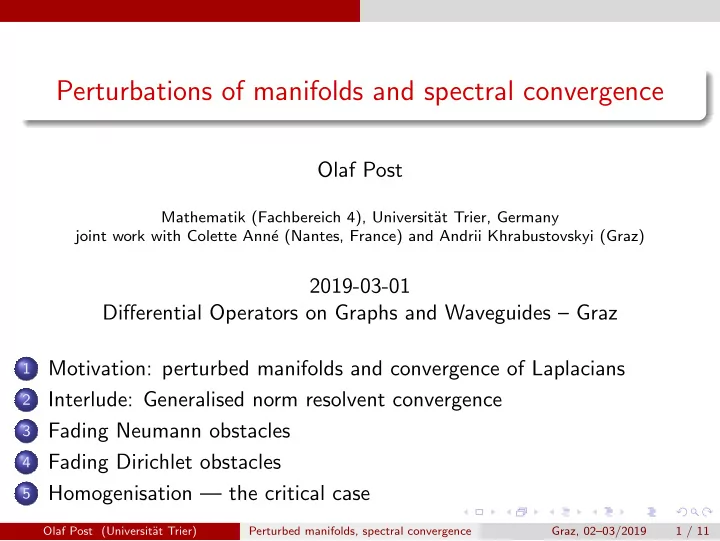
Perturbations of manifolds and spectral convergence Olaf Post - - PowerPoint PPT Presentation

perturbations of manifolds and spectral convergence
SMART_READER_LITE
LIVE PREVIEW

Perturbations of manifolds and spectral convergence Olaf Post - - PowerPoint PPT Presentation

Perturbations of manifolds and spectral convergence Olaf Post Mathematik (Fachbereich 4), Universit at Trier, Germany joint work with Colette Ann e (Nantes, France) and Andrii Khrabustovskyi (Graz) 2019-03-01 Differential Operators on


slide-1
SLIDE 1

Perturbations of manifolds and spectral convergence

Olaf Post

Mathematik (Fachbereich 4), Universit¨ at Trier, Germany joint work with Colette Ann´ e (Nantes, France) and Andrii Khrabustovskyi (Graz)

2019-03-01 Differential Operators on Graphs and Waveguides – Graz

1

Motivation: perturbed manifolds and convergence of Laplacians

2

Interlude: Generalised norm resolvent convergence

3

Fading Neumann obstacles

4

Fading Dirichlet obstacles

5

Homogenisation — the critical case

Olaf Post (Universit¨ at Trier) Perturbed manifolds, spectral convergence Graz, 02–03/2019 1 / 11

slide-2
SLIDE 2

Motivation: perturbed manifolds and convergence of Laplacians

Motivation: perturbed manifolds and convergence of Laplacians

X Riemannian manifold (or subset of Rn or waveguide . . . ) “wild perturbations” (name by Rauch-Taylor [RT75]):

remove obstacles Bε, e.g. many small balls, Xε := X \ Bε add many small handles, resulting manifold Xε (neither subset nor superset of X!)

Question: Convergence of (Neumann/Dirichlet) Laplacian on Xε? To what limit? Here mostly free limit: Laplacian on X (we call obstacles Bε with ∆(Neu/Dir)

→ ∆X fading) Another question: Now to define norm resolvent convergence if spaces change?

Olaf Post (Universit¨ at Trier) Perturbed manifolds, spectral convergence Graz, 02–03/2019 2 / 11

slide-3
SLIDE 3

Interlude: Generalised norm resolvent convergence

Interlude: What is a good generalisation of norm resolvent convergence?

∆ε ≥ 0 in Hilbert space Hε for all ε ≥ 0 Definition (Generalised norm resolvent convergence, P:06, P:12) ∆ε

gnrs

− → ∆0 :⇔ there exist J = Jε : H0 → Hε bdd. and δε → 0 such that (id0 −J∗J)R0 ≤ δε, (idε −JJ∗)Rε ≤ δε, (1) RεJ − JR0 ≤ δε. (2) If (1)–(2) hold for some J, we call ∆ε, ∆0 δε-quasi-unitary equivalent. Generalisation of standard norm resolvent convergence δε = 0 for (1): J unitary; w.l.o.g. H0 = Hε, J = id. Then (2) is Rε − R0 → 0

Olaf Post (Universit¨ at Trier) Perturbed manifolds, spectral convergence Graz, 02–03/2019 3 / 11

slide-4
SLIDE 4

Interlude: Generalised norm resolvent convergence

Interlude: What is a good generalisation of norm resolvent convergence?

∆ε ≥ 0 in Hilbert space Hε for all ε ≥ 0 Definition (Generalised norm resolvent convergence, P:06, P:12) ∆ε

gnrs

− → ∆0 :⇔ there exist J = Jε : H0 → Hε bdd. and δε → 0 such that (id0 −J∗J)R0 ≤ δε, (idε −JJ∗)Rε ≤ δε, (1) RεJ − JR0 ≤ δε. (2) If (1)–(2) hold for some J, we call ∆ε, ∆0 δε-quasi-unitary equivalent. Generalisation of unitary equivalence δε = 0 for (1)–(2): J unitary and ∆ε, ∆0 unititarily equivalent

Olaf Post (Universit¨ at Trier) Perturbed manifolds, spectral convergence Graz, 02–03/2019 3 / 11

slide-5
SLIDE 5

Interlude: Generalised norm resolvent convergence

Consequences of generalised norm resolvent convergence

Definition (Generalised norm resolvent convergence, P:06, P:12) ∆ε

gnrs

− → ∆0 :⇔ there exist J : H0 → Hε bdd. and δε → 0 such that (1) (id0 −J∗J)R0 ≤ δε, (idε −JJ∗)Rε ≤ δε, (2) RεJ − JR0 ≤ δε. Theorem (P:06, P:12) If ∆ε

gnrs

− → ∆0, we have e.g. ϕ(∆ε) − Jϕ(∆0)J∗ ≤ Cϕδε (e.g. ϕt(λ) = e−tλ, ϕ = ✶I) σ(∆ε) → σ(∆0) on compact intervals [also for discrete and essential spectrum], convergence of eigenfunctions (even in energy norm) In particular: no spectral pollution, no spurious eigenvalues: λ0 ∈ σ(∆0) ⇐ ⇒ ∃(λε)ε : λε ∈ σ(∆ε), λε → λ0 Cannot have generalised norm resolvent convergence for compact spaces approximating a non-compact one (as essential spectra converge)

Olaf Post (Universit¨ at Trier) Perturbed manifolds, spectral convergence Graz, 02–03/2019 4 / 11

slide-6
SLIDE 6

Fading Neumann obstacles

Fading Neumann obstacles

General assumption X complete Riemannian manifold with Laplacian ∆0 := ∆X of bounded geometry (injectivity radius ι > 0, Ricci curvature bounded from below). Consequences: Small balls look Euclidean! ∃Cell > 0 ∀f ∈ H2(X): f H2(X) ≤ Cell(∆X + 1)f L2(X) Definition (Neumann fading obstacles) Bε are Neumann fading obstacles iff Bε ⊂ X, δε → 0, f L2(Bε) ≤ δεf H1(X), (4) ∃Eε : H1(Xε) → H1(X), Eεu↾Xε = u : EεH1→H1 ≤ Cext (5) (4) means: eigenfunctions non-concentrating on Bε (5): Xε := X \ Bε strongly connected (in homogenisation theory)

Olaf Post (Universit¨ at Trier) Perturbed manifolds, spectral convergence Graz, 02–03/2019 5 / 11

slide-7
SLIDE 7

Fading Neumann obstacles

Neumann fading obstacles II

Theorem (Ann´ e-P:18) If Bε ⊂ X are Neumann fading obstacles then ∆Neu

Xε gnrs

− → ∆X. Flavour of proof: Hilbert spaces: Hε = L2(Xε), H0 := L2(X) Energy forms: Eε(u) =

  • Xε|du|2, dom Eε = H1(Xε),

( Neumann Laplacian on Xε) E0(f ) =

  • X|du|2, dom E0 = H1(X)

Identification operators: J : L2(X0) → L2(Xε), Jf := f ↾Xε, hence J∗u = ¯ u := u ⊕ 0. Then: u = JJ∗u and f − J∗Jf = f ↾Bε ⊕ 0, Hence: f − J∗Jf 2 = f 2

L2(Bε) (4)

≤ δ2

εf 2 H1(X) = δ2 ε(∆X + 1)1/2f 2 L2(X),

(non-concentrating on Bε) hence (1) fulfilled with δε

Olaf Post (Universit¨ at Trier) Perturbed manifolds, spectral convergence Graz, 02–03/2019 6 / 11

slide-8
SLIDE 8

Fading Neumann obstacles

Neumann fading obstacles III

Example: For each ε > 0 let ηε > 0 and Iε ⊂ X be an ηε-separated set, i.e., x, y ∈ Iε, x = y = ⇒ d(x, y) ≥ 2ηε then Bε := Bηε(Iε) =

x∈Iε Bηε(x) is a disjoint union of small balls.

We assume that 0 < ε ≪ ηε ≪ 1, i.e., ηε → 0, ε ηε → 0 as ε → 0 (e.g. ηε = εα, α ∈ (0, 1)). Proposition (Ann´ e-P:18) Bε are Neumann fading obstacles with δε = O(ε/ηε) (n ≥ 3). Corollary (Ann´ e-P:18) If Bε are disjoint balls as above then ∆Neu

Xε gnrs

− → ∆X.

Olaf Post (Universit¨ at Trier) Perturbed manifolds, spectral convergence Graz, 02–03/2019 7 / 11

slide-9
SLIDE 9

Fading Dirichlet obstacles

Fading Dirichlet obstacles

Definition (Dirichlet fading obstacles) Bε are Dirichlet fading obstacles iff Bε ⊂ X, δε → 0, ∃χε : X → [0, 1], B+

ε := { x ∈ X | χε(x) = 1 }:

f L2(B+

ε ) ≤ δεf H1(X),

(6) H2(X) → L2(T ∗(B+

ε )),

f → fdχε↾B+

ε

(7) Theorem ([Ann´ e-P:18]) Assume Bε ⊂ X are Dirichlet fading obstacles then Then ∆Dir

Xε gnrs

− → ∆X. Corollary ([Ann´ e-P:18]) Assume Bε := Bηε(Iε) =

x∈Iε Bηε(x) is εα-separated, α ∈ (0, (m − 2)/m),

then ∆Dir

Xε gnrs

− → ∆X.

Olaf Post (Universit¨ at Trier) Perturbed manifolds, spectral convergence Graz, 02–03/2019 8 / 11

slide-10
SLIDE 10

Fading Dirichlet obstacles

Meaning of the fading conditions in Neu/Dir case

Assume X is compact then by the ηε-separation the number of balls Nε = |Iε| is finite. Moreover if ηε = εα, then vol Bηε ∼ εαm and Nεεαm 1, hence (number of balls) Nε ε−αm. When do the obstacles fade away . . . ? Neumann: 0 < α < 1: number of balls less than ε−m, or Nεεm ∼ = ε(1−α)m → 0 (volume of obstacles). Dirichlet (m ≥ 3): 0 < α < m − 2 m : number of balls less than ε−(m−2), or Nεεm−2 → 0 (capacity of obstacles).

Olaf Post (Universit¨ at Trier) Perturbed manifolds, spectral convergence Graz, 02–03/2019 9 / 11

slide-11
SLIDE 11

Homogenisation — the critical case

Homogenisation — the critical case

Consider the case α = (m − 2)/m: Let Xε = X \ Bε, Bε union of balls (little obstacles) Dε = εD of radius ε in a grid of length ηε = εα Let q = limε→0

cap(Dε) εαm

exist. Theorem (Khrabustovskiy-Post:18) We have ∆Dir

Xε gnrs

− → ∆X + q. Typical results only include strong resolvent convergence.

Olaf Post (Universit¨ at Trier) Perturbed manifolds, spectral convergence Graz, 02–03/2019 10 / 11

slide-12
SLIDE 12

Homogenisation — the critical case

  • C. Ann´

e and O. Post, Wildly perturbed manifolds: norm resolvent and spectral convergence, arXiv:1802.01124 (2018).

  • A. Khrabustovskyi and O. Post, Operator estimates for the crushed ice problem,
  • Asymptot. Anal. 110 (2018), 137–161.
  • O. Post and J. Simmer, Approximation of fractals by discrete graphs: norm

resolvent and spectral convergence, Integral Equations Operator Theory 90 (2018), 90:68.

  • J. Rauch and M. Taylor, Potential and scattering theory on wildly perturbed

domains, J. Funct. Anal. 18 (1975), 27–59.

Olaf Post (Universit¨ at Trier) Perturbed manifolds, spectral convergence Graz, 02–03/2019 11 / 11