
SLIDE 1
1
PERT and Monte Carlo Simulation for Project Scheduling
T CM 545/ 645 – Pr
- je c t Contr
- l Syste ms
We e k 3
PERT and Monte Carlo Simulation for Project Scheduling Until now we - - PDF document
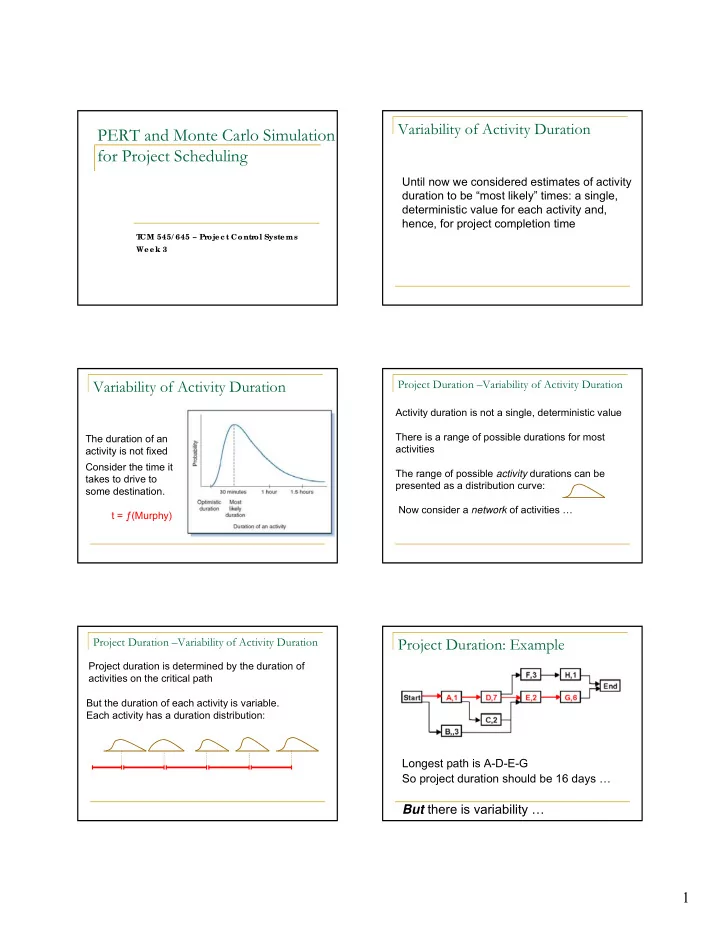
Variability of Activity Duration PERT and Monte Carlo Simulation for Project Scheduling Until now we considered estimates of activity duration to be most likely times: a single, deterministic value for each activity and, hence, for
T CM 545/ 645 – Pr
We e k 3
In reality, actual activity times will vary, hence so
Might say that, e.g., project will be completed in
PERT treats completion times as probabilistic
PERT deals with uncertainty in projects, and to
PERT answers questions e.g.
What is probability of completing project within 20
days?
If we want a 95% level of confidence, what should the
project duration be?
Was developed in the 1950s for the USA Polaris Missile-submarine program
USA Naval Office of Special Projects Lockheed Corporation
(now Lockheed-Martin)
Booz, Allen, Hamilton Corporation
a m b?
Definite cut-off point for b
Where a = optimistic m = most likely b = pessimistic
(50% chance of activity completed by te)
e
e = te
CP
(50% chance of project completed by T
e)
Could be skewed (not symmetrical)
Definite cut-off points A single peak a m b
For each activity calculate the te value (a + 4m + b)/6 Everywhere in network, insert expected time, te
Assume times shown are te,
Identify the critical path, based on te values (not m-values) CP is A-D-E-G, which indicates expected project completion time, Te = 16 days (50% chance)
(justified by the Central Limit Theorem – discussed later)
e = expected project
50% 50%
e T s
Z = number of standard deviations that T
s is from the mean
project duration
σ = standard deviation for project (found by summing the variance of each activity along the critical path and then taking the square root of the total) T
s = the project duration under consideration (time of interest,
i.e. 20 days) T
e = the expected project duration
e = expected project duration = Σ te
s = project completion time of interest
e = 16 T
s =20
Te Ts
Compute Te, , and variance for the critical path Vproject = ∑ VCP = ∑2 = 7
CP te 2 = V =variance A 1 1 1 D 7 2 4 E 2 1 1 G 6 1 1 Total for CP: 16 = Te 7 = V
Assume the following values are given:
(see later why we add up variances)
Ts - ∑ te p = 20 - 16 = √ 7 1.52 Z =
e = 16 T
s =20
Te Ts
For project duration of 20 days: P (z ≤ 1.52) = 0.93 (approximately 93%. As estimates are used, higher accuracy does not make sense)
Hence, conclude that there is a 93% probability that the project will be completed in 20 days or less
1. Given a network with estimates a, m, and b as well as a value for project duration, it provides a probability figure for finishing on time 2. Alternatively, given a network with estimates a, m, and b as well as a desired level of confidence (probability figure, say 99%), it can calculate a project duration that corresponds with the level of confidence 3. It provides insight in the effect of variability of activity duration on the critical path
Now the question is: How confident are
93% is high percentage. So, can we be
If estimates are based upon experience backed by
historical data, maybe we can believe the 93% estimate
If a, m, and b are guesses, be careful! If any of these
estimates are substantially incorrect, the computed % will be meaningless
misleading when near-critical paths could become critical
PERT only considers the critical path and is misleading when near-critical paths could become critical Merge-point bias: Two paths merging, each 50% chance of being on time 25% chance of finishing on time (or early)
Merge-point bias addressed by Monte-Carlo simulation
We will use the statistical analysis software package called @Risk to study Monte Carlo simulations of project schedules.
Assumes that a successor will start immediately
PERT technique can provide false confidence Expecting high probability of project completion,
1/6
Number of spots on single die = x
Mean of x = 3 ½ Variance of x = 2 11/12
1 2 3 4 5 6
Number of spots on two dice = y
Mean of y = 7 = double that for one die Variance of y = 5 5/6 = double that for one die
2 3 4 5 6 7 8 9 10 11 12 1/36 6/36
Number of spots on three dice = z
Mean of z = 10 ½ = 3 x that for one die Variance of z = 8 ¾ = 3 x that for one die
28/216 1/216
5 activities in sequence, each with a specific skewed duration distribution The distribution of project duration for the 5 activities above is more or less normal