Wisconsin Traffic Operations and Safety Laboratory
Performance Management Research Data Set 21 st ITS World Congress - - PowerPoint PPT Presentation
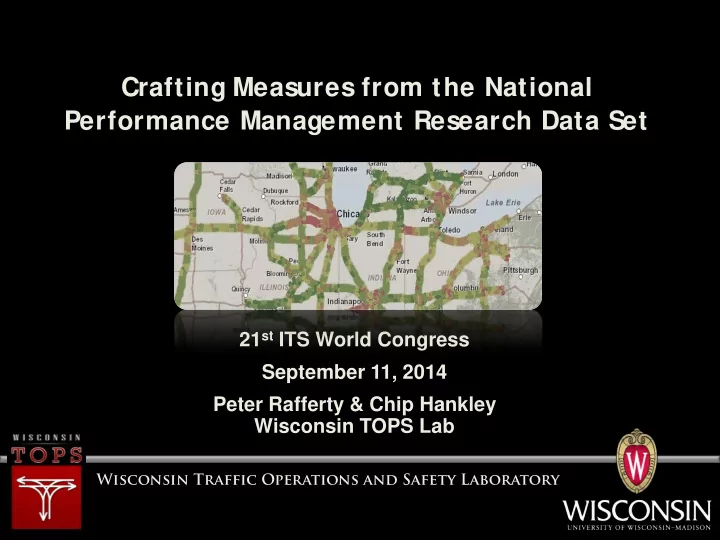
Crafting Measures from the National Performance Management Research Data Set 21 st ITS World Congress September 11, 2014 Peter Rafferty & Chip Hankley Wisconsin TOPS Lab Wisconsin Traffic Operations and Safety Laboratory Overview
Overview
- Introductions and Background Motivation
- Data Purposes and Objectives
- Traffic Probe Data and the NPMRDS
- Accessing and Utilizing the Data
- Visualizing TMCs in GIS
- Questions
Non-Intrusive Traffic Detection
- Wire loop
- bsolescence
- Classes of non-intrusive detection
- Traffic probes and traffic data providers
- Wireless detectors
- Advantages: maintenance, portability,
accuracy, cost, reliability
Traffic Probes - Overview
- Probes by
- Automatic vehicle location (AVL)
- Cellular signal processing
- GPS enabled mobile apps
- Aggregated and provided (sold)
by third parties
- E.g., Google,
TomTom, Inrix, Nokia
0% 10% 20% 30% 40% 50% 60% 70% 80% 90% 100% 4 6 8 10 12 14 16 Cumulative Probaility Segment Travel Time (minutes) 7:00 7:15 7:30 7:45 8:00 8:15 8:30
7:00 7:15 7:30 7:45 8:00 8:15 8:30
Multistate Operations
Interactive Map Online at www.glrtoc.org/map/npmrds/pti2013
Incident and Event Performance
- Example shown on next two slides:
- North/West Passage Coalition
- I-94 in North Dakota and Minnesota
- February 9-11, 2013 Winter Weather
- Hundreds of miles of interstate closed 12-18 hours
Question – How best to handle this in analysis…
Multistate Operations
West < I-94 Link Location > East 2/1/13 < Date & Hour > 2/20/13
Observations Present in NPMRDS
ND
- MN
West < I-94 Link Location > East 2/1/13 < Date & Hour > 2/20/13
Average Speed from NPMRDS
ND
- MN
Business Applications
- Mobility Performance Measures
- Vehicle Delay and User Cost
- Travel Time Reliability
Business Applications
- Planning Processes
- Operational Needs Assessment
- Reliability Valuation
National Performance Management Research Data Set (NPMRDS)
- Covers complete National Highway System
- By short segments, “Traffic Message Channel”
(TMC)
- 5-minute bins
- Made available to states as of October 2013
- Minimally processed
- Clean file structure
and data integrity
NPMRDS Coverage
- 261 thousand TMCs
- 1.8 million GIS features
- Several billion travel time observations
(potentially 20+ billion per year)
- Passenger
- Freight
- Combined
Performance Measure Process Overview
Accessing NPMRDS
- Suggest FTP
- File Structure
- 2012q3, 2013q2, etc.
- americas
– additional_content_americas
» … static files, archive, monthly updates,
shapefile (2013q2)
- documentation_tools
– documentation
» … technical references, availability dates,
points of interest (poi), etc.
transportal.cee.wisc.edu/products/fhwa-here/
Utilizing NPMRDS
- Hardware, software, and skill set requirements
- Don’t try to open CSVs in Excel
- Access has 2 GB per table limit, also quickly exceeded
- Requires database and scripting resources
- If mapping, requires GIS expertise
Handling Outliers
Hourly Volume Travel Time Sigma (per TMC)
It’s NOT like this …rather an undifferentiated cloud Nice distribution, but with long tails
Missing Observations
- Assumptions
- Imputation vs
parameterization
Wyoming Interstates
Missing Observations
Question – What’s an efficient way to handle this?
65 mph Posted Speed 3-hr grids 36 epochs
Freight vs Passenger
- Freight and Passenger travel times provided
separately
- Fewer freight observations (but increasing…)
- See www.glrtoc.org/map/npmrds/pti2013
- St. Louis (city and county),
July-December 2013 Average Observations per TMC
Freight vs Passenger
- Freight speeds are systematically lower
- St. Louis (city and county), July-
December 2013, Interstates and US Highways, paired observations
Comparisons to Other Data
- mean error
- mean absolute error
- mean square error
- mean absolute
percentage error
- mean square
percentage error
- root mean square error
- root mean square
percentage error
- Theil inequality
- Thiel bias
- Thiel variance
- Thiel covariance
- PTI delta %
- Obs delta %
- Etc…
- Etc…
Integration w ith GIS
- Performance data is based on Traffic Message
Channel (TMC) segments.
- TMCs are
associated with roads by name
- r route ID –
lots of overlap
Visualizing TMCs in GIS
- Raw data coded by “LINK”
- Lookup table provides ability to map LINK to TMC
- Many to many relationship
LINK TMC A 120N06503 C 120N06503 E 120N06503 B 118N14321 C 118N14321 D 118N14321
Displaying Road Direction
- Want to show different directions at all scales (no overlap)
- The lookup table has a field called DIR (so does the shapefile –
DIR_TRAVEL, but that’s different!)
- Values are T or F
- (could be B, but only found one instance of this in the entire data set)
- Indicates Direction of Travel along the link with respect to the reference
node (the SOUTHERN end of the link, or WESTERN end if it’s an E-W line)
- T = Direction of travel TOWARDS reference node
- F = Direction of travel FROM reference node
Towards Reference Node From Reference Node
Sometimes the geometry of roadways are shown offset (e.g. divided interstate highways), other times geometry will be coincident (e.g. non-divided US highway)
Displaying Road Direction
- Offset the line to the RIGHT or LEFT depending on the DIR value
- FROM -> RIGHT
- TO -> LEFT
If you are trying to symbolize with a performance measure, you may need to add TWO layers, one for the FROM and one for the TWO Arrows indicate geometric direction of
- line. Reference node is
always the S or W end
- f the line. This
example has two sets
- f coincident lines
representing different traffic directions Allows you to see BOTH lines at all scales Symbolize linework by offseting FROM lines RIGHT and TO lines LEFT
Traffic Direction: BLUE – CW UPPER, CCW LOWER GREEN – CCW UPPER CW LOWER
Getting to the Spatial View …
- Single spatial dataset provided with NPMRDS
- NHS_NPMRDS_Shape_file_HERE_QX_YYYY
- All major US highways
- Made up of
“links” (road segments)
- LINK – TMC
lookup table provided as DBF
1,792,650 features
Getting to the Spatial View …
- Import DBF into SQL Server (using import wizard in
SSMS)
- Import shapefile into SQL Server
- Shape2SQL tool from www.sharpgis.net
- Create an empty SDE feature class and append
- If you use SDE, leave the feature class unversioned
- Build your query logic with SSMS
Working w ith Spatial View s
- Great for exploring datasets when you need a
more powerful query environment
- Performance isn’t great – probably want to
export the query to a stand alone dataset for better performance in a production environment (e.g. web map)
- May be a reflection of SQL Server expertise
- Next up is trying this in PostgreSQL/PostGIS
Online Examples
- Wisconsin DOT Mobility
Performance Measures
- http://www.dot.wi.gov/about/
performance/goalmobility.htm
- Mid-America Operations
- http://www.glrtoc.org/map/
mafc_region/
- National NPMRDS
Reliability Map
- http://www.glrtoc.org/map/
npmrds/pti2013/
I-94 Betw een Milw aukee and IL State Line
Each Day of 2013 Southbound Northbound
IL Line IL Line Marquette Marquette Mitchell Mitchell WIS 50 WIS 50 Racine Racine
Wisconsin Traffic Operations and Safety Laboratory