Performance analysis : Hands-on time Wall/CPU parallel context - - PowerPoint PPT Presentation

performance analysis hands on
SMART_READER_LITE
LIVE PREVIEW

Performance analysis : Hands-on time Wall/CPU parallel context - - PowerPoint PPT Presentation

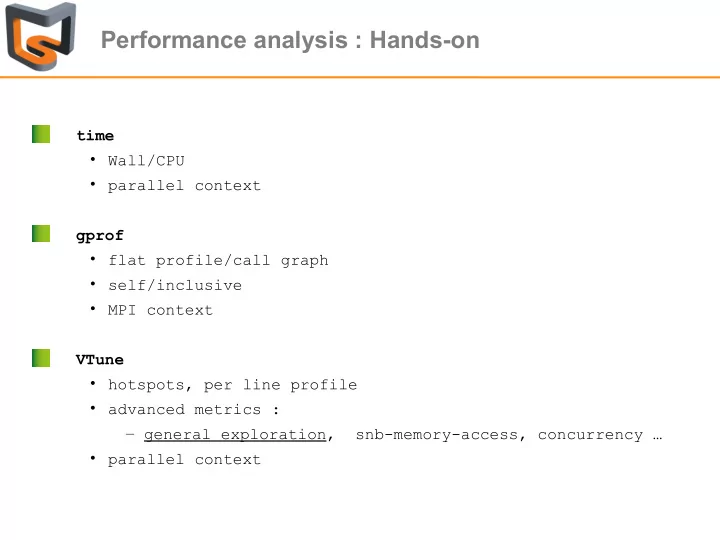
Performance analysis : Hands-on time Wall/CPU parallel context gprof flat profile/call graph self/inclusive MPI context VTune hotspots, per line profile advanced metrics : general exploration, snb-memory-access,


slide-1
SLIDE 1

time

  • Wall/CPU
  • parallel context

gprof

  • flat profile/call graph
  • self/inclusive
  • MPI context

VTune

  • hotspots, per line profile
  • advanced metrics :

– general exploration, snb-memory-access, concurrency …

  • parallel context

Performance analysis : Hands-on

slide-2
SLIDE 2

Scalasca

  • Load imbalance
  • PAPI counters

Vampir

  • trace

A memory instrumentation

Performance analysis : Hands-on

slide-3
SLIDE 3

Hands on Environment

slide-4
SLIDE 4

Architecture

  • 92 nodes
  • 2 Sandy Bridge x 8 cores
  • 32 Go

Environnement

  • Intel 13.0.1
  • OpenMPI 1.6.3

Job & resources manager

  • Today : Max 1 node / job
  • Compile on interactive nodes :

[mdlslx181]$ poincare

  • Run on :

[poincareint01]$ llinteractif 1 clallmds 6

The platform : Poincare

Hwloc : lstopo

slide-5
SLIDE 5

Poisson – MPI @ IDRIS

  • C / Fortran

Code reminder

  • Stencil :

u_new[ix,iy] = c0 * ( c1 * ( u[ix+1,iy] + u[ix-1,iy] ) + c2 * ( u[ix,iy+1] + u[ix,iy-1] )

  • f[ix,iy] );
  • Boundary limits :

u = 0

  • Convergence criterion :

max | u[ix,iy] - u_new[ix,iy] | < eps MPI

  • Domain decomposition
  • Exchanging ghost cells

The code : Poisson

slide-6
SLIDE 6

Data size $ cat poisson.data 480 400 Validation :

  • compile on an interactive node :

[poincareint01]$ make read [poincareint01]$ make calcul_exact

  • Run on a compute node

[poincare001]$ make verification … BRAVO, Vous avez fini

The code : Poisson (2)

slide-7
SLIDE 7

Basics

slide-8
SLIDE 8

Command lines : $ time mpirun -np 1 ./poisson.mpi Sequential results : … Convergence apres 913989 iterations en 425.560393 secs … real 7m6.914s user 7m6.735s sys 0m0.653s

time : Elapsed, CPU

Time to solution Resources used MPI_Wtime : Macro instrumentation

slide-9
SLIDE 9

Command lines : $ time mpirun -np 16 ./poisson.mpi MPI results : … Convergence apres 913989 iterations en 38.221655 secs … real 0m39.866s user 10m27.603s sys 0m1.614s

time : MPI

slide-10
SLIDE 10

Command lines : $ export OMP_NUM_THREADS=8 $ time mpirun -bind-to-socket -np 1 ./poisson.omp OpenMP results : … Convergence apres 913989 iterations en 172.729974 secs … real 2m54.224s user 22m32.978s sys 0m31.832s

time : OpenMP

slide-11
SLIDE 11

Binding : $ time mpirun –report-bindings -np 16 ./poisson.mpi 100000 Convergence apres 100000 iterations en 4.249197 secs $ time mpirun –bind-to-none -np 16 ./poisson.mpi 100000 Convergence apres 100000 iterations en 25.626133 secs $ man mpirun / mpiexec … for the required option $ export OMP_NUM_THREADS=8 $ time mpirun –report-bindings -np 1 ./poisson.omp 100000 $ time mpirun -bind-to-socket -np 1 ./poisson.omp 100000 But not only :

  • Process/thread distribution
  • Dedicated resources

Resources

slide-12
SLIDE 12

Scaling metrics & Optimisation

1 2 4 8 16 1 2 4 8 16 200 400 600

MPI Scaling : Optimised

Grid Size : 480 x 400

MPI Process Time per iteration (μs) Relatve efficiency

1 2 4 8 16 1 2 4 8 16

MPI Scaling : Additional Optim

Grid size : 480 x 400

MPI Process Time per iteration (μs) Relatve efficiency

1 2 4 8 16 100 200 300 400 500

Optimisation

Grid size : 480 x 400

poisson.mpi poisson.mpi_opt

MPI Process Time per iteration (μs)

Damaged scaling but ... Better restitution time

slide-13
SLIDE 13

Widely available :

  • GNU, Intel, PGI …

Regular code pattern, limit the number of iterations

  • Should be consolidated after optimisation
  • Measure reference on a limited number of iterations

Edit make_inc to enable -pg option, then recompile Command lines : $ mpirun -np 1 ./poisson 100000 Convergence apres 100000 iterations en 47.714439 secs $ ls gmon.out gmon.out $ gprof poisson gmon.out

gprof : Basics

slide-14
SLIDE 14

Each sample counts as 0.01 seconds. % cumulative self self total time seconds seconds calls us/call us/call name 74.87 35.66 35.66 100000 356.60 356.60 calcul 25.27 47.70 12.04 100000 120.37 120.37 erreur_globale 0.00 47.70 0.00 100000 0.00 0.00 communication index % time self children called name <spontaneous> [1] 100.0 0.00 47.70 main [1] 35.66 0.00 100000/100000 calcul [2] 12.04 0.00 100000/100000 erreur_globale [3] 0.00 0.00 100000/100000 communication [4] 0.00 0.00 1/1 creation_topologie [5] ...

  • 35.66 0.00 100000/100000 main [1]

[2] 74.8 35.66 0.00 100000 calcul [2]

gprof : Flat profile

Consolidate application behavior using an external tool

slide-15
SLIDE 15

Each sample counts as 0.01 seconds. % cumulative self self total time seconds seconds calls us/call us/call name 74.87 35.66 35.66 100000 356.60 356.60 calcul 25.27 47.70 12.04 100000 120.37 120.37 erreur_globale 0.00 47.70 0.00 100000 0.00 0.00 communication index % time self children called name <spontaneous> [1] 100.0 0.00 47.70 main [1] 35.66 0.00 100000/100000 calcul [2] 12.04 0.00 100000/100000 erreur_globale [3] 0.00 0.00 100000/100000 communication [4] 0.00 0.00 1/1 creation_topologie [5] ...

  • 35.66 0.00 100000/100000 main [1]

[2] 74.8 35.66 0.00 100000 calcul [2]

gprof : Call graph

slide-16
SLIDE 16

A per process profile :

  • Setting environment variable : GMON_OUT_PREFIX

Command lines : $ cat exec.sh –---------------------------------------------------------- #!/bin/bash # "mpirun -np 1 env|grep RANK" export GMON_OUT_PREFIX='gmon.out-'${OMPI_COMM_WORLD_RANK} ./poisson –---------------------------------------------------------- $ mpirun -np 2 ./exec.sh $ ls gmon.out-* gmon.out-0.18003 gmon.out-1.18004 $ gprof poisson gmon.out-0.18003

Addtionnal informations : gprof & MPI

slide-17
SLIDE 17

Vtune - Amplificator

slide-18
SLIDE 18

Optimise the available sources : $ mpirun -np 16 ./poisson Convergence apres 913989 iterations en 1270.757420 secs Reminder : $ mpirun -np 16 ./poisson.mpi Convergence apres 913989 iterations en 38.221655 secs Reduce number of iterations to 10000 : $ mpirun -np 1 ./poisson 10000 Convergence apres 10000 iterations en 38.011032 secs $ mpirun -np 1 amplxe-cl -collect hotspots -r profil ./poisson Convergence apres 10000 iterations en 38.109222 secs $ amplxe-gui profil.0 &

VTune : Start

https://software.intel.com/en-us/qualify-for-free-software/student

slide-19
SLIDE 19

VTune : Analysis

slide-20
SLIDE 20

VTune : Profile

slide-21
SLIDE 21

VTune : Data filtering

Timeline filtering Per function Application/MPI/system

slide-22
SLIDE 22

VTune : Per line profile

Edit make_inc to enable -g option, then recompile $ mpirun -np 1 amplxe-cl -collect hotspots -r pline ./poisson Convergence apres 10000 iterations en 38.109222 secs $ amplxe-gui pline.0 &

slide-23
SLIDE 23

VTune : Line & Assembly

50% function calcul in a mov op.

slide-24
SLIDE 24

$ amplxe-cl -report hotspots -r profil.0 Function Module CPU Time:Self calcul poisson 35.220 erreur_globale poisson 2.770 __psm_ep_close libpsm_infinipath.so.1 1.000 read libc-2.3.4.so 0.070 PMPI_Init libmpi.so.1.0.6 0.020 strlen libc-2.3.4.so 0.020 strcpy libc-2.3.4.so 0.010 __GI_memset libc-2.12.so 0.010 _IO_vfscanf libc-2.3.4.so 0.010 __psm_ep_open libpsm_infinipath.so.1 0.010

Addtionnal informations : Command line profile

slide-25
SLIDE 25

VTune : Advanced Metrics

$ mpirun -np 1 amplxe-cl -collect general-exploration -r ge ./poisson Convergence apres 10000 iterations en 38.109222 secs $ amplxe-gui ge.0 & Cycle Per Instruction https://software.intel.com/en-us/node/544398 https://software.intel.com/en-us/node/544419

slide-26
SLIDE 26

Advanced Metrics : Back-End Bound

slide-27
SLIDE 27

Advanced Metrics : DTLB

slide-28
SLIDE 28

Advanced Metrics : Flat profile

$ mpirun -np 1 amplxe-cl -collect general-exploration -r ge ./poisson Convergence apres 10000 iterations en 38.109222 secs $ amplxe-gui ge.0 &

slide-29
SLIDE 29

Advanced Metrics : Per line profile

$ mpirun -np 1 amplxe-cl -collect general-exploration -r ge ./poisson Convergence apres 10000 iterations en 38.109222 secs $ amplxe-gui ge.0 &

slide-30
SLIDE 30

Hotspot #1 : Hotspot #2 : Can we go further ?

  • Hotspot #3
  • And further ?

Sequential optimisations

slide-31
SLIDE 31

Hotspot #1 :

  • Stencil : DTLB

→ Invert loops in calcul Hotspot #2 :

  • Convergence criterion : Vectorisable

→ delete #pragma -novector Can we go further ?

  • Hotspot #3 : Back on stencil

– using -no-vec compiler option : no impact on calcul – stencil vectorisable → add #pragma simd on the internal loop

  • Does it worth to call erreur_globale for each iteration ?

Sequential optimisations

slide-32
SLIDE 32

Hotspots :

$ mpirun -np 2 amplxe-cl -collect hotspots -r pmpi ./poisson $ ls pmpi.*/*.amplxe pmpi.0/pmpi.0.amplxe pmpi.1/pmpi.1.amplxe

Advanced metrics through a dedicated driver :

$ mpirun -np 2 amplxe-cl -collect general-exploration -r gempi ./poisson amplxe: Error: PMU resource(s) currently being used by another profiling tool or process. amplxe: Collection failed. amplxe: Internal Error

MPMD like mode :

$ mpirun -np 1 amplxe-cl -collect general-exploration -r gempi ./poisson : -np 1 ./poisson

Addtionnal informations : MPI Context

A single collect per CPU Per MPI processus profile

slide-33
SLIDE 33

Addtionnal informations : Thread concurrency

$ export OMP_NUM_THREADS=8

$ mpirun -bind-to-socket -np 1 amplxe-cl -collect concurrency -r omp ./poisson

slide-34
SLIDE 34

Addtionnal informations : Memory counters

Per MPI processus profile

$ mpirun -bind-to-socket -np 1 amplxe-cl -collect snb-memory-access -r mem ./poisson

slide-35
SLIDE 35

And more ...

Extract command lines for custom analysis Explore the GUI : $ amplxe-gui &

slide-36
SLIDE 36

Scorep, Scalasca, Vampir

slide-37
SLIDE 37

Scorep : instrumentation, profiling and tracing

Scorep : Scalable Performance Measurement Infrastructure for Parallel Codes Objectives

  • Automatic instrumentation at compilation
  • Generation of call-path profiles and event traces
  • Recording time, number of visits, exchanged data volumes, hardware

counters, ...

  • A wide range of associated softwares for results analyse and visualization

(Scalasca, Cube, Vampir, TAU, ...)

  • Supports MPI, OpenMP, basic CUDA.

Pros & Cons + Open Source, in continuous development, well supported + Scalable, portable on most HPC platforms + Compatible with the main compilers

  • Introduces an overhead in time and memory, especially for the trace
  • collection. (classic tradeoff of the instrumentation)
  • Some open issues and remaining case-specific bugs (bur refer to advantage

1)

slide-38
SLIDE 38

Scorep exercise : instrumentation and first profile

Environment - on Poincare : module use /gpfslocal/pub/vihps/UNITE/local module load UNITE module load scorep/2.0.2-intel13-openmpi163 scalasca/2.3.1-intel13-

  • penmpi163

Instrumentation : by prefixing the compilation and linking commands Ex: mpif90 -> scorep mpif90 gcc -> scorep gcc Profile generation : automatic by running a normal execution

Generates a folder scorep-yyyymmdd_hhmm_#### containing a profile.cubex file First analysis : using scorep-score command : scorep-score scorep-########/profile.cubex Gives a summary analysis with the main informations Second analysis : usins Scalasca analysis and Cube interface scalasca --examine scorep-########/

  • pens detailed results in Cube graphical interface
slide-39
SLIDE 39

Scorep-score : Summary Analysis Result Scoring

  • bash-4.1$ scorep-score scorep-20160613_1739_7420448901032141/profile.cubex

Estimated aggregate size of event trace: 6GB Estimated requirements for largest trace buffer (max_buf): 376MB Estimated memory requirements (SCOREP_TOTAL_MEMORY): 378MB (hint: When tracing set SCOREP_TOTAL_MEMORY=378MB to avoid intermediate flushes

  • r reduce requirements using USR regions filters.)

flt type max_buf[B] visits time[s] time[%] time/visit[us] region ALL 393,966,035 116,461,281 1968.70 100.0 16.90 ALL MPI 328,456,523 72,788,288 1129.39 57.4 15.52 MPI COM 43,673,016 29,115,344 271.79 13.8 9.34 COM USR 21,836,496 14,557,649 567.51 28.8 38.98 USR

  • bash-4.1$ scorep-score scorep-20160613_1739_7420448901032141/profile.cubex

Estimated aggregate size of event trace: 6GB Estimated requirements for largest trace buffer (max_buf): 376MB Estimated memory requirements (SCOREP_TOTAL_MEMORY): 378MB (hint: When tracing set SCOREP_TOTAL_MEMORY=378MB to avoid intermediate flushes

  • r reduce requirements using USR regions filters.)

flt type max_buf[B] visits time[s] time[%] time/visit[us] region ALL 393,966,035 116,461,281 1968.70 100.0 16.90 ALL MPI 328,456,523 72,788,288 1129.39 57.4 15.52 MPI COM 43,673,016 29,115,344 271.79 13.8 9.34 COM USR 21,836,496 14,557,649 567.51 28.8 38.98 USR

Region/callpath classification : MPI : pure MPI library functions OMP : pure OpenMP functions/refions USR : user-level source local computation COM : 'combined' USR + OMP/MPI ANY/ALL : aggregation of all regions

ALL USR COM MPI OMP USR MPI OMP

slide-40
SLIDE 40

Cube interface (through scalasca --examine)

slide-41
SLIDE 41

Scorep : Trace Collection (1)

Tracing give more insight into the code behavior It often generates too much collected data, resulting in huge time and memory

  • verheads

First step : estimate this cost

  • The scorep scoring gives an estimation of the needed memory buffer and trace

files size.

  • r option shows all regions

External example : code X running on Curie on 288 processes

me@curie90 $ scorep-score -r scorep-20150701_1639_1289782540682648/profile.cubex Estimated aggregate size of event trace: 15TB Estimated requirements for largest trace buffer (max_buf): 64GB Estimated memory requirements (SCOREP_TOTAL_MEMORY): 64GB (hint: When tracing set SCOREP_TOTAL_MEMORY=64GB to avoid intermediate flushes

  • r reduce requirements using USR regions filters.)

flt type max_buf[B] visits time[s] time[%] time/visit[us] region ALL 68,445,407,406 684,452,054,099 308648.07 100.0 0.45 ALL USR 68,436,752,472 684,392,045,176 118937.03 38.5 0.17 USR MPI 8,701,920 59,381,659 76915.79 24.9 1295.28 MPI COM 52,272 627,264 112795.25 36.5 179821.02 COM USR 68,344,181,664 683,280,328,752 117688.27 38.1 0.17 mod_kernel.kernel_ USR 92,665,344 1,111,120,000 230.54 0.1 0.21 mod_intgr.binsearch_ MPI 2,463,231 8,195,263 26.98 0.0 3.29 MPI_Isend MPI 2,325,231 8,195,268 18.44 0.0 2.25 MPI_Irecv MPI 2,197,704 26,271,152 4.55 0.0 0.17 MPI_Cart_rank MPI 1,452,744 14,908,466 40192.02 13.0 2695.92 MPI_Waitall MPI 407,360 1,543,680 30548.99 9.9 19789.72 MPI_Sendrecv MPI 71,750 1,435 0.22 0.0 152.44 MPI_Ssend USR 46,128 430,000 0.21 0.0 0.48 mod_intgr.sumrk3_ (...) me@curie90 $ scorep-score -r scorep-20150701_1639_1289782540682648/profile.cubex Estimated aggregate size of event trace: 15TB Estimated requirements for largest trace buffer (max_buf): 64GB Estimated memory requirements (SCOREP_TOTAL_MEMORY): 64GB (hint: When tracing set SCOREP_TOTAL_MEMORY=64GB to avoid intermediate flushes

  • r reduce requirements using USR regions filters.)

flt type max_buf[B] visits time[s] time[%] time/visit[us] region ALL 68,445,407,406 684,452,054,099 308648.07 100.0 0.45 ALL USR 68,436,752,472 684,392,045,176 118937.03 38.5 0.17 USR MPI 8,701,920 59,381,659 76915.79 24.9 1295.28 MPI COM 52,272 627,264 112795.25 36.5 179821.02 COM USR 68,344,181,664 683,280,328,752 117688.27 38.1 0.17 mod_kernel.kernel_ USR 92,665,344 1,111,120,000 230.54 0.1 0.21 mod_intgr.binsearch_ MPI 2,463,231 8,195,263 26.98 0.0 3.29 MPI_Isend MPI 2,325,231 8,195,268 18.44 0.0 2.25 MPI_Irecv MPI 2,197,704 26,271,152 4.55 0.0 0.17 MPI_Cart_rank MPI 1,452,744 14,908,466 40192.02 13.0 2695.92 MPI_Waitall MPI 407,360 1,543,680 30548.99 9.9 19789.72 MPI_Sendrecv MPI 71,750 1,435 0.22 0.0 152.44 MPI_Ssend USR 46,128 430,000 0.21 0.0 0.48 mod_intgr.sumrk3_ (...)

Tracing requires 15TB on disk 64GB buffer on each process
slide-42
SLIDE 42

Scorep : Trace Collection (2)

Observations on the overhead :

  • Some USR regions, like kernek functions, called too many times, are problematic

for scorep, generating too much overhead due to their instrumentation

  • Filtering them out of the collection can improve the quality of the profile

collection, and is necessary for the trace collection

  • Other ways exist to reduce requirements. Ex :reducing the number of iteration

Filtering : by using a filter file

  • Scorep scoring with -f option allows a new estimation without re-running

Example : code X

me@curie90 $ cat scorep.filt SCOREP_REGION_NAMES_BEGIN EXCLUDE mod_kernel.kernel* mod_intgr.binsear* SCOREP_REGION_NAMES_END me@curie90 $ scorep-score -f scorep.filt scorep-20150701_1639_1289782540682648/profile.cubex Estimated aggregate size of event trace: 2176MB Estimated requirements for largest trace buffer (max_buf): 9MB Estimated memory requirements (SCOREP_TOTAL_MEMORY): 11MB (hint: When tracing set SCOREP_TOTAL_MEMORY=11MB to avoid intermediate flushes

  • r reduce requirements using USR regions filters.)

(...) me@curie90 $ cat scorep.filt SCOREP_REGION_NAMES_BEGIN EXCLUDE mod_kernel.kernel* mod_intgr.binsear* SCOREP_REGION_NAMES_END me@curie90 $ scorep-score -f scorep.filt scorep-20150701_1639_1289782540682648/profile.cubex Estimated aggregate size of event trace: 2176MB Estimated requirements for largest trace buffer (max_buf): 9MB Estimated memory requirements (SCOREP_TOTAL_MEMORY): 11MB (hint: When tracing set SCOREP_TOTAL_MEMORY=11MB to avoid intermediate flushes

  • r reduce requirements using USR regions filters.)

(...)

Trace files reduced to 2 GB Buffer needed on each process to avoid intermediate flushes < 15M

slide-43
SLIDE 43

Scorep : Trace Collection (3) - Exercise

Run the trace collection : you need to

  • Define the following variables :

– SCAN_ANALYZE_OPTS=--time-correct – SCOREP_FILTERING_FILE=#the name of the filter file if needed# – SCOREP_TOTAL_MEMORY=#the required memory estimated by scorep-score#

  • Prefix the execution line with 'scalasca --analyse -t'

First analysis : on Cube interface (scalasca --examine scalasca_trace_folder)

  • > additional metrics such as Late Sender / Late Receiver cases quantification

Second analysis : visualization with Vampir

  • Load vampir module
  • Open traces.otf2 file in the Vampir interface

» vampir scorep_poisson_O_trace/traces.otf2 &

  • Zoom in on the timeline, explore
  • Color different regions for better visualization

Check the 'Process timeline', the 'Communication matrix', and other charts available in the charts menu

Got some idea about the inbalance reasons?

slide-44
SLIDE 44

Trace visualisation with Vampir

Running the trace collection needs :

  • Prefixing the execution command with « scalasca -t »
slide-45
SLIDE 45

Trace visualisation with Vampir (2)

Running the trace collection needs :

  • Prefixing the execution command with « scalasca -t »
slide-46
SLIDE 46

PAPI

slide-47
SLIDE 47

PAPI : Performance Application Programming Interface

Processors are equiped with a big number of counters PAPI is a portable library that gives easy access to these counters PAPI can be used as :

  • libraries for advanced use with C, Fortran, ...
  • through end-user perf tools providing easy collection and visualization

Can provide insight into :

  • Memory, L1, L2, L3 Cache and tlb behaviors
  • Cycles, Instructions, Pipeline stalls, Branch behaviors
  • Floating point operations, ...

Downsides :

  • Only 4 to 6 counters can be accessed at the same time
  • Simultaneous access to 2 available counters can be problematic (check with

papi_command_line)

  • The availability of each counter depends on the hardware (papi_avail)

Some hardware counters are erroneous (ex : FP ops on Sandy Bridge) Increases size and buffer requirement of the profile or trace collection

slide-48
SLIDE 48

Importance of data access performance

Location Access L1 ~4 cycles L2 ~10 cycles L3 ~40-65 cycles memory 60ns (150-200 cycles)

Source http://software.intel.com/en-us/forums/topic/287236

Data access

Number of cycles per data access depending on its location

Bad data access has a huge effect on the performance Causes instruction pipelines stalls, thus reduction of completed instructions per cycle.

slide-49
SLIDE 49

PAPI counters collection with Scorep - exercise

Load papi module papi/5.3.0_intel13 Choose set of PAPI counters to collect

  • Browse available preset counters with papi_avail
  • Check compatibility of a chosen set with papi_command_line

– Ex : papi_command_line PAPI_L1_DCM PAPI_L2_DCM PAPI_TOT_CYC Run profile collection :

  • Define the SCOREP_METRIC_PAPI variable prior to the execution line:

– Ex : export SCOREP_METRIC_PAPI=list of counters separated with commas Open the profile in Cube (scalasca --examine) Run trace collection :

  • Check first the requirements with scorep-score -c number_of_papi_metrics
  • Adapt your run to the requirements
  • Define SCOREP_METRIC_PAPI

Open the trace in Vampir. Visualize the perf counters in the 'Counter Data Timeline' and the 'Performance Radar' charts

slide-50
SLIDE 50

PAPI – Scorep/Scalasca results

slide-51
SLIDE 51

PAPI metrics in Scalasca trace – Visualization with Vampir

slide-52
SLIDE 52

Memory

slide-53
SLIDE 53

Ecosystem light :

  • Initiative @ :

– a memory trace included in EZTrace – Exascale Lab : MALT (a MALloc Tracker) – MdlS : LIBMTM (Modeling and Tracing Memory Library)

  • Memory bandwidth estimation in Allinea Perf Reports

Linux function : getrusage #include <sys/resource.h> { struct rusage r_usage; getrusage(RUSAGE_SELF,&r_usage); // r_usage.ru_maxrss } Read /proc/pid/status $ grep VmRss /proc/pid/status

Memory instrumentation

Max value only

slide-54
SLIDE 54

Edit make_inc to enable -D_INST_MEM option, then recompile $ mpirun -np 1 ./poisson 1 … Taille du domaine : ntx=480 nty=400 … Start --- Rang 0 - Memory usage: 24448 Kbytes Alloc --- Rang 0 - Memory usage: 30512 Kbytes … Convergence apres 1 iterations en 0.003954 secs Clean --- Rang 0 - Memory usage: 24736 Kbytes Grid footprint :

  • 480 x 400 x 8 = 1500 Kbytes / grid
  • x 4 grids

Memory instrumentation

slide-55
SLIDE 55

Edit make_inc to enable -D_INST_MEM option, then recompile $ mpirun -np 1 ./poisson 1 … Taille du domaine : ntx=480 nty=400 … Start --- Rang 0 - Memory usage: 24448 Kbytes Alloc --- Rang 0 - Memory usage: 30512 Kbytes … Convergence apres 1 iterations en 0.003954 secs Clean --- Rang 0 - Memory usage: 24736 Kbytes Memory leaks MPI ? Load imbalance

Memory instrumentation