SLIDE 1
Johnson Hafernik, J. & Wiant, F.M. (2012) Integrating Multilingual Students into College Classrooms. Practical Advice for Faculty. Bristol. Multilingual Matters.
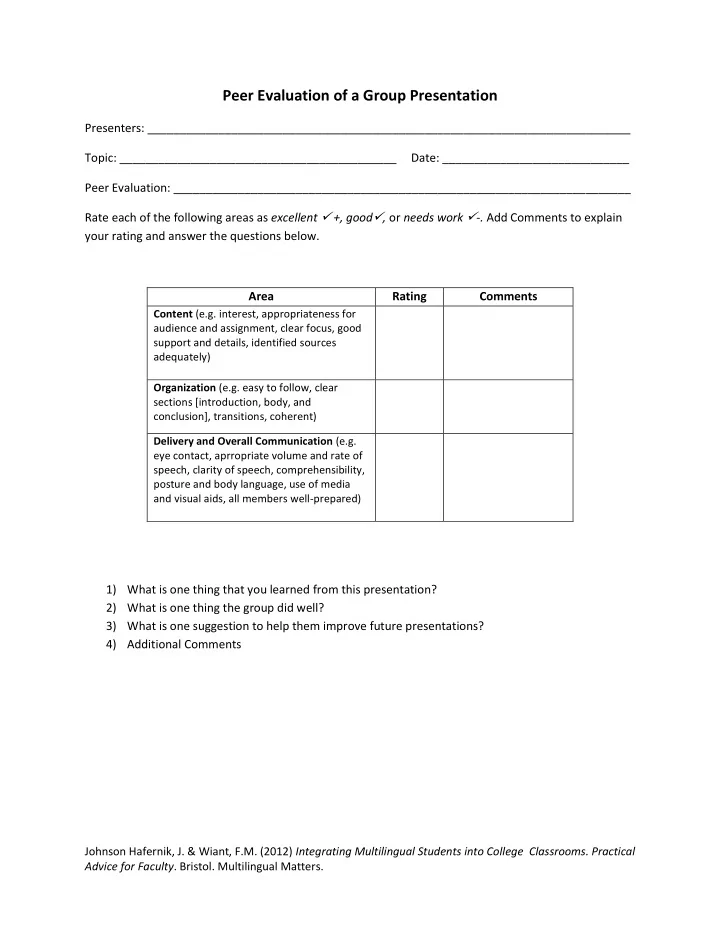
Peer Evaluation of a Group Presentation
Presenters: ___________________________________________________________________________ Topic: ___________________________________________ Date: _____________________________ Peer Evaluation: _______________________________________________________________________ Rate each of the following areas as excellent +, good, or needs work -. Add Comments to explain your rating and answer the questions below. Area Rating Comments
Content (e.g. interest, appropriateness for audience and assignment, clear focus, good support and details, identified sources adequately) Organization (e.g. easy to follow, clear sections [introduction, body, and conclusion], transitions, coherent) Delivery and Overall Communication (e.g. eye contact, aprropriate volume and rate of speech, clarity of speech, comprehensibility, posture and body language, use of media and visual aids, all members well-prepared)
1) What is one thing that you learned from this presentation? 2) What is one thing the group did well? 3) What is one suggestion to help them improve future presentations? 4) Additional Comments
SLIDE 2 Johnson Hafernik, J. & Wiant, F.M. (2012) Integrating Multilingual Students into College Classrooms. Practical Advice for Faculty. Bristol. Multilingual Matters.
Faculty Rubric Speech Evaluation and Comments
Speaker’s Name: _________________________________________ Date: _____________________ Time: ___________________________ (time allowed for speech = ___________________________) Strong Good Needs Work N/A TOTAL for area CONTENT and ORGANIZATION (Overall) 30 25 18
+ -
+ -
- c. Transitions/ Connections
+ -
+ -
+ -
- f. Accurate documention of
sources + -
DELIVERY (Overall) 10 8 6
+ -
+ -
+ -
+ -
+ -
+ -
+ -
+ -
- i. Use of PowerPoint or other aids
+ -
- j. Time within given range
+ -
LANGUAGE EFFECTIVENESS
(e.g. word choice, grammar, easy to understand)
10 8 6 TOTALS General Comments and Suggestions: Grading Scale: ________/ 50 A: 45-50 B: 40-44 C: 35-39 D: 30-34 F: <12
SLIDE 3 Johnson Hafernik, J. & Wiant, F.M. (2012) Integrating Multilingual Students into College Classrooms. Practical Advice for Faculty. Bristol. Multilingual Matters.
Faculty Rubric Essay Evaluations and Comments
Higher Order Concerns (HOCs) – Global Level – 50%
- 1. Does the paper have a clear and concise thesis?
Yes No
- 2. Does the introduction contain a preview of the main
arguments? Yes No
- 3. Do the arguments contain sufficient evidence and
reasoning to support the conclusions? Yes No
- 4. Does the paper have an attention getter?
Yes No
- 5. Does the paper have an effective conclusion?
Yes No Middle Order Concerns (MOCs) – Paragraph Level – 35%
- 1. Does each paragraph have a topic sentence and
support? Yes No
- 2. Is the organizational pattern easy to follow? Do
effective transitions lead naturally and logically from one point to the next? Yes No
- 3. Do sentences reflect the old-new information pattern?
Yes No
- 4. Do sentences flow logically from one to the next?
Yes No Lower Order Concerns (LOCs) – Sentence Level – 15%
- 1. Do all quotations, paraphrases, and summaries have
source citations? Yes No
- 2. Do sentences contain specific and accurate verbs?
Have you avoided the overuse of 'be' verbs and passive voice? Yes No
- 3. Are adverbials used to vary the complexity of
sentences and subordinate less important information? Yes No
- 4. Are there errors in grammar, spelling, or punctuation
that need to be corrected? Yes No Comments and Grade
SLIDE 4
Johnson Hafernik, J. & Wiant, F.M. (2012) Integrating Multilingual Students into College Classrooms. Practical Advice for Faculty. Bristol. Multilingual Matters.
Faculty Rubric – Group Persuasive Speech (Debate) Evaluation Form
Group 1 (For) _________________________________________________________________________ References (20 pts) _____ Visual Aids (10 pts) _____ Attention getter (5 pts) _____ Organization/Teamwork (30 pts) _____ Delivery (20 pts) _____ Closing (10 pts) _____ Time (5 pts) _____ Total (100 pts) _____ Comments: Group 1 (Against) ______________________________________________________________________ References (20 pts) _____ Visual Aids (10 pts) _____ Attention getter (5 pts) _____ Organization/ Teamwork (30 pts) _____ Delivery (20 pts) _____ Closing (10 pts) _____ Time (5 pts) _____ Total (100 pts) _____ Comments:
SLIDE 5 Johnson Hafernik, J. & Wiant, F.M. (2012) Integrating Multilingual Students into College Classrooms. Practical Advice for Faculty. Bristol. Multilingual Matters.
Faculty Comments Rubric for Essay #3: A Response to a Text
Name: Date final submitted to Turnitin: Strong Adequate Needs Work Item(s) Missing
- 1. The Introductory Paragraph has:
- a. an interesting relevant 'hook' and
context/background
- b. a thesis statement with opinion and
controlling ideas; and
- c. the controlling ideas are parallel
2 3 1 1 2 1
- 2. The Body Paragraphs:
- a. have topic sentences and relevant details
and examples;
- b. follow the order of the thesis statement;
- c. use quotes and paraphrases from texts to
support main ideas; and
- d. introduce quotes and paraphrases with a
variety of reprting verbs
3 1 3 4 2 2 3 1 1 2
- 3. The concluding paragraph restates the
thesis with different words and/ or strucure
2 1 1
- 4. All 'borrowed language' is correctly
quoted and cited.
- 5. Quotes are correctly punctuated
(quotation marks, commas, periods).
4 4 3 3 2 2
- 6. Slang and informal language are avoided.
2 1
- 7. Transitions (FANBOYS, for example,
however, etc.) are correctly used and punctuated.
3 2 1
- 8. Subordinators (because, when, as, if, etc.)
are correctly used and punctuated.
3 2 1
- 9. Feedback is followed, the paper is
spellchecked, and MLA formatting is used.
3 2 1
- 10. Essay is appropriate length.
2 1
subtotals Deductions: Late submission of draft or final copy. (-1 to -4) Score and grade A: 37-40 C:29-32 B:33-36 D:27-28 F:<27
_____/ 40