PCOS PHENOTYPES LEARNING OBJECTIVES PCOS Phenotypes At the - - PowerPoint PPT Presentation

pcos phenotypes
SMART_READER_LITE
LIVE PREVIEW

PCOS PHENOTYPES LEARNING OBJECTIVES PCOS Phenotypes At the - - PowerPoint PPT Presentation

Management of Menstrual Disclosure Irregularities and Hirsutism Nothing to disclose Heather Huddleston, MD Associate Professor University of California San Francisco PCOS PHENOTYPES LEARNING OBJECTIVES PCOS Phenotypes At the conclusion of


slide-1
SLIDE 1

Management of Menstrual Irregularities and Hirsutism Heather Huddleston, MD Associate Professor University of California San Francisco

Disclosure

Nothing to disclose LEARNING OBJECTIVES

At the conclusion of this presentation, participants should be able to:

  • Describe strategies for menstrual cycle management.
  • Discuss controversies around use of oral contraceptives in the

population.

  • Describe strategies for management of the cutaneous

manifestations of hyperandrogenism.

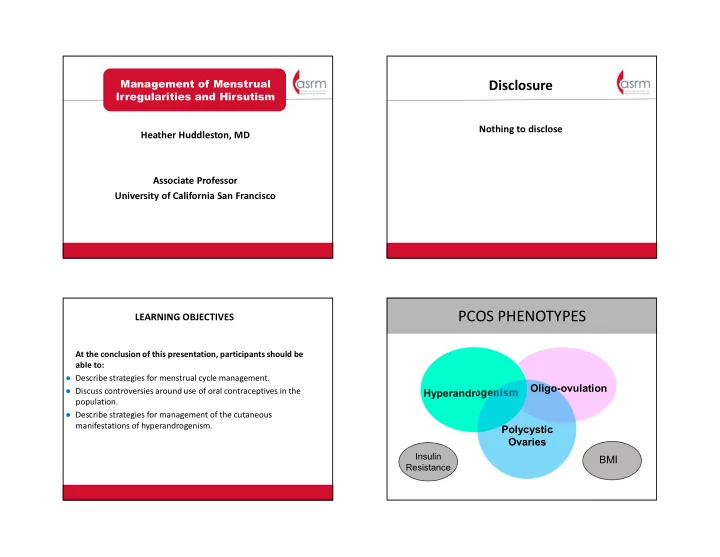
PCOS Phenotypes

Hyperandrogenism

PCOS PHENOTYPES

Oligo-ovulation Polycystic Ovaries BMI

Insulin Resistance

slide-2
SLIDE 2

Hyperinsulinemia

Decreased SHBG Increased Free Androgen

Clinical Hyperandrogenism

Insulin Resistance

Androgen production

  • vary

IGF RECEPTO R

Hyperglycemia Diabetes Cardiovascular disease

Non-Alcoholic Fatty Liver Disease

Obesity Depression

PCOS is a multi-system disorder

Infertility

anovulation

Gibson-Helm M., Dokras et al. Delayed Diagnosis and a Lack of Information Associated With Dissatisfaction in Women With Polycystic Ovary

  • Syndrome. J Clin Endocrinol Metab. 2016;102(2):604-612. 2017 Feb 01.

Clinical Features of Importance to Women with PCOS Distress

  • Secondary analysis of data collected from 17,015 young, Australian women

participating in a national longitudinal cohort study.

  • 60% of women reporting a diagnosis of PCOS had moderate to severe levels of

psychological distress.

  • Compared to women without PCOS, the odds of moderate to severe psych

distress at Survey 2 were significantly higher for women recently diagnosed with PCOS (AOR 1.52 1.21-2.18).

  • Women recently diagnosed with PCOS also had a greater likelihood of moderate

to severe distress in the year prior to their diagnosis.

  • Hormonal contraceptive use did not attenuate the risk of distress among women

with PCOS.

Rowlands, I.J. et al. Young Women's Psychological Distress After a Diagnosis of Polycystic Ovary Syndrome or Endometriosis. Hum Reprod 31 (9), 2072-2081. 2016 Jul 13. Gibson-Helm M., Dokras et al. Delayed Diagnosis and a Lack of Information Associated With Dissatisfaction in Women With Polycystic Ovary

  • Syndrome. J Clin Endocrinol Metab. 2016;102(2):604-612. 2017 Feb 01.
  • Cross sectional study using online questionnaire
  • Recruitment via support group web sites in 2015 and 2016
  • 1385 women with PCOS
  • 1/3 reported 2 years and >3 health professionals before a

diagnosis was established.

  • Satisfied with diagnosis experience: 35.2%
  • Satisfied with information received: 15.6%
slide-3
SLIDE 3

Perceptions of the PCOS Diagnosis Experience

Gibson-Helm et al Clin Endocrinol Metab 2017 Feb 1;102(2):604-612.

Menstrual Cycle Control Control of Hyperandrogenism

Fertility

Long Term Health and Lifestyle Modification

PCOS Diagnostic Treatment Plan

Psychology

Rotterdam Criteria:

  • Oligomenorrhea:
  • Hyperandrogenism:
  • Polycystic Ovaries:

Menstrual Regulation: Why?

  • Irregular cycles indicate

anovulation, which leads to lack

  • f progesterone
  • Progesterone is needed to

antagonize the stimulatory effects

  • f estrogen on endometrium
  • Unimpeded estrogen stimulation

can lead to hyperplasia or endometrial cancer

Barry, J.A. et al Risk of endometrial, ovarian and breast cancer in women with polycystic ovary syndrome: a systematic review and meta-analysis. Hum Reprod Update. 2014; 20(5):748-758.

Menstrual Regulation and Endometrial Cancer

Meta-analysis indicates a roughly 3x increased risk of endometrial cancer in PCOS, including in pre- menopausal women Women with PCOS have several risk factors, including

  • ligomenorrhea, infertility, diabetes,
  • besity

It is likely, but not known, that the risk is primarily linked to lack of progesterone exposure Degree of risk reduction with OCP is not known, but can be extrapolated

slide-4
SLIDE 4

Jennifer M. Gierisch et al.Cancer Epidemiol Biomarkers Prev 2013;22:1931-1943.

Meta-analysis of ever versus never oral contraceptive use and endometrial cancer incidence

OCPs result in reduction of endometrial cancer risk of about 50%

Oral contraceptives and cancer risk reduction

Iverson L. et al; Lifetime cancer risk and combined oral contraceptives: the Royal College of General Practitioners’ Oral Contraception Study. Institute of Applied Health Sciences, University of Aberdeen, Aberdeen, UK. Institute of Applied Health Sciences, University of Aberdeen, Aberdeen, UK. Obstet Gynecol. 2017 Jun;2016(6):580.

46,022 women recruited to UK Roual College Oral Contraception study in 1969 and observed for up to 44 years Ever use of oral contraceptives was associated with reduction in endometrial cancer (incidence rate ratio, 0.66 [0.48-0.89])

Strategies for Menstrual Cycle Regulation

  • Oral contraceptives
  • Cycle progesterone
  • Levonorgestrel-releasing intrauterine device

Oral Contraceptives

Oral contraceptives are first-line management for menstrual abnormalities and hirsutism in PCOS.

Legro, R.S. et al. Diagnosis and Treatment of Polycystic Ovary Syndrome: An Endocrine Society Clinical Practice Guideline. J Clin Endocrinol Metab (2013) 98 (12): 4565-4592.

slide-5
SLIDE 5

Levonorgestrel IUD (LNG-IUS)

Mirena: 20 mcg LNG per day Kyleena: 19.5 mcg LNG per day Skyla: 14 mcg LNG per day Often associated with spotting or irregular bleeding for 6 months, followed by amenorrhea

Levonorgestrel IUD in PCOS

  • 30 patients with PCOS

with poor tolerance of OCP versus 30 ovulatory patients, followed for 6 months

Da Silva, A.V., Levonorgestrel-Releasing Intrauterine System for Women With Polycystic Ovary Syndrome: Metabolic and Clinical Effects. Reprod Sci. 2016 Jul;23(7):877-84.

LNG-IUS saw decreases in ovarian volume 10%, LDL 5.2%, and total cholesterol 6.7% (p<.05) Fasting glucose increased in LNG-IUS, but decreased 2.6% in controls.

Management: Hyperandrogenism

Acne

Hirsutism

Androgenic Alopecia

Escobar-Moreale, H.F et al., Epidemiology, diagnosis and management of hirsutism: a consensus statement by the Androgen Excess and Polycystic Ovary Syndrome Society. Hum Reprod Update. 2011;18(2):146-170.

  • Pilosebaceous Unit (PSU) is

sensitive to androgens

  • 5 alpha reductase activity

converts T to DHT binds to PSU with androgen insensitivity with high affinity

  • Not all patients with

hirsutism/acne have elevated androgens and vice versa

Androgens and the Pilosebaceous Unit

slide-6
SLIDE 6

Hirsutism: Objective Evaluation

  • The modified Ferriman-Gallwey Score is gold standard
  • Cutoff score of 6-8 vs. “patient important hirsutism”

Symptoms of Androgen Excess: Prevalence

5 10 15 20 25 30 35 40 1 2 3 4 5 6 7 8 9 10 11 12 13 14 15 16 17 18 19 20 21 22 23 25 27 28 29 30 31 Count MFG score

MFG Score Distribution: UCSF PCOS Cohort (N=409)

MFG Cutoff of > 8 Hirsutism: 55%

Huddleston, unpublished data

Hirsutism and Quality of Life

  • 229 women with PCOS completed the Skindex and underwent

a complete dermatologic exam

  • Validated quality of life index for all skin disorders
  • Assess impact on three domains: skin symptoms, emotions,

social and physical functioning

  • Findings:

– High degree of effect on emotions and functioning – Rates of distess were higher than for other skin disorders reported in literature – Mean clinical rated was 8.6 MFG, patient rated was 13

Hirsutism and the Patient Experience

Pasch et al Clinician vs Self-ratings of Hirsutism in Patients With Polycystic Ovarian Syndrome. Associations With Quality of Life and Depression.JAMA Dermatol. 2016;152(7):783-788.

UCSF PCOS Cohort: 229 Women with Rotterdam PCOS, Ages 14-52

slide-7
SLIDE 7

Hirsutism and Ethnicity

Afifi, L. et al. Association of ethnicity, Fitzpatrick skin type, and hirsutism: A retrospective cross-sectional study of women with polycystic ovarian syndrome. International Journal of Women’s Dermatology. Published online 2017 Mar 13. doi: 10.1016/j.ijwd.2017.01.006. Adapted from Reid RL (2015) Polycystic Ovary Syndrome. http://dx.doi.org/10.15226/2374-6890/2/4/00132

Pharmacologic Interventions for Hirsutism

  • Pharmacologic: Androgen

Suppression:

  • OCP
  • Anti-androgens (spironolactone,

flutamide, finasteride)

  • Insulin Sensitizers/Lifestyle
  • Topical: Eflornithine
  • Cosmetic Direct Removal
  • Choices depend on:
  • Plans for pregnancy
  • Degree of hirsutism
  • Patient preferences

Oral Contraceptives

  • Progestins cause suppression of LH levels and inhibition of LH-

mediated ovarian androgen synthesis.

  • EE in OCPs leads to increase in SHBG which reduces free T.
  • 60%-100% see reduction in hirsutism with OCPs = sufficient to

recommend as a mono-therapy

  • Variables to consider:
  • Oral versus non-oral?
  • Type of progestin?
  • Dose of estrogen?
  • Continuous versus cyclic?

Oral Contraceptives: But which route/dose of estrogen? Estrogen Dose: Varies from 10 ug-35 ug Low-dose (20-25 ug) similar to higher dose 30-35 ug in T suppression, but has less SHBG effect Oral vs. Non-oral Most studies show equivalent effects on SHBG, thus likely similar effects for treating symptoms of estrogen excess.

slide-8
SLIDE 8

Oral Contraceptives: But Which Progestin?

Second-generation progestin

  • Levonorgestrel

Third-generation progestin

  • Desogestrel

Anti-androgenic generation progestin

  • Cyproterone

Acetate

  • Drosperinone

(DRSP)

Bhattacharya et al. Comparative study of the therapeutic effects of oral contraceptive pills containing desogestrel, cyproterone acetate, and drospirenone in patients with polycystic ovary syndrome. Fertil Steril. 2012 Oct;98(4):1053-9.

After six months of treatment: Similar effects After 12 months of treatment: MFG:

  • Cyproterone Acetate significantly decreased mFG (-5.29) compared to

desogesterel (-1.69) and drosperinone (-2.12) SHBG:

  • Cyproterone Acetate significantly increased SHBG (change of 131.52)

compared to desogestrel (change 99.52)

  • Drosperinone increased SHBG compared to desogestrel

Free Androgen Index:

  • Cyproterone Acetate significantly decreased Free Androgen Index (-10.57)

compared to desogestrel (-5.58)

Which Pill to use?

Bernardine H Stegeman et al. Different combined oral contraceptives and the risk of venous thrombosis: systematic review and network meta-analysis. BMJ 2013; 347

Venous Thrombosis Risk across OCP Formulations

slide-9
SLIDE 9

Legro, R.S. et al. Effects of Continuous Versus Cyclical Oral Contraception: A Randomized Controlled Trial. Clin Endocrinol Metab. 2008;93(2):420-429. Legro, R.S. et al. Effects of Continuous Versus Cyclical Oral Contraception: A Randomized Controlled Trial. Clin Endocrinol Metab. 2008;93(2):420-429.

OCPs: Relative Contraindication

Condition RISK Obesity BMI ≥ 30 2 Adequately controlled hypertension where blood pressure can be evaluated 3 Known dyslipidemias without other known CVD risk factors 2 Multiple risk factors for arterial CVD (older age, diabetes, hypertension, smoking, known dyslipidemias) 3-4 Depressive disorders 1 History of gestational diabetes 1 Nonvascular diabetes (insulin and non–insulin dependent) 2 Thyroid disorders 1 Age >40 2 DVT 3/4

  • 1. No restrictions
  • 2. Advantages outweigh

theoretical or proven risks

  • 3. Theoretical or proven

risks usually outweigh advantages

  • 4. Unacceptable health

risk

www.cdc.gov/reproductive health

Metformin and Lifestyle

  • Both metformin and lifestyle have favorable effects on insulin

sensitivity and may reduce serum androgens.

  • However meta-analysis of 6 trials did not reveal any clinically

significant differences in reduction of the FG score compared to placebo.

  • Metformin was shown less effective compared to spironolactone

and flutamide.

  • Metformin is not recommended for treatment of hirsutism.

Cosma M., Swiglo BA, Flynn DN et al. Clinical review: Antiandrogens for the treatment of hirsutism: a systematic review and metanalyses of randomized controlled trials. JCEM 2008; 93: (4) 1153-60.

slide-10
SLIDE 10

Androgen Receptor Blockers

Spironolactone Finasteride Flutamide Cyproterone Acetate

Moghetti P, Tosi F, Tosti A et al Comparison of Spironolactone, Flutamide, and Finasteride Efficacy in the Treatment

  • f Hirsutism: A Randomized, Double Blind, Placebo-Controlled Trial1 J Clin Endocrinol Metab. 2000;85(1):89-94

Relative Efficacy of Anti-Androgens

Anti-androgens induced a 30-40% reduction in MFG score

Comparative Effectiveness with Anti-Androgens

Wong et al A prospective randomized trial comparing finasteride to spironolactone in the treatment of hirsute women. J Clin Endocrinol Metab. 1995 Jan;80(1):233-8. JCEM 1995; 80(1):233-8.

  • RCT comparing Finasteride and Spironolactone
  • 40 women with idiopathic hirsutism
  • Significantly greater response with Spironolactone

Anti-Androgens as Combined Therapy

  • Swiglo, B.A., et al. Antiandrogens for the Treatment of Hirsutism: A Systematic Review and Metaanalyses of Randomized

Controlled Trials. J Clin Endocrinol Metab April 2008 93(4) 1153-1160.

slide-11
SLIDE 11

Cosmetic Methods for Hirsutism

  • Short-term:

– Plucking – Waxing – Shaving

  • Long-term:

– Electrology – Laser – Intense pulsed light (IPL)

Recommendations: Endocrine Society

  • First line is OCP
  • After six months, add AR Blocker
  • Recommend against the use of metformin for hirsutism

Martin et al JCEM 93:1105-1120,2008

Acne as a Sign of Androgen Excess

  • Androgen excess (AE) plays a role in

development of acne vulgaris

  • AE is associated with increase in sebum

and decreased shedding of hyperkeratinized epithelium, which leads to occlusion of the hair follicle and proliferation of propionibacterium acnes

  • Bacteria metabolize sebum triglycerides

to glycerol and free fatty acids, causing further inflammation of PSU

Acne: Treatment

  • Hormonal contraceptives are more effective than placebo

(Cochrane data) and are first line

  • Topical agents such as benzoyl peroxide and retinoids can be

used to treat inflammatory acne

  • Oral antibiotics
  • Oral isotretinoin has maximum clinical effectiveness for all

forms of acne - currently reserved for severe, nodular acne,

  • r other forms resistant to treatment
  • Anti-androgen therapy may be helpful but data are lacking

Arowojolu AO, Gallo MF, Lopez LM et al, combined oral contraceptive pills for treatment of acne. Cochrane Database;. 2004;(3):CD004425.

slide-12
SLIDE 12

Androgenetic Alopecia

Androgenetic Alopecia aka Female Pattern Hair Loss

  • Characterized by thinning of sagittal scalp hair growth with

recession of frontal and frontoparietal hair lines

  • Reported in 22% of women with PCOS
  • More likely to have other signs of androgen excess, but no

evidence of increased serum androgens

  • FDA-approved treatment is minoxidil 2%
  • Data on efficacy of anti-androgen treatment are limited

Quinn M. Prevalence of androgenic alopecia in patients with polycystic ovary syndrome and characterization of associated clinical and biochemical features. Fertility and Sterility Apr;101(4):1129-34.

Treatment Plan: Long Term Health

  • Review Assessment:
  • Big Picture Message:
  • Review of Strategies:

Prevalence of IGT or Diabetes

Legro, et al. JCEM 1999; 84: 165-169 Azziz et al. JCEM 2001; 86: 1626-1632 Ehrmann et al. Diabetes Care 1999; 22:141-146

Normal Impaired Diabetes About 40%

slide-13
SLIDE 13

Diabetes Prevention Trial

  • Multi-center, 4 year study
  • 3234 people with impaired glucose tolerance and

mean BMI of 34

  • 45% of participants from higher risk minority groups
  • Interventions:
  • Metformin (850 mg bid)
  • Structured Lifestyle (goal of 7% weight loss)
  • No intervention
  • Ended study 1 year early

Knowler et al. N Engl J Med 2002;346:393-403. Cumulative Incidence of Diabetes According to Study Group. Knowler et al. N Engl J Med 2002;346:393-403.

Diabetes Prevention Trial: Results

Conversion to Diabetes: Placebo: 29% Metformin 22% Lifestyle 14% Risk reduction Metformin 31% Lifestyle 58%

Randomiz

Legro et al JCEM 2015 Lifestyle Intervention:

calorie restriction, medication (sibutramine or

  • rlistat and increase activity

to promote 7% weight loss

OWL PCOS RCT of 149 women OCP Combined Followed for 16 weeks Underwent 4 cycles of clomiphene citrate and TIC

Lifestyle intervention versus OCP versus both

  • Lifestyle and combined lost significant

weight and body fat compared to OCP (p<.0001)

  • Mean weight loss in lifestyle groups was

about 6 kgs and 6% of body weight

  • Serum triglycerides, Glucose AUC and

insulin sensitivity worsened in OCP compared to lifestyle and combined. OCP Lifestyle Combined Ovulation 46% 60% 67% Conception 16% 32% 28% Livebirth 10% 25% 24% Legro et al JCEM 2015

slide-14
SLIDE 14

Lifestyle for Overweight and Obese PCOS

  • Lifestyle interventions may increase ovulations

and chance of pregnancy

  • Weight reduction may reduce pregnancy

complications

  • Weight loss is helpful for lifelong health
  • Lifestyle interventions should be considered first

line Lifestyle in PCOS: Systematic Review

Domecq et al JCEM 2013

The Nutrition Consult

  • Assess current status

with diet recall instruments

  • Strategize about areas

for improvement

  • Discuss resources and
  • ptions in community for

additional assistance

What Type of Diet is Best?

slide-15
SLIDE 15

Which Type of Diet is Best?

Eucaloric Diet 8 weeks 30 Women with PCOS Standard Diet Reduced CHO diet Goss et al Metabolism 2014

  • Lower carbohydrate diet

induced redistribution of fat mass awayfrom metabolically dangerous location.

  • Standard diet lead to loss
  • f lean muscle mass

Low Carbohydrate Versus Standard

Goss et al Metabolism 2014

Low Carbohydrate versus Standard diet

Lower CHO diet lead to greater decreases in:

  • Fasting glucose
  • Fasting insulin
  • Homa IR

Goss et al Metabolism 2014

Composition of Diet: Systematic Review

Reviewed the literature and found 5 studies with 137 subjects.

 Greater weight loss for a monounsaturated fat enriched diet  Improved menstrual regularity for a low glycemic index diet  Increased free androgen index for a high-carbohydrate  Greater reductions in insulin resistance, fibrinogen, total, and high-density lipoprotein cholesterol for a low-carbohydrate or low glycemic index diet;  Improved quality of life for a low glycemic index diet  Improved depression and self-esteem for a high protein diet

Conclusion:

  • Data to understand this question is scarce
  • Most benefit likely derived from weight loss
  • The diet that the patient can adhere to best should be encouraged

Moran et al Journal of the Academy of Nutrition and Dietetics 2013

slide-16
SLIDE 16
  • The Department of Health and Human

Services (DHHS) recommends: – 75 minutes of vigorous or – 150 minutes of moderate physical activity per week

Activity Recommendations For All Americans

  • Vigorous
  • Hard physical effort
  • Makes you breath much

harder than normal

  • Moderate
  • Moderate physical effort
  • Makes you breath

somewhat harder than normal

International Physical Activity Questionnaire Metabolic Equivalents (METs) per week = [4 x (moderate minutes)] + [8 x (vigorous minutes)]

Physical Activity in the Real World

Lamb and Huddleston Am J of Obste Gynecol 2011

  • Cross sectional study of 150 women with PCOS (Rotterdam)
  • Assessed adherence to DHHS guidelines for exercise:
  • 150 minutes of moderate or 75 minutes of vigorous exercise

per week

59% 41%

PHYSICAL ACTIVITY

Met DHHS Guidelines Did not meet DHHS Guidelines

  • Active women more likely to be white (72% vs. 46%) and

nulliparous (64% vs. 40%)

“Real World” Physical Activity with PCOS

Lamb et al Am J of Obste Gynecol 2011; 204:352-356

Variable Not Active Active p

Body mass index kg/m2 33.7 29.9 .009 Waist circumference (cm) 98 89 0.03 Weight fluctuations (kg) 28.0 19.2 .008 Fasting glucose (mg/dL) 94.0 87.8 .04 OGTT (mg/Dl) 122.3 105.4 .07 Depression 5.5 3.6 .005

slide-17
SLIDE 17

65

Physical activity in PCOS

  • 326 women with PCOS included

– 56% of PCOS patients met DHHS guidelines for exercise

  • Of these, 83% did so through vigorous activity criteria while 17%

did so by moderate activity. `

No Moderate Vigorous Yes

182

31

144 151 31

Greenwood et al F and S 2016

Exercise Intensity and Metabolic Syndrome

47% 36% 33% 0% 10% 20% 30% 40% 50%

Chi Square = 0.07

Metabolic Syndrome (%)

Metabolic Syndrome:

Waist >80 cm HDL <50 mg/dL Triglycerides >150 mg/dL BP >130/85 mmHg Fasting Glucose > 100mg/dL

Prevalence (%)

Inactive Vigorous Moderate

Greenwood et al F and S 2016

Exercise Intensity: Metabolic Syndrome

Adjusted Odds Ratio (95% CI) for Metabolic Syndrome

0.78 (0.62, 0.98) 1.12 (0.99, 1.20) 1.10 (1.04, 1.18) 1.15 (1.09, 1.21)

60 minutes of vigorous exercise per week decreases odds of Metabolic Syndrome by 22%, controlling for age, BMI and total volume of exercise 1 Vigorous Total METs Age BMI

Greenwood et al F and S 2016

Cumulative Incidence of Diabetes According to Study Group.

Diabetes Prevention J Med 2002;346:393-403.

Knowler et al. N Engl J Med 2002;346:393-403

Diabetes Prevention Trial es Prevention

Trial: Results

slide-18
SLIDE 18

From: Metformin and lifestyle modification in polycystic ovary syndrome: systematic review and meta-analysis

Hum Reprod Update. 2015;21(5):560-574. doi:10.1093/humupd/dmv025

Metformin

  • Use as insulin sensitizer recently recommended by

International Evidenced Based Guidelines

  • Indication: PCOS with evidence of impaired glucose

tolerance or impaired fasting glucose

  • Start at 500 per day and workup to TID
  • Consider long acting

Summary: Management of Symptoms of Androgen Excess

  • Menstrual dysfunction should be managed by oral

contraceptives, cycle progestins, or LNG-IUS.

  • Hirsutism is common in PCOS and does not correlate well with

biochemical hyperandrogenemia.

  • OCPs are first line, with consideration of anti-androgens as a

second agent.

  • Acne is improved with OCPs, with anti-androgens, and topical

agents as second line.

  • Androgenic alopecia can be managed by minoxidil.
  • Lifestyle and Metformin should both be considered in weight

management for PCOS