Outline Across the Lifespan with PCOS and Reproductive Care: - - PowerPoint PPT Presentation

outline
SMART_READER_LITE
LIVE PREVIEW

Outline Across the Lifespan with PCOS and Reproductive Care: - - PowerPoint PPT Presentation

10/20/2017 Outline Across the Lifespan with PCOS and Reproductive Care: Diagnostic Criteria and PCOS features A focus on adolescents, fertility and aging Diagnostic Criteria by age Care for the woman with PCOS, with a focus on:


slide-1
SLIDE 1

10/20/2017 1

Across the Lifespan with PCOS and Reproductive Care: A focus on adolescents, fertility and aging

Heather Huddleston, M.D. Associate Professor Director of UCSF Multidisciplinary Clinic for Women with PCOS

University of California, San Francisco

Outline

  • Diagnostic Criteria and PCOS features
  • Diagnostic Criteria by age
  • Care for the woman with PCOS, with a focus on:

– Adolescence – Fertility and pregnancy – Post Reproductive

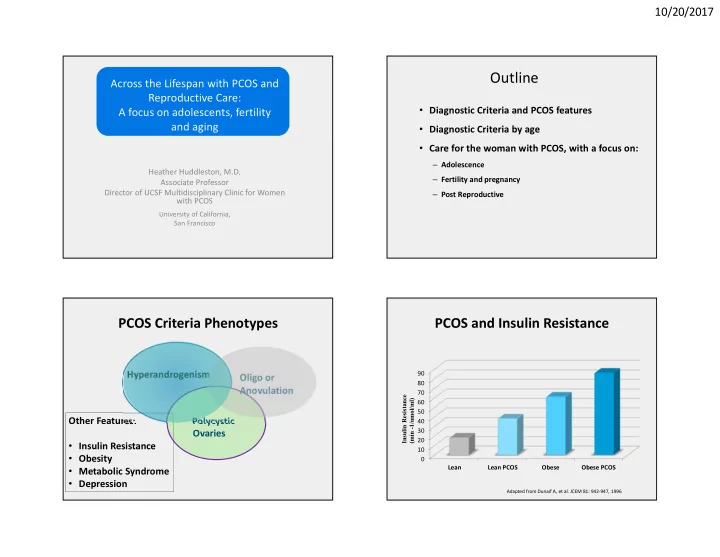
PCOS Criteria Phenotypes

Hyperandrogenism Oligo or Anovulation Polycystic Ovaries Other Features:

  • Insulin Resistance
  • Obesity
  • Metabolic Syndrome
  • Depression

PCOS and Insulin Resistance

10 20 30 40 50 60 70 80 90 Lean Lean PCOS Obese Obese PCOS Insulin Resistance (min -1/nmol/ml)

Adapted from Dunaif A, et al. JCEM 81: 942-947, 1996

slide-2
SLIDE 2

10/20/2017 2

Metabolic Syndrome

368 Non-diabetic PCOS patients (Ages 18-41)

  • No Metabolic syndrome

in Women with BMI <27 (n=52)

  • Women with BMI > 30

had 13X chance of Metabolic syndrome

0% 20% 40% 60% 80% 33% 80% 66% 32% 21% 5%

Ehrmann et al. J Clin Endocrinol Metab. 2006 Jan;91(1):48-53.

Insulin and the Pathophysiology of PCOS

Hyperinsulinemia Decreased SHBG

Increased Free Androgen Clinical Hyperandrogenism Anovulation Insulin Resistance

Androgen production

  • vary

IGF RECEPTOR

Hyperglycemia Diabetes Cardiovascular disease

Diagnostic Criteria Across the Lifespan

Adolescence Childhood

Acne, Irregular cycles common Recommend assessing 2 years post menarche

Can’t be diagnosed

Young Adult 18-35

Stable: Criteria are reliable

Mid-Adult 35-50

Cycles and Androgens may regularize Fertile window extended

Menopause and Beyond

Can’t be diagnosed. No cycles, decreased androgens

PCOS Across the Lifespan

Adolescence Childhood Young Adult 18-35 Mid-Adult 35-50 Menopause and Beyond

Criteria are most appropriate for reproductive aged women

slide-3
SLIDE 3

10/20/2017 3

Diagnostic Criteria Across the Lifespan

Childhood

Studies in PCOS daughters

  • PCOS daughters n= 135
  • Control daughters n=93
  • Matched for Tanner Stage

2 4 6 8 10 12 14 1 2 3 4 5

PCOS Daughter Control Daughter

5 10 15 20 25 1 2 3 4 5 Tanner Stage AGE BMI PCOS and Control daughters have similar BMI and age at a given tanner stage Tanner Stage

Sir Peterman JCEM 2009 94:1923

20 40 60 80 1 2 3 4 5 Control 4 8 12 1 2 3 4 5 Testosterone Ovarian volume 20 40 60 80 100 1 2 3 4 5

Tanner

70 80 90 100 110 1 2 3 4 5

Sir Peterman JCEM 2009 94:1923

Tanner Tanner Tanner

2 Hour Insulin P<.05 2 Hour Glucose P<0.05 PCOS Control PCOS PCOS Control Control

Diagnostic Criteria Across the Lifespan

Adolescence

slide-4
SLIDE 4

10/20/2017 4

Why make a diagnosis in an adolescent?

  • Early diagnosis of

metabolic disease

  • Early intervention in

lifestyle changes

  • Early treatment of

clinical symptoms causing anxiety

  • Diagnostic criteria

problematic

  • Puberty mimics

several signs of PCOS

  • Risk of overdiagnosis

and underdiagnosis Pro Con

Challenges PCOS diagnosis in adolescents:

#1 Ovulatory Dysfunction Immature HPO axis leads to ovulatory irregularity for several years following #2 Hyperandrogenism Normative data for adolescents does not exist for androgen assays Many physiologic pubertal changes

  • verlap with PCOS

findings . #3 Ultrasound Transvaginal ultrasound undesirable Transabdominal suboptimal Polycystic ovaries may be very common in this age group

Natural History of Oligomenorrhea

Van Hooff: nested case control of adolescents at 3 years (mean) post menarche and three years later

Van Hooff et al Human Reprod 2004; 19: 383-392

Cycles at 15 Cycles at 18 Regular Cycles Regular 87% Irregular 13% Oligomenorrhea 2% Irregular (24-41 day) Regular 48% Irregular 39% Oligomenorrhea 11% Oligomenorrhea Regular 22 % Irregular 27% Oligomenorrhea 51%

Natural History of Oligomenorrhea

Van Hooff et al Human Reprod 2004; 19: 383-392

Predictor Hazard Ratio BMI 5.1 (1.7, 15) Testosterone 2.5 (1.0, 6.0) LH 1.6 (0.6, 3.6) Androstenedione 2.8 (1.2, 6.6) Polycystic ovaries 2.1 (0.7, 6.7) Insulin 0.3 (0.7, 1.3)

Hazard Ratio for Oligomenorrhea at 18 yo amongst those with Oligomenorrhea at 15 yo

slide-5
SLIDE 5

10/20/2017 5

Adolescent PCOS Characteristics

Acne High Fast Insulin High Free TT High Total T High LDL Gluc/insul <4.5

Bekx et al; J Pediatr Adolesc Gynecol 2010

High Trig Type II Diabetes Hirsutism

Prevalence of Metabolic Syndrome by BMI

0% 20% 40% 60% 80% 100% 37% 0% 11% 63% 5% 0% 0% 32% PCOS

Coviello et al 2006 JCEM 91: 492-497

4.5 fold increased risk

  • f metabolic

syndrome, adjusting for BMI

Percent with Metabolic syndrome

Take Home Message: PCOS in Adolescent

  • Diagnosis should be approached gingerly with option

to re-assess over time encouraged

  • Menstrual patterns fairly well established 2-3

years post menarche

  • Acne is common in adolescents
  • Hirsutism and biochemical more specific
  • High prevalence of metabolic risk

PCOS Across the Lifespan

Adolescence Childhood Young Adult 18-35 Mid-Adult 35-50 Menopause and Beyond

Criteria are most appropriate for reproductive aged women

slide-6
SLIDE 6

10/20/2017 6

Before Pregnancy: Preconception

  • Routine pre-natal labs
  • Discussion of implications of BMI for pregnancy
  • Discussion of potential lifestyle changes before

pregnancy

  • Counseling about risks in pregnancy
  • Screening
  • Hyperglycemia with OGTT
  • Hypertension
  • Dyslipidemia

Risk of Pregnancy Complications

Meta-analysis of 2544 patients with PCOS compared with 89,848 patients without PCOS.

  • Gestational diabetes mellitus (OR 2.82; 95% CI: 1.93–4.10),
  • Pregnancy-induced hypertension 4.07 (2.75–6.02)
  • Preeclampsia 4.23 (2.77–6.46)
  • Preterm delivery 2.20 (1.59–3.04)
  • Small-for-gestational age 2.62 (1.35–5.10)
  • Kjerulff. Pregnancy outcomes and polycystic Am J of OBGYN 2010

Pituitary Gland

Estradiol

Clomid

Letrozole

Ovulation Induction: Mechanism

Metformin Weight Loss Decreased hyperinsulinemia Insulin Resistance Follicle Stimulating Hormone

Hypothalmamus

Lifestyle Change : Exercise vs. Diet

40 women with PCOS/anovulatory infertility

Palomba et al Human Reproduction 2008

Structured Exercise

  • 3 sessions per

week

Hypocaloric Diet

  • High Protein
  • 800 kcal deficit

Patient Choice 24 weeks

slide-7
SLIDE 7

10/20/2017 7

Lifestyle: Exercise vs. Diet

Palomba et al Hum Reprod. 2010 Nov;25(11):2783-91

Exercise Diet p Age 26.8 25.8 NS BMI 33.1 33.2 NS Dropout 15% 35% 0.14 % Ovulatory 65% 25% 0.01 Pregnancy 35% 10% 0.06

Palomba et al.

Lifestyle vs. Standard Treatments

Clomid Metformin Clomid and Metformin Lifestyle n 90 88 90 75 Age 27.5 27.3 27.3 27.5 Infertility 4.1 3.0 4.55 3.9 BMI kg/m2 27.2 27.2 28 27.9 Waist (cm) 102 102 97 98

  • 344 overweight women with PCOS
  • Randomized to clomiphene, metformin, both or lifestyle
  • Lifestyle included advice on diet and exercise
  • Followed up after six months

Karminzadeh Fertil and Steril 2010; 94: 216-220

Lifestyle vs. Standard Treatments

P=NS

Karminzadeh Fertil and Steril 2010; 94: 216-220

Lifestyle for Overweight and Obese PCOS

  • Lifestyle interventions may increase ovulations

and chance of pregnancy

  • Weight reduction may reduce pregnancy

complications

  • Weight loss is helpful for lifelong health
  • Lifestyle interventions should be considered first

line

slide-8
SLIDE 8

10/20/2017 8

Clomiphene Citrate (Clomid)

  • Synthetic Anti-estrogen
  • Convenient
  • Inexpensive
  • Long-standing first choice for
  • vulation induction in women

with PCOS

Imani, B. et al. J Clin Endocrinol Metab 1998;83:2361-2365

How Many Women Will Ovulate With Clomid? About ¾ of women with PCOS will

  • vulated with

clomid

Imani, B. et al. J Clin Endocrinol Metab 1999;84:1617-1622

  • 160 patients
  • Normogonadotropic

anovulation

  • Successful response to

clomid

  • Normal SA
  • BMI >18.5

Clomid: Chances for conception?

Results of RMN PPCOS Trial

P<.001 P<.001

Legro et al. NEJM 2007; 35:551-66

slide-9
SLIDE 9

10/20/2017 9

Metformin as Pre-Treatment: Results

Morin-Papunen L et al. JCEM 2012;97:1492-1500

Pregnancy rate: Metformin 52.6% Placebo: 40.4% Effect more pronounced in

  • bese women

Obese Non-Obese

Aromatase Inhibitors

  • 750 women with PCOS by modified Rotterdam

assigned to receive letrozole or clomiphene for up to five treatment cycles

  • 18-40, had one patent fallopian tube and a normal

uterine cavity, normal sperm concentration.

  • Primary outcome was live birth

Letrozole has superior live birth to Clomiphene

slide-10
SLIDE 10

10/20/2017 10

Letrozole has superior live birth to Clomiphene

Hum Reprod. 2015;30(9):2222-2233. doi:10.1093/humrep/dev182

Factors that Predict Live Birth in PCOS

PCOS and Fertility

  • Lifestyle change/weight loss should be

encouraged prior to pregnancy

  • Letrozole is now the first line treatment for

PCOS

PCOS and Aging

Adolescence Childhood Young Adult 18-35 Mid-Adult 35-50 Menopause and Beyond

slide-11
SLIDE 11

10/20/2017 11

How do we counsel our PCOS patients as they age?

PCOS and Aging

  • Some have found that PCOS metabolic status

and reproductive symptoms improve with age (Carmina et al; n=35 PCOS).

  • Other studies have also shown increased rates
  • f surrogate markers of cardiovascular disease

using retrospectively dx PCOS (Wang et al; Soloman et al)

  • No studies to date have shown increased rates
  • f cardiac events

PCOS with Reproductive Aging

N 18-25 26-35 36-45 p-trend Total N 71 120 29 PCOS 161 76% 76% 52% 0.05 PCO 173 87% 93% 75% 0.46 AFC 165 35 31 20 0.001 Ovarian volume (mm3) 195 9.1 8.6 8.4 0.79 Oligo-ovulation 200 84% 79% 72% 0.18 Clinical hyperandrogenism 213 77% 71% 69% 0.38 Biochemical hyperandrogenism 182 68% 47% 24% <0.0005 Elevated total T 183 38% 29% 5% 0.006 Elevated free T 166 37% 25% 5% 0.007 Elevated DHEA-S 187 21% 16% 9% 0.18 MFG (mean) 214 9.7 7.3 7.5 0.08 Acne 199 71% 58% 48% 0.03 Androgenic alopecia 189 7% 18% 26% 0.01

PCOS with Reproductive Aging

N 18-25 26-35 36-45 p-trend N 161 54 92 15 BMI (kg/m2) 159 29.9 31.3 34.7 0.07 Waist circumference (inches) 134 36.1 35.9 41.4 0.03 Diastolic blood pressure (mm Hg) 151 73 75 79 0.01 LDL choleterol (mg/dl) 144 100 115 117 0.01 Fasting glucose (mg/dl) 149 88 90 96 0.06 Fasting insulin (mIU/ml) 126 13.5 13 20.3 0.16 HOMA-IR 125 3.3 3.2 5.4 0.06 2h OGTT 133 106 109 135 0.25 Number of metabolic syndrome elements 117 1.2 1.5 2.5 0.01

Johnstone et al Gynecol Endo 2012

slide-12
SLIDE 12

10/20/2017 12

Longitudinal Change in Metabolic Health PCOS versus Controls

CONTROL (BMI>30) CONTROL (BMI<=30) PCOS (BMI>30) PCOS (BMI<=30) P VALUE PCOS

  • VS. CONTROL

P VALUE BMI <=30 VS. >30. TRIGLYCERIDES (MG/DL) 0.44 (-1.16, 2.04)

  • 0.08

(-1, 0.84) 3.75 (0.99, 6.51)* 1.65 (-1.17, 4.46)* <.05 NS HOMA-IR

  • 0.08

(-0.14, -0.02)

  • 0.02

(-0.05, 0.01) 0.01 (-0.09, 0.11) 0.09 (-0.03, 0.19) <.05 NS LDL (MG/DL) 1.25 (0.44, 2.05)* 1.23 (0.76, 1.69)* 0.55 (-0.85, 1.95) 0.66 (-0.77, 2.17) NS NS HDL (MG/DL) 0.29 (-0.16, 0.73) 0.03 (-0.23, 0.28) 0.01 (-0.76, 0.79)

  • 0.59

(-1.4, 0.22) NS NS FASTING GLUCOSE (MG/DL) 0.06 (-0.23, 0.35) 0.01 (-0.15, 0.18) 0.16 (-0.34, 0.65) 0.14 (-0.34, 0.61) NS NS C-REACTIVE PROTEIN (MG/L)

  • 0.15

(-0.38, 0.07) 0.05 (-0.12, 0.21)

  • 0.15

(-0.45, 0.16) 0.14 (-0.18, 0.46) NS NS ALT (U/L)

  • 0.15

(-0.47, 0.16) 0.1 (-0.07, 0.28)

  • 0.36

(-0.91, 0.2) 0.03 (-0.53, 0.58) NS NS TOTAL TESTOSTERONE (NG/DL)

  • 2.6

(-4.57, -0.48)*

  • 1.20

(-3.1, 1)

  • <.05

TWO HOUR GLUCOSE (MG/DL) AUC GLUCOSE (MG/DL/HR)

  • 1.8

(-0.47, 4.07) 0.7 (-0.38, 1.78)

  • 0.18

(-2.12, 1.75)

  • 0.03

(-1.04, 0.98)

  • NS

NS SBP (MMHG)

  • 0.88

(0.18, 1.59)* 1.4 (0.5, 2.31)*

  • NS

DBP (MMHG)

  • 0.17

(-0.3, 0.65)

  • 0.16

(-0.78, 0.45)

  • NS

Longitudinal Change in Metabolic Health PCOS versus Controls

  • Testosterone declines over

time

  • Blood pressure increases
  • ver time

Longitudinal Change in Metabolic Health PCOS versus Controls Longitudinal Change in Metabolic Health PCOS versus Controls

slide-13
SLIDE 13

10/20/2017 13

PCOS and Reproductive Aging Summary

  • Increasing menstrual regularity
  • Decreasing biochemical hyperandrogenemia
  • Cardiac risk factors may increase
  • Currently no clear evidence supporting

increased cardiac events

Summary and Key Points

  • Lifestyle interventions should be considered first line

as high BMI decreases chance of pregnancy, increases rates of miscarriage and pregnancy complications

  • Letrozole first choice in pharmacologic therapy
  • Role of metformin remains unclear, though potential

uses in leaner women without time pressure to conceive remains possibility

  • Current evidence suggests that metabolic status may

worsen with age in PCOS, despite declines in hyperandrogenemia and normalization of menstrual cycles

Thank you

0% 20% 40% 60% 80%

All Classic Ovulatory Normal Androgens

Insulin Resistance Metabolic Syndrome

P<.001

Moghetti et al JCEM April 2013 Epub B-coeff P Classic

  • .2.13

.003 Ovulatory

  • 1.66

.054 Normal Androgens

  • .62

.451 Age .1 .016 Fat Mass

  • 0.11

<.001

Insulin Resistance and PCOS Phenotype

slide-14
SLIDE 14

10/20/2017 14

IR and DEPRESSION in PCOS

Huddleston, submitted

Controlling for BMI and age, a one unit increase in HOMA IR increased risk of depressive symptoms by 7% (p = .06)

Physical activity in PCOS

  • 326 women with PCOS included

– 56% of PCOS patients met DHHS guidelines for exercise

  • Of these, 83% did so through vigorous activity criteria

while 17% did so by moderate activity. `

54

No Moderate Vigorous Yes

182

31

144 151 31

Huddleston , unpublished data

The Withdrawal Bleed Could Be a Hindrance

  • Secondary analysis of RMN PCOS trial
  • Use of withdrawal bleed prior to cycle start was up to discretion
  • f site investigators

0% 10% 20% 30%

Preg/cycle Preg/Ov LB/cycle LB/Ov Spont menses 3% 5% 2% 3% Withdraw 2% 7% 2% 5% No Withdraw 8% 27% 5% 20%

*

*

* * * P<.001

Diamond et al Obset Gyncol 2012 119: 902-905

56

Results: Univariate Logistic Regression

0.82 (0.7, 0.798) 1.02 (0.98, 1.07) 0.96 (0.88, 1.05) Vigorous (60 min) Moderate (60 min) Total METs (500)

Odds Ratio (95%CI) for Metabolic Syndrome Vigorous, but not moderate or total METS, is associated with a reduced odds of metabolic syndrome.

1

Huddleston, unpublished

slide-15
SLIDE 15

10/20/2017 15

Results: Multivariate Logistic Regression

Adjusted Odds Ratio (95% CI) for Metabolic Syndrome

0.78 (0.62, 0.98) 1.12 (0.99, 1.20) 1.10 (1.04, 1.18) 1.15 (1.09, 1.21)

60 minutes of vigorous exercise per week decreases odds of Metabolic Syndrome by 22%, controlling for age, BMI and total volume of exercise

1 Vigorous (60 min) Total METs Age BMI

Palomba: Met vs. Clomid

Metformin Clomid Age 26.4 25.9 BMI 27.1 26.7 Duration of infertility 19.2 20.2 MFG 15.8 15.2 FAI% 12.6 13.7 HOMA 3.8 4.2

  • Randomized, double blind, double dummy
  • Inclusion: NIH-defined PCOS with primary infertility
  • Exclusion: BMI>30, prior fertility treatment, evidence of

glucose intolerance

Palomba et al JCEM 2005; 90: 4068-4075