Paying Attention in Class A classroom contextual cognitive training - - PowerPoint PPT Presentation

paying attention in class
SMART_READER_LITE
LIVE PREVIEW

Paying Attention in Class A classroom contextual cognitive training - - PowerPoint PPT Presentation

Paying Attention in Class A classroom contextual cognitive training Marthe van der Donk Case of Daniel Problems that can be related to executive functions Executive functions Deficits often seen in children with ADHD (Barkley, 1997;


slide-1
SLIDE 1

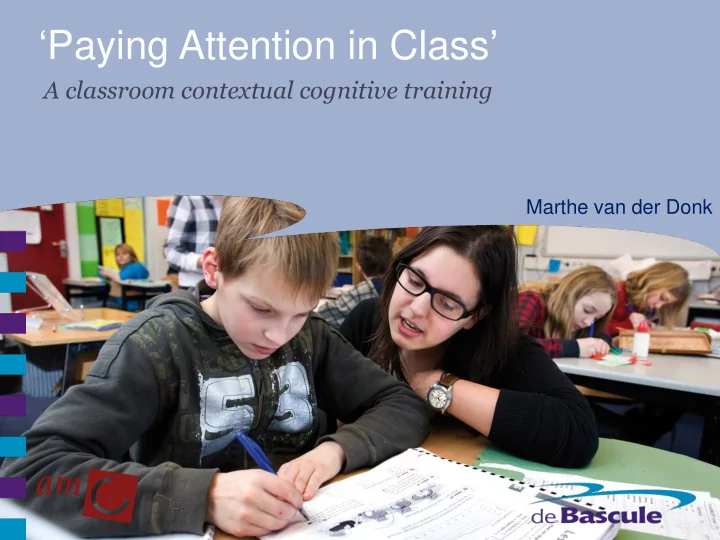
‘Paying Attention in Class’

A classroom contextual cognitive training

Marthe van der Donk

slide-2
SLIDE 2

Case of Daniel

Problems that can be related to executive functions

slide-3
SLIDE 3
  • Deficits often seen in children with ADHD

(Barkley, 1997; Willcutt et al., 2005)

  • Important role in academic performance

(Bull and Scerif, 2001)

  • Especially working memory skills

(Aronen et al., 2005; Gathercole et al., 2000).

Executive functions

slide-4
SLIDE 4

Cognitive training

1) Processed based interventions (Sonuga-Barke et al.

2014)

2) Compensatory interventions (Dehn, 2008)

▫ Strategy training (Morrison & Chein, 2011) ▫ Modify environment (e.g. Holmes, Gathercole & Dunning,

2010)

slide-5
SLIDE 5

Previous studies of CWMT in children with ADHD

Near transfer Far transfer

slide-6
SLIDE 6

Critical notes

1) Theoretical concerns

  • Near- and far transfer

2) Methodological concerns

  • Inconsistent methods
  • Lack of adequate control group
  • Single tasks

3) Clinical implications

slide-7
SLIDE 7

Aims of our study

  • Determine the effects of CWMT and compare

effects with active control group

  • Extension with 6 months follow up and

academic performance measures

slide-8
SLIDE 8

102 children included

  • age 8-12 years
  • Diagnosed with ADHD

Pre-assessment N=52 Cogmed Working Memory Training N=50 Paying Attention in Class Post assessment Follow-up 6 months

Methods

Procedure

slide-9
SLIDE 9

Methods

Assessment

Primary outcome measures

  • Neurocognitive functioning

(attention, working memory, planning and inhibition)

  • Academic performance

(word reading fluency, automated math, spelling)

  • The Behaviour Rating of Executive Functions (BRIEF-P/T)

Secondary outcome measures

  • Behavior in class (Learning Condition questionnaire)
  • Behavior problems (CBCL/TRF)
  • Quality of Life (Kidscreen-27)
slide-10
SLIDE 10

Cogmed Working Memory Training - RM

  • Daily sessions
  • During school hours
slide-11
SLIDE 11

Paying Attention in Class

  • 25 sessions of 45 minutes
  • Contextual to classroom learning
  • Three key ingredients

Metacognition Goal directed behavior

Working memory Planning and initation Selective attention

slide-12
SLIDE 12

Paying Attention in Class

(1) Psycho education

Pitfalls

Distraction Too fast Forgetful Emotion Repeat Take time Picture Routine

Compensatory strategies

slide-13
SLIDE 13

Paying Attention in Class

(2) Working memory training

Visual spatial span Instruction task Listening recall span task My table

slide-14
SLIDE 14
  • School related tasks
  • Registration card
  • Active involvement

teacher

Paying Attention in Class

(3) Transfer to classroom

slide-15
SLIDE 15

Demographics

CWMT

(n=52)

Paying Attention in Class

(n=50)

Age 9.88 (1.33) 10 (1.31) boy/girl 34/15 36/13 Medication yes/no 20/25 18/29 ADHD-C/ADHD-I 55% / 43% 59% / 39% Learning Disability 22% 40% Type of education

Regular/special primary/special education

89% / 4% / 7% 86% / 14% / 0% ***

Linear Mixed Model & Bonferonni correction

slide-16
SLIDE 16

Results – post treatment

Attention Verbal WM Visual WM Inhibition Parents

  • Behavior

regulation

  • Metacognition
  • Attention

Teacher

  • Attention

CWMT

Attention Verbal WM Visual WM Inhibition Parents

  • Behavior

regulation

  • Metacognition
  • Attention

Teacher

  • Attention

PAC

d 0.87

slide-17
SLIDE 17

Results – follow up

Verbal WM Visual WM Inhibition Planning Parents

  • Attention

Teacher

  • Attention
  • Metacognition

CWMT

Verbal WM Visual WM Inhibition Planning Parents

  • Attention

Teacher

  • Attention
  • Metacognition

PAC

d 0.49

slide-18
SLIDE 18

Summary & discussion

1) Broad improvements in neurocognitive functioning 2) Confirmed by both parent and teacher ratings 3) CWMT outperformed only on visual spatial working memory 4) Limitedness of far transfer

slide-19
SLIDE 19

Future research (1)

Why?

slide-20
SLIDE 20

Attention

How and why?

Working memory Trained function Non-trained function

slide-21
SLIDE 21

For whom?

ADHD + WM problems

slide-22
SLIDE 22

Thanks to:

  • Co authors and supervisors

▫ Anne-Claire Hiemstra, Ariane Tjeenk, Aryan van der Leij and Ramón Lindauer

  • Collaborators

▫ Marieke Krop, Carola Oosterveer, Jan Geelhoed, Jehanne Vieijra, Julie Stoter, Maartje van Ballegoij and Marjolijn Glotzbach

  • Funding

▫ Ministry of Education

slide-23
SLIDE 23

Questions?

  • Marthe van der Donk

m.vanderdonk@debascule.com