Pathophysiology of the digesti e s stem digestive system Blagoi - - PDF document

pathophysiology of the digesti e s stem digestive system
SMART_READER_LITE
LIVE PREVIEW

Pathophysiology of the digesti e s stem digestive system Blagoi - - PDF document

5/28/2015 Pathophysiology of the digesti e s stem digestive system Blagoi Marinov, MD, PhD Pathophysiology Department Medical University of Plovdiv Digestive system overview 1 5/28/2015 Most frequent GI disorders Gastritis Peptic


slide-1
SLIDE 1

5/28/2015 1

Pathophysiology of the digesti e s stem digestive system

Blagoi Marinov, MD, PhD Pathophysiology Department Medical University of Plovdiv

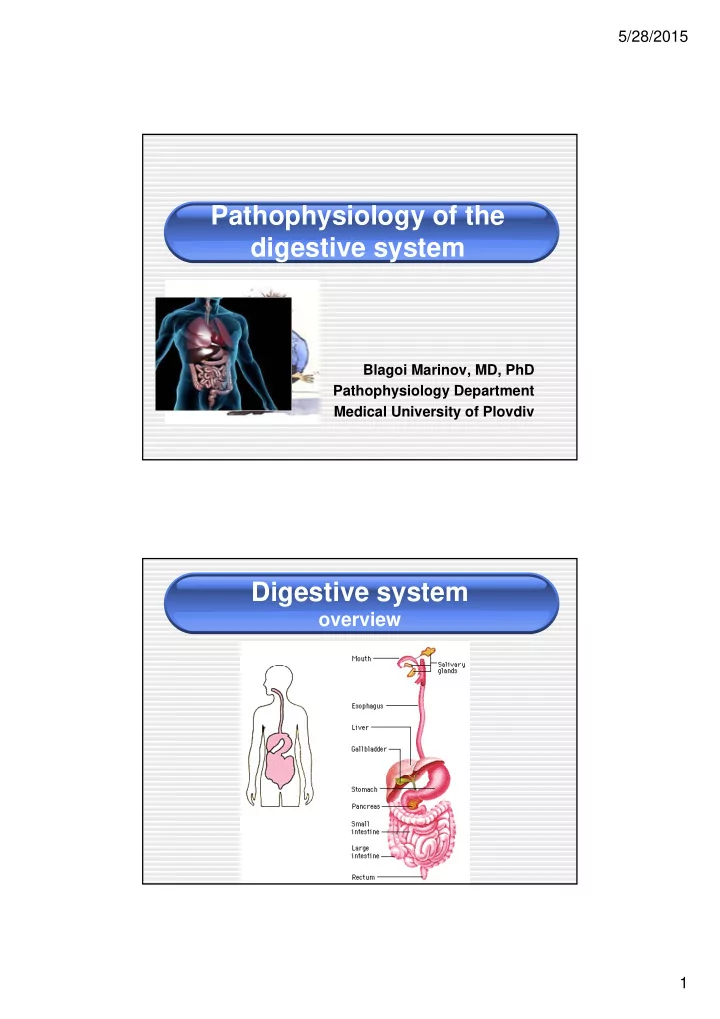
Digestive system

  • verview
slide-2
SLIDE 2

5/28/2015 2

Most frequent GI disorders

  • Gastritis
  • Peptic ulcer disease
  • Pancreatitis
  • Bowel obstruction

General etiology of GI disorders

slide-3
SLIDE 3

5/28/2015 3

Acute Gastritis

definiton Acute gastritis is a term covering a broad spectrum of entities that induce inflammatory changes in the gastric mucosa. The different etiologies share the same general clinical presentation. However, they differ in their unique histologic characteristics.

Gastritis: classification

  • Acute Gastritis:
  • Irritants, drugs, chemicals, alcohol.
  • Chronic Gastritis:
  • Autoimmune: Pernicious anaemia.
  • Anti-parietal cell & Anti-intrinsic factor AB.
  • Chemical:
  • NSAIDs, Bile reflus, Alcohol.
  • Bacterial:
  • Helicobacter pylori (most common)
slide-4
SLIDE 4

5/28/2015 4

Gastritis:

Types

Gastritis

risk factors

  • Environmental factors
  • Radiation, smoking
  • Diet
  • Alcohol, spicy food
  • Pathophysiologic conditions
  • Pathophysiologic conditions
  • Burns, renal failure, sepsis
  • Other factors
  • Psychologic stress, NG tube
slide-5
SLIDE 5

5/28/2015 5

Gastritis:

etiology

  • Alcohol
  • NSAIDs
  • Helicobacter
  • Stress/ICU associated
  • Autoimmune

Acute gastritis:

pathogenesis

Exogenous factors Endogenous factors Gastritis

  • Irritants
  • Drugs
  • Alcohol
  • Aggressive

substances

  • Uremia
  • Diabetic coma
  • Shock

 Bloodflow  HCO3-

slide-6
SLIDE 6

5/28/2015 6

Acute Gastritis

Clinical Manifestations

  • Anorexia

Anorexia

  • Nausea
  • Vomiting
  • Epigastric tenderness
  • Feeling of fullness
  • Hemorrhage
  • Common with alcohol abuse
  • May be only symptom

Chronic Gastritis

definiton

Chronic gastritis is a histopathologic entity characterized by chronic inflammation

  • f

the stomach mucosa. The epithelial changes may become dysplastic and constitute a backround for the development of constitute a backround for the development of carcinoma.

slide-7
SLIDE 7

5/28/2015 7

Chronic H. Pylori gastritis

  • Direct cytopathogenic
  • Direct cytopathogenic

action (toxins, enzymes)

  • Indirect effect pathogenic

effect on mucous defense through bacterial g lipase and protease

  • Urease activity

(urea  NH3)

Chronic autoimmune gastritis (atrophic)

slide-8
SLIDE 8

5/28/2015 8

Evolution of atrophic gastritis

  • Pernicious anemia
  • Gastrointestinal
  • Hematologic
  • Neurologic
  • Precancerosis

syndrome

  • Gastric carcinoma appears 3 to 20 times more

frequently in patients with atrophic gastritis.

Gastritis:

complication

  • Dyspepsia (particularly alcohol NSAIDs)
  • Dyspepsia (particularly alcohol, NSAIDs)
  • Bleeding
  • Loss of intrinsic factor (if body involved)
  • Decreased gastric acid secretion
  • Progression to ulcer

Progression to ulcer

  • Progression to cancer/lymphoma
slide-9
SLIDE 9

5/28/2015 9

Peptic ulcer disease:

Definition

Defect of gastric or duodenal mucosa which interfere over lamina muscularis mucosae, submucosa or penetrates across whole gastric or duodenal wall

Ulcer disease

slide-10
SLIDE 10

5/28/2015 10

Localisation of ulcers Location and Type of Ulcer:

  • Type 1: Primary gastric ulcer. Associated with

diffuse antral gastritis.

  • Type 2: Gastric ulcers with duodenal ulcers, most

likely secondary to duodenal ulcers.

  • Type 3: Prepyloric or channel ulcer.
  • Type 4: Proximal stomach or gastric cardia.

Acid hyper secretion common among type 2 and 3

  • ulcers. Type 1 an 4 pathophysiologycally the

same.

slide-11
SLIDE 11

5/28/2015 11

Peptic ulcer disease:

Frequencies

  • 10% of the world population (6-11% in different

sources)

  • Men: Women– 7:1
  • Duodenal : Gastric– 4:1
  • Duodenal ulcer is prevalent in the age group 30-

p g g p 50 (men > women)

  • Gastric ulcer is predominant after the age of 40

(morbidity in men and women is equal)

Peptic ulcer disease

Classification:

Acute ulcer (ulcus acutum)

  • smooth non-elevated borders and smooth base
  • major bleeding into upper GIT

Chronic ulcer (ulcus chronicum)

  • rushed and elevated boders, inflammation with

, hypertrophic and fibrotic proliferation is present

  • the most frequent form of ulcer disease
slide-12
SLIDE 12

5/28/2015 12

Etiology of PUD Normal Increased Attack

Hyperacidity, Zollinger Ellison syndrome.

Weak defense

Stress, drugs, smoking Helicobacter pylori*

Peptic ulcer disease:

Etiology

  • Helicobacter pylori infection*
  • Hyperacidity
  • Drugs - anti-inflammatory

(NSAIDs) & Corticostroids.

  • Cigarette smoking, Alcohol,
  • Rapid gastric emptying

p g p y g

  • Duodenal reflux.
  • Personality and stress
  • Genetic

Hurry, Worry, Curry….!

H.Pylori on the surface of gastric epithelial cells

slide-13
SLIDE 13

5/28/2015 13

Pathogenesis of ulcer disease

Gastric Ulcer Duodenal

  • Less common - 1
  • More common - 3
  • Increase with age
  • High in high class
  • A group common
  • Lower acid levels.
  • H.pylori – 70%
  • Increase upto 35y
  • Equal
  • O group common.
  • Higher acid levels
  • H.pylori – 95-100%
slide-14
SLIDE 14

5/28/2015 14

Gastric ulcer

  • Ulcer of the corpus of the

t h stomach

  • Prepyloric ulcer
  • Gastric, preceded by

duodenal ulcer

Hypersecretion

Th i th ti it i d d l The main pathogenetic unit is decreased mucosal resistance of the stomach, and the main pathogenetic factor – hypersecretion

  • f gastric juice.
  • epigastric pain after meal or during meal

Symptoms of gastric ulcer disease:

  • epigastric pain after meal or during meal
  • upper dyspeptic syndrome – loss of appetite,

nauzea, vomiting, flatulence

  • vomiting brings relief
  • reduced nutrition
  • loss of weight
slide-15
SLIDE 15

5/28/2015 15

Duodenal ulcer

  • Elevated peptic activity of gastric juice

Elevated peptic activity of gastric juice

  • Stress
  • Humoral-hormonal stimuli
  • Increasing the number and sensitivity of

gastric parietal cells

  • Altered secretory and evacuational
  • Altered secretory and evacuational

capacity of the stomach

  • Decreased resistance of duodenal

mucosa

  • epigastric pain 2 hours after meal or on a

t t h d i i ht

Symptoms of duodenal ulcer disease:

empty stomach or during night

  • pyrosis
  • good nutrition
  • obstipation
  • seasonal dependence (spring, autumn)
slide-16
SLIDE 16

5/28/2015 16

A – penetration B – perforation C – bleeding D - stenosis

Penetrating and perforating ulcers

slide-17
SLIDE 17

5/28/2015 17

Lifestyle Changes

  • Di

ti NSAID

  • Discontinue NSAIDs.
  • Acid suppression—Antacids
  • Smoking cessation
  • No dietary restrictions unless certain foods are associated with

problems. Al h l i d ti

  • Alcohol in moderation
  • Men under 65: 2 drinks/day
  • Men over 65 and all women: 1 drink/day
  • Stress reduction

Surgery

People who do not respond to medication or who develop People who do not respond to medication, or who develop complications:

  • Vagotomy - cutting the vagus nerve to interrupt messages sent from

the brain to the stomach to reducing acid secretion.

  • Antrectomy - remove the lower part of the stomach (antrum), which

produces a hormone that stimulates the stomach to secrete digestive produces a hormone that stimulates the stomach to secrete digestive

  • juices. A vagotomy is usually done in conjunction with an antrectomy.
  • Pyloroplasty - the opening into the duodenum and small intestine

(pylorus) are enlarged, enabling contents to pass more freely from the

  • stomach. May be performed along with a vagotomy.
slide-18
SLIDE 18

5/28/2015 18

10 min. break  Pancreatitis

definition

Pancreatitis is an inflammatory process in which pancreatic enzymes autodigest the gland. Acute pancreatitis occurs suddenly and lasts for a short period of time and usually resolves.

slide-19
SLIDE 19

5/28/2015 19

Acute Pancreatitis: Etiology

  • Alcohol abuse
  • Gallstones
  • Gallstones
  • Hyperlipidemia, Hypercalcemia
  • Genetic/Idiopathic
  • Hyperparathyroidism
  • Shock, hypothermia.
  • Infections - mumps
  • Abdominal / surgical trauma
  • Drugs: steroids & thiazide
  • Peptic ulcer, Carcinoma,
  • Snake/insect bite, poisoning.
  • Tropical calcific Pancreatitis

Etiology

Biliary pancreatitis: About 40~60% of cases of Biliary pancreatitis: About 40 60% of cases of pancreatitis are associated with gallstone disease, which, if untreated, usually gives rise to additional acute attacks.

  • Bile refluxpancreatic ductactivate

enzymes. y

  • Obstruction  increased duct pressure 

damage pancreatic acinus  distroy gland.

slide-20
SLIDE 20

5/28/2015 20

Etiology

Alcoholic Pancreatitis: Alcohol stimulates gastric acid secretion which increases CCK-PZ (cholecystokin and pancreozymin) excretion in duodenum and then increases pancreatic secretion.

  • M k

th hi t d d

  • Make the sphincter spasm and edema
  • Increase duct pressure.
  • Direct toxic to pancreas

Etiology

  • Hypercalcemia:

yp hyperparahtyroidism and other disorders accompanied by hypercalcemia are occasionally complicated by acute pancreatitis, it is thought that the increased calcium concentrations in pancreatic juice that result from hypercalcemia p j yp may prematurely activate proteases, they may also facilitate precipitation of calculi in the duct.

slide-21
SLIDE 21

5/28/2015 21

Etiology

Hyperlipidemia:

  • pancreatitis seems to be a direct

consequence of the metabolic

  • abnormality. during an acute attack

usually associated with mormal serum amylase levels because the lipid amylase levels, because the lipid interferes with the chemical determination for amylase; urinary

  • utput of amylase may still be high.

Etiology

Drug-induced pancreatitis: g p corticosteroids, estrogen-containing contraceptives, azathioprine, thiazide diuretics, and tetracyclines. Pancreatitis associated with use of estrogens is associated with use of estrogens is usually the result of drug-induced hypertriglyceridemia.

slide-22
SLIDE 22

5/28/2015 22

Acute Pancreatitis Acute Pancreatitis -

  • Pathogenesis

Pathogenesis SUMMARY: SUMMARY: Lipase  Fat necrosis – Inflammation. Protease  Blood Vessel injury – Bleeding. Trypsin  Kallikrein  Thrombosis - Necrosis

Acute pancreatitis

clinical manifestations

  • Abdominal distention
  • Abdominal distention
  • Abdominal guarding
  • Abdominal tympany
  • Hypoactive bowel sounds

S di it l i

  • Severe disease: peritoneal signs,

ascites, jaundice, palpable abdominal mass, Grey Turner’s sign, Cullen’s sign, and signs of hypovolemic shock

slide-23
SLIDE 23

5/28/2015 23

Grey Turner Sign

  • Cullen’s Sign

Severe Mild

Acute Pancreatitis:

Common Complications P l M t b li

  • Pulmonary
  • Atelactasis
  • Pleural effusions
  • ARDS
  • Cardiovascular
  • Cardiogenic
  • Metabolic
  • Metabolic acidosis
  • Hypocalcemia
  • Altered glucose

metabolism

  • Hematologic
  • DIC

GI bl di shock

  • Neurologic
  • Pancreatic

encephalopathy

  • GI bleeding
  • Renal
  • Prerenal failure
slide-24
SLIDE 24

5/28/2015 24

Chronic Pancreatitis:

  • Painful, relapsing, inflammation, fibrosis & exocrine

atrophy atrophy.

  • Malabsorption, hypoalbuminemia, weight loss,
  • Type I DM (if sufficient loss of islets).
  • Recurrent Jaundice - gall stone.
  • Types:
  • Toxic metabolic- 70%: Alcohol, Hyperlipidaemia,

toxins, drugs, hypercalcaemia. g yp

  • Idiopathic-20%: Early/Late.
  • Others: Genetic, autoimmune, Post necrotic.
  • Destruction of exocrine pancreas, Fibrosis, cystic ducts
  • remain. (both true & pseudocyst).
  • Calcification, lithiasis & Malignant transformation.

Bowel obstruction (Ileus)

  • Definitions:
  • Ileus : Mechanical or functional intest.

Obstruction (Adynamic or paralytic).

  • Mechanical obstruction :complete or

partial blockage of the intestinal lumen. Si l b t ti b t ti

  • Simple obstruction: one obstructing

point.

slide-25
SLIDE 25

5/28/2015 25

COMMON CAUSES OF INTESTINAL OBSTRUCTION ACCORDING TO AGE

Intussusception

80% of intussusception occur in children under 2 years

slide-26
SLIDE 26

5/28/2015 26

Etiology?

  • Outside the wall
  • Inside the wall
  • Inside the lumen

Lesions Extrinsic to Intestinal Wall

  • Adhesions (usually postoperative)
  • Adhesions (usually postoperative)
  • Hernia
  • External (e.g., inguinal, femoral, umbilical, or ventral hernias)
  • Internal (e.g., congenital defects such as paraduodenal,

foramen of Winslow, and diaphragmatic hernias or postoperative secondary to mesenteric defects) N l ti

  • Neoplastic
  • Carcinomatosis, extraintestinal neoplasm
  • Intra-abdominal abscess/ diverticulitis
  • Volvulus (sigmoid, cecal)
slide-27
SLIDE 27

5/28/2015 27

Lesions Intrinsic to Intestinal Wall

  • Congenital
  • Neoplastic

g

  • Malrotation
  • Duplications/cysts
  • Traumatic
  • Hematoma
  • Ischemic stricture

p

  • Primary neoplasms
  • Metastatic neoplasms
  • Inflammatory
  • Crohn's disease
  • Miscellaneous
  • Infections
  • Tuberculosis
  • Actinomycosis
  • Diverticulitis
  • Intussusception
  • Endometriosis
  • Radiation

enteropathy/stricture

Intraluminal/ Obturator Lesions

  • Gallstone
  • Enterolith
  • Bezoar
  • Foreign body
slide-28
SLIDE 28

5/28/2015 28

Where?

  • May occur at any point in length of small bowel

CLASSIFICATION

1 Mechanical obstruction obturation

  • 1. Mechanical obstruction obturation
  • bstructoin intestine compression lesions in

the intestinal wall

  • 2. Nonmechanical obstruction

dynamic ileus----->including paralytic ileus

slide-29
SLIDE 29

5/28/2015 29

Dynamic vs Mechanical Ileus Obstruction

  • Gas diffusely through
  • Large small intestinal

Gas diffusely through intestine, incl. colon

  • May have large diffuse

A/F levels

  • Quiet abdomen
  • N

b i t iti Large small intestinal loops, less in colon

  • Definite laddered A/F

levels

  • “Tinkling”, quiet= late
  • Ob i

t iti

  • No obvious transition

point on contrast study

  • Peritoneal exudate if

peritonitis

  • Obvious transition

point on contrast study

  • No peritoneal exudate

Pathophysiology

  • Hypercontractility – hypocontractility

yp y yp y

  • Massive third space losses
  • oliguria, hypotension, hemoconcentration
  • Electrolyte depletion
  • Bowel distension--increased intraluminal

pressure--impedement in venous return-- arterial insufficiency

slide-30
SLIDE 30

5/28/2015 30

Local Effects of Obstruction

1 Hyperperistalsis >abnormal peristalsis

  • 1. Hyperperistalsis->abnormal peristalsis
  • 2. Secretion increase and absorption

decrease

  • 3. Accumulation of fluids and electrolytes

4 Distension of intestinal lumen

  • 4. Distension of intestinal lumen
  • 5. Edema of the bowel wall ->anoxemia-

>necrosis

Systemic Effects of Obstruction

  • 1. Water and electrolyte losses
  • 2. Toxic materials and toxemia
  • 3. Cardiopulmonary dysfunction
  • 4. Shock
slide-31
SLIDE 31

5/28/2015 31

Clinical features

  • 1. Abdominal pain
  • 2. Vomiting
  • 3. Obstipation
  • 4. Distention

Partial vs Complete

  • Flatus

R id l l i

  • Complete obstipation

N id l l i

  • Residual colonic gas

above peritoneal reflection /p 6-12h

  • Adhesions
  • 60-80% resolve with

ti M

  • No residual colonic

gas on AXR

  • Early complete from

high-grade partial non-operative Mx

  • Must show objective

improvement, if none by 48h consider OR

  • Almost all should be
  • perated on within

24h

slide-32
SLIDE 32

5/28/2015 32

Thank You