
SLIDE 1
Path Integrals for Radio Astronomy
Job Feldbrugge (PI and CMU) Ue-Li Pen and Neil Turok
ArXiv: 1909.04532
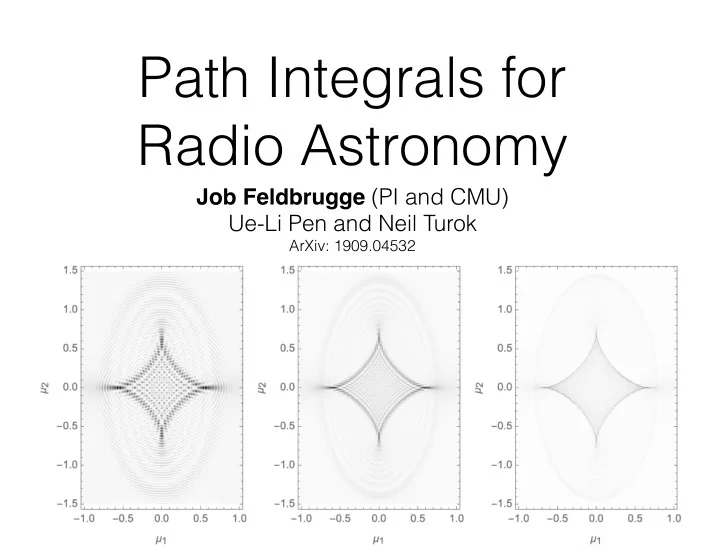
Path Integrals for Radio Astronomy Job Feldbrugge (PI and CMU) - - PowerPoint PPT Presentation
Path Integrals for Radio Astronomy Job Feldbrugge (PI and CMU) Ue-Li Pen and Neil Turok ArXiv: 1909.04532 Interference Interference is a universal phenomenon in physics. In radio astronomy, the scintillation of pulsars and potentially Fast
Job Feldbrugge (PI and CMU) Ue-Li Pen and Neil Turok
ArXiv: 1909.04532
radio astronomy, the scintillation of pulsars and potentially Fast Radio Bursts
expensive to evaluate numerically
integration theorem and Picard-Lefschetz theory
efficient as the integrand becomes more oscillatory
the Fresnel integral
Z x(1)=xobs
x(0)=xs
Dx eiS[x] = Z dx⊥e
i ω
2c
(x⊥−µ)2 d
− R dz
ω2 p(x⊥,z) ω2
d = 1 dsl + 1 dlo !2
p = ne(x)e2
✏0me
Ψ(µ, ν) = ⇣ν π ⌘D/2 Z dDx eiν[(x−µ)2+φ(x)]
integral with the imaginary exponent
Φ(x) = iν ⇥ (x − µ)2 + φ(x) ⇤
by caustics, where intensity spikes
integral is approximated with the real saddle points of the exponent
evaluate the integral. Nontrivial behaviour near caustics
Φ(x)
[Arnol’d 1973, 1975, Berry and Upstill 1980, many others]
meromorphic oscillatory integral I = Z
RD dDx eif(x;µ)
if(x; µ) = h(x; µ) + iH(x; µ)
I = X
i
ni Z
Ji
dDx eif(x;µ)
ni = hRD, Kii
convex integrals
J J
σ σ
Kσ Kσ
σ
Z
R
dx eix2
integral by a deformation in the complex plane
1 + i √ 2 Z
R
du e−u2
φ(x) = α 1 + x2
integration domain Φ(x, µ) = h(x, µ) + iH(x, µ) ∂γλ(x0) ∂λ = rh(γλ(x0)) γ0(x0) = x0
lim
λ→∞ γλ(RN) = J =
X
i
niJi
Ψ(µ) = Z
R2 eiν[(x−µ)2−φ(x)]dx
φ(x) = α 1 + x2
1 + 2x2 2
Ψ(µ) = Z
R2 eiν[(x−µ)2−φ(x)]dx
φ(x) = α 1 + x2
1 + 2x2 2
lens consisting of a blob
φ(x) = α 1 + x4
1 + x2 2
Ψ(µ) = Z
R2 eiν[(x−µ)2−φ(x)]dx
Ψ(µ) = Z
R2 eiν[(x−µ)2−φ(x)]dx
φ(x) = α(x3
1 − 3x1x2 2)
1 + x2
1 + x2 2
multi-dimensional oscillatory integrals
measurements, how much amplifications?
[Main et al. 2018]
the lens?
[Arnol’d 1973, 1975, Berry and Upstill 1980, many others]