Patent Licensing: Advanced Tactics for Licensees Post-AIA - - PowerPoint PPT Presentation

patent licensing advanced tactics
SMART_READER_LITE
LIVE PREVIEW

Patent Licensing: Advanced Tactics for Licensees Post-AIA - - PowerPoint PPT Presentation

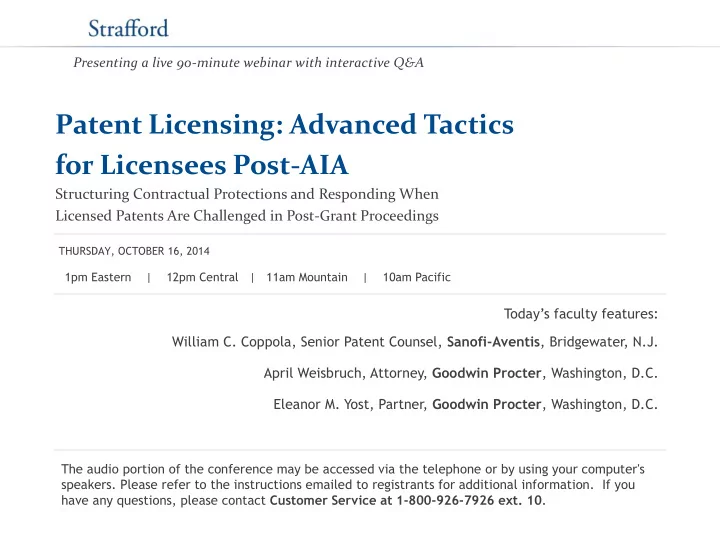
Presenting a live 90-minute webinar with interactive Q&A Patent Licensing: Advanced Tactics for Licensees Post-AIA Structuring Contractual Protections and Responding When Licensed Patents Are Challenged in Post-Grant Proceedings THURSDAY,


slide-1
SLIDE 1

Patent Licensing: Advanced Tactics for Licensees Post-AIA

Structuring Contractual Protections and Responding When Licensed Patents Are Challenged in Post-Grant Proceedings

Today’s faculty features:

1pm Eastern | 12pm Central | 11am Mountain | 10am Pacific

The audio portion of the conference may be accessed via the telephone or by using your computer's

  • speakers. Please refer to the instructions emailed to registrants for additional information. If you

have any questions, please contact Customer Service at 1-800-926-7926 ext. 10.

THURSDAY, OCTOBER 16, 2014

Presenting a live 90-minute webinar with interactive Q&A William C. Coppola, Senior Patent Counsel, Sanofi-Aventis, Bridgewater, N.J. April Weisbruch, Attorney, Goodwin Procter, Washington, D.C. Eleanor M. Yost, Partner, Goodwin Procter, Washington, D.C.

slide-2
SLIDE 2

Sound Quality If you are listening via your computer speakers, please note that the quality

  • f your sound will vary depending on the speed and quality of your internet

connection. If the sound quality is not satisfactory, you may listen via the phone: dial 1-866-570-7602 and enter your PIN when prompted. Otherwise, please send us a chat or e-mail sound@straffordpub.com immediately so we can address the problem. If you dialed in and have any difficulties during the call, press *0 for assistance. Viewing Quality To maximize your screen, press the F11 key on your keyboard. To exit full screen, press the F11 key again.

FOR LIVE EVENT ONLY

slide-3
SLIDE 3

For CLE purposes, please let us know how many people are listening at your location by completing each of the following steps:

  • In the chat box, type (1) your company name and (2) the number of

attendees at your location

  • Click the SEND button beside the box

If you have purchased Strafford CLE processing services, you must confirm your participation by completing and submitting an Official Record of Attendance (CLE Form). You may obtain your CLE form by going to the program page and selecting the appropriate form in the PROGRAM MATERIALS box at the top right corner. If you'd like to purchase CLE credit processing, it is available for a fee. For additional information about CLE credit processing, go to our website or call us at 1-800-926-7926 ext. 35.

FOR LIVE EVENT ONLY

slide-4
SLIDE 4

If you have not printed the conference materials for this program, please complete the following steps:

  • Click on the ^ symbol next to “Conference Materials” in the middle of the left-

hand column on your screen.

  • Click on the tab labeled “Handouts” that appears, and there you will see a

PDF of the slides for today's program.

  • Double click on the PDF and a separate page will open.
  • Print the slides by clicking on the printer icon.

FOR LIVE EVENT ONLY

slide-5
SLIDE 5

Patent Licensing: Advanced Tactics for Licensees Post-AIA

William C. Coppola, Senior Patent Counsel, Sanofi- Aventis Eleanor M. Yost, Partner, Goodwin Procter LLP April E. Weisbruch, Attorney, Goodwin Procter LLP October 16, 2014

slide-6
SLIDE 6

Goodwin Procter LLP

Important Considerations of the AIA

DISCLAIMER The comments and opinions expressed here are solely those of the speakers and do not in any way reflect those of any current or former client of the speaker or any party having any potential or actual business with any current or former client of the speaker. This presentation is provided for informational purposes only and is not legal advice.

*

slide-7
SLIDE 7

Goodwin Procter LLP

Presentation Overview

§ AIA Changes That Impact Licensees § Protection Challenges For Licensees § Responding To Attempts To Invalidate A Licensed Patent In Post-Grant Proceedings § Best Practices And Sample Agreement Provisions

*

slide-8
SLIDE 8
  • I. AIA Changes That Impact

Licensees

slide-9
SLIDE 9

Goodwin Procter LLP

  • Objectives of Presentation:

Explain some of the more pertinent changes that the AIA has made to Patent Act, from the perspective of a licensee

Provide explanation and helpful suggestions on dealing with the AIA when negotiating with a partner that may help avoid costly litigation

*

  • I. AIA Changes That Affect Licensees
slide-10
SLIDE 10

Goodwin Procter LLP *

  • I. AIA Changes That Affect Licensees
  • A. Post Grant Proceedings
  • The AIA provides new trial procedures:

Inter Partes Review (IPR)

Post-Grant Review (PGR)

Covered Business Method Review (CBM)

Supplemental Examination

  • The role of the patent owner in these processes is critical
slide-11
SLIDE 11

Goodwin Procter LLP *

  • Generally, however, the licensee is not the patent owner

Licensee may want to retain control over various aspects of the post- grant proceedings, including, e.g.,

▪ whether such proceedings will be requested (or the risk that they

will be requested by a Third Party Petitioner), and if so, for what type of proceeding

  • varying considerations, such as estoppel considerations, for

IPR, PGR, CBM, etc.

▪ the timing of such proceedings ▪ the content of all documents filed in such proceedings

  • important for motions to amend, claim construction positions

Particularly important if licensee is paying prosecution costs

  • I. AIA Changes That Affect Licensees
slide-12
SLIDE 12

Goodwin Procter LLP

Preliminary Response to Petition for Inter Partes Review (35 USC § 313)

Statute specifically states patent owner has right to file preliminary response to petition.

Licensee of IP subject to petition does not have right to file response.

May be desirable for licensee to require control/input in response patent

  • wner (licensor) files with the USPTO.

Settlement of Inter Partes Review (35 USC § 317)

Inter Partes Review will be terminated upon the joint request of petitioner and the patent owner.

Licensee of IP subject to Inter Partes Review does not have right to settle. Licensee may consider requiring right to control whether to settle, and terms of settlement.

At minimum, licensee may consider requiring that licensor not settle any post-grant review proceeding without express written consent of licensee.

*

  • I. AIA Changes That Affect Licensees
slide-13
SLIDE 13

Goodwin Procter LLP

Preliminary Response to a Petition for Post-Grant Review (35 USC § 323)

Statute specifically states patent owner has right to file preliminary response to petition for post-grant review.

Licensee does not have the right to file response.

Licensee may want to control/provide input of response patent owner files. Settlement of post-grant Review Proceeding (35 USC § 327)

Just as with inter partes review, statute specifically states post-grant review proceeding will be terminated upon joint request of petitioner and patent owner.

Licensee may want right to control whether to settle, and terms of such settlement.

At minimum, may want licensor (patent owner) not to settle without express written consent of licensee.

*

  • I. AIA Changes That Affect Licensees
slide-14
SLIDE 14

Goodwin Procter LLP

Supplemental Examination (35 USC § 257)

Permits supplemental examination of issued patent to correct for

  • missions/errors that may have occurred during prosecution of patent.

A patent will not be held unenforceable on the basis of conduct relating to information that:

▪ had not been considered; ▪ was inadequately considered; or ▪ was incorrect in a prior examination of the patent; ›

if the information was considered, reconsidered, or corrected during a supplemental examination of the patent.

Patent owner only may request supplemental examination.

*

  • I. AIA Changes That Affect Licensees
slide-15
SLIDE 15

Goodwin Procter LLP

Exception to Supplemental Examination (35 USC § 257 (c)(1))

35 USC § 257 (c)(1) will not apply to:

▪ An allegation pled with particularity in a civil action; or ▪ An allegation set forth with particularity in a notice received by the

patent owner under 21 USC § 355(j)(2)(B)(iv)(II) before the date the

  • f supplemental request to consider, reconsider, or correct

information forming the basis for the allegation

  • 21 USC § 355(j)(2)(B)(iv)(II) is the ANDA Paragraph IV

certification.

  • Thus, Supplemental Examination will not be effective to resolve

an allegation relating to information that had not been considered, was inadequately considered, or was incorrect in a prior examination if the allegation is made in a Paragraph IV Certification the patent owner received prior to the filing of the petition for Supplemental Examination.

*

  • I. AIA Changes That Affect Licensees
slide-16
SLIDE 16

Goodwin Procter LLP

Supplemental Examination: 35 USC § 257 (cont.)

Due to the § 257(c)(1) exception, it may be desirable for a licensee to have the following rights in license agreement:

▪ Licensee controls whether to file Supplemental Examination petition,

and to instruct patent owner/licensor accordingly;

▪ Licensee controls content of petition and all correspondence with

USPTO.

Considerations Regarding Supplemental Examination:

▪ Thorough review should be made of prosecution history of patent to

be listed to determine whether Supplemental Examination is necessary

▪ In light of the § 257(c)(1) exception, make any decision on

Supplemental Examination before any Paragraph IV certifications are received

*

  • I. AIA Changes That Affect Licensees
slide-17
SLIDE 17

Goodwin Procter LLP

  • B. Common Ownership Under Joint Research Agreements

Cooperative Research and Technology Enhancement (CREATE) Act of 2004

The CREATE Act promoted joint research activities by providing that the prior art of the collaborators could not be used against each other to invalidate inventions arising out of the collaboration

▪ Previously, the joint research agreement had to have been in effect

prior to the invention; under the AIA, the agreement only needs to be in effect prior to the date of filing

CREATE Act in AIA moved from previous location within 35 USC § 103 to 35 USC § 102(c).

*

  • I. AIA Changes That Affect Licensees
slide-18
SLIDE 18

Goodwin Procter LLP

  • An example of a paragraph that may be used in agreement and

considers the changes the AIA has made in the Patent Act:

*

Notwithstanding anything to the contrary in this Agreement, Licensee shall have the right to invoke 35 USC §102 (c) without the prior written consent of the other Party. Where Licensee intends to invoke 35 USC § 102 (c) as permitted by the preceding sentence, it shall notify the other Party and the

  • ther Party shall cooperate and coordinate its activities with

Licensee with respect to any submissions, filings or other activities in support thereof. The Parties acknowledge and agree that this Agreement is a "joint research agreement" as defined in 35 USC § 100 (h).

  • I. AIA Changes That Affect Licensees
slide-19
SLIDE 19

Goodwin Procter LLP

  • C. Inventor Declarations (35 USC § 115)
  • The AIA allows assignee to file a substitute statement in lieu of an

inventor’s declaration or oath when:

inventor is unable to submit the oath; or

inventor is unwilling to do so and has an obligation to assign the invention to “assignee”

*

  • I. AIA Changes That Affect Licensees
slide-20
SLIDE 20

Goodwin Procter LLP

  • Consider confirming that all employees/consultants of third party

potential licensor have executed an agreement, e.g. an employment agreement, that at minimum, obligates employee to assign all inventions and works to third party licensor

  • Should employee/inventor disappear, become uncooperative or
  • therwise refuse to execute a declaration for any inventions in which

Licensee would have rights, third party licensor (inventor’s employer) can submit the substitute statement, and commence prosecution of the application

  • Licensee may want right to instruct the third party licensor to file the

substitute statement in order to avoid any delay in prosecution, and thus loss of grant

*

  • I. AIA Changes That Affect Licensees
slide-21
SLIDE 21

Goodwin Procter LLP

  • D. Derivation Proceedings (35 USC § 135)

AIA introduces derivation proceeding in order retain the one year grace period for filing applications in the US after public disclosure.

Statute specifically states that "applicant" of the later filed application has right to request a derivation proceeding.

Thus, when negotiating in-licensing agreements, potential licensee may want:

▪ Control over whether to request such a proceeding; ▪ Control of content of all papers applicant files with the USPTO in the

proceeding should a proceeding be commenced;

▪ Licensor to agree licensor’s employees/inventors will cooperate in

the filing and prosecuting of such a proceeding.

*

  • I. AIA Changes That Affect Licensees
slide-22
SLIDE 22

Goodwin Procter LLP

  • E. Citation of Prior Art and Written Statements (35 USC § 301)

Written statements of the patent owner filed in a proceeding before a Federal Court or USPTO are citable prior art in certain post grant proceedings:

▪ Reexamination proceeding ordered by the Director (35 USC § 304); ▪ Inter Partes Review proceeding (35 USC § 314); ▪ Post-Grant Review proceeding (35 USC § 324).

  • Licensee may consider requiring input/control of all documents filed

with USPTO during prosecution of patents covering any invention in- licensed, or more importantly in a collaboration, in which applications may likely cover a potential product that results from the collaboration in order to control what is stated in the prior art.

*

  • I. AIA Changes That Affect Licensees
slide-23
SLIDE 23
  • II. Protection Challenges For

Licensees

slide-24
SLIDE 24

Goodwin Procter LLP

Medtronic v. Mirowski Family Ventures, 134 S.Ct. 843 (2014)

  • Unanimous reversal of the Federal Circuit
  • Patentee maintains the burden of proof on infringement even in

declaratory judgment actions by licensees in good standing

› Patentee ordinarily has the burden of proving infringement

  • Licensees may be further emboldened in challenging licensed patents
  • The Court reinforced that licensees may be the only parties with the

economic motivation to challenge questionable patents

*

  • II. Protection Challenges for Licensees
slide-25
SLIDE 25

Goodwin Procter LLP *

  • II. Protection Challenges for Licensees

FTC v. Actavis, Inc., 133 S.Ct. 2223 (2013)

  • Question before the Court was whether Hatch-Waxman Act settlements

are generally legal as long as they don’t exceed the scope of the patent

  • Federal Trade Commission urged that all “pay-for-delay” settlements

should be blocked

  • Other side urged “scope of the patent” test

Settlements are fine as long as they…

▪ Don’t exceed the substance of the patent ▪ Don’t extend the duration of the patent ▪ Result from sham litigation ▪ Protect patents obtained through fraud

slide-26
SLIDE 26

Goodwin Procter LLP *

  • II. Protection Challenges for Licensees

FTC v. Actavis, Inc., 133 S.Ct. 2223 (2013) (cont.)

  • Settled in Sept. 2006

Claim construction had been fully briefed

Discovery was underway

  • FTC alleged that terms of the settlement were not arms length and

exceeded the value of the services provided

  • The Supreme Court rejected both positions, holding that reverse

payment settlements are not presumptively anticompetitive

“Rule of Reason” applies

  • Decision arguably opens the door for all patent license agreements

to be challenged in a similar fashion

slide-27
SLIDE 27

Goodwin Procter LLP *

  • General Protecht Group v. Leviton Mfg., 651 F.3d 1355 (Fed. Cir.

2011)

▪ There is a strong presumption that continuations are impliedly

included in license agreements unless there is a positive manifestation in the papers to the contrary

▪ This issue should be negotiated and clearly reflected in drafting

  • Intel Corp. v. Negotiated Data Solutions, Inc., 703 F.3d 1360 (Fed.
  • Cir. 2012)

▪ Unless the stated intent of the parties is to the contrary, reissue

patents are within the scope of a broad and unrestricted grant of a license

▪ Holding to the contrary would run the risk of allowing the licensor to

pull the rug out from under the licensee by filing for a reissue

  • II. Protection Challenges for Licensees
slide-28
SLIDE 28

Goodwin Procter LLP *

Relume Corp. Trust v. GE Lighting Solutions, 2013 U.S. Dist. LEXIS 182537 (D. Del. Dec. 30, 2013)

  • Background:

December 1999 – RCT and Ecolux settle patent infringement suit through a Settlement Agreement including the following provisions:

▪ (2) Relume…grants to Ecolux a paid-up, royalty free… under the

‘645 and ‘909 patents … and any … reissues thereof …

▪ (5) Relume … covenants, represents and warrants that it will not

assert against Ecolux, its … successor-in-interest, assigns… any claim for infringement

▪ (14) This Agreement shall inure to the benefit of, and be binding

upon, the parties and their respective affiliates, successors and assigns.

Ecolux transferred the Agreement to GE when GE acquired Ecolux

  • II. Protection Challenges for Licensees
slide-29
SLIDE 29

Goodwin Procter LLP *

Relume Corp. Trust v. GE Lighting Solutions, 2013 U.S. Dist. LEXIS 182537 (D. Del. Dec. 30, 2013) (cont.)

  • Issue

RCT argued that Section 14 was narrow and did not permit the assignment of the Section 2 license to a reissue patent through acquisition

GE contended that Section 14 applied to the entirety of the Agreement

  • Holding

Section 14’s broad “successors and assigns” clause properly applies to the Reissue patent license granted under Section 2

The Court rejected RCT’s argument that Section 2 does not contain the “successors” and “assigns” language that is, for example, in Section 5, and thus Section 14 does not apply

  • II. Protection Challenges for Licensees
slide-30
SLIDE 30

Goodwin Procter LLP *

Relume Corp. Trust v. GE Lighting Solutions, 2013 U.S. Dist. LEXIS 182537 (D. Del. Dec. 30, 2013) (cont.)

  • Lessons Learned

› Be specific in the rights you are granting › If you don’t want a future third party to end up with a license,

either expressly limit the same, or build in the ability to approve future successors or assigns, while maintaining the right to terminate the license

  • II. Protection Challenges for Licensees
slide-31
SLIDE 31
  • III. Invalidation Of A Licensed

Patent In Post-Grant Proceedings

slide-32
SLIDE 32

Goodwin Procter LLP

  • A licensee wishing to invalidate a licensed patent may be hesitant to

do so if a traditional “No Challenge” clause appears in the license

  • “Neither Licensee nor any of its affiliates shall pursue, or cause, aid,
  • r encourage a third party to pursue, any Patent Challenge …”

(Validity / Enforceability / Scope / Infringement / Ownership)

  • General Rule: Not Enforceable

› Courts follow Lear v. Adkins (S.Ct. 1969) and reject the

enforceability of "no-challenge" clauses in license agreements

› If license agreement entered into at the time litigation threatened,

but prior to initiation, clause still unenforceable

  • General Exception: Litigation Settlements

› Courts (specifically the Federal Circuit) enforce "no-challenge"

clauses in license agreements or consent judgments used to settle litigation

*

  • III. Invalidation Of A Licensed Patent In Post-Grant

Proceedings

slide-33
SLIDE 33

Goodwin Procter LLP

  • Licensee Strategy: Alternatives to a “No Challenge” Clause

Shorter License Term

▪ License term renews only if there is no dispute or litigation between the

parties, or only if Licensee has not challenged the licensed patent

Notice and Information Procedures

▪ Licensee must give Licensor advance notice of challenge and

information regarding challenge

Set a Higher Upfront License Fee/Declining Royalty Structure (disincentive to Licensee patent challenge)

Royalty Step-Up if Unsuccessful Challenge

Payment of Attorneys’ and/or Experts’ Fees Upon Challenge

Licensee Considerations

▪ Include an express right to challenge ▪ Make explicit that Licensee makes no admission of validity or

enforceability of the patent(s)

*

  • III. Invalidation Of A Licensed Patent In Post-Grant

Proceedings

slide-34
SLIDE 34

Goodwin Procter LLP

  • Through post-grant proceedings, the AIA makes challenging

patents more attractive to third parties (and licensees)

Rather than bringing a costly declaratory judgment proceeding in District Court, a party may instead seek IPR, PGR, or CBM review

Chance of invalidating patent claims is significantly higher with an IPR

  • r CBM than in District Court
  • Forum selection provisions become important for the licensee

who may wish to challenge a licensed patent

Licensor may attempt to require that challenges be handled by arbitration or in District Court

In this instance, a Licensee should include the Patent Trial and Appeal Board (PTAB) as a forum

Forum selection provisions omitting PTAB as a forum for challenges may be held unenforceable if litigated

*

  • III. Invalidation Of A Licensed Patent In Post-Grant

Proceedings

slide-35
SLIDE 35

Goodwin Procter LLP

  • Negotiation leverage of post-grant petitions

› To gain an advantage in a licensing negotiation… › Consider preparing an IPR or CBM petition › Show the petition to the Licensor prior to filing

  • IPRs/PGRs/CBMs are very real threats to validity of

patent

*

  • III. Invalidation Of A Licensed Patent In Post-Grant

Proceedings

slide-36
SLIDE 36
  • IV. Best Practices And Sample

Agreement Provisions

slide-37
SLIDE 37

Goodwin Procter LLP *

  • A. Post Grant Proceedings (Filed by a Third Party Regarding a

Licensed Patent)

In the event that Licensor becomes aware that a Third Party has filed a Post Grant Proceeding with respect to any Licensed Patent, Licensor will notify Licensee in writing to that effect within 10 days of becoming aware of such filing. Once such a Post Grant Proceeding has commenced, Licensor shall provide Licensee: (A) with a copy of any action, communication, letter, or other correspondence issued by the relevant patent office or the Third Party within at least 10 days of receipt thereof; (B) with a copy of any proposed response, amendment, paper, or other correspondence to be filed with the relevant patent office no more than 30 days prior to filing the same in any patent office worldwide, unless otherwise agreed by patent counsel for both parties. Licensee shall have the right to provide suggestions and recommendations regarding the content of the response, amendment, paper, or other correspondence by no later than 15 days prior to its

  • filing. Licensor shall accept any suggestions or recommendations Licensee

provides;

  • IV. Best Practices And Sample Agreement Provisions
slide-38
SLIDE 38

Goodwin Procter LLP *

  • A. Post Grant Proceedings (Filed by a Third Party Regarding a

Licensed Patent) (cont.)

(C) with a copy of any response, amendment, paper, or other correspondence as filed with the relevant patent office no more than 10 days after Licensor receives confirmation from the relevant patent office that the response, amendment, paper,

  • r other correspondence has indeed been filed; and

(D) Licensor agrees not settle any Post Grant Proceeding a Third Party files with respect to a Licensed Patent without the prior written approval of Licensee, not to be unreasonably withheld or delayed.

  • IV. Best Practices And Sample Agreement Provisions
slide-39
SLIDE 39

Goodwin Procter LLP *

  • B. Post Grant Proceedings (Filed by Party Regarding a Licensed

Patent)

Should a Party desire to file a Post Grant Proceeding with respect to a Licensed Patent, the Party shall so notify the other Party. The Parties shall then consult with each other and consider each other's input with respect to whether such a post grant proceeding should be filed; provided, however, Licensee shall have final decision authority with respect to the filing of such a proceeding. Should such a proceeding be filed, Licensor shall provide Licensee: (A) with a copy of any action, communication, letter, or other correspondence issued by the relevant patent office within at least 10 days of receipt thereof; (B) with a copy of any response, amendment, paper, or other correspondence to be filed with the relevant patent office no more than 30 days prior to filing the same in any patent office worldwide, unless otherwise agreed by patent counsel for both

  • parties. Licensee shall have the right to provide suggestions and recommendations

regarding the content of the response, amendment, paper, or other correspondence by no later than 15 days prior to its filing. Licensor shall accept any suggestions or recommendations Licensee provides;

  • IV. Best Practices And Sample Agreement Provisions
slide-40
SLIDE 40

Goodwin Procter LLP *

  • B. Post Grant Proceedings (Filed by Party Regarding a Licensed

Patent) (cont.)

(C) with a copy of any response, amendment, paper, or other correspondence as filed with the relevant patent office no more than 10 days after Licensor receives confirmation from the relevant patent office that the response, amendment, paper,

  • r other correspondence has indeed been filed; and

(D) Licensor shall not settle such a Post Grant Proceeding without the prior written approval of Licensee, not to be unreasonably withheld or delayed.

  • IV. Best Practices And Sample Agreement Provisions
slide-41
SLIDE 41

Goodwin Procter LLP *

  • C. Additional Comments: Post Grant Proceedings
  • May also need language in any “prosecution" provisions, such as, e.g.:

The Parties hereby agree that for the purpose of this Agreement, “Prosecution” shall not include Post Grant Proceedings.

  • May also include the following definitions, if necessary:

“Post Grant Proceedings” means all any and all proceedings before any national patent authority that involves the review, examination, analysis or any combination thereof, of any issued Patent. Particular examples of Post Grant Proceedings include, but certainly are not limited to, post grant review proceedings, inter partes review proceedings, supplemental examination, patent interference proceedings, opposition proceedings, and reexamination.

  • IV. Best Practices And Sample Agreement Provisions
slide-42
SLIDE 42

Goodwin Procter LLP *

  • D. Biosimilar Applications

If either Party receives a copy of an application submitted to the FDA under subsection (k) of Section 351 of the Public Health Service Act (“PHSA”) (a “Biosimilar Application”) naming a Product as a reference product or otherwise becomes aware that such a Biosimilar Application has been filed (such as in an instance described in Section 351(1)(9)(C) of the PHSA), either Party shall, within ten (10) Business Days, notify the other Party. Licensee shall then seek permission to view the application and related confidential information from the filer of the Biosimilar Application under Section 351(l)(1)(B)(iii) of the PHSA. If either Party receives any equivalent or similar certification or notice in any other jurisdiction, either Party shall, within ten (10) Business Days, notify and provide the other Party copies of such communication. Regardless of the party that is the “reference product sponsor” for purposes of such Biosimilar Application: (i) Licensee shall have the sole right to designate pursuant to Section 351(l)(1)(B)(ii)

  • f the PHSA the outside counsel and in-house counsel who shall receive

confidential access to the Biosimilar Application;

  • IV. Best Practices And Sample Agreement Provisions
slide-43
SLIDE 43

Goodwin Procter LLP *

  • D. Biosimilar Applications (cont.)

(ii) Licensee shall have the sole right to list any patents, including Licensor Patents, Licensee Patents and Joint Patents, insofar as they claim or cover the applicable Product as required pursuant to Section 351(l)(1)(3)(A), Section 351(l)(5)(b)(i)(II), or Section 351(l)(7) of the PHSA, to respond to any communications with respect to such lists from the filer of the Biosimilar Application, and to negotiate with the filer of the Biosimilar Application as to whether to utilize a different mechanism for information exchange other than that specified in Section 351(l) of the PHSA; and

  • IV. Best Practices And Sample Agreement Provisions
slide-44
SLIDE 44

Goodwin Procter LLP *

  • D. Biosimilar Applications (cont.)

(iii) Licensee shall have the sole right to identify Patents or respond to communications under any equivalent or similar listing in any other jurisdiction. If required pursuant to Applicable Law, Licensor shall prepare such list and make such response at Licensee’s direction. Licensor will provide to Licensee, within (15) days

  • f Licensee’s request, all information, including a correct and complete list of

Licensor and Joint Patents that is necessary or reasonably useful to enable Licensee to make such lists of Patents that cover the Product, and cooperate with Licensee’s reasonable requests in connection therewith, including meeting any submission deadlines, in each case, to the extent required or permitted by Applicable Law. Licensee shall reasonably consult with Licensor prior to identifying any Licensor Patents to a Third Party as contemplated by this Section. Licensee shall consider in good faith advice and suggestions with respect thereto received from Licensor, and notify Licensor of any such lists or communications promptly after they are made. If Licensee does not proceed under this Section, then Licensor shall have the right to proceed in place of Licensee under this Section with the roles

  • f the Parties reversed.
  • IV. Best Practices And Sample Agreement Provisions
slide-45
SLIDE 45

Goodwin Procter LLP

  • Final Thoughts

› Understand that the AIA can impact dramatically impact

strategic and practical decisions about licensing

› Do the hard work when drafting › Keep up to date with current case law

*

  • IV. Best Practices And Sample Agreement Provisions
slide-46
SLIDE 46

Questions?

William C. Coppola, Senior Patent Counsel, Sanofi-Aventis william.coppola@sanofi.com Eleanor M. Yost, Partner, Goodwin Procter LLP EYost@goodwinprocter.com April E. Weisbruch, Attorney, Goodwin Procter LLP AWeisbruch@goodwinprocter.com

Thank you!