PASSIVE HOUSES IN NEW ZEALAND: a comparison between predicted and - - PowerPoint PPT Presentation

passive houses in new zealand
SMART_READER_LITE
LIVE PREVIEW

PASSIVE HOUSES IN NEW ZEALAND: a comparison between predicted and - - PowerPoint PPT Presentation

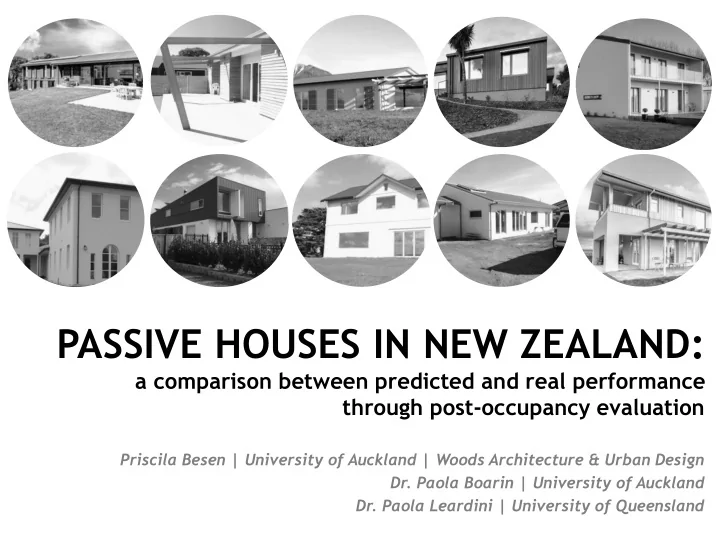
PASSIVE HOUSES IN NEW ZEALAND: a comparison between predicted and real performance through post-occupancy evaluation Priscila Besen | University of Auckland | Woods Architecture & Urban Design Dr. Paola Boarin | University of Auckland Dr.


slide-1
SLIDE 1

PASSIVE HOUSES IN NEW ZEALAND:

a comparison between predicted and real performance through post-occupancy evaluation

Priscila Besen | University of Auckland | Woods Architecture & Urban Design

  • Dr. Paola Boarin | University of Auckland
  • Dr. Paola Leardini | University of Queensland
slide-2
SLIDE 2

RESEARCH PROCESS

Master of Architecture in Sustainable Design

Overview of NZ housing stock performance

Conclusions, finding gaps and improvements for the future Qualitative Assessment Post-occupancy evaluation of two completed Passive Houses Analysis of all certified Passive Houses in NZ Analysis of existing building certification schemes in NZ Comparison with NZBC code- complying houses Quantitative Assessment Overview of Passive House worldwide & in NZ

slide-3
SLIDE 3

Post Occupancy Evaluation (POE)

“The process of evaluating buildings in a systematic and rigorous manner they have been built and occupied for some

  • time. POEs focus on

, and thus they provide insights into the consequences of past design decisions and the resulting building

  • performance. This knowledge

forms a sound basis for ”

Preiser, Rabinowitz, & White, 1988

slide-4
SLIDE 4

A B

Auckland Whanganui

slide-5
SLIDE 5

Auckland

A B

Whanganui

Completed in 2014 Passive House certification: In progress Homestar: 8/10 rating granted Construction: Timber framing with double layer of insulation 8kW Photovoltaic Panels Passive House certification: Granted Completed in 2014 Construction: Insulated Concrete Forms (ICF) 3kW Photovoltaic Panels

slide-6
SLIDE 6

TFA: 138m2 A/V Ratio: 0.79 A/TFA: 2.7 5 x 4 x 2 x 1 x TFA: 216m2 A/V ratio: 0.72 A/TFA: 3.1 4 x 4 x 2 x 2 x

A B

slide-7
SLIDE 7

Orientation

A

slide-8
SLIDE 8

Orientation

B

slide-9
SLIDE 9

A B

Ground Floor Upper Floor Ground Floor Upper Floor

slide-10
SLIDE 10

Comparison: Insulation

A B

slide-11
SLIDE 11

A B

Comparison: Window-to-wall Ratio

A B

slide-12
SLIDE 12

Quantitative Data Monitoring System

Sensors installed in different rooms+ Data transmission bridge Data: Ambient temperature Relative humidity Wall heat flow CO2 concentration Luminance Energy consumption and production

  • Data gathered every 15 minutes
  • Available online for homeowners and

researchers

  • Measurement procedures according

to ISO 7726 (1998)

  • All sensors positioned away from

windows to avoid direct sunlight

slide-13
SLIDE 13

Ground Floor Plan Upper Floor Plan

1 Outside 2 Garage 3 Living Room 4 Laundry – Air Exhaust 5 Bedroom East – Air Supply 6 Guest Bedroom 7 Guest Bedroom 8 Bedroom West 9 Upstairs Bedroom 10 Upstairs Bathroom

Quantitative Data Position of sensors

slide-14
SLIDE 14

Monitoring System

slide-15
SLIDE 15

A

Winter Peak Temperature

slide-16
SLIDE 16

A

Summer Peak Temperature

slide-17
SLIDE 17

Winter Peak Temperature

B

slide-18
SLIDE 18

Summer Peak Temperature

B

slide-19
SLIDE 19

Humidity – full period

A

slide-20
SLIDE 20

Qualitative Assessment

Interviews based on ISO 7730 Thermal sensation assessed retrospectively

slide-21
SLIDE 21

Qualitative Assessment

Key findings: Occupants felt comfortable in all seasons Health benefits – especially for children Superior indoor environment compared to their workplaces, previous houses and other buildings Occupants would like to have additional shading in summer

slide-22
SLIDE 22

Energy consumption and production

Annual Primary Energy Demand (total) Annual Primary Energy Demand per square metre

Passive House Limit:120kWh/m2a

A B

Percentage of energy provided by solar panels

slide-23
SLIDE 23

Comparison: Energy consumption

500 1000 1500 2000 2500 3000 Auckland Region Wellington/Whanganui Region

Housing Stock House A House B Housing stock energy consumption from HEEP (BRANZ): http://www.branz.co.nz/HEEP-energy- graphs/graphs.aspx Annual electricity consumption per person (kWh/occupant/year) Housing Stock

A B

slide-24
SLIDE 24

Comparison with New Zealand dwellings built after 1978

Housing stock temperatures from HEEP (BRANZ): http://www.branz.co.nz/HEEP-energy-graphs/graphs.aspx

10 12 14 16 18 20 22 24 26 28 30 0h 2h 4h 6h 8h 10h 12h 14h 16h 18h 20h 22h Temperature (oC)

Daily Temperature Profile - Bedrooms - Winter

NZ Housing Stock - Bedrooms House A - Bedrooms House B - Bedrooms

Comparison: Temperature

A B

slide-25
SLIDE 25

Comparison with New Zealand code-compliant houses built after the year 2000

Time-weighted temperature ranges for living rooms: Comparison between 15 code-compliant houses (left) and two Passive Houses (right). Based on Rosemeier (2014): Healthy and affordable housing in New Zealand: the role of ventilation.

Passive Houses

Comparison: Temperature

A B

slide-26
SLIDE 26

CONCLUSIONS

Real performance is very similar to simulation predicitions; Design choices and occupants’ behaviour have significant impact on performance; Passive House performance is confirmed to be highly superior in terms of energy and comfort when compared to housing stock; There is still scope for improving design and technical solutions; Health benefits are evident; Sun shading is key for achieving comfortable conditions indoors during summer; Next challenges are no longer to confirm that Passive Houses work well, but to investigate how to increase the number of houses built this way.

slide-27
SLIDE 27

FUTURE RESEARCH FOR PH IN NZ

Group builders Prefabrication Retrofitting existing housing stock Affordability Multi unit Passive Houses Life cycle assessment

slide-28
SLIDE 28

Priscila Besen The University of Auckland | Woods Architecture & Urban Design - Auckland priscila.besen@woods.co.nz

  • Dr. Paola Boarin

The University of Auckland | p.boarin@auckland.ac.nz

  • Dr. Paola Leardini

The University of Queensland | p.leardini@uq.edu.au

Thank You!