Parton Showers and Matching/Merging Lecture 2 of 2: Matching/Merging - - PowerPoint PPT Presentation

parton showers and matching merging
SMART_READER_LITE
LIVE PREVIEW

Parton Showers and Matching/Merging Lecture 2 of 2: Matching/Merging - - PowerPoint PPT Presentation

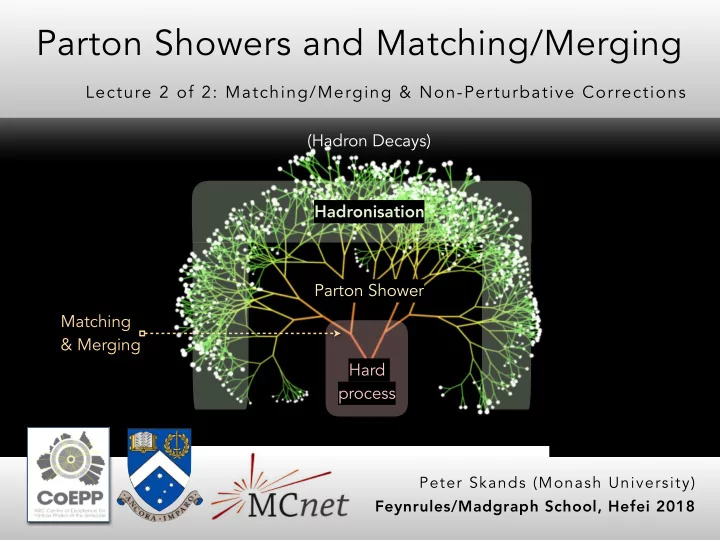
Parton Showers and Matching/Merging Lecture 2 of 2: Matching/Merging & Non-Perturbative Corrections (Hadron Decays) Hadronisation Parton Shower Matching & Merging Hard process Peter Skands (Monash University) Feynrules/Madgraph


slide-1
SLIDE 1

Parton Showers and Matching/Merging

Lecture 2 of 2: Matching/Merging & Non-Perturbative Corrections

Peter Skands (Monash University) Feynrules/Madgraph School, Hefei 2018

Hard process Parton Shower Hadronisation (Hadron Decays) Matching & Merging

slide-2
SLIDE 2

So combine them!

SHOWERS VS MATRIX ELEMENTS

Peter Skands

  • 2

Monash University

๏Showers. Nice to have all-orders solution
  • But only exact in singular (soft & collinear) limits
  • → gets bulk of bremsstrahlung corrections right, but no

precision for hard wide-angle radiation: visible, extra jets

  • … which is exactly where fixed-order (ME) calculations work!

See also: PS, Introduction to QCD, TASI 2012, arXiv:1207.2389

F @ LO×LL

` (loops) 2

(2) (2)

1

. . .

1

(1) (1)

1

(1)

2

. . . (0) (0)

1

(0)

2

(0)

3

. . .

1 2 3

. . .

k (legs)

+

F+1 @ LO×LL

` (loops) 2

(2) (2)

1

. . .

1

(1) (1)

1

(1)

2

. . . (0) (0)

1

(0)

2

(0)

3

. . .

1 2 3

. . .

k (legs)

= ? =

F & F+1 @ LO×LL

` (loops) 2

(2) (2)

1

. . .

1

(1) (1)

1

(1)

2

. . . (0) (0)

1

(0)

2

(0)

3

. . .

1 2 3

. . .

k (legs)

Matching

slide-3
SLIDE 3

HOW NOT TO DO IT … IN MORE DETAIL

Peter Skands

  • 3

Monash University

► A (Complete Idiot’s) Solution – Combine

  • 1. [X]ME + showering
  • 2. [X + 1 jet]ME + showering
  • 3. …

► Doesn’t work

  • [X] + shower is inclusive
  • [X+1] + shower is also inclusive

Run generator for X (+ shower) Run generator for X+1 (+ shower) Run generator for … (+ shower) Combine everything into one sample What you get What you want Overlapping “bins” One sample

slide-4
SLIDE 4

EXAMPLE: .

Peter Skands

  • 4

Monash University

Born + Shower Born + 1 @ LO

2 2

+

+

2

Shower Approximation to Born + 1

+ …

What you get from first-order (LO) madgraph What the first-order shower expansion gives you

slide-5
SLIDE 5

Born + Shower Born + 1 @ LO

1

EXAMPLE: .

Peter Skands

  • 5

Monash University

2

+= g2

s 2CF

 2sik sijsjk + 1 sIK ✓ sij sjk + sjk sij ◆ = g2

s 2CF

 2sik sijsjk + 1 sIK ✓ sij sjk + sjk sij + 2 ◆ Total Overkill to add these two. All we really need is just that +2 …

2

+ …

Example of shower kernel (here, used an “antenna function” for coherent gluon emission from a quark pair) Example of matrix element; what MG would give you

slide-6
SLIDE 6
  • 1. MATRIX-ELEMENT CORRECTIONS

Peter Skands

  • 6

Monash University

๏Exploit freedom to choose non-singular terms
  • Modify parton shower to use process-dependent radiation functions for

first emission → absorb real correction

Process-dependent MEC → P’ different for each process

  • Done in PYTHIA for all SM decays and many BSM ones

Based on systematic classification of spin/colour structures

Also used to account for mass effects, and for a few 2→2 procs

๏Difficult to generalise beyond one emission
  • Parton-shower expansions complicated & can have “dead zones”
  • Achieved in VINCIA (by devising showers that have simple expansions)
  • Only recently done for hadron collisions

Bengtsson, Sjöstrand, PLB 185 (1987) 435 Norrbin, Sjöstrand, NPB 603 (2001) 297

Parton Shower P(z) Q2 → P 0(z) Q2 = P(z) Q2 |Mn+1|2 P

i Pi(z)/Q2 i |Mn|2

| {z }

MEC Giele, Kosower, Skands, PRD 84 (2011) 054003

(suppressing αs and Jacobian factors)

Fischer et al, arXiv:1605.06142

slide-7
SLIDE 7

MECS WITH LOOPS: POWHEG

Peter Skands

  • 7

Monash University

Legs Loops +0 +1 +2 +0 +1 +2 +3

|MF|2

Generate “shower” emission

|MF+1|2 LL ∼ X

i∈ant

ai |MF|2

Correct to Matrix Element Unitarity of Shower

P | | Virtual = − Z Real

Correct to Matrix Element

Z |MF|2 → |MF|2 + 2Re[M 1

FM 0 F] +

Z Real

X

ai → |MF+1|2 P ai|MF|2 ai

R e p e a t :

  • r

d i n a r y p a r t

  • n

s h

  • w

e r

Start at Born level

Nason, JHEP 0411 (2004) 040 Frixione, Nason, Oleari JHEP 0711 (2007) 070 + POWHEG Box JHEP 1006 (2010) 043

Acronym stands for: Positive Weight Hardest Emission Generator.

Note: still LO for X+1 Shower for X+2, …

๏Method is widely applied/available, can be used

with PYTHIA, HERWIG, SHERPA

๏Subtlety 1: Connecting with parton shower
  • Truncated Showers & Vetoed Showers
๏Subtlety 2: Avoiding (over)exponentiation of

hard radiation

  • Controlled by “hFact” parameter (POWHEG)
slide-8
SLIDE 8

2: SLICING (MLM & CKKW-L)

Peter Skands

  • 8

Monash University

First emission: “the HERWIG correction”

Use the fact that the angular-ordered HERWIG parton shower has a “dead zone” for hard wide-angle radiation (Seymour, 1995)

! !

F @ LO×LL-Soft (HERWIG Shower)

` (loops) 2

(2) (2)

1

. . .

1

(1) (1)

1

(1)

2

. . . (0) (0)

1

(0)

2

(0)

3

. . .

1 2 3

. . .

k (legs)

+

F+1 @ LO×LL (HERWIG Corrections)

` (loops) 2

(2) (2)

1

. . .

1

(1) (1)

1

(1)

2

. . . (0) (0)

1

(0)

2

(0)

3

. . .

1 2 3

. . .

k (legs)

=

F @ LO1×LL (HERWIG Matched)

` (loops) 2

(2) (2)

1

. . .

1

(1) (1)

1

(1)

2

. . . (0) (0)

1

(0)

2

(0)

3

. . .

1 2 3

. . .

k (legs)

Many emissions: the MLM & CKKW-L prescriptions

F @ LO×LL-Soft (excl)

` (loops) 2

(2) . . .

1

(1) (1)

1

. . . (0) (0)

1

(0)

2

1 2 k (legs)

+

F+1 @ LO×LL-Soft (excl)

` (loops) 2

(2) . . .

1

(1) (1)

1

. . . (0) (0)

1

(0)

2

1 2 k (legs)

+

F+2 @ LO×LL (incl)

` (loops) 2

(2) . . .

1

(1) (1)

1

. . . (0) (0)

1

(0)

2

1 2 k (legs)

=

F @ LO2×LL (MLM & (L)-CKKW)

` (loops) 2

(2) . . .

1

(1) (1)

1

. . . (0) (0)

1

(0)

2

1 2 k (legs)

(Mangano, 2002) (CKKW & Lönnblad, 2001) (+many more recent; see Alwall et al., EPJC53(2008)473)

slide-9
SLIDE 9

THE GAIN THE COST

Peter Skands

  • 9

Monash University

W + N jets

RATIO

Plot from mcplots.cern.ch; see arXiv:1306.3436 Shower (w 1st order MECs)

MLM w 3rd order Matrix Elements

NJETS 1 2 3 Example: LHC7 : W + 20-GeV Jets

0.1s 1s 10s 100s 1000s

Z→n : Number of Matched Emissions

2 3 4 5 6

SHERPA (CKKW-L)

  • 2. Time to generate 1000 events

(Z → partons, fully showered &

  • matched. No hadronization.)

1000 SHOWERS

See e.g. Lopez-Villarejo & Skands, arXiv:1109.3608

Time Matching Order Example: e+e- → Z → Jets

slide-10
SLIDE 10

3: SUBTRACTION

Peter Skands

  • 10

Monash University

๏LO × Shower ๏NLO

X(2) X+1(2) … X(1) X+1(1) X+2(1) X+3(1) … Born X+1(0) X+2(0) X+3(0) … … …

Fixed-Order Matrix Element Shower Approximation

X(2) X+1(2) … X(1) X+1(1) X+2(1) X+3(1) … Born X+1(0) X+2(0) X+3(0) … Examples: MC@NLO, aMC@NLO

slide-11
SLIDE 11

MATCHING 3: SUBTRACTION

Peter Skands

  • 11

Monash University

๏LO × Shower ๏NLO - ShowerNLO

X(2) X+1(2) … X(1) X+1(1) X+2(1) X+3(1) … Born X+1(0) X+2(0) X+3(0) … … …

Fixed-Order Matrix Element Shower Approximation

Fixed-Order ME minus Shower Approximation (NOTE: can be < 0!)

X(2) X+1(2) … X(1) X+1(1) X+2(1) X+3(1) … Born X+1(0) X+2(0) X+3(0) …

Expand shower approximation to NLO analytically, then subtract:

Examples: MC@NLO, aMC@NLO

slide-12
SLIDE 12

MATCHING 3: SUBTRACTION

Peter Skands

  • 12

Monash University

๏LO × Shower ๏(NLO - ShowerNLO) × Shower

X(2) X+1(2) … X(1) X+1(1) X+2(1) X+3(1) … Born X+1(0) X+2(0) X+3(0) … … …

Fixed-Order Matrix Element Shower Approximation

Fixed-Order ME minus Shower Approximation (NOTE: can be < 0!)

X(1) X(1) … X(1) X(1) X(1) X(1) … Born X+1(0) X(1) X(1) … …

Subleading corrections generated by shower off subtracted ME

Examples: MC@NLO, aMC@NLO

slide-13
SLIDE 13

MATCHING 3: SUBTRACTION

Peter Skands

  • 13

Monash University

๏Combine ➤ MC@NLO
  • Consistent NLO + parton shower (though correction events can have w<0)
  • Recently, has been fully automated in aMC@NLO

X(2) X+1(2) … X(1) X+1(1) X+2(1) X+3(1) … Born X+1(0) X+2(0) X+3(0) …

NB: w < 0 are a problem because they kill efficiency: Extreme example: 1000 positive-weight - 999 negative-weight events → statistical precision

  • f 1 event, for 2000 generated (for comparison, normal MC@NLO has ~ 10% neg-weights)

Frederix, Frixione, Hirschi, Maltoni, Pittau, Torrielli, JHEP 1202 (2012) 048 Frixione, Webber, JHEP 0206 (2002) 029

Examples: MC@NLO, aMC@NLO

slide-14
SLIDE 14

POWHEG VS MC@NLO

Peter Skands

  • 14

Monash University

๏Both methods include the complete

first-order (NLO) matrix elements.

  • Difference is in whether only the

shower kernels are exponentiated (MC@NLO) or whether part of the matrix-element corrections are too (POWHEG)

๏In POWHEG, how much of the MEC

you exponentiate can be controlled by the “hFact” parameter

  • Variations basically span range

between MC@NLO-like case, and

  • riginal (hFact=1) POWHEG case (~

PYTHIA-style MECs)

50 100 150 200 250 300 350 400 pH

T (GeV)

10−4 10−3 10−2 10−1 100 101

dσ dpH

T (pb/GeV)

no damping no damping, LHEF h = mH/1.2 GeV h = mH/2 GeV h = 30 GeV h = 30 GeV, LHEF NLO

Plot from Bagnashi, Vicini, JHEP 1601 (2016) 056

Dh = h2 h2 + (pH

⊥)2

Rs = Dh Rdiv , Rf = (1 Dh) Rdiv .

Example: Higgs Production

exponentiated not exponentiated

No Damping Pure NLO

slide-15
SLIDE 15

(MULTI-LEG MERGING AT NLO)

Peter Skands

  • 15

Monash University

๏Currently, much activity on how to combine several NLO matrix

elements for the same process: NLO for X, X+1, X+2, …

  • Unitarity is a common main ingredient for all of them
  • Most also employ slicing (separating phase space into regions defined by
  • ne particular underlying process)
๏Methods
  • UNLOPS, generalising CKKW-L/UMEPS: Lonnblad, Prestel, arXiv:1211.7278
  • MiNLO, based on POWHEG: Hamilton, Nason, Zanderighi (+more)
  • FxFx, based on MC@NLO: Frederix & Frixione, arXiv:1209.6215
  • (VINCIA, based on NLO MECs): Hartgring, Laenen, Skands, arXiv:1303.4974
๏Most (all?) of these also allow NNLO on total inclusive cross section
  • Will soon define the state-of-the-art for SM processes
  • For BSM, the state-of-the-art is generally one order less than SM
  • arXiv:1206.3572,
  • arXiv:1512.02663
slide-16
SLIDE 16

SUMMARY: MATCHING AND MERGING

Peter Skands

  • 16

Monash University

๏The Problem:
  • Showers generate singular parts of (all) higher-order matrix elements
  • Those terms are of course also present in X + jet(s) matrix elements
  • To combine, must be careful not to count them twice! (double counting)
๏3 Main Methods
  • 1. Matrix-Element Corrections (MECs): multiplicative correction factors

Pioneered in PYTHIA (mainly for real radiation ➠ LO MECs)

Similar method used in POWHEG (with virtual corrections ➠ NLO)

Generalised to multiple branchings: VINCIA

  • 2. Slicing: separate phase space into two regions: ME populates high-Q

region, shower populates low-Q region (and calculates Sudakov factors)

CKKW-L (pioneered by SHERPA) & MLM (pioneered by ALPGEN)

  • 3. Subtraction: MC@NLO, now automated: aMC@NLO
๏State-of-the-art ➤ Multi-Leg NLO (UNLOPS, MiNLO, FxFx)
slide-17
SLIDE 17

QUIZ: CONNECT THE BOXES

Peter Skands

  • 17

Monash University

Matrix-Element Corrections (MECs) CKKW-L & MLM MC@NLO

A B C

Ambiguity about how much of the nonsingular parts of the ME that get exponentiated; controlled by:

hFact

Procedure can lead to a substantial fraction of events having:

Negative Weights

Ambiguity about definition of which events “count” as hard N-jet events; controlled by:

Merging Scale

1 2 3 ? ? ?

slide-18
SLIDE 18

FROM PARTONS TO PIONS

Peter Skands

18

Monash University

Here’s a fast parton

It showers (bremsstrahlung) It ends up at a low effective factorization scale Q ~ mρ ~ 1 GeV Fast: It starts at a high factorization scale Q = QF = Qhard

Qhard 1 GeV Q

slide-19
SLIDE 19

Q

FROM PARTONS TO PIONS

Peter Skands

19

Monash University

Here’s a fast parton

How about I just call it a hadron?

→ “Local Parton-Hadron Duality” Qhard 1 GeV

It showers (bremsstrahlung) It ends up at a low effective factorization scale Q ~ mρ ~ 1 GeV Fast: It starts at a high factorization scale Q = QF = Qhard

slide-20
SLIDE 20

PARTON → HADRONS?

Peter Skands

20

Monash University

q π π π

๏Early models: “Independent Fragmentation”
  • Local Parton Hadron Duality (LPHD) can give useful results for

inclusive quantities in collinear fragmentation

  • Motivates a simple model:
๏But …
  • The point of confinement is that partons are coloured
  • Hadronisation = the process of colour neutralisation

→ Unphysical to think about independent fragmentation of a single parton into hadrons

→ Too naive to see LPHD (inclusive) as a justification for Independent Fragmentation (exclusive)

→ More physics needed

“Independent Fragmentation”

slide-21
SLIDE 21

COLOUR NEUTRALISATION

Peter Skands

21

Monash University

Space Time

Early times (perturbative) Late times (non-perturbative)

Strong “confining” field emerges between the two charges when their separation > ~ 1fm

anti-R moving along right lightcone R m

  • v

i n g a l

  • n

g l e f t l i g h t c

  • n

e

pQCD

non-perturbative

A physical hadronization model

  • Should involve at least TWO partons, with opposite

color charges (e.g., R and anti-R)

slide-22
SLIDE 22

THE ULTIMATE LIMIT: WAVELENGTHS > 10-15 M

Peter Skands

  • 22

Monash University

๏Quark-Antiquark Potential
  • As function of separation distance

46 STATIC QUARK-ANTIQUARK

POTENTIAL:

  • SCALING. . .

2641

Scaling plot

2GeV-

1 GeV—

2

I
  • 2
k, t

0.5

1.

5

1 fm

2.5

l~

RK

B= 6.0, L=16 B= 6.0, L=32 B= 6.2, L=24 B= 6.4, L-24

B = 6.4, L=32

3.

5

~ 'V ~ ~ I ~ A I

4 2'

  • FIG. 4. All potential

data of the five lattices have been scaled to a universal curve by subtracting

Vo and measuring

energies and distances

in appropriate units of &E. The dashed curve correspond

to V(R)=R —

~/12R. Physical units are calculated

by exploit- ing the relation &cr =420 MeV.

AM~a=46. 1A~ &235(2)(13) MeV .

Needless

to say, this value does not necessarily

apply to full QCD.

In addition

to the long-range

behavior of the confining potential it is of considerable interest to investigate its ul- traviolet

structure. As we proceed into the weak cou-

pling regime lattice simulations

are expected to meet per-

turbative results. Although

we are aware that our lattice

resolution is not yet really

suScient,

we might

dare to

previe~ the

continuum behavior

  • f the

Coulomb-like term from our results.

In Fig. 6(a) [6(b)] we visualize the

confidence regions

in the K-e plane from fits to various

  • n- and off-axis potentials
  • n the 32

lattices at P=6.0

[6.4]. We observe that the impact of lattice discretization

  • n e decreases by a factor 2, as we step up from P=6.0 to

150 140

Barkai '84

  • MTC

'90

Our results:---

130-

120-

110-

100-

80—

5.6 5.8

6.2 6.4

  • FIG. 5. The on-axis string tension

[in units of the quantity

c =&E /(a AL )] as a function of P. Our results are combined

with pre- vious values obtained by the MTc collaboration

[10]and Barkai, Moriarty,

and Rebbi [11].

~ Force required to lift a 16-ton truck

LATTICE QCD SIMULATION. Bali and Schilling Phys Rev D46 (1992) 2636

What physical! system has a ! linear potential?

Short Distances ~ “Coulomb”

“Free” Partons

Long Distances ~ Linear Potential

“Confined” Partons (a.k.a. Hadrons)

(in “quenched” approximation)
slide-23
SLIDE 23

FROM PARTONS TO STRINGS

Peter Skands

23

Monash University

๏Motivates a model:
  • Let color field collapse into

a (infinitely) narrow flux tube of uniform energy density κ ~ 1 GeV / fm

  • → Relativistic 1+1

dimensional worldsheet

Pedagogical Review: B. Andersson, The Lund model.

  • Camb. Monogr. Part. Phys. Nucl. Phys. Cosmol., 1997.

String Schwinger Effect + ÷ Non-perturbative creation

  • f e+e- pairs in a strong

external Electric field

~ E

e- e+

P ∝ exp ✓−m2 − p2

κ/π ◆

Probability from Tunneling Factor

(κ is the string tension equivalent)

๏In “unquenched” QCD
  • g→qq → The strings will break

→ Gaussian pT spectrum Heavier quarks suppressed. Prob(q=d,u,s,c) ≈ 1 : 1 : 0.2 : 10-11

slide-24
SLIDE 24

(NOTE ON THE LENGTH OF STRINGS)

Peter Skands

24

Monash University

๏In Space:
  • String tension ≈ 1 GeV/fm → a 5-GeV quark can travel 5 fm before all its

kinetic energy is transformed to potential energy in the string.

  • Then it must start moving the other way. String breaks will have happened

behind it → yo-yo model of mesons

๏In Rapidity :

y = 1 2 ln ✓E + pz E − pz ◆ = 1 2 ln ✓(E + pz)2 E2 − p2

z

ymax ∼ ln ✓2Eq mπ ◆

For a pion with z=1 along string direction (For beam remnants, use a proton mass):

Note: Constant average hadron multiplicity per unit y → logarithmic growth of total multiplicity

slide-25
SLIDE 25

THE (LUND) STRING MODEL

Peter Skands

25

Monash University

Map:

  • Quarks → String

Endpoints

  • Gluons → Transverse

Excitations (kinks)

  • Physics then in terms of

string worldsheet evolving in spacetime

  • Probability of string

break (by quantum tunneling) constant per unit area → AREA LAW

Simple space-time picture

Details of string breaks more complicated (e.g., baryons, spin multiplets)

→ STRING EFFECT

slide-26
SLIDE 26

DIFFERENCES BETWEEN QUARK AND GLUON JETS

Peter Skands

  • 26

Monash University

[GeV]

T

Jet p 500 1000 1500 〉

charged

n 〈 20 ATLAS

= 8 TeV s = 20.3

int

L

> 0.5 GeV

track T

p

Quark Jets (Data) Gluon Jets (Data) Quark Jets (Pythia 8 AU2) Gluon Jets (Pythia 8 AU2) LO pQCD

3

Quark Jets N LO pQCD

3

Gluon Jets N

quark antiquark gluon string motion in the event plane (without breakups)

Gluon connected to two string pieces Each quark connected to one string piece → expect factor 2 ~ CA/CF larger particle multiplicity in gluon jets vs quark jets Can be hugely important for discriminating new-physics signals (decays to quarks vs decays to gluons, vs composition of background and bremsstrahlung combinatorics ) Recent “hot topic”: Q/G Discrimination

ATLAS, Eur.Phys.J. C76 (2016) no.6, 322 See also Larkoski et al., JHEP 1411 (2014) 129 Thaler et al., Les Houches, arXiv:1605.04692

slide-27
SLIDE 27

➤ EVENT GENERATORS

Peter Skands

  • 27

Monash University

๏Aim: generate events in as much detail as mother nature
  • → Make stochastic choices ~ as in Nature (Q.M.) → Random numbers
  • Factor complete event probability into separate universal pieces, treated

independently and/or sequentially (Markov-Chain MC)

๏Improve lowest-order (perturbation) theory by including ‘most

significant’ corrections

  • Resonance decays (e.g., t→bW+, W→qq’, H0→γ0γ0, Z0→μ+μ-, …)
  • Bremsstrahlung (FSR and ISR, exact in collinear and soft* limits)
  • Hard radiation (matching & merging)
  • Hadronization (strings / clusters)
  • Additional Soft Physics: multiple parton-parton interactions, Bose-Einstein

correlations, colour reconnections, hadron decays, …

๏Coherence*
  • Soft radiation → Angular ordering or Coherent Dipoles/Antennae