Solving Recurrences Finding a closed form (two approaches, there are - - PowerPoint PPT Presentation

solving recurrences
SMART_READER_LITE
LIVE PREVIEW

Solving Recurrences Finding a closed form (two approaches, there are - - PowerPoint PPT Presentation

Announcements: PA1 available, due 01/28, 11:59p. HW2 out soon, due 10/04, 11:59p. TODAY: Merge Sort, general sorting discussion A divide and conquer algorithm. 1. If the array has 0 or 1 elements, its sorted. Stop. 2. Split the array


slide-1
SLIDE 1

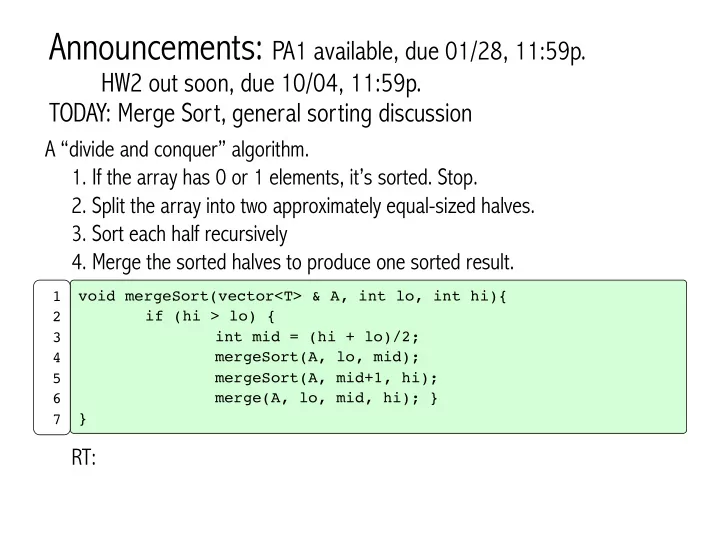
Announcements: PA1 available, due 01/28, 11:59p.

HW2 out soon, due 10/04, 11:59p. TODAY: Merge Sort, general sorting discussion

A “divide and conquer” algorithm.

  • 1. If the array has 0 or 1 elements, it’s sorted. Stop.
  • 2. Split the array into two approximately equal-sized halves.
  • 3. Sort each half recursively
  • 4. Merge the sorted halves to produce one sorted result.

RT:

1 2 3 4 5 6 7 void mergeSort(vector<T> & A, int lo, int hi){ if (hi > lo) { int mid = (hi + lo)/2; mergeSort(A, lo, mid); mergeSort(A, mid+1, hi); merge(A, lo, mid, hi); } }

slide-2
SLIDE 2

Solving Recurrences

Finding a closed form (two approaches, there are others): 1) Expand and generalize:

slide-3
SLIDE 3

Finding a closed form (two approaches, there are others): 2) Recursion Tree:

slide-4
SLIDE 4

Proving the closed form is correct: Thm: ∀𝑜 ≥ 1, 𝑈 𝑜 ≤ 𝑑𝑜 log 𝑜 + 𝑐𝑜.

slide-5
SLIDE 5

MergeSort Correctness:

7 1 6 4 5 3 2 8

1 2 3 4 5 6 7 void mergeSort(vector<T> & A, int lo, int hi){ if (hi > lo) { int mid = (hi + lo)/2; mergeSort(A, lo, mid); mergeSort(A, mid+1, hi); merge(A, lo, mid, hi); } }

Call MergeSort: mergeSort(A, 0, A.size()-1);

slide-6
SLIDE 6

MergeSort Correctness continued:

To contemplate: does the value of mid matter in the correctness proof? does the value of mid matter in the analysis of the runtime?

slide-7
SLIDE 7

Where are we in the sorting picture?

Best Case Average Case Worst Case Insertion Selection Merge

https://www.toptal.com/developers/sorting-algorithms

slide-8
SLIDE 8

Complexity of the Sorting Problem:

The complexity of a problem is the runtime of the fastest algorithm for that problem. We'll only consider comparison-based algorithms. They can compare two array elements in constant time. They cannot manipulate array elements in any other way. For example, they cannot assume that the elements are numbers and perform arithmetic operations (like division) on them. Insertion, Merge, Quick, Radix, Selection