SLIDE 1
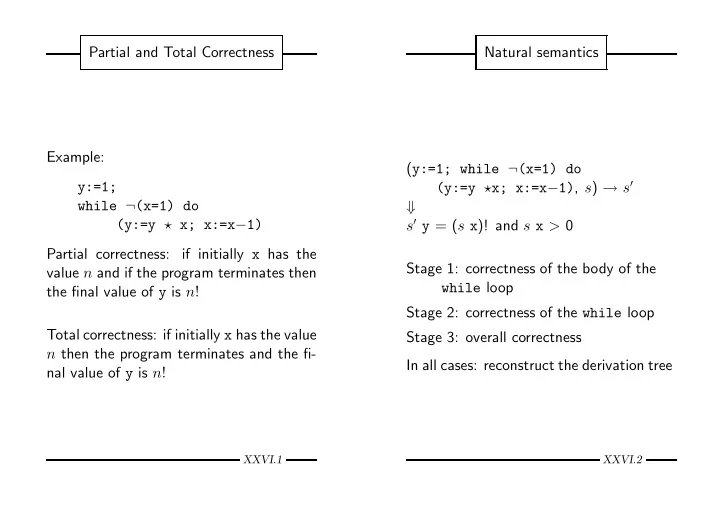
Partial and Total Correctness Example: y:=1; while ¬(x=1) do (y:=y ⋆ x; x:=x−1) Partial correctness: if initially x has the value n and if the program terminates then the final value of y is n! Total correctness: if initially x has the value n then the program terminates and the fi- nal value of y is n!
XXVI.1
Natural semantics (y:=1; while ¬(x=1) do (y:=y ⋆x; x:=x−1), s) → s′ ⇓ s′ y = (s x)! and s x > 0 Stage 1: correctness of the body of the while loop Stage 2: correctness of the while loop Stage 3: overall correctness In all cases: reconstruct the derivation tree
XXVI.2
SLIDE 2
Stage 1 (y:=y⋆x; x:=x−1, s) → s′′ and s′′ x > 0 ⇓ (s y)⋆(s x)!=(s′′ y)⋆(s′′ x)! and s x > 0 Proof: (y:=y⋆x; x:=x−1, s) → s′′ ⇓ (y:=y⋆x, s) → s′, (x:=x−1, s′) → s′′ ⇓ s′ = s[y→A[y⋆x]s] s′′ = s′[x→A[x−1]s′] If s′′ x > 0 then (s′′ y) ⋆ (s′′ x)! = ((s y) ⋆ (s x)) ⋆ ((s x)−1)! = (s y) ⋆ (s x)! and s x = s′′ x + 1 > 0
XXVI.3
Stage 2 (while ¬(x=1) do (y:=y⋆x; x:=x−1), s) → s′ ⇓ (s y) ⋆ (s x)! = s′ y, s′ x = 1, s x > 0 Proof: If B[¬(x=1)]s = ff then s = s′ so s′ x = 1 and the result follows. If B[¬(x=1)]s = tt then (y:=y⋆x; x:=x−1, s) → s′′ (while ¬(x=1) do (y:=y⋆x; x:=x−1), s′′) → s′ We have (s y) ⋆ (s x)! = (s′′ y) ⋆ (s′′ x)!, s x > 0 (s′′ y) ⋆ (s′′ x)! = s′ y, s′ x = 1, s′′ x > 0 so (s y) ⋆ (s x)! = s′ y, s′ x = 1, s x > 0
XXVI.4
SLIDE 3
Stage 3 (y:=1; while ¬(x=1) do (y:=y⋆x; x:=x−1), s) → s′ ⇓ s′ y = (s x)! and s x > 0 Proof: (y:=1; while ¬(x=1) do (y:=y⋆x; x:=x−1), s) → s′ ⇓ (y:=1, s) → s′′ (while ¬(x=1) do (y:=y⋆x; x:=x−1), s′′) → s′ ⇓ s′′ = s[y→1] (s′′ y) ⋆ (s′′ x)! = s′ y, s′ x = 1, s′′ x > 0 ⇓ s′ y = (s x)! and s x > 0
XXVI.5
Structural operational semantics (y:=1; while ¬(x=1) do (y:=y⋆x; x:=x−1), s) ⇒∗ s′ ⇓ s′ y = (s x)! and s x > 0 Stage 1: correctness of the while loop Stage 2: overall correctness In both cases: reconstruct the derivation sequence
XXVI.6
SLIDE 4 Denotational semantics ψfac(S[y:=1; while ¬(x=1) do (y:=y⋆x; x:=x−1)]) = tt ψfac: (State ֒ → State) → T ψfac(g) = tt
- g s = s′ implies s′ y = (s x)! and s x > 0
XXVI.7
Fixed Point Induction Let (D,⊑) be a ccpo. Then ψ: D → T is an admissible predicate if and only if ψ d = tt for all d ∈ Y ⇓ ψ(
Y ) = tt
for every chain Y in D. Theorem 6.5: Let (D,⊑) be a ccpo and let f: D → D be a continuous function and let ψ be an admissible predicate on D. If for all d ∈ D ψ d = tt implies ψ(f d) = tt then ψ(FIX f) = tt.
XXVI.8
SLIDE 5 Example (1) Define ψ′
fac(g) = tt
- g s = s′ implies s′ y = (s y)⋆(s x)!, s x>0
Then ψ′
fac is an admissible predicate.
Proof: Assume Y is a chain in State ֒ → State and ψ′
fac g = tt for all g ∈ Y .
We shall prove ψ′
fac( Y ) = tt
(
Y ) s = s′
⇓ g s = s′ for some g ∈ Y ⇓ s′ y = (s y) ⋆ (s x)! and s x > 0
XXVI.9
Example (2) S[y:=1; while ¬(x=1) do (y:=y⋆x; x:=x−1)]s = (FIX F)(s[y→1]) where F g s =
s if s x = 1 g(s[y→(s y)⋆(s x)][x→(s x)−1])
ψfac(S[y:=1; while ¬(x=1) do (y:=y⋆x; x:=x−1)]) = tt
fac(FIX F) = tt
From Theorem 6.5 it is sufficient to prove
fac is admissible
fac g = tt implies ψ′ fac(F g) = tt
XXVI.10
SLIDE 6
Example (3) Assume ψ′
fac g = tt and (F g) s = s′.
We shall prove s′ y = (s y) ⋆ (s x)! and s x > 0. If s x = 1 then s = s′, s y = (s y) ⋆ (s x)! and s x > 0. If s x = 1 then (F g) s = g(s[y→(sy)⋆(sx)][x→(sx)−1]) From the assumptions about g we have s′ y = ((s y)⋆(s x))⋆((s x)−1)! (s x)−1>0 and therefore s′ y = (s y) ⋆ (s x)! and s x > 0
XXVI.11
Proof of Theorem 6.5 We shall first note that ψ ⊥ = tt holds by admissibility of ψ applied to the chain Y = ∅ By induction on n we can then show that ψ(fn ⊥) = tt using the assumptions of the theorem. By admissibility of ψ applied to the chain Y = { fn ⊥ | n ≥ 0 } we then have ψ(FIX f) = tt This completes the proof.
XXVI.12