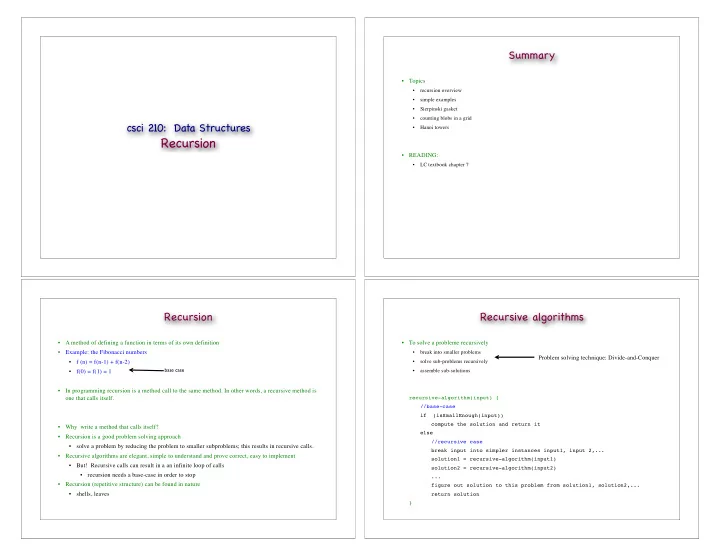

SLIDE 1
csci 210: Data Structures
Recursion
Summary
- Topics
- recursion overview
- simple examples
- Sierpinski gasket
- counting blobs in a grid
- Hanoi towers
- READING:
- LC textbook chapter 7
Recursion
- A method of defining a function in terms of its own definition
- Example: the Fibonacci numbers
- f (n) = f(n-1) + f(n-2)
- f(0) = f(1) = 1
- In programming recursion is a method call to the same method. In other words, a recursive method is
- ne that calls itself.
- Why write a method that calls itself?
- Recursion is a good problem solving approach
- solve a problem by reducing the problem to smaller subproblems; this results in recursive calls.
- Recursive algorithms are elegant, simple to understand and prove correct, easy to implement
- But! Recursive calls can result in a an infinite loop of calls
- recursion needs a base-case in order to stop
- Recursion (repetitive structure) can be found in nature
- shells, leaves
base case
Recursive algorithms
- To solve a probleme recursively
- break into smaller problems
- solve sub-problems recursively
- assemble sub-solutions
recursive-algorithm(input) { //base-case if (isSmallEnough(input)) compute the solution and return it else //recursive case break input into simpler instances input1, input 2,... solution1 = recursive-algorithm(input1) solution2 = recursive-algorithm(input2) ... figure out solution to this problem from solution1, solution2,... return solution }
Problem solving technique: Divide-and-Conquer