Part I (B) Find the hidden parameter! (Fixed parameter tractable - - PowerPoint PPT Presentation

part i
SMART_READER_LITE
LIVE PREVIEW

Part I (B) Find the hidden parameter! (Fixed parameter tractable - - PowerPoint PPT Presentation

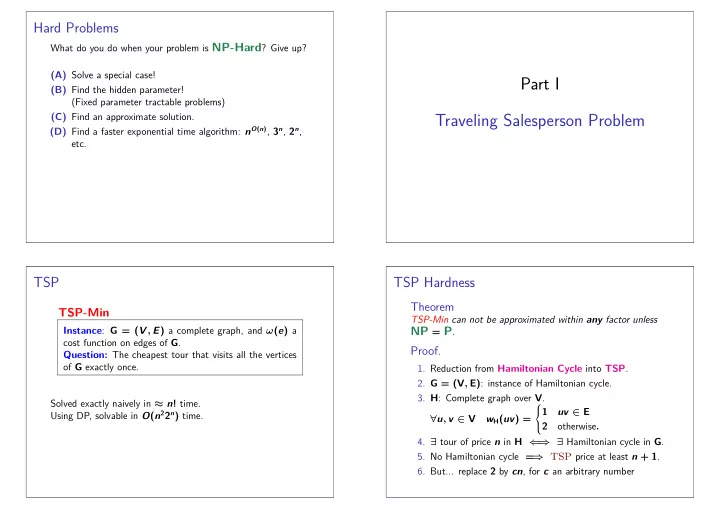
Hard Problems What do you do when your problem is NP-Hard ? Give up? (A) Solve a special case! Part I (B) Find the hidden parameter! (Fixed parameter tractable problems) (C) Find an approximate solution. Traveling Salesperson Problem (D) Find a


slide-1
SLIDE 1

Hard Problems

What do you do when your problem is NP-Hard? Give up? (A) Solve a special case! (B) Find the hidden parameter! (Fixed parameter tractable problems) (C) Find an approximate solution. (D) Find a faster exponential time algorithm: nO(n), 3n, 2n, etc.

Part I Traveling Salesperson Problem

TSP

TSP-Min

Instance: G = (V, E) a complete graph, and ω(e) a cost function on edges of G. Question: The cheapest tour that visits all the vertices

  • f G exactly once.

Solved exactly naively in ≈ n! time. Using DP, solvable in O(n22n) time.

TSP Hardness

Theorem

TSP-Min can not be approximated within any factor unless

NP = P. Proof.

  • 1. Reduction from Hamiltonian Cycle into TSP.
  • 2. G = (V, E): instance of Hamiltonian cycle.
  • 3. H: Complete graph over V.

∀u, v ∈ V wH(uv) =

  

1 uv ∈ E 2

  • therwise.
  • 4. ∃ tour of price n in H ⇐

⇒ ∃ Hamiltonian cycle in G.

  • 5. No Hamiltonian cycle =

⇒ TSP price at least n + 1.

  • 6. But... replace 2 by cn, for c an arbitrary number
slide-2
SLIDE 2

TSP Hardness - proof continued

Proof.

  • 1. Price of all tours are either:

(i) n (only if ∃ Hamiltonian cycle in G), (ii) larger than cn + 1 (actually, ≥ cn + (n − 1)).

  • 2. Suppose you had a poly time c-approximation to

TSP-Min.

  • 3. Run it on H:

(i) If returned value ≥ cn + 1 = ⇒ no Ham Cycle since (cn + 1)/c > n (ii) If returned value ≤ cn = ⇒ Ham Cycle since OPT ≤ cn < cn + 1

  • 4. c-approximation algorithm to TSP =

⇒ poly-time algorithm for NP-Complete problem. Possible only if

P = NP.

TSP with the triangle inequality

Because it is not that bad after all.

TSP△=-Min

Instance: G = (V, E) is a complete graph. There is also a cost function ω(·) defined over the edges of G, that complies with the triangle inequality. Question: The cheapest tour that visits all the vertices

  • f G exactly once.

triangle inequality: ω(·) if ∀u, v, w ∈ V(G) , ω(u, v) ≤ ω(u, w) + ω(w, v) .

Shortcutting

σ: a path from s to t in G = ⇒ ω(st) ≤ ω(σ).

TSP with the triangle inequality

Continued...

Definition

Cycle in G is Eulerian if it visits every edge of G exactly once. Assume you already seen the following:

Lemma

A graph G has a cycle that visits every edge of G exactly once (i.e., an Eulerian cycle) if and only if G is connected, and all the vertices have even degree. Such a cycle can be computed in O(n + m) time, where n and m are the number of vertices and edges of G, respectively.

TSP with the triangle inequality

Continued...

  • 1. Copt optimal TSP tour in G.
  • 2. Observation:

ω(Copt) ≥ weight

  • cheapest spanning graph of G
  • .
  • 3. MST: cheapest spanning graph of G.

ω(Copt) ≥ ω(MST(G))

  • 4. O(n log n + m) = O(n2): time to compute MST.

n = |V(G)|, m =

n

2

  • .
slide-3
SLIDE 3

TSP with the triangle inequality

2-approximation

  • 1. T ← MST(G)
  • 2. H ← duplicate every edge of T.
  • 3. H has an Eulerian tour.
  • 4. C: Eulerian cycle in H.
  • 5. ω(C) = ω(H) = 2ω(T) = 2ω(MST(G)) ≤

2ω(Copt).

  • 6. π: Shortcut C so visit every vertex once.
  • 7. ω(π) ≤ ω(C)

TSP with the triangle inequality

2-approximation algorithm in figures

s w u v C

s w u v C D

(a) (b) (c) (d) Euler Tour: vuvwvsv First occurrences: vuvwvsv Shortcut String: vuwsv

TSP with the triangle inequality

2-approximation - result

Theorem

G: Instance of TSP△=-Min. Copt: min cost TSP tour of G. = ⇒ Compute a tour of G of length ≤ 2ω(Copt). Running time of the algorithm is O

  • n2

. G: n vertices, cost function ω(·) on the edges that comply with the triangle inequality.

TSP with the triangle inequality

3/2-approximation

Definition

G = (V, E), a subset M ⊆ E is a matching if no pair of edges of M share endpoints. A perfect matching is a matching that covers all the vertices

  • f G.

w: weight function on the edges. Min-weight perfect matching, is the minimum weight matching among all perfect matching, where ω(M) =

  • e∈M

ω(e) .

slide-4
SLIDE 4

TSP with the triangle inequality

3/2-approximation

The following is known:

Theorem

Given a graph G and weights on the edges, one can compute the min-weight perfect matching of G in polynomial time.

Min weight perfect matching vs. TSP

Lemma

G = (V, E): complete graph. S ⊆ V: even size. ω(·): a weight function over E. = ⇒ min-weight perfect matching in GS is ≤ ω(TSP(G))/2.

σ π

S

A more perfect tree?

  • 1. How to make the tree Eulerian?

4

1 3 5 6 7 2

  • 2. Pesky odd degree vertices must die!
  • 3. Number of odd degree vertices in a graph is even!
  • 4. Compute min-weight matching on odd vertices, and add

to MST.

  • 5. H = MST + min − weight − matching is Eulerian.
  • 6. Weight of resulting cycle in H ≤ (3/2)ω(TSP).

Even number of odd degree vertices

Lemma

The number of odd degree vertices in any graph G′ is even.

Proof:

µ =

v∈V(G′) d(v) = 2|E(G′)| and thus even.

U =

  • v∈V(G′),d(v) is even d(v) even too.

Thus, α =

  • v∈V,d(v) is odd

d(v) = µ − U = even number, since µ and U are both even. Number of elements in sum of all odd numbers must be even, since the total sum is even.

slide-5
SLIDE 5

3/2-approximation algorithm for TSP

The result

Theorem

Given an instance of TSP with the triangle inequality, one can compute in polynomial time, a (3/2)-approximation to the

  • ptimal TSP.