Part 1 Why Housing First for Youth? When we let young people - - PowerPoint PPT Presentation

part 1 why housing first for youth when we let young
SMART_READER_LITE
LIVE PREVIEW

Part 1 Why Housing First for Youth? When we let young people - - PowerPoint PPT Presentation

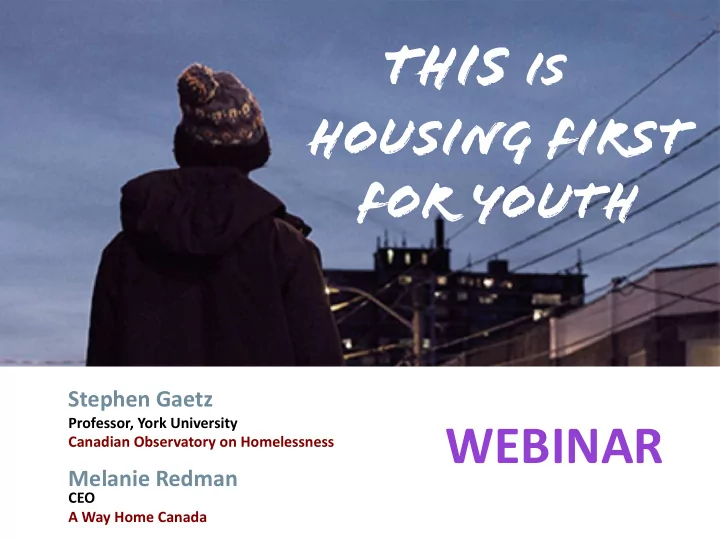
THIS is Housing first for youth Stephen Gaetz WEBINAR Professor, York University Canadian Observatory on Homelessness Melanie Redman CEO A Way Home Canada Part 1 Why Housing First for Youth? When we let young people become homeless

slide-1
SLIDE 1

THIS is

Housing first for youth WEBINAR

Stephen Gaetz

Professor, York University Canadian Observatory on Homelessness

Melanie Redman

CEO A Way Home Canada

slide-2
SLIDE 2

Part 1 Why Housing First for Youth?

slide-3
SLIDE 3

When we let young people become homeless …

slide-4
SLIDE 4

When we let young people become homeless …

  • Health worsens
  • Mental health declines
  • Exploitation
  • Greater risk of addictions
  • Involvement with the law
  • Dropping out of school
  • Trauma and criminal victimization
  • Entrenchment in life on the

streets

slide-5
SLIDE 5
slide-6
SLIDE 6

How are youth different from the adult homelessness population?

  • Age
  • Adolescent development
  • Experience
  • Dependency and supports
slide-7
SLIDE 7

Key question:

Can Housing First be adapted for youth?

slide-8
SLIDE 8

“We suggest considering modifications

  • f "Housing First" to maintain fidelity to

core principles while better meeting the needs of youth”.

Kozloff et al., (2016) At Home / Chez Soi

slide-9
SLIDE 9

A framework for Housing First for Youth

(2014)

slide-10
SLIDE 10
slide-11
SLIDE 11

Part 2 THIS is Housing First for Youth!

slide-12
SLIDE 12

2014

2017

slide-13
SLIDE 13

The importance of developing a response based on the needs of young people.

slide-14
SLIDE 14

Housing First for Youth (HF4Y) is a rights-based intervention for young people (aged 13-24) who experience homelessness, or who are at risk. It is designed to address the needs of developing adolescents and young adults by providing them with immediate access to housing that is safe, affordable and appropriate, and the necessary and age-appropriate supports that focus on health, well- being, life skills, engagement in education and employment, and social inclusion.

slide-15
SLIDE 15
slide-16
SLIDE 16

1

A Right to Housing with No Preconditions

  • What does “no

preconditions” mean?

  • Separation of Housing

and Supports

slide-17
SLIDE 17

2

Youth Choice, Youth Voice and Self-Determination

  • What does CHOICE mean?
  • Limits to choice?
  • Putting choice into action!
slide-18
SLIDE 18

3

Positive Youth Development and Wellness Orientation

The HF4Y model employs a “positive youth development”

  • rientation, a strengths-based

approach that focuses not just

  • n risk and vulnerability, but

also youth’s assets. A positive youth development approach:

slide-19
SLIDE 19

4

Individualized, Client-Driven Supports with No Time Limits

Active engagement without coercion In doing so, one must consider:

  • Supports must be flexible in terms of time frames.
  • The needs of young people will evolve over time.
  • What the worker thinks the young person needs or wants is

not necessarily what they want for themselves.

  • It may take a long time to build a trusting relationship to

engage in this kind of work.

  • Young people should be encouraged to focus on positive

change and to learn from mistakes.

  • The importance of harm reduction
  • Consider the impact of trauma and disabling conditions
slide-20
SLIDE 20

5

Social Inclusion and Community Integration

  • Housing models should not

stigmatize clients

  • Make available opportunities

for social and cultural engagement

  • Build natural supports
  • Ensure opportunities to

identify and engage in meaningful activities

slide-21
SLIDE 21

Part 3

Models of Accommodation & Supports

slide-22
SLIDE 22
slide-23
SLIDE 23
slide-24
SLIDE 24
slide-25
SLIDE 25
slide-26
SLIDE 26

¡

Help in obtaining housing

¡

Housing retention

¡

Rent supplements

¡

Support when things go wrong

¡

Aftercare

1

slide-27
SLIDE 27

¡

Trauma informed care

¡

Mental Health

¡

Substance use and addictions

¡

Harm Reduction

¡

Healthy Sexuality

¡

Personal Safety

2

slide-28
SLIDE 28

¡

Income supports

¡

Training

¡

Employment

¡

Education

3

slide-29
SLIDE 29

Complementary Supports

¡

Life skills

¡

Adult support and mentoring

¡

Supporting young people with children

¡

System Navigation and Advocacy

¡

Peer support

¡

Legal supports

4

slide-30
SLIDE 30

¡

Developing social relations

¡

Family Reconnect

¡

Community engagement

¡

Cultural engagement

¡

Meaningful activities

5

slide-31
SLIDE 31

Part 4

Considerations for

Service Delivery

slide-32
SLIDE 32
slide-33
SLIDE 33
slide-34
SLIDE 34
slide-35
SLIDE 35

Good Case Management

  • Client driven
  • Effective assessment
  • Collaboration and Cooperation
  • Right matching of services
  • Contextual case management
  • Evaluation for Success
slide-36
SLIDE 36

Consider the importance of

Family and Natural Supports

slide-37
SLIDE 37
slide-38
SLIDE 38

Each youth has a primary worker but consider Shared Caseload

slide-39
SLIDE 39

Working with Landords

slide-40
SLIDE 40

Rent and Income Supplements

slide-41
SLIDE 41
slide-42
SLIDE 42
slide-43
SLIDE 43

Part 5 How do we get there?

slide-44
SLIDE 44
slide-45
SLIDE 45

Can guide targeted Plans to Prevent and End Youth Homelessness!

slide-46
SLIDE 46

In communities of any size, the response to youth

homelessness can be driven by these principles.

slide-47
SLIDE 47

HF4Y Program Model An Aspirational Goal

slide-48
SLIDE 48

Part 6 Building the evidence base

slide-49
SLIDE 49
slide-50
SLIDE 50

This project is funded in part by the Government of Canada’s Youth Employment Strategy program

slide-51
SLIDE 51

2 Provinces, 10 Communities, DOZENS of Community Partners

Making the Shift

Project: Phase ONE

slide-52
SLIDE 52
slide-53
SLIDE 53

Canadian Demonstration Projects

Building the Evidence Base

slide-54
SLIDE 54

Housing First for Youth Demonstration Projects

Ottawa:

  • Housing First for Youth

Toronto:

  • Housing First for Youth (leaving care)

Hamilton:

  • Housing First for Youth (Indigenous)
slide-55
SLIDE 55

Research and Evaluation

Evaluation:

  • Developmental Evaluation
  • Outcomes Evaluation

Research:

  • Control trial – interviews at three

month intervals

  • Control groups in each city
  • Quantitative and quantitative methods
  • Outcomes tied to service and supports
  • Positive youth development
  • rientation (strengths-based approach)
slide-56
SLIDE 56

Research Team

Sam Tsemberis Clinical Director Many key researchers from At Home/Chez Soi

slide-57
SLIDE 57

Questions or comments?

www.homelesshub.ca www.AWayHome.ca

slide-58
SLIDE 58

Resources

  • A Way Home Canada Youth Homelessness Community Planning Webinar

#6: Serving Youth Better: Introducing the Youth Homelessness Assessment and Prioritization (YAP) Tool | September 2017 https://www.youtube.com/watch?v=2tWVawRwZ18&feature=youtu.be

  • THIS is Housing First for Youth: A program model guide:

http://www.homelesshub.ca/HF4Y?_ga=2.121375695.694991686.151723 6497-29638153.1506525847