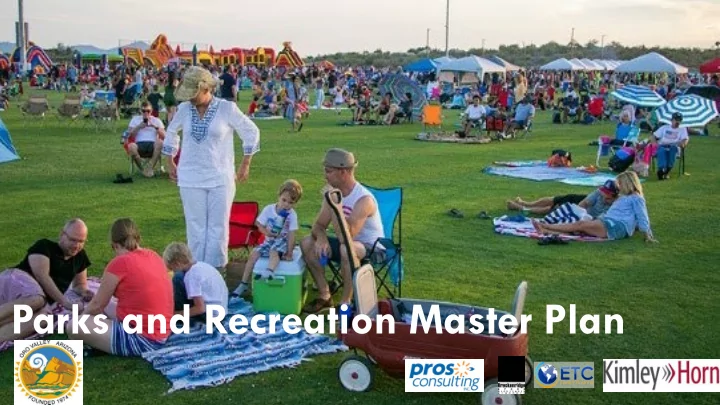
Inspiring communities to action
Parks and Recreation Master Plan Inspiring communities to action - - PowerPoint PPT Presentation
Parks and Recreation Master Plan Inspiring communities to action Agenda Influencing Factors Focus Group and Stakeholder Key Themes Website Participation Intercept Survey Online Survey Statistically Valid Survey
Agenda
- Influencing Factors
- Focus Group and Stakeholder Key Themes
- Website Participation
- Intercept Survey
- Online Survey
- Statistically Valid Survey
- Prioritized Needs
- Next Steps
Influencing Factors
Population
- Town Average Annual Growth rate = 1%
- US Average Annual Growth Rate = 0.8%
Age Segmentation
- Today, 48.7% of
the population is 55+
- By 2034, 58.1% of
population will be 55+
Ethnicity
- Culture often influences park and recreation experiences
Income
Higher Income Levels. Provide high quality experiences with a focus on cost recovery
$49,475 $28,634 $31,950 $85,173 $54,974 $58,100
Oro Valley Arizona U.S.A.
COMPARATIVE INCOME CHARACTERISTICS
Per Capita Income Median Household Income
Holistic and Continuous Public Input
Focus Group and Town Hall Meetings Project Website Outreach Surveys Community
Collaborative Planning
Focus Group/Town Hall Meeting – Key Themes
- Strong Advocacy and Appreciation for the System
- Economic Development through Park Development
- Invest in Existing Park System
- Open Space Preservation
- Trails, Trails, Trails
- Financial Strategies to maintain and grow the system
Project Website
www.planyourparksov.com/
- The website has generated 926+ comments since January
Website Participation and Key Themes
- Purpose: Prioritize Importance of Park and Recreation
Facilities and Amenities
- Administered by Consulting Team and Parks and Recreation
Advisory Board
- February 7th – March 16th, 2020
- Nine dates and times at various locations and events
- Total of 404 participants
Intercept Surveys
Intercept Survey Feedback
- Administered via Survey Monkey
- Developed in partnership with the Town
- April 20 – May 3, 2020
- Total of 372 completed surveys
- 4,451 residents represented by the 372 completed surveys
Online Survey
On-Line Survey Priorities
Statistically Valid Survey
- Only scientific and defensible
method to understand community needs
- Administered by mail/phone/web
- Developed in partnership with the
Town
- Methodology allows high return rate
(25%-35%)
- Total of 443 completed surveys,
95% level of confidence with a margin of error of +/- 4.6% (Goal was 375)
Statistically-Valid Survey
Survey Response Location Map
Advocacy
Park and Facility Visitation and Condition
Ninety-five percent (95%) of Oro Valley’s parks and recreation facilities were given a condition rating that exceeded the national benchmark for excellent of 29%.
Program Participation and Quality
The national benchmark for program participation is 33%.
The national benchmark for excellent is 33%.
Excellent Good Fair Poor
The national benchmark for too busy/not interested is 32% and for not knowing what is offered is 35%.
Recreation Program and Activity Needs
National Benchmarks
- Community special events - 21%
- Senior programs and services 16%
- Adult fitness programs – 48%
- Adult learning classes 14%
Park, Facility and Amenity Needs
National Benchmarks
- Walking and biking trails
(multi-use paved) 45%
- Walking & hiking trails (natural
surface) 33%
- Open Space Conservation
Areas/Trails – 24%
- Golf - 9%
Public Support
Community Needs
43
Needs Analysis Methodology
This model evaluates both quantitative and qualitative data.
- Quantitative data includes the local demographics, recreation trends, statistically valid
survey and the on-line.
- Qualitative data includes community input via stakeholder interviews, staff input,
intercept surveys, the project website, and planning team observations.
- A weighted scoring system is used to determine the priorities for facilities and programs
and services
- The results of the priority ranking are tabulated into three categories: High Priority,
Medium Priority, and Low Priority.
Recreation Programs and Services Prioritized Needs
Recreation Program/Service Priority
Community special events Fitness & wellness programs Adult learning classes Senior programs & services Art classes
High
Recreation Program/Service Priority
Walking/jogging/running/cycling clubs Performing arts programs Golf lessons/clinics Environmental education programs Pickleball lessons/clinics Open swim
Medium
Recreation Program/Service Priority
Water fitness programs/lap swimming Weightlifting/bodybuilding programs Running events Reservation/rental of picnic shelters After school programs/out ‐
- f
‐ school camps Tennis lessons & leagues Family ‐
- riented programs
Bicycle lessons & clubs Learn to swim programs Volleyball programs Soccer programs Programs for people with special needs Reservation/rental of indoor meeting space Archery Basketball programs Sand volleyball programs Recreation/competitive swim team Gymnastics Softball programs Reservation/rental of athletic fields Football programs Baseball programs Lacrosse programs
Low
Next Steps
Next Steps June – October/November
- Park Level of Service Standards and Geographical Analysis
through Mapping
- Recreation Programming Assessment and Operational Funding
Analysis
- Capital Improvement Plan
- Funding and Revenue Strategies for Capital Improvement Plan
- Strategic Action Plan Development
- Final Master Plan Development