Parking UNDER THE CANALS An innovative garage ofgers plenty of - - PDF document

parking
SMART_READER_LITE
LIVE PREVIEW

Parking UNDER THE CANALS An innovative garage ofgers plenty of - - PDF document

Parking UNDER THE CANALS An innovative garage ofgers plenty of parking in an unused space under water. By Bas Symons and Dirk van Weelden I N THE 1970s, parking problems in the older neighborhoods of Amsterdam were so severe that


slide-1
SLIDE 1

UNDER THE CANALS
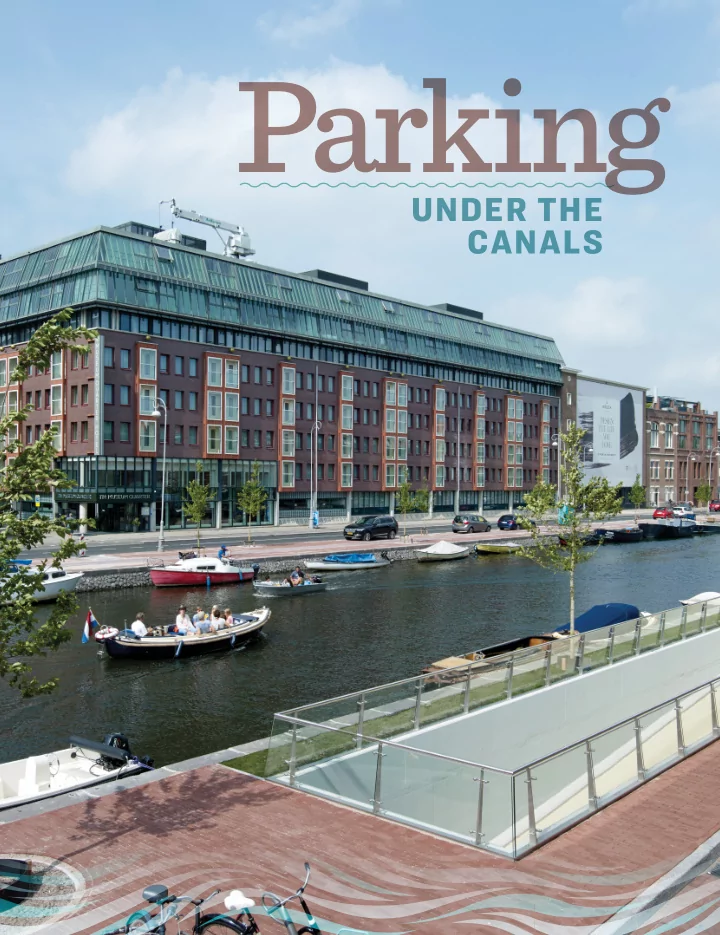
Parking

slide-2
SLIDE 2

I

N THE 1970s, parking problems in the
  • lder neighborhoods of Amsterdam

were so severe that cars were left on the

  • sidewalks. People had to negotiate their way

around them to get to the store or the tram stop, there was little opportunity for children to play in the streets, and residents no longer felt like sitting outside on summer days to drink cofgee and chat with passing neighbors. One such neighborhood was De Pijp, built in the 1880s just outside the city’s ring of 17th- century canals and bound by the River Amstel to the east and the wide Boerenwetering waterway to the west. The streets were narrow because they followed the routes of the old ditches that drained the swampy land. Not meant for the affmuent, the houses were thrown up quickly and cheaply and after almost a century, were in a poor state. De Pijp was not a pleasant place to live in the 1970s, and people regarded its downsides as simply the inevitable disadvantages of urban life. Many moved out to new developments on the periphery, such as Purmerend, Lelystad, Almere, and Diemen.

An innovative garage ofgers plenty of parking in an unused space— under water.

By Bas Symons and Dirk van Weelden

PHOTOGRAPH: JEROEN MUSCH THE PARKING PROFESSIONAL | OCTOBER 2018 | PARKING.ORG/TPP 21
slide-3
SLIDE 3 Forty years later, Amsterdam is growing rapidly, both as a massively popular tourist destination and as a city in which to live and work. De Pijp has its own styl- ish subway station on the new North-South metro line that connects the north of the city beyond the water of the IJ, an area that is developing at an explosive rate, to the city center and the Zuidas, the spectacular new business district of high-rise offjce blocks just 20 min- utes from Schiphol International Airport. De Pijp is now one of the most popular neighbor- hoods in Amsterdam. Many of its residential buildings have been renovated or replaced. The kilometer-long Albert Cuyp Market and the Amsterdam Heineken Ex- perience make it a tourist destination in its own right, and it has become an area where students, young pro- fessionals, and families love to live. But parking remains extremely tricky. The city council has tried to improve living conditions by reducing the number of parking
  • places. But where are local residents supposed to park?

AMFORA: A Visionary Idea

Few people understand the intricacies of the way the structure of Amsterdam is determined by the complex relationship between water and land. The city origi- nated in a peat bog where three rivers came together to fmow into the Zuiderzee, an inlet of the North Sea. In the 1930s, a huge dike was built to shut ofg the shallow Zuiderzee, which was partly reclaimed. All extensions to the city since the Middle Ages have required a sys- tem of drainage to make the land habitable, so canals and ditches were dug. Dig down a meter or so anywhere in the city and you will come to muddy water. For centuries, the most important drainage route of water from the city was via the Boerenwetering, now the western border of De Pijp. To dig the famous ring
  • f canals that gives the city its unique shape and fjll up
the plots in between with soil, a big and sophisticated water management system had to be devised, with locks and dams and pumps powered by windmills. The areas developed in the 19th and 20th centuries likewise required the draining or back-fjlling of swampy areas. Amsterdam became a city crisscrossed by canals and waterways. To give an impression: This densely populated city of less than a million residents has 1,680 bridges. Together with contractor Strukton, ZJA architects developed a visionary plan in 2010 to anticipate the growth and modernization of the city. As there is little
  • pen space left for development, that which is available
would have to be used more intensively. A large part of the city is protected as a historic monument. AMFO- RA (Alternative Multifunctional Underground Space Amsterdam) explores the idea of using the canals and waterways in the city as the roofs of underground spac-
  • es. All kinds of essential functions can be housed under
the water without damaging the character of the city at street level. Building parking lots, roads, and walkways under the river and canals would free neighborhoods such as De Pijp from parking problems, as well as pro- vide space for children to play, greenery, and space for pedestrians and cyclists. The visionary AMFORA plan includes an ener- gy-saving concept that allows heat/cold storage to replace traditional air conditioning in the city. Many facilities that are now impossible to accommodate in the center of town, including congress centers and sports venues, could be built right near where people live and work.

The Albert Cuyp Parking Garage

ZJA designed an underground parking facility for 600 cars under the Boerenwetering waterway intended for visitors to the neighborhood and permit holders in the area. The disappearance of a great number of above-ground parking spots creates room for new play- grounds, green areas, and squares. The garage also pro- vides parking for 60 bicycles. For pedestrians, cyclists, and playing children, De Pijp will be immeasurably improved. In 2016 a sheet-pile wall was driven down into the banks of the Boerenwetering, allowing the water to be pumped away. Excavation then commenced for the building of the garage. The site was 300 meters (984 feet) long, 30 meters (90 feet) wide, and 10 meters (32 feet) deep. The biggest challenge lay in building an underground parking lot in a densely populated part
  • f the city with hardly any room for storage and with
narrow and constricted access routes. Inconvenience for residents had to be kept to a minimum. Above all, there could be no damage done to the foundations of

AMFORA (Alternative Multifunctional Underground Space Amsterdam) explores the idea of using the canals and waterways in the city as the roofs

  • f underground spaces. All kinds of essential

functions can be housed under the water without damaging the character of the city at street level.

22 THE PARKING PROFESSIONAL | OCTOBER 2018 | PARKING.ORG/TPP

slide-4
SLIDE 4 the 19th-century houses, which stand on wooden piles driven 15 meters (49 feet) deep into the marshy soil. The roof of the garage became the new one- meter- thick concrete fmoor of the Boerenwetering. In the spring of 2018, water 2.5 meters (8 feet) deep fmowed back over the parking lot. Boats pass along the Boeren- wetering once more. To house the required number of vehicles, parking space on two levels over a length of 260 meters (853 feet) was built. Access has to be easy in such a long and narrow space, so long ramps against the outside walls provide for straightforward one-way traffjc. To use the width of the garage as effjciently as possible, the cars are angle-parked at 70 degrees. The oval columns along the centerline of the structure are at the same angle, which results in a lively and rhythmical visual efgect for users on foot or in cars. The columns themselves have a custom-designed shape that combines func- tionality with an elegant silhouette, contributing to an uplifting atmosphere of lightness and clarity. Cobalt-blue lines and pictograms help to ensure that wayfjnding is quick and easy. The ceilings are smooth, as almost all cables and ducts were incorporated into the concrete, and there are no dark corners. The glass pe- destrian entrances and the long ramps allow maximum daylight to enter the garage. All this contributes to a pleasant and restful feeling of safety and transparency.

From the Street

The idea behind the design by ZJA is to blend the parking garage into the existing urban landscape. All installations are out of sight as far as possible, and the VISUAL AMFORA: ZJA ZWARTS & JANSMA ARCHITECTS THE PARKING PROFESSIONAL | OCTOBER 2018 | PARKING.ORG/TPP 23
slide-5
SLIDE 5 ramps are integrated into the waterside roads with-
  • ut any conspicuous elevations. Emergency exits and
vents are minimalist objects in the street. The motto is “simple and safe,” and the entire structure is visually as unobtrusive as possible, so the quality of the public space for pedestrians and cyclists remains optimal. Entrances and elevators are therefore modest in size and as transparent as possible. When passing the entrances and seeing the rail around the ramps, one is struck by the care and eye for detail that went into the choice of materials and fjnish-
  • ings. The same goes for the staircases, elevators, and
  • doors. Every efgort was made to ensure that the addi-
tion of an underground parking lot has minimal conse- quences for its immediate environment. Because the parking system records which car is parked in which slot, the structure qualifjes as a smart garage. The real intelligence here, however, lies in the fact that not one square foot of the city has been sacrifjced to house 600
  • cars. De Pijp’s residents and visitors can now enjoy
more spacious, greener and quieter streets. Along the banks of the Boerenwetering, the 55 fmoat- ing gardens that town residents have tended for more than 20 years have returned. They are made of large wooden crates fjlled with soil in which native aquatic and wetland plants grow, improving water quality.

Is This the Future?

The Albert Cuyp parking garage designed by ZJA is the fjrst parking garage built under an Amsterdam canal.Whether this brings the implementation of the AMFORA vision, as conceived by ZJA in 2010, any closer remains to be seen. It will be quite a while before a walkway, mall, or theater is built under the River
  • Amstel. But the Albert Cuyp parking garage proves it is
possible to construct a substantial underground park- ing facility beneath a waterway in a diffjcult type of soil, in the middle of a densely populated area, enabling a 19th century neighborhood to benefjt from the very latest technology. BAS SYMONS is senior architect with ZJA Zwarts & Jansma Architects. He can be reached at info@zja.nl. DIRK VAN WEELDEN is an essayist and
  • novelist. He can be reached at
weelden@xs4all.nl. CLIENT: The Municipality of Amsterdam CONTRACTOR: Max Bögl PHOTOGRAPH: JEROEN MUSCH

24 THE PARKING PROFESSIONAL | OCTOBER 2018 | PARKING.ORG/TPP