Palliative Care Consult Service supportive of patient/family goals - - PDF document

palliative care consult service
SMART_READER_LITE
LIVE PREVIEW

Palliative Care Consult Service supportive of patient/family goals - - PDF document

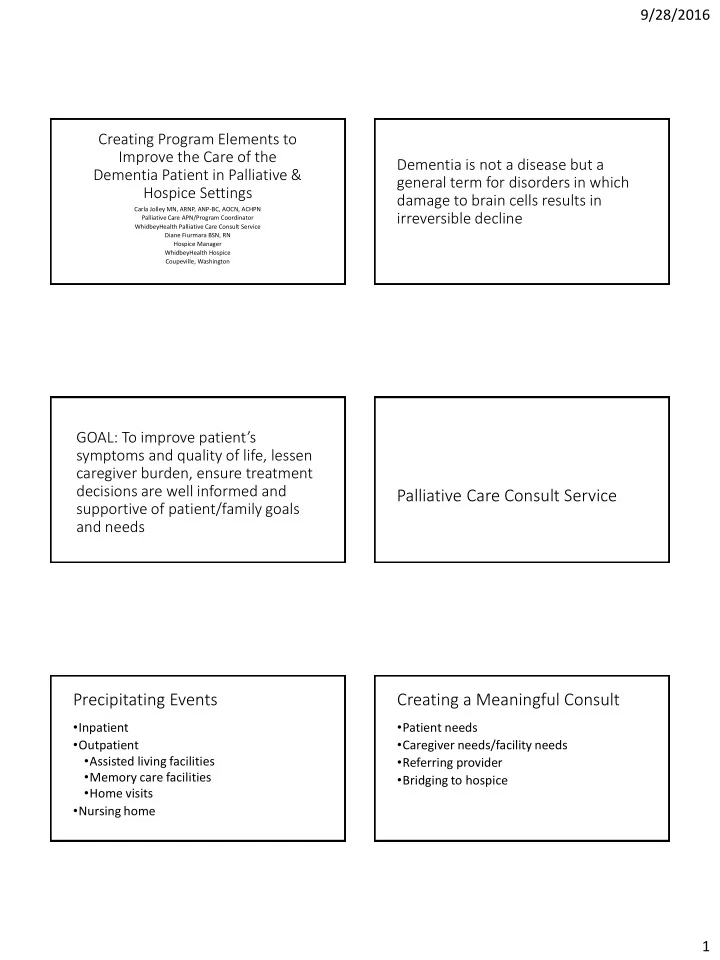
9/28/2016 Creating Program Elements to Improve the Care of the Dementia is not a disease but a Dementia Patient in Palliative & general term for disorders in which Hospice Settings damage to brain cells results in Carla Jolley MN, ARNP,


slide-1
SLIDE 1

9/28/2016 1 Creating Program Elements to Improve the Care of the Dementia Patient in Palliative & Hospice Settings

Carla Jolley MN, ARNP, ANP-BC, AOCN, ACHPN Palliative Care APN/Program Coordinator WhidbeyHealth Palliative Care Consult Service Diane Fiurmara BSN, RN Hospice Manager WhidbeyHealth Hospice Coupeville, Washington

Dementia is not a disease but a general term for disorders in which damage to brain cells results in irreversible decline GOAL: To improve patient’s symptoms and quality of life, lessen caregiver burden, ensure treatment decisions are well informed and supportive of patient/family goals and needs

Palliative Care Consult Service Precipitating Events

  • Inpatient
  • Outpatient
  • Assisted living facilities
  • Memory care facilities
  • Home visits
  • Nursing home

Creating a Meaningful Consult

  • Patient needs
  • Caregiver needs/facility needs
  • Referring provider
  • Bridging to hospice
slide-2
SLIDE 2

9/28/2016 2

Patient Needs

  • Assessment
  • Cognitive
  • Functional
  • Nutrition
  • Symptoms
  • Fall risk
  • ADL’s (bathing!!!!!!!)

Presenting Symptoms of Major Types of Dementia

Alzheimer’s Vascular Mixed Lewy Body Frontotemporal Short-term memory loss Impaired executive function Includes symptoms

  • f both Alz & Vasc

Fluctuating cognition Disinhibition Forgetfulness Motor deficits Recurrent visual hallucinations Expressive or receptive aphasia Difficulty learning new tasks Difficulty retrieving memories Parkinsonian movements Emotional distance Poor attention Aphasia REM sleep disorder Stubbornness Difficulty with finding words Inefficiency of thought Sensitivity to neuroleptics Apathy Difficulty with complex task Poor problem solving Repeated falls Selfishness Poor recognition Autonomic dysfunction Facial recognition difficulty Systemic delusions

Symptom Management

  • Agitation
  • Aggression
  • Delusions
  • Hallucinations
  • Depression
  • Apathy
  • Sleep disturbances
  • Pain
  • Constipation

Consult Note Goals

  • Development/type/stage of Dementia
  • History and number of infections in last year
  • Weight/nutritional status
  • Symptoms burden as well as behaviors
  • Social history/include caregiver burden and transition to care setting
  • Performance status/include ADL’s/personal care issues
  • Recommendations/Counseling
  • Medication review
  • Symptom management
  • Counseling for cg/disease progression/behavioral management/safety
  • Advanced care planning

Medications: the good?, the bad? And the ugly?

  • Benzodiazepines: worsening gait, fall risk, paradoxical reaction, relief
  • f anxiety/distress, sedation
  • Antihistamines: discouraged
  • Antipsychotic drugs: not FDA approved/black box warnings
  • Benefits outweigh burdens? Balancing act
  • Olanzapine 2.5 daily up to max 5 mg BID AD/VD (NNH 1:40)
  • Risperidone no more than 1 mg (NNH 1:27)
  • Quetiapine 25 mg at bedtime up to max 75 mg BID (NNH 1:50)
  • Haldol ……..Cochrane review may help with aggression (NNH 1:26)
  • Lewy Body not to use Haldol and risperidone

Non pharm therapies

  • Music therapy
  • Touch therapy
  • Massage/sensory interventions
  • Aromatherapies mixed results: lemon balm & lavender
  • Exercise training
  • Spiritual support
  • Person centered communication strategies/training caregivers
  • Events that trigger behaviors
  • Unmet needs anticipate and alleviated
  • Environmental triggers
slide-3
SLIDE 3

9/28/2016 3

Caregiver Needs

  • Education on disease and managing behaviors
  • Advanced care planning
  • Reliant on substitute decision making
  • Balance of benefits and burdens
  • Anticipatory guidance
  • Counsel on progression
  • Future complications
  • Resources
  • Self care

Facility Needs

  • Advanced care planning
  • Regulations, regulations, regulations………
  • Enlisting IDT support
  • Anticipatory guidance

Referring Provider

  • More grounded assessment
  • Symptom management
  • Medication review
  • Caregiving issues
  • Prognostication

Prognostication

  • FAST Functional Assessment Staging
  • Advanced Dementia Prognostic Tool (ADEPT)
  • Prognosis /Mitchell Index

http://eprognosis.ucsf.edu/calculators/#/

  • Risk Core for Patients with Dementia and Pneumonia

http://www.emgo.nl/quality-of-our-research/research- tools/prognotische-score

Bridging to Hospice

  • Collecting Data
  • Education for caregiver/facility
  • Eligibility
  • Meeting thresholds
  • Discharging back to Palliative Care
  • challenges

Resources

  • Alzheimer's Org /APP
  • Bell, V & Troxell, D. A Dignified Life: The Best Friends Approach to Alzheimer’s
  • Care. 2012 Health Professions Press. Inc. Deerfield Fl.
  • http://www.alz.org/documents_custom/2016-facts-and-figures.pdf
  • NHPCO (National Hospice & Palliative Care Organization)
  • Caring for Persons with Alzheimer’s and other Dementias: Guidelines for Hospice Providers

https://www.caregiver.org/caregivers-guide-understanding-dementia-behaviors

  • AAHPM/HPNA
  • National Institute on Aging has many education sheets for caregiver to download

https://www.nia.nih.gov/alzheimers/topics/caregiving

  • FAST FACTS APP or http://www.mypcnow.org/fast-facts
slide-4
SLIDE 4

9/28/2016 4

References

  • Arcand, m. End of Life Issues in Advanced Dementia. Part 2: Management of Poor Nutriotnal

intake, dehydration, & pneumonia. April vol. 61 337-341. Canadian Family Physician

  • Brody,A. (2016) Cognitive Impairment. Advanced Practice Palliative Nursing/Ed. Dahlin,Coyne,
  • Ferrell. P506-515.
  • Evans, B. (2002) Improving Palliative Care in the Nurisng Home from a Dementia Perspective.

Journal of Hospice and Palliative Nursing vol 4 (2)

  • Sachs, G. et al (2004). Barriers to Excellent End-of-life Care for Patients with Dementia. Journal of

General Internal Medicine 19:1057-1063.

  • Shega,J. & et al. (2005). Factors Associated with Self-and Caregiver Report of Pain among

Community-Dwelling Persons with Dementia. Journal of Palliative Medicine Vol.8(3) 567-575.

  • UptoDate: Management of Neuropsychiatric symptoms of dementia. Press,D & Alexander, M.

downloaded 8/19/2016

  • UpToDate: Treatment of Dementia. Press,. & Alexander, M. downloaded 8/21/2016.

Hospice

2014 Changes to Hospice Dementia Coding

Multiple dementia codes could not longer be used CMS states “not appropriate as principle diagnosis because of etiology or manifestation guidelines…you must code the underlying condition as principle diagnosis and these dementia conditions would only be appropriate as secondary conditions” This included: Dementia with behavioral disturbance F03.91 Dementia without behavioral disturbance F03.90 Vascular dementia with behavioral disturbance F01.51 Vascular dementia without behavioral disturbance F01.50 And many others…

Percentage of Dementia Diagnosis

  • NHPCO 2014 has 9.3% of patients with a primary diagnosis of

dementia

  • In 1995 less than 1% of patients had a primary hospice diagnosis of

dementia

  • WhidbeyHealth Hospice had 11.4% of patients with a primary

diagnosis of dementia (G31.1 and G30.9) in the last 12 month period

  • Annual cost of dementia in the United States is estimated at 159-215

billion dollars

Prevalence of Dementia

Cost of Care

  • Current estimates suggest the annual cost of

dementia care in the United States is between 159-215 billion dollars

  • These estimates quadruple in the next 50

years due to the increased aging population

slide-5
SLIDE 5

9/28/2016 5

Dementia Predictions Cancer decline vs dementia decline Hospice Eligibility

FAST stage 7 or beyond

  • Inability to ambulate independently
  • Inability to bathe independently
  • Inability to dress independently
  • Incontinence (intermittent or constant)
  • Fewer than 6 intelligible words

One of the following in the last 6 month

  • Aspiration pneumonia
  • Pyelonephritis
  • Septicemia
  • Decubitus Stage 3 or 4
  • 10% weight loss over last 6 months
  • Albumin < 2.5gm/dl

Referral

Screening by intake/referral nurse and hospice Medical Director Comorbidities? Challenges

  • Providers – unaware of hospice criteria for dementia…early

referrals/late referrals

  • Families – lack of understanding about disease progression/symptom

management

  • Facilities – ability to provide level of care

Education…Staff and Family

Don’t assume staff have had the education or have the tools to care for the dementia patient Why are we doing what we are doing? How each discipline can provide support

Care Planning

  • Creating individualized approaches to the

Patient dementia

  • Nurses
  • Chaplain
  • Social work
  • Aides
  • Volunteers
slide-6
SLIDE 6

9/28/2016 6 Hospice Dementia Care in the Home

  • Caregiver education
  • Caregiver burnout
  • Patient safety

Dementia care in AFH

  • Long term relationship with patient
  • Regulatory issues
  • PRN medications
  • Caregiver understanding of disease

progression

Dementia care in ALF/SNF

  • Establishment of meaningful care plans
  • Medication Management – PRN meds?

Frequency of room checks, ability to assess patient status

  • Ability to provide level of care required (ALF)
  • LTC pharmacies and challenges

Music Program

  • Music and Memory
  • Program Development
  • Successes and Challenges

Conclusion

  • Finding the patient’s story
  • Defining quality of life not only from our

perspective but families, facilities, and creating dignity

  • Negotiating the world of regulation
  • Doing good work