} (pages and frames, respectively) free frames can be tracked using a - - PowerPoint PPT Presentation

pages and frames respectively free frames can be tracked
SMART_READER_LITE
LIVE PREVIEW

} (pages and frames, respectively) free frames can be tracked using a - - PowerPoint PPT Presentation

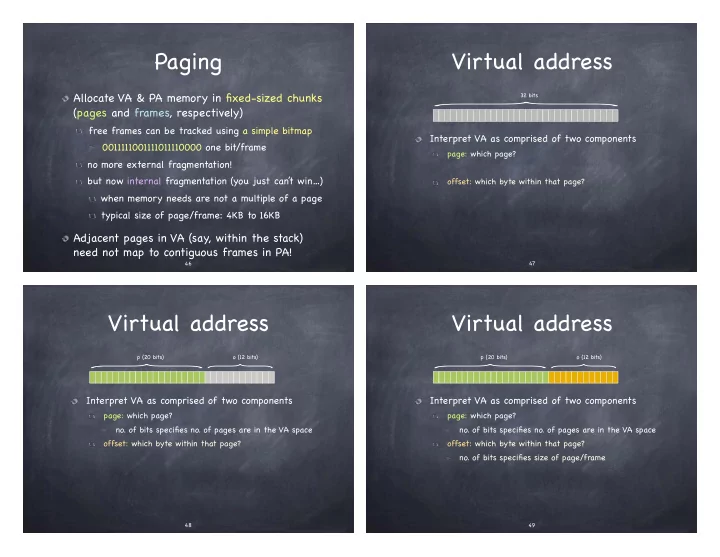
Paging Virtual address Allocate VA & PA memory in fixed-sized chunks 32 bits } (pages and frames, respectively) free frames can be tracked using a simple bitmap Interpret VA as comprised of two components 0011111001111011110000 one bit/frame


slide-1
SLIDE 1

Paging

Allocate VA & PA memory in fixed-sized chunks (pages and frames, respectively)

free frames can be tracked using a simple bitmap 0011111001111011110000 one bit/frame no more external fragmentation! but now internal fragmentation (you just can’ t win…) when memory needs are not a multiple of a page typical size of page/frame: 4KB to 16KB

Adjacent pages in VA (say, within the stack) need not map to contiguous frames in PA!

46

Virtual address

Interpret VA as comprised of two components

page: which page?

  • ffset: which byte within that page?

}

32 bits 47

Virtual address

}

  • (12 bits)

}

p (20 bits) 48

Interpret VA as comprised of two components

page: which page?

  • no. of bits specifies no. of pages are in the VA space
  • ffset: which byte within that page?

Virtual address

}

}

49

Interpret VA as comprised of two components

page: which page?

  • no. of bits specifies no. of pages are in the VA space
  • ffset: which byte within that page?
  • no. of bits specifies size of page/frame

p (20 bits)

  • (12 bits)
slide-2
SLIDE 2

Virtual address

}

}

50

To access a byte extract page number map that page number into a frame number using a page table extract offset access byte at offset in frame

8 4 6 1 2

Page Table

1 2 3 4 220 -1 . . . . . . . . . . .

p (20 bits)

  • (12 bits)

Basic Paging

CPU

PTBR

  • p

p f

f

  • 51

Physical Memory

Page Table

(stores frame nos)

f

The Page Table lives in memory at the physical address stored in the Page Table Base Register PTBR saved/restored on context switch

Page Table Entries

Frame number Valid/Invalid bit

Set if entry stores a valid mapping If not, page fault

Cache modified bit

Set for memory-mapped I/O

Referenced bit

Set if page has been referenced

Modified bit

Set if page has been modified

Protection bits (R/W/X)

4 i 7 i 2 i i 7 v 6 i 5 v 4 i 2 i i 3 v 4 v v 6 v 1 v 2 v

Page table

11 2 9 4 5 1 3

1 2 3 4 5 6 7 8 9 10 11 12 13 14 15

Physical memory

}

Protection bits (R/W/X) Caching disabled Referenced Modified Valid/ invalid

52

1 2 3 4 5 6 7

Frame no.

Caching disabled Valid Referenced Modified Protection

Sharing

By now, it’ s old hat:

Processes share pages by mapping virtual pages to the same frame Fine tuning using protection bits (RWX) We can refine COW to operate at the granularity of pages

  • n fork, mark all pages

read only

  • n write, copy only the

affected page

Page Table Process 1 Page Table Process 0 Physical Memory

53

slide-3
SLIDE 3

Example

A B C D E F G H I J K L

1 2

VA Space

1 2 3 4

PA Space

1 2

Page Table A B C D E F G H I J K L 1 4 3

Page size: 4 bytes

Space overhead

Two sources, in tension:

data structure overhead (the Page Table itself) fragmentation

How large should a page be?

Overhead for paging:

(#entries x sizeofEntry) + (#“segments” x pageSize/2) ((VA_Size/pagesize) x sizeofEntry) + (#“segments” x pageSize/2) = = Size of entry

enough bits to identify physical page (log2 (PA_Size / page size)) should include control bits (valid, modified, referenced, etc) usually word or byte aligned

55

Computing paging

  • verhead

1 MB maximum VA, 1 KB page, 3 segments (program, stack, heap)

((220 / 210) x sizeofEntry) + (3 x 29) If I know PA is 64 KB then sizeofEntry = 6 bits (26 frames) + control bits if 7 control bits, byte aligned size of entry: 16 bits

56

What’ s not to love?

Space overhead

With a 64-bit address space, size of page table can be huge

Time overhead

Accessing data now requires two memory accesses

must also access page table, to find mapped frame

57

slide-4
SLIDE 4

Reducing the Storage Overhead of Page Tables

Size of the page table for a machine with 64- bit addresses and a page size of 4KB? an array of 252 entries! Good news most space is unused Use a better data structure to express the Page Table a tree!

Example 32 bit address space 4Kb pages 4 bytes PTE

VP 0 . . . VP 1023 VP 1024 . . . VP 2047 Gap 1023 unallocated pages VP 9215 unallocated pages

}

2K pages code/data

}

6K pages unallocated 1023 pages unallocated

}

1 page for stack 58

Reducing the Storage Overhead of Page Tables

Size of the page table for a machine with 64- bit addresses and a page size of 4KB? an array of 252 entries! Good news most space is unused Use a better data structure to express the Page Table a tree!

PTE 0 . . . PTE 1023 PTE 0 . . . PTE 1023 PTE 1023 1023 null PTEs

Example 32 bit address space 4Kb pages 4 bytes PTE

VP 0 . . . VP 1023 VP 1024 . . . VP 2047 Gap 1023 unallocated pages VP 9215 unallocated pages

}

2K pages code/data

}

6K pages unallocated 1023 pages unallocated

}

1 page for stack 59 PTE 0 PTE 1 PTE 2 (null) PTE 3 (null) PTE 4 (null) PTE 5 (null) PTE 6 (null) PTE 7 (null) PTE 8 (9-1024) null PTEs

Multi-level Paging

Structure virtual address space as a tree Virtual address of a SPARC p1 p2

  • p3

8 6 6 12

255 1 63

v

63 4K 8K 16K

p1 p2 p3 PTBR

Example

What is the page size?

}

8 bits

}

6 bits

}

8 bits

}

10 bits

slide-5
SLIDE 5

Example

What is the page size?

}

8 bits

}

6 bits

}

8 bits

}

10 bits

Page size is 256 bytes What is the Page Table size for a process with a 256KB VAS starting at address 0?

Example

What is the page size?

}

8 bits

}

6 bits

}

8 bits

}

10 bits

Page size is 256 bytes What is the Page Table size for a process with a 256KB VAS starting at address 0?

The process needs to map 1024 pages (256KB/256 bytes) To do so, it is sufficient to materialize the following tree

}

1024 entries

}

256 entries

}

64 entries 1 15

since 1024/ 64 = 16 So, assuming each PTE is 2 bytes

1024 x 2 + 256 x 2 + 16 x 64 x 2 = 4608 bytes