PagerDuty Provider PagerDuty (https://www.pagerduty.com/) is an - - PDF document

pagerduty provider
SMART_READER_LITE
LIVE PREVIEW

PagerDuty Provider PagerDuty (https://www.pagerduty.com/) is an - - PDF document

PagerDuty Provider PagerDuty (https://www.pagerduty.com/) is an alarm aggregation and dispatching service for system administrators and support teams. It collects alerts from your monitoring tools, gives you an overall view of all of your


slide-1
SLIDE 1

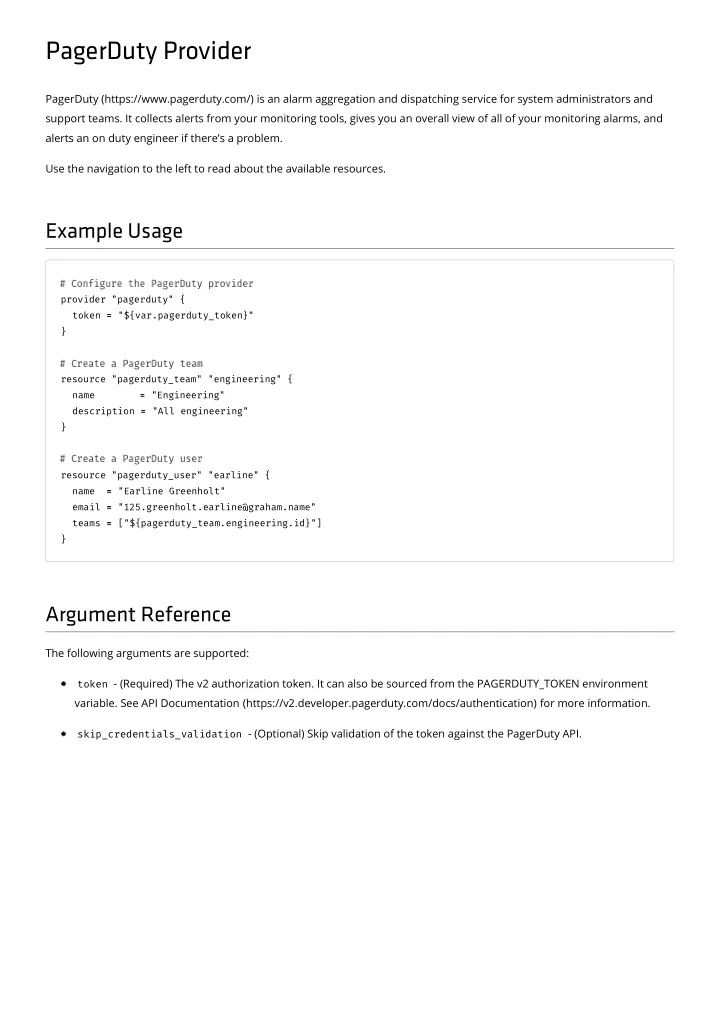
PagerDuty Provider

PagerDuty (https://www.pagerduty.com/) is an alarm aggregation and dispatching service for system administrators and support teams. It collects alerts from your monitoring tools, gives you an overall view of all of your monitoring alarms, and alerts an on duty engineer if there’s a problem. Use the navigation to the left to read about the available resources.

Example Usage

provider "pagerduty" { token = = "${var.pagerduty_token}" } resource "pagerduty_team" "engineering" { name = = "Engineering" description = = "All engineering" } resource "pagerduty_user" "earline" { name = = "Earline Greenholt" email = = "125.greenholt.earline@graham.name" teams = = ["${pagerduty_team.engineering.id}"] }

Argument Reference

The following arguments are supported:

token - (Required) The v2 authorization token. It can also be sourced from the PAGERDUTY_TOKEN environment

  • variable. See API Documentation (https://v2.developer.pagerduty.com/docs/authentication) for more information.

skip_credentials_validation - (Optional) Skip validation of the token against the PagerDuty API.

slide-2
SLIDE 2

pagerduty_escalation_policy

Use this data source to get information about a specic escalation policy (https://v2.developer.pagerduty.com/v2/page/api- reference#!/Escalation_Policies/get_escalation_policies) that you can use for other PagerDuty resources.

Example Usage

data "pagerduty_escalation_policy" "test" { name = = "Engineering Escalation Policy" } resource "pagerduty_service" "test" { name = = "My Web App" auto_resolve_timeout = = 14400 acknowledgement_timeout = = 600 escalation_policy = = "${data.pagerduty_escalation_policy.test.id}" }

Argument Reference

The following arguments are supported:

name - (Required) The name to use to nd an escalation policy in the PagerDuty API.

Attributes Reference

id - The ID of the found escalation policy. name - The short name of the found escalation policy.

slide-3
SLIDE 3

pagerduty_extension_schema

Use this data source to get information about a specic extension (https://v2.developer.pagerduty.com/v2/page/api- reference#!/Extension_Schemas/get_extension_schemas) vendor that you can use for a service (e.g: Slack, Generic Webhook, ServiceNow).

Example Usage

data "pagerduty_extension_schema" "webhook" { name = = "Generic V2 Webhook" } resource "pagerduty_user" "example" { name = = "Howard James" email = = "howard.james@example.domain" teams = = ["${pagerduty_team.example.id}"] } resource "pagerduty_escalation_policy" "foo" { name = = "Engineering Escalation Policy" num_loops = = 2 rule { escalation_delay_in_minutes = = 10 target { type = = "user" id = = "${pagerduty_user.example.id}" } } } resource "pagerduty_service" "example" { name = = "My Web App" auto_resolve_timeout = = 14400 acknowledgement_timeout = = 600 escalation_policy = = "${pagerduty_escalation_policy.example.id}" } resource "pagerduty_extension" "slack"{ name = = "My Web App Extension" endpoint_url = = "https://generic_webhook_url/XXXXXX/BBBBBB" extension_schema = = "${data.pagerduty_extension_schema.webhook.id}" extension_objects = = ["${pagerduty_service.example.id}"] }

Argument Reference

The following arguments are supported:

slide-4
SLIDE 4

name - (Required) The extension name to use to nd an extension vendor in the PagerDuty API.

Attributes Reference

id - The ID of the found extension vendor. name - The short name of the found extension vendor. type - The generic service type for this extension vendor.

slide-5
SLIDE 5

pagerduty_schedule

Use this data source to get information about a specic schedule (https://v2.developer.pagerduty.com/v2/page/api- reference#!/Schedules/get_schedules) that you can use for other PagerDuty resources.

Example Usage

data "pagerduty_schedule" "test" { name = = "Daily Engineering Rotation" } resource "pagerduty_escalation_policy" "foo" { name = = "Engineering Escalation Policy" num_loops = = 2 rule { escalation_delay_in_minutes = = 10 target { type = = "schedule" id = = "${data.pagerduty_schedule.test.id}" } } }

Argument Reference

The following arguments are supported:

name - (Required) The name to use to nd a schedule in the PagerDuty API.

Attributes Reference

id - The ID of the found schedule. name - The short name of the found schedule.

slide-6
SLIDE 6

pagerduty_service

Use this data source to get information about a specic service (https://api- reference.pagerduty.com/#!/Services/get_services).

Example Usage

data "pagerduty_service" "example" { name = = "My Service" } data "pagerduty_vendor" "datadog" { name = = "Datadog" } resource "pagerduty_service_integration" "example" { name = = "Datadog Integration" vendor = = data.pagerduty_vendor pagerduty_vendor.datadog datadog.id id service = = data.pagerduty_service pagerduty_service.example example.id id type = = "generic_events_api_inbound_integration" }

Argument Reference

The following arguments are supported:

name - (Required) The service name to use to nd a service in the PagerDuty API.

Attributes Reference

id - The ID of the found service. name - The short name of the found service.

slide-7
SLIDE 7

pagerduty_team

Use this data source to get information about a specic team (https://v1.developer.pagerduty.com/documentation/rest/teams/list) that you can use for other PagerDuty resources.

Example Usage

data "pagerduty_user" "me" { email = = "me@example.com" } data "pagerduty_team" "devops" { name = = "devops" } resource "pagerduty_escalation_policy" "foo" { name = = "DevOps Escalation Policy" num_loops = = 2 teams = = ["${data.pagerduty_team.devops.id}"] rule { escalation_delay_in_minutes = = 10 target { type = = "user" id = = "${data.pagerduty_user.me.id}" } } }

Argument Reference

The following arguments are supported:

name - (Required) The name of the team to nd in the PagerDuty API.

Attributes Reference

id - The ID of the found team. name - The name of the found team. description - A description of the found team.

slide-8
SLIDE 8

pagerduty_user

Use this data source to get information about a specic user (https://v2.developer.pagerduty.com/v2/page/api- reference#!/Users/get_users) that you can use for other PagerDuty resources.

Example Usage

data "pagerduty_user" "me" { email = = "me@example.com" } resource "pagerduty_escalation_policy" "foo" { name = = "Engineering Escalation Policy" num_loops = = 2 rule { escalation_delay_in_minutes = = 10 target { type = = "user" id = = "${data.pagerduty_user.me.id}" } } }

Argument Reference

The following arguments are supported:

email - (Required) The email to use to nd a user in the PagerDuty API.

Attributes Reference

id - The ID of the found user. name - The short name of the found user.

slide-9
SLIDE 9

pagerduty_vendor

Use this data source to get information about a specic vendor (https://v2.developer.pagerduty.com/v2/page/api- reference#!/Vendors/get_vendors) that you can use for a service integration (e.g Amazon Cloudwatch, Splunk, Datadog).

Example Usage

data "pagerduty_vendor" "datadog" { name = = "Datadog" } resource "pagerduty_user" "example" { name = = "Earline Greenholt" email = = "125.greenholt.earline@graham.name" teams = = ["${pagerduty_team.example.id}"] } resource "pagerduty_escalation_policy" "foo" { name = = "Engineering Escalation Policy" num_loops = = 2 rule { escalation_delay_in_minutes = = 10 target { type = = "user" id = = "${pagerduty_user.example.id}" } } } resource "pagerduty_service" "example" { name = = "My Web App" auto_resolve_timeout = = 14400 acknowledgement_timeout = = 600 escalation_policy = = "${pagerduty_escalation_policy.example.id}" } resource "pagerduty_service_integration" "example" { name = = "Datadog Integration" vendor = = "${data.pagerduty_vendor.datadog.id}" service = = "${pagerduty_service.example.id}" type = = "generic_events_api_inbound_integration" }

Argument Reference

The following arguments are supported:

name - (Required) The vendor name to use to nd a vendor in the PagerDuty API.

slide-10
SLIDE 10

Attributes Reference

id - The ID of the found vendor. name - The short name of the found vendor. type - The generic service type for this vendor.

slide-11
SLIDE 11

pagerduty_addon

With add-ons (https://v2.developer.pagerduty.com/v2/page/api-reference#!/Add-ons/get_addons), third-party developers can write their own add-ons to PagerDuty's UI. Given a conguration containing a src parameter, that URL will be embedded in an iframe on a page that's available to users from a drop-down menu.

Example Usage

resource "pagerduty_addon" "example" { name = = "Internal Status Page" src = = "https://intranet.example.com/status" }

Argument Reference

The following arguments are supported:

name - (Required) The name of the add-on. src - (Required) The source URL to display in a frame in the PagerDuty UI. HTTPS is required.

Attributes Reference

The following attributes are exported:

id - The ID of the add-on.

Import

Add-ons can be imported using the id , e.g.

$ terraform import pagerduty_addon.example P3DH5M6

slide-12
SLIDE 12

pagerduty_escalation_policy

An escalation policy (https://v2.developer.pagerduty.com/v2/page/api- reference#!/Escalation_Policies/get_escalation_policies) determines what user or schedule will be notied rst, second, and so on when an incident is triggered. Escalation policies are used by one or more services.

Example Usage

resource "pagerduty_team" "example" { name = = "Engineering" description = = "All engineering" } resource "pagerduty_user" "example" { name = = "Earline Greenholt" email = = "125.greenholt.earline@graham.name" teams = = ["${pagerduty_team.example.id}"] } resource "pagerduty_escalation_policy" "example" { name = = "Engineering Escalation Policy" num_loops = = 2 teams = = ["${pagerduty_team.example.id}"] rule { escalation_delay_in_minutes = = 10 target { type = = "user" id = = "${pagerduty_user.example.id}" } } }

Argument Reference

The following arguments are supported:

name - (Required) The name of the escalation policy. teams - (Optional) Teams associated with the policy. Account must have the teams ability to use this parameter. description - (Optional) A human-friendly description of the escalation policy. If not set, a placeholder of "Managed

by Terraform" will be set.

num_loops - (Optional) The number of times the escalation policy will repeat after reaching the end of its escalation. rule - (Required) An Escalation rule block. Escalation rules documented below.

Escalation rules ( rule ) supports the following:

slide-13
SLIDE 13

escalation_delay_in_minutes - (Required) The number of minutes before an unacknowledged incident escalates

away from this rule.

targets - (Required) A target block. Target blocks documented below.

Targets ( target ) supports the following:

type - (Optional) Can be user , schedule , user_reference or schedule_reference . Defaults to user_reference id - (Required) A target ID

Attributes Reference

The following attributes are exported:

id - The ID of the escalation policy.

Import

Escalation policies can be imported using the id , e.g.

$ terraform import pagerduty_escalation_policy.main PLBP09X

slide-14
SLIDE 14

pagerduty_event_rule

An event rule (https://v2.developer.pagerduty.com/docs/global-event-rules-api) determines what happens to an event that is sent to PagerDuty by monitoring tools and other integrations.

Example Usage

resource "pagerduty_event_rule" "second" { action_json = = jsonencode([ [ "route", "P5DTL0K" ], [ "severity", "warning" ], [ "annotate", "2 Managed by terraform" ], [ "priority", "PL451DT" ] ]) condition_json = = jsonencode([ "and", ["contains",["path","payload","source"],"website"], ["contains",["path","headers","from","0","address"],"homer"] ]) advanced_condition_json = = jsonencode([ [ "scheduled-weekly", 1565392127032, 3600000, "America/Los_Angeles", [ 1, 2, 3, 5, 7 ] ] ]) } resource "pagerduty_event_rule" "third" { action_json = = jsonencode([ [ "route", "P5DTL0K" ], [ "severity",

slide-15
SLIDE 15

"severity", "warning" ], [ "annotate", "3 Managed by terraform" ], [ "priority", "PL451DT" ] ]) condition_json = = jsonencode([ "and", ["contains",["path","payload","source"],"website"], ["contains",["path","headers","from","0","address"],"homer"] ]) depends_on = = [pagerduty_event_rule.two two] }

Argument Reference

The following arguments are supported:

action_json - (Required) A list of one or more actions for each rule. Each action within the list is itself a list. condition_json - (Required) Contains a list of conditions. The rst eld in the list is and or or , followed by a list of

  • perators and values.

advanced_condition_json - (Optional) Contains a list of specic conditions including active-between , scheduled- weekly , and frequency-over . The rst element in the list is the label for the condition, followed by a list of values

for the specic condition. For more details on these conditions see Advanced Condition (https://v2.developer.pagerduty.com/docs/global-event-rules-api#section-advanced-condition) in the PagerDuty API documentation.

catch_all - (Optional) A boolean that indicates whether the rule is a catch all for the account. depends_on - (Optional) A Terraform meta-parameter (https://www.terraform.io/docs/conguration-0-

11/resources.html#depends_on) that ensures that the event_rule specied is created before the current rule. This is important because Event Rules in PagerDuty are executed in order. depends_on ensures that the rules are created in the order specied.

Attributes Reference

The following attributes are exported:

id - The ID of the event rule.

Import

slide-16
SLIDE 16

Escalation policies can be imported using the id , e.g.

$ terraform import pagerduty_event_rule.main 19acac92-027a-4ea0-b06c-bbf516519601

slide-17
SLIDE 17

pagerduty_extension

An extension (https://v2.developer.pagerduty.com/v2/page/api-reference#!/Extensions/post_extensions) can be associated with a service.

Example Usage

slide-18
SLIDE 18

data "pagerduty_extension_schema" "webhook" { name = = "Generic V2 Webhook" } resource "pagerduty_user" "example" { name = = "Howard James" email = = "howard.james@example.domain" teams = = ["${pagerduty_team.example.id}"] } resource "pagerduty_escalation_policy" "foo" { name = = "Engineering Escalation Policy" num_loops = = 2 rule { escalation_delay_in_minutes = = 10 target { type = = "user" id = = "${pagerduty_user.example.id}" } } } resource "pagerduty_service" "example" { name = = "My Web App" auto_resolve_timeout = = 14400 acknowledgement_timeout = = 600 escalation_policy = = "${pagerduty_escalation_policy.example.id}" } resource "pagerduty_extension" "slack"{ name = = "My Web App Extension" endpoint_url = = "https://generic_webhook_url/XXXXXX/BBBBBB" extension_schema = = "${data.pagerduty_extension_schema.webhook.id}" extension_objects = = ["${pagerduty_service.example.id}"] config = = << <<EOF { "restrict": "any", "notify_types": { "resolve": false, "acknowledge": false, "assignments": false }, "access_token": "XXX" } EOF }

Argument Reference

The following arguments are supported:

slide-19
SLIDE 19

name - (Optional) The name of the service extension. endpoint_url - (Optional) The url of the extension. extension_schema - (Required) This is the schema for this extension. extension_objects - (Required) This is the objects for which the extension applies (An array of service ids). config - (Optional) The conguration of the service extension as string containing plain JSON-encoded data.

Note: You can use the pagerduty_extension_schema data source to locate the appropriate extension vendor ID.

Attributes Reference

The following attributes are exported:

id - The ID of the extension. html_url - URL at which the entity is uniquely displayed in the Web app

Import

Extensions can be imported using the id.e.g.

$ terraform import pagerduty_extension.main PLBP09X

slide-20
SLIDE 20

pagerduty_maintenance_window

A maintenance window (https://v2.developer.pagerduty.com/v2/page/api- reference#!/Maintenance_Windows/get_maintenance_windows) is used to temporarily disable one or more services for a set period of time. No incidents will be triggered and no notications will be received while a service is disabled by a maintenance window. Maintenance windows are specied to start at a certain time and end after they have begun. Once started, a maintenance window cannot be deleted; it can only be ended immediately to re-enable the service.

Example Usage

resource "pagerduty_maintenance_window" "example" { start_time = = "2015-11-09T20:00:00-05:00" end_time = = "2015-11-09T22:00:00-05:00" services = = ["${pagerduty_service.example.id}"] }

Argument Reference

The following arguments are supported:

start_time - (Required) The maintenance window's start time. This is when the services will stop creating incidents. If

this date is in the past, it will be updated to be the current time.

end_time - (Required) The maintenance window's end time. This is when the services will start creating incidents

  • again. This date must be in the future and after the start_time .

services - (Required) A list of service IDs to include in the maintenance window. description - (Optional) A description for the maintenance window.

Attributes Reference

The following attributes are exported:

id - The ID of the maintenance window.

Import

Maintenance windows can be imported using the id , e.g.

$ terraform import pagerduty_maintenance_window.main PLBP09X

slide-21
SLIDE 21

pagerduty_schedule

A schedule (https://v2.developer.pagerduty.com/v2/page/api-reference#!/Schedules/get_schedules) determines the time periods that users are on call. Only on-call users are eligible to receive notications from incidents.

Example Usage

resource "pagerduty_user" "example" { name = = "Earline Greenholt" email = = "125.greenholt.earline@graham.name" teams = = ["${pagerduty_team.example.id}"] } resource "pagerduty_schedule" "foo" { name = = "Daily Engineering Rotation" time_zone = = "America/New_York" layer { name = = "Night Shift" start = = "2015-11-06T20:00:00-05:00" rotation_virtual_start = = "2015-11-06T20:00:00-05:00" rotation_turn_length_seconds = = 86400 users = = ["${pagerduty_user.foo.id}"] restriction { type = = "daily_restriction" start_time_of_day = = "08:00:00" duration_seconds = = 32400 } } }

Argument Reference

The following arguments are supported:

name - (Optional) The name of the schedule. time_zone - (Required) The time zone of the schedule (e.g Europe/Berlin). description - (Optional) The description of the schedule layer - (Required) A schedule layer block. Schedule layers documented below.

  • verflow - (Optional) Any on-call schedule entries that pass the date range bounds will be truncated at the bounds,

unless the parameter overflow is passed. For instance, if your schedule is a rotation that changes daily at midnight UTC, and your date range is from 2011-06-01T10:00:00Z to 2011-06-01T14:00:00Z : If you don't pass the

  • verow=true parameter, you will get one schedule entry returned with a start of 2011-06-01T10:00:00Z and end of

2011-06-01T14:00:00Z . If you do pass the overflow parameter, you will get one schedule entry returned with a

start of 2011-06-01T00:00:00Z and end of 2011-06-02T00:00:00Z .

slide-22
SLIDE 22

Schedule layers ( layer ) supports the following:

name - (Optional) The name of the schedule layer. start - (Required) The start time of the schedule layer. This value will not be read back from the PagerDuty API

because the API will always return a new start time, which represents the last updated time of the schedule layer.

end - (Optional) The end time of the schedule layer. If not specied, the layer does not end. rotation_virtual_start - (Required) The eective start time of the schedule layer. This can be before the start time

  • f the schedule.

rotation_turn_length_seconds - (Required) The duration of each on-call shift in seconds . users - (Required) The ordered list of users on this layer. The position of the user on the list determines their order in

the layer.

restriction - (Optional) A schedule layer restriction block. Restriction blocks documented below.

Restriction blocks ( restriction ) supports the following:

type - (Required) Can be daily_restriction or weekly_restriction start_time_of_day - (Required) The start time in HH:mm:ss format. duration_seconds - (Required) The duration of the restriction in seconds . start_day_of_week - (Required for weekly_restriction ) Number of the day when restriction starts. From 1 to 7

where 1 is Monday and 7 is Sunday.

Attributes Reference

The following attributes are exported:

id - The ID of the schedule

Import

Schedules can be imported using the id , e.g.

$ terraform import pagerduty_schedule.main PLBP09X

slide-23
SLIDE 23

pagerduty_service

A service (https://v2.developer.pagerduty.com/v2/page/api-reference#!/Services/get_services) represents something you monitor (like a web service, email service, or database service). It is a container for related incidents that associates them with escalation policies.

Example Usage

resource "pagerduty_user" "example" { name = = "Earline Greenholt" email = = "125.greenholt.earline@graham.name" teams = = ["${pagerduty_team.example.id}"] } resource "pagerduty_escalation_policy" "foo" { name = = "Engineering Escalation Policy" num_loops = = 2 rule { escalation_delay_in_minutes = = 10 target { type = = "user" id = = "${pagerduty_user.example.id}" } } } resource "pagerduty_service" "example" { name = = "My Web App" auto_resolve_timeout = = 14400 acknowledgement_timeout = = 600 escalation_policy = = "${pagerduty_escalation_policy.example.id}" alert_creation = = "create_incidents" }

Argument Reference

The following arguments are supported:

name - (Required) The name of the service. description - (Optional) A human-friendly description of the service. If not set, a placeholder of "Managed by

Terraform" will be set.

auto_resolve_timeout - (Optional) Time in seconds that an incident is automatically resolved if left open for that

  • long. Disabled if set to the "null" string.

acknowledgement_timeout - (Optional) Time in seconds that an incident changes to the Triggered State after being

  • Acknowledged. Disabled if set to the "null" string.
slide-24
SLIDE 24

escalation_policy - (Required) The escalation policy used by this service. alert_creation - (Optional) Must be one of two values. PagerDuty receives events from your monitoring systems

and can then create incidents in dierent ways. Value "create_incidents" is default: events will create an incident that cannot be merged. Value "create_alerts_and_incidents" is the alternative: events will create an alert and then add it to a new incident, these incidents can be merged.

alert_grouping - (Optional) Denes how alerts on this service will be automatically grouped into incidents. Note that

the alert grouping features are available only on certain plans. If not set, each alert will create a separate incident; If value is set to time : All alerts within a specied duration will be grouped into the same incident. This duration is set in the alert_grouping_timeout setting (described below). Available on Standard, Enterprise, and Event Intelligence plans; If value is set to "intelligent" - Alerts will be intelligently grouped based on a machine learning model that looks at the alert summary, timing, and the history of grouped alerts. Available on Enterprise and Event Intelligence plan.

alert_grouping_timeout - (Optional) The duration in minutes within which to automatically group incoming alerts.

This setting applies only when alert_grouping is set to time . To continue grouping alerts until the incident is resolved, set this value to 0 . You may specify one optional incident_urgency_rule block conguring what urgencies to use. Your PagerDuty account must have the urgencies ability to assign an incident urgency rule. The block contains the following arguments:

type - The type of incident urgency: constant or use_support_hours (when depending on specic support hours;

see support_hours ).

urgency - The urgency: low Notify responders (does not escalate), high (follows escalation rules) or severity_based Set's the urgency of the incident based on the severity set by the triggering monitoring tool. during_support_hours - (Optional) Incidents' urgency during support hours.

  • utside_support_hours - (Optional) Incidents' urgency outside of support hours.

When using type = "use_support_hours" in incident_urgency_rule you must specify exactly one (otherwise optional)

support_hours block. Your PagerDuty account must have the service_support_hours ability to assign support hours.

The block contains the following arguments:

type - The type of support hours. Can be fixed_time_per_day . time_zone - The time zone for the support hours. days_of_week - Array of days of week as integers. 1 to 7 , 1 being Monday and 7 being Sunday. start_time - The support hours' starting time of day. end_time - The support hours' ending time of day.

When using type = "use_support_hours" in incident_urgency_rule you must specify at least one (otherwise optional)

scheduled_actions block. The block contains the following arguments: type - The type of scheduled action. Currently, this must be set to urgency_change . to_urgency - The urgency to change to: low (does not escalate), or high (follows escalation rules). at - A block representing when the scheduled action will occur.

The at block contains the following arguments: * type - The type of time specication. Currently, this must be set to

named_time . * name - Designates either the start or the end of the scheduled action. Can be support_hours_start or support_hours_end .

slide-25
SLIDE 25

Below is an example for a pagerduty_service resource with incident_urgency_rules with type =

"use_support_hours" , support_hours and a default scheduled_action as well.

resource "pagerduty_service" "foo" { name = = "bar" description = = "bar bar bar" auto_resolve_timeout = = 3600 acknowledgement_timeout = = 3600 escalation_policy = = "${pagerduty_escalation_policy.foo.id}" incident_urgency_rule { type = = "use_support_hours" during_support_hours { type = = "constant" urgency = = "high" }

  • utside_support_hours {

type = = "constant" urgency = = "low" } } support_hours { type = = "fixed_time_per_day" time_zone = = "America/Lima" start_time = = "09:00:00" end_time = = "17:00:00" days_of_week = = [1, 2, 3, 4, 5] } scheduled_actions { type = = "urgency_change" to_urgency = = "high" at { type = = "named_time" name = = "support_hours_start" } } }

Attributes Reference

The following attributes are exported:

id - The ID of the service. last_incident_timestamp - Last incident timestamp of the service created_at - Creation timestamp of the service status - The status of the service

slide-26
SLIDE 26

html_url - URL at which the entity is uniquely displayed in the Web app

Import

Services can be imported using the id , e.g.

$ terraform import pagerduty_service.main PLBP09X

slide-27
SLIDE 27

pagerduty_service_integration

A service integration (https://v2.developer.pagerduty.com/v2/page/api-reference#!/Services/post_services_id_integrations) is an integration that belongs to a service.

Example Usage

slide-28
SLIDE 28

resource "pagerduty_user" "example" { name = = "Earline Greenholt" email = = "125.greenholt.earline@graham.name" teams = = ["${pagerduty_team.example.id}"] } resource "pagerduty_escalation_policy" "foo" { name = = "Engineering Escalation Policy" num_loops = = 2 rule { escalation_delay_in_minutes = = 10 target { type = = "user" id = = "${pagerduty_user.example.id}" } } } resource "pagerduty_service" "example" { name = = "My Web App" auto_resolve_timeout = = 14400 acknowledgement_timeout = = 600 escalation_policy = = "${pagerduty_escalation_policy.example.id}" } resource "pagerduty_service_integration" "example" { name = = "Generic API Service Integration" type = = "generic_events_api_inbound_integration" service = = "${pagerduty_service.example.id}" } data "pagerduty_vendor" "datadog" { name = = "Datadog" } resource "pagerduty_service_integration" "datadog" { name = = "${data.pagerduty_vendor.datadog.name}" service = = "${pagerduty_service.example.id}" vendor = = "${data.pagerduty_vendor.datadog.id}" } data "pagerduty_vendor" "cloudwatch" { name = = "Cloudwatch" } resource "pagerduty_service_integration" "cloudwatch" { name = = "${data.pagerduty_vendor.cloudwatch.name}" service = = "${pagerduty_service.example.id}" vendor = = "${data.pagerduty_vendor.cloudwatch.id}" }

Argument Reference

slide-29
SLIDE 29

The following arguments are supported:

service - (Required) The ID of the service the integration should belong to. name - (Optional) The name of the service integration. type - (Optional) The service type. Can be: aws_cloudwatch_inbound_integration , cloudkick_inbound_integration , event_transformer_api_inbound_integration , events_api_v2_inbound_integration (requires service alert_creation to be create_alerts_and_incidents ), generic_email_inbound_integration , generic_events_api_inbound_integration , keynote_inbound_integration , nagios_inbound_integration , pingdom_inbound_integration or sql_monitor_inbound_integration .

Note: This is meant for generic service integrations. To integrate with a vendor (e.g Datadog or Amazon Cloudwatch) use the vendor eld instead.

vendor - (Optional) The ID of the vendor the integration should integrate with (e.g Datadog or Amazon Cloudwatch). integration_key - (Optional) This is the unique key used to route events to this integration when received via the

PagerDuty Events API.

integration_email - (Optional) This is the unique fully-qualied email address used for routing emails to this

integration for processing. Note: You can use the pagerduty_vendor data source to locate the appropriate vendor ID.

Attributes Reference

The following attributes are exported:

id - The ID of the service integration. integration_key - This is the unique key used to route events to this integration when received via the PagerDuty

Events API.

integration_email - This is the unique fully-qualied email address used for routing emails to this integration for

processing.

html_url - URL at which the entity is uniquely displayed in the Web app

To congure an event, please use the integration_key in the following interpolation:

https:// /events.pagerduty pagerduty.com com/ /integration/ /${pagerduty_service_integration.slack slack.integration_key integration_key}/ /enqueue

Import

Services can be imported using their related service id and service integration id separated by a dot, e.g.

$ terraform import pagerduty_service_integration.main PLSSSSS.PLIIIII

slide-30
SLIDE 30

pagerduty_team

A team (https://v2.developer.pagerduty.com/v2/page/api-reference#!/Teams/get_teams) is a collection of users and escalation policies that represent a group of people within an organization. The account must have the teams ability to use the following resource.

Example Usage

resource "pagerduty_team" "example" { name = = "Engineering" description = = "All engineering" }

Argument Reference

The following arguments are supported:

name - (Required) The name of the group. description - (Optional) A human-friendly description of the team. If not set, a placeholder of "Managed by

Terraform" will be set.

Attributes Reference

The following attributes are exported:

id - The ID of the team. html_url - URL at which the entity is uniquely displayed in the Web app

Import

Teams can be imported using the id , e.g.

$ terraform import pagerduty_team.main PLBP09X

slide-31
SLIDE 31

pagerduty_team_membership

A team membership (https://v2.developer.pagerduty.com/v2/page/api-reference#!/Teams/put_teams_id_users_user_id) manages memberships within a team.

Example Usage

resource "pagerduty_user" "foo" { name = = "foo" email = = "foo@bar.com" } resource "pagerduty_team" "foo" { name = = "foo" description = = "foo" } resource "pagerduty_team_membership" "foo" { user_id = = "${pagerduty_user.foo.id}" team_id = = "${pagerduty_team.foo.id}" }

Argument Reference

The following arguments are supported:

user_id - (Required) The ID of the user to add to the team. team_id - (Required) The ID of the team in which the user will belong.

Attributes Reference

The following attributes are exported:

user_id - The ID of the user belonging to the team. team_id - The team ID the user belongs to.

Import

Team memberships can be imported using the user_id and team_id , e.g.

$ terraform import pagerduty_team_membership.main PLBP09X:PLB09Z

slide-32
SLIDE 32

pagerduty_user_contact_method

A contact method (https://v2.developer.pagerduty.com/v2/page/api-reference#!/Users/get_users_id_contact_methods) is a contact method for a PagerDuty user (email, phone or SMS).

Example Usage

resource "pagerduty_user" "example" { name = = "Earline Greenholt" email = = "125.greenholt.earline@graham.name" teams = = ["${pagerduty_team.example.id}"] } resource "pagerduty_user_contact_method" "email" { user_id = = "${pagerduty_user.example.id}" type = = "email_contact_method" address = = "foo@bar.com" label = = "Work" } resource "pagerduty_user_contact_method" "phone" { user_id = = "${pagerduty_user.example.id}" type = = "phone_contact_method" country_code = = "+1" address = = "2025550199" label = = "Work" } resource "pagerduty_user_contact_method" "sms" { user_id = = "${pagerduty_user.example.id}" type = = "sms_contact_method" country_code = = "+1" address = = "2025550199" label = = "Work" }

Argument Reference

The following arguments are supported:

user_id - (Required) The ID of the user. type - (Required) The contact method type. May be ( email_contact_method , phone_contact_method , sms_contact_method , push_notification_contact_method ). send_short_email - (Optional) Send an abbreviated email message instead of the standard email output. country_code - (Optional) The 1-to-3 digit country calling code. Required when using phone_contact_method or sms_contact_method . label - (Required) The label (e.g., "Work", "Mobile", etc.).

slide-33
SLIDE 33

address - (Required) The "address" to deliver to: email , phone number , etc., depending on the type.

Attributes Reference

The following attributes are exported:

id - The ID of the contact method. blacklisted - If true, this phone has been blacklisted by PagerDuty and no messages will be sent to it. enabled - If true, this phone is capable of receiving SMS messages.

Import

Contact methods can be imported using the user_id and the id , e.g.

$ terraform import pagerduty_user_contact_method.main PLBP09X:PLBP09X

slide-34
SLIDE 34

pagerduty_user

A user (https://v2.developer.pagerduty.com/v2/page/api-reference#!/Users/get_users) is a member of a PagerDuty account that have the ability to interact with incidents and other data on the account.

Example Usage

resource "pagerduty_team" "example" { name = = "Engineering" description = = "All engineering" } resource "pagerduty_user" "example" { name = = "Earline Greenholt" email = = "125.greenholt.earline@graham.name" teams = = ["${pagerduty_team.example.id}"] }

Argument Reference

The following arguments are supported:

name - (Required) The name of the user. email - (Required) The user's email address. color - (Optional) The schedule color for the user. Valid options are purple, red, green, blue, teal, orange, brown,

turquoise, dark-slate-blue, cayenne, orange-red, dark-orchid, dark-slate-grey, lime, dark-magenta, lime-green, midnight-blue, deep-pink, dark-green, dark-orange, dark-cyan, darkolive-green, dark-slate-gray, grey20, rebrick, maroon, crimson, dark-red, dark-goldenrod, chocolate, medium-violet-red, sea-green, olivedrab, forest-green, dark-

  • live-green, blue-violet, royal-blue, indigo, slate-blue, saddle-brown, or steel-blue.

role - (Optional) The user role. Account must have the read_only_users ability to set a user as a read_only_user .

Can be admin , limited_user , owner , read_only_user , team_responder or user

job_title - (Optional) The user's title. teams - (Optional, DEPRECATED) A list of teams the user should belong to. Please use pagerduty_team_membership

instead.

description - (Optional) A human-friendly description of the user. If not set, a placeholder of "Managed by

Terraform" will be set.

Attributes Reference

The following attributes are exported:

id - The ID of the user.

slide-35
SLIDE 35

avatar_url - The URL of the user's avatar. time_zone - The timezone of the user html_url - URL at which the entity is uniquely displayed in the Web app invitation_sent - If true, the user has an outstanding invitation.

Import

Users can be imported using the id , e.g.

$ terraform import pagerduty_user.main PLBP09X