Page Table Entry Page Fault Protection D R V Page frame number - - PDF document

page table entry
SMART_READER_LITE
LIVE PREVIEW

Page Table Entry Page Fault Protection D R V Page frame number - - PDF document

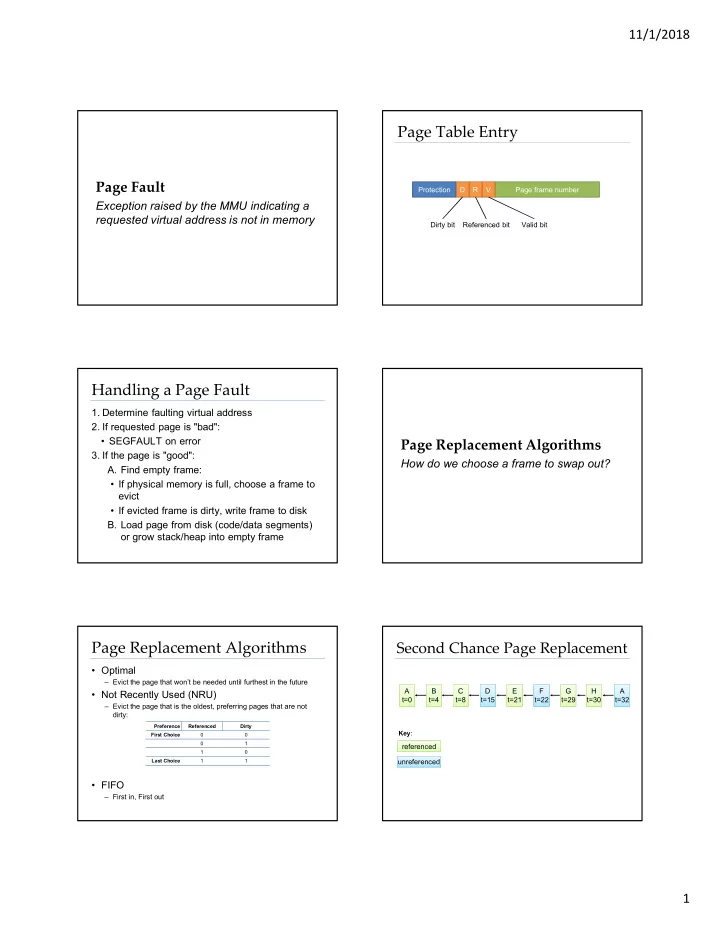
11/1/2018 Page Table Entry Page Fault Protection D R V Page frame number Exception raised by the MMU indicating a requested virtual address is not in memory Dirty bit Referenced bit Valid bit Handling a Page Fault 1. Determine faulting


slide-1
SLIDE 1

11/1/2018 1 Page Fault

Exception raised by the MMU indicating a requested virtual address is not in memory

Page Table Entry

Page frame number V R D Protection Valid bit Referenced bit Dirty bit

Handling a Page Fault

  • 1. Determine faulting virtual address
  • 2. If requested page is "bad":
  • SEGFAULT on error
  • 3. If the page is "good":
  • A. Find empty frame:
  • If physical memory is full, choose a frame to

evict

  • If evicted frame is dirty, write frame to disk
  • B. Load page from disk (code/data segments)
  • r grow stack/heap into empty frame

Page Replacement Algorithms

How do we choose a frame to swap out?

Page Replacement Algorithms

  • Optimal

– Evict the page that won’t be needed until furthest in the future

  • Not Recently Used (NRU)

– Evict the page that is the oldest, preferring pages that are not dirty:

  • FIFO

– First in, First out

Preference Referenced Dirty First Choice 1 1 Last Choice 1 1

Second Chance Page Replacement

A t=0 referenced unreferenced B t=4 C t=8 D t=15 E t=21 F t=22 G t=29 A t=32 H t=30

Key:

slide-2
SLIDE 2

11/1/2018 2

Clock Algorithm

A t=0 B t=4 C t=8 D t=15 E t=21 F t=22 G t=29 H t=30 A t=32 B t=32 C t=32 J t=32 referenced unreferenced

Key:

Least Recently Used (LRU)

Look to the past to predict the future

Aging Scheme

10000000 00000000 10000000 00000000 10000000 10000000

Tick 0

11000000 10000000 01000000 00000000 01000000 11000000

Tick 1

11100000 01000000 00100000 00000000 10100000 01100000

Tick 2

01110000 00100000 10010000 10000000 11010000 10110000

Tick 3

10111000 00010000 01001000 01000000 01101000 11011000

Tick 4

Referenced this tick

Page 0 Page 1 Page 2 Page 3 Page 4 Page 5

Working Set

  • Working set is the set of pages used by the

k most recent memory references

  • w(k,t) is the size of the working set at time t

k w(k,t)

Working Set Page Replacement Summary

Algorithm Comment

OPT (Optimal) Not implementable, but useful as a benchmark NRU (Not Recently Used) Crude FIFO (First-In, First Out) Might throw out useful pages Second chance Big improvement over FIFO Clock Better implementation of second chance LRU (Least Recently Used) Excellent, but hard to implement exactly NFU (Not Frequently Used) Poor approximation to LRU Aging Good approximation to LRU, efficient to implement Working Set Somewhat expensive to implement WSClock Implementable version of Working Set

slide-3
SLIDE 3

11/1/2018 3

Modeling Page Replacement

Page: 0 1 2 3 1 4 1 2 3 4 Youngest page 1 2 3 1 4 4 4 2 3 3 1 2 3 1 1 1 4 2 2 Oldest page 1 2 3 1 4 4

  • FIFO replacement on reference string

0 1 2 3 0 1 4 0 1 2 3 4

  • Page replacements highlighted in orange

Belady’s Anomaly

Page: 0 1 2 3 1 4 1 2 3 4 Youngest page 1 2 3 3 3 4 1 2 3 4 1 2 2 2 3 4 1 2 3 1 1 1 2 3 4 1 2 Oldest page 1 2 3 4 1

  • Try to reduce the number of page faults by supplying

more memory

  • Use previous reference string and FIFO algorithm
  • Add another page to physical memory (total 4 pages)

Local vs. Global Allocation

14 A0 12 A1 8 A2 5 A3 10 B0 9 B1 3 B2 16 C0 12 C1 8 C2 5 C3 4 C4 Page Last access time A4 A4 Local allocation A4 Global allocation

Page Fault Frequency Page Size

  • For larger pages

– Smaller page tables – Less frames in memory (smaller degree of multiprogramming?) – Internal fragmentation

  • For smaller pages

– Bigger page table – More levels of page tables – Less wasted space

Page Sharing

Map multiple pages to a single frame

slide-4
SLIDE 4

11/1/2018 4 When to Write to Disk

Now or later?

Implementation

  • Process creation
  • During process execution
  • Page fault time
  • Process termination time

Backing Store I- and D-Spaces

Code Data 232-1 Code Data Instructions Data

Segmentation