Pacing/Teacher's Notes Investigation #13: Enzyme Activity Click on - - PDF document

pacing teacher s notes
SMART_READER_LITE
LIVE PREVIEW

Pacing/Teacher's Notes Investigation #13: Enzyme Activity Click on - - PDF document

Slide 1 / 28 Slide 2 / 28 New Jersey Center for Teaching and Learning Progressive Science Initiative AP BIOLOGY This material is made freely available at www.njctl.org and is intended for the non-commercial use of students and teachers. These


slide-1
SLIDE 1

Slide 1 / 28

This material is made freely available at www.njctl.org and is intended for the non-commercial use of students and teachers. These materials may not be used for any commercial purpose without the written permission of the owners. NJCTL maintains its website for the convenience of teachers who wish to make their work available to other teachers, participate in a virtual professional learning community, and/or provide access to course materials to parents, students and others.

Click to go to website: www.njctl.org New Jersey Center for Teaching and Learning Progressive Science Initiative

Slide 2 / 28

AP BIOLOGY Investigation #13 Enzyme Activity

www.njctl.org Summer 2014

Slide 3 / 28 Investigation #13: Enzyme Activity

· Pre-Lab · Guided Investigation - Procedure 1 · Independent Inquiry

Click on the topic to go to that section

· Pacing/Teacher's Notes · Guided Investigation - Procedure 2 · Spectrophotometer Use

Slide 4 / 28

Pacing/Teacher's Notes

Return to Table of Contents

Slide 5 / 28 Teacher's Notes

Lab procedure adapted from College Board AP Biology Investigative Labs: An Inquiry Approach Teacher's Manual Click here for CB AP Biology Teacher Manual

Slide 6 / 28 Pacing

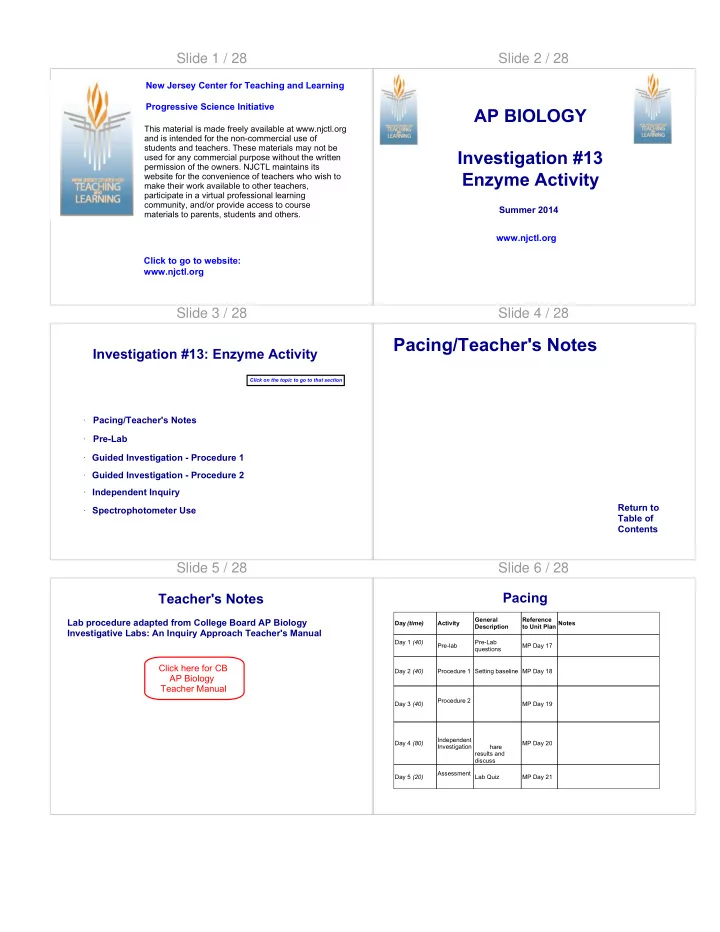
Day (time) Activity General Description Reference to Unit Plan Notes Day 1 (40) Pre-lab Pre-Lab questions MP Day 17 Day 2 (40) Procedure 1 Setting baseline MP Day 18 If you have a spectrophotometer, see instruction in presentation or lab

  • manual. Prepare for tomorrow: pH

buffers Day 3 (40) Procedure 2 Guided Practice

  • Affect of pH

and review experimental design MP Day 19 Day 4 (80) Independent Investigation Conduct independent investigation and share results and discuss MP Day 20 Day 5 (20) Assessment Lab Quiz MP Day 21

slide-2
SLIDE 2

Slide 7 / 28

Pre-Lab

Return to Table of Contents

Slide 8 / 28 Question/Objectives

How do abiotic or biotic factors influence the rates of enzymatic reactions?

In this lab we will: · Understand the relationship between enzyme structure and function. · Make some generalizations about enzymes by studying just one enzyme in particular. · Determine which factors can change the rate of an enzyme reaction. · Determine which factors that affect enzyme activity could be biologically important.

Slide 9 / 28 Pre-Lab Questions

Read the background information and answer the following questions in your lab notebook.

  • 1. Describe the structure of enzymes and relate this structure to an

enzyme's function.

  • 2. Graph free energy (G) vs. time of a exergonic biochemical reaction

with and without an enzyme present.

  • 3. Explain what is meant by "induced fit."

Slide 10 / 28 Safety

Follow general laboratory safety procedures. Wear proper footwear, safety goggles or glasses, a laboratory coat, and gloves. Use proper pipetting techniques, and use pipette pumps, syringes, or rubber bulbs. Never pipette by mouth. Dispose of any broken glass in the proper container. Since the concentrations of the reactive materials in this laboratory are environmentally friendly (0.1% hydrogen peroxide and 0.3% guaiacol), they can be rinsed down a standard laboratory drain. The concentrations used here are deemed safe by all chemical standards, but recall that any compound has the potentiality of being detrimental to living things and the environment.

Slide 11 / 28

Guided Investigation - Procedure 1

Return to Table of Contents

Slide 12 / 28

Materials - Procedure 1

· Turnip peroxidase · 0.1% hydrogen peroxide · Guaiacol · Distilled (deionized) water · 3 test tubes and test tube rack · Timer · 1, 5, and 10 mL graduated pipettes · Camera · Spectrophotometer (if available) · Laboratory notebook

slide-3
SLIDE 3

Slide 13 / 28

Procedure 1: Determining a Baseline

Step 1 Using two 16 x 150 mm test tubes, mark one "substrate" and the other tube "enzyme." To the substrate tube, add 7 mL of distilled water, 0.3 mL of 0.1% hydrogen peroxide, and 0.2 mL guaiacol for a total volume of 7.5 mL. Cover the test tube with a piece of Parafilm and gently mix. Step 2 To the enzyme tube, add 6.0 mL of distilled water and 1.5 mL of peroxidase for a total volume of 7.5 mL. Cover the test tube with a piece of Parafilm and gently mix.

Slide 14 / 28

Procedure 1: Determining a Baseline

Step 3 Combine the contents of the two tubes (substrate and enzyme) in another 16 x 150 mm test tube, cover the tube with Parafilm, invert twice to mix, and place the tube in a test tube rack. IMMEDIATELY begin timing the reaction. Step 4 Observe the color change for the next 5 minutes. Rotate the tube before each reading. Record the observed color at 0, 1, 2, 3, 4, and 5 minutes using a digital camera or cell phone.

Slide 15 / 28

Procedure 1: Determining a Baseline

Step 5 Use the color palette/chart to help you quantify changes in color over time. Graph your data in your laboratory notebook.

Slide 16 / 28

Analyzing & Evaluating Results

Analysis Questions: · You measured the color change at different times. Which time will you use for your later assays? Why? (The time change that you select will serve as your baseline for additional investigations.) · When you use this assay to assess factors that change enzyme activity, which components of the assay will you change? Which will you keep constant?

Slide 17 / 28

Guided Investigation - Procedure 2

Return to Table of Contents

Slide 18 / 28

Materials - Procedure 2

· Turnip peroxidase · 0.1% hydrogen peroxide · Guaiacol · Buffers with range of pH · Distilled (deionized) water · 18 test tubes and test tube rack · Timer · 1, 5, and 10 mL graduated pipettes · Camera · Spectrophotometer (if available) · Laboratory notebook

slide-4
SLIDE 4

Slide 19 / 28

Procedure 2: The Effect of pH

Step 1 Using clean 16 x 150 mm test tubes, make six sets of pairs

  • f substrate and enzyme tubes for a total of 12 tubes. You will

substitute a different pH buffer for the distilled water used in the

  • riginal enzyme tubes. Prepare the tubes as follows and be sure to

label them. · For each substrate tube in a pair, add 7 mL of distilled water, 0.3 mL of hydrogen peroxide, and 0.2 mL of guaiacol for a total volume of 7.5 mL. · For each enzyme tube in a pair, add 6.0 mL of a specific pH solution and 1.5 mL of peroxidase for a total volume of 7.5 mL. · Cover each test tube with a piece of Parafilm, and gently mix.

Slide 20 / 28

Procedure 2: The Effect of pH

Step 2 Combine the substrate and enzyme tubes for all six pairs (total volume 15.0 mL per pair), cover with Parafilm, gently mix, and place the tubes back in the test tube rack. IMMEDIATELY begin timing reactions. Step 3 Record the observed color for each tube at 0 minutes and again at the time you chose based on your results in Procedure 1. Step 4 Use the palette/color chart to help you quantify the changes you observe. Graph your data as color intensity vs. pH

Slide 21 / 28

Analyzing & Evaluating Results

Analysis Questions: · What conclusions can you draw from your results?

Slide 22 / 28

Independent Inquiry

Return to Table of Contents

Slide 23 / 28

Designing & Conducting Your Investigation

You now have the basic information and tools needed to explore enzymes in more depth on your own. In this part of the lab, you will do just that. You will have the chance to develop and test your own hypotheses about enzyme activity. To help you get started, read the following questions, and write your answers in your laboratory notebook. · In Procedure 1, was the limiting factor of your baseline reaction the enzyme or the substrate? How could you modify the procedure you learned to answer this question? · What are three or four factors that vary in the environment in which organisms live? Which of those factors do you think could affect enzyme activity? How would you modify your basic assay to test your hypothesis?

Slide 24 / 28

Designing & Conducting Your Investigation

Design and conduct an experiment to investigate an answer to one of the questions above or another question that might have been raised as you conducted Procedures 1 and 2. Remember, the primary objective of the investigation is to explore how biotic and abiotic factors influence the rate of enzymatic reactions. Complete the following investigation proposal for teacher approval.

slide-5
SLIDE 5

Slide 25 / 28

Spectrophotometer Use

Return to Table of Contents

Slide 26 / 28

Spectrophotometer - Procedure 1

  • 1. Turn on your spectrophotometer approximately 10 to 15

minutes prior to starting the investigation so that it will warm up appropriately.

  • 2. To measure the amount of the compound tetraguaiacol, set

the wavelength to 470 nm.

  • 3. Set your machine to zero absorbance using a blank

containing all the appropriate materials except the substrate (i.e., 13.3 mL of distilled water, 0.2 mL of guaiacol, and 1.5 mL of enzyme extract = 15 mL total

Slide 27 / 28

  • 4. Determine the baseline.

· Using two 16 x 150 mm test tubes, label one "substrate" and

  • ther "enzyme." Substrate tube: 7 mL of distilled water, 0.3 mL
  • f hydrogen peroxide, and 02 mL guaiacol. Enzyme tube: 6

mL of distilled water and 1.5 mL of peroxidase. · Combine the material of the substrate and enzyme tubes. Mix the tubes twice and pour into a cuvette. · Place the cuvette into the spectrophotometer and record absorbance; this is your initial or "0" time reading. Remove the

  • tube. Repeat recording absorbance at 1, 2, 3, 4, and 5
  • minutes. Be sure to rotate the tube and also clean its surface

with a scientific cleaning wipe before each reading.

Spectrophotometer - Procedure 1

Slide 28 / 28

Spectrophotometer - Procedure 2

  • 1. Turn on your spectrophotometer approximately 10 to 15

minutes prior to starting the investigation so that it will warm up appropriately.

  • 2. To measure the amount of the compound tetraguaiacol, set

the wavelength to 470 nm.

  • 3. Set your machine to zero absorbance using a blank

containing all the appropriate materials except the substrate (i.e., 13.3 mL of distilled water, 0.2 mL of guaiacol, and 1.5 mL of enzyme extract = 15 mL total

  • 4. Set up test tubes as described in Procedure 1, and use

spectrophotometer to take readings at time 0 and selected time.