SLIDE 1
Page | 1
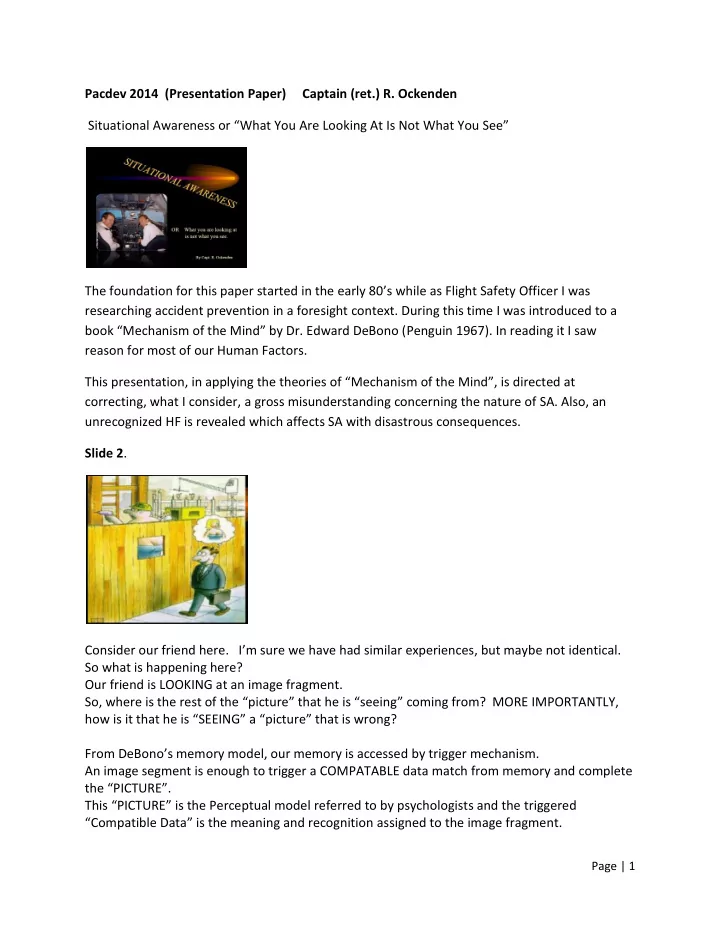
Pacdev 2014 (Presentation Paper) Captain (ret.) R. Ockenden Situational Awareness or “What You Are Looking At Is Not What You See” The foundation for this paper started in the early 80’s while as Flight Safety Officer I was researching accident prevention in a foresight context. During this time I was introduced to a book “Mechanism of the Mind” by Dr. Edward DeBono (Penguin 1967). In reading it I saw reason for most of our Human Factors. This presentation, in applying the theories of “Mechanism of the Mind”, is directed at correcting, what I consider, a gross misunderstanding concerning the nature of SA. Also, an unrecognized HF is revealed which affects SA with disastrous consequences. Slide 2. Consider our friend here. I’m sure we have had similar experiences, but maybe not identical. So what is happening here? Our friend is LOOKING at an image fragment. So, where is the rest of the “picture” that he is “seeing” coming from? MORE IMPORTANTLY, how is it that he is “SEEING” a “picture” that is wrong? From DeBono’s memory model, our memory is accessed by trigger mechanism. An image segment is enough to trigger a COMPATABLE data match from memory and complete the “PICTURE”. This “PICTURE” is the Perceptual model referred to by psychologists and the triggered “Compatible Data” is the meaning and recognition assigned to the image fragment.
SLIDE 2
Page | 2
Slide 3 Trigger Effect. Advantages:- Allows rapid identification of our environment. Allows rapid judgment and reaction to our environment. Disadvantages:- Can generate a mental picture DIFFERENT to reality. Which in turn, will corrupt the judgment of and our reaction to the environment. Slide 4. As a more obvious example of the “Trigger Mechanism”, consider this paragraph. Once a pattern is in memory (which could be an image, an experience or situation) then all that is required is a fragment of that pattern to trigger it. Slide 5. Here we have another example of the trigger mechanism operating in these well known ambiguous figures. The memory is switching between the two possible scenarios. The incoming visual segment presents the possibility of an alternative data match from memory. It is analogous to a jigsaw puzzle piece where two different adjoining pieces will fit in the one slot. The mental picture is unable to be resolved.
SLIDE 3 Page | 3
Slide 6. Incoming Data Fragment: - (Memory picture Schematic) Affected by: Physiological factors Sensory selectivity. Environmental factors. The Mental Picture is the compatible data match triggered from memory. Memory Base is inclusive of:- Experiences. Cultural Influences. Beliefs. Supplemental information. As we shall see, this is MOST IMPORTANT. It supplements the incoming sensory fragment and modifies the “compatible data” match. If this is deficient
- r erroneous a false mental picture will result.
Information such as, NOTAMS, advisory highway and railway signs, and warnings are examples. Slide 7. The “Mental Picture” is VIRTUAL in our cyberspace, and is in fact our REALITY. It follows that our Mental picture and Situational Awareness are closely integrated and for the purpose of this presentation can be considered as synonymous. It is therefore essential that these be accurate if we are to react correctly with our environment.
SLIDE 4
Page | 4
Slide 8. Our AWARENESS is always “full screen”, whether the focus is close up (as in viewing a Jepp. Chart) or panoramic (as in scanning outside for traffic and weather). Currently some CRM courses teach what to do when you lose SA. So, how do you know you have lost Awareness when it is always there? Answer, of course you don’t, unless you are asleep, unconscious or daydreaming. So to say you have lost SA is misleading. However, the question becomes, whether your awareness includes the elements required for you to react correctly with your situation. Focusing (or tunnel vision) and distraction are enemies of maintaining an up to date SA. The more dynamic the situation the faster the “refresh rate” (or scan) should be. Else those vital elements will change significance or fade altogether. Slide 9. Incomplete or misleading SENSORY INPUT and/or combined with incomplete or erroneous SUPPLEMENTARY INFORMATION will trigger a compatible fit scenario that creates an erroneous S/A which WILL BE PERCEIVED AS REALITY. Slide 10.
SLIDE 5 Page | 5
Slide 11. Conflict S/D:- Generally, feelings of doubt or confusion indicate that our “Mental Picture” is NOT resolved. There is conflicting sensory input preventing the Mental Picture from being resolved. Here, rescanning instruments, checking frequencies or confirming with ATC will generally resolve the doubt or confusion. For example, you are flying manually straight and level and you notice you are feeding in crossed controls to maintain the status quo. You know something is not right. Checking instruments or noticing a comparator warning will resolve the conflict. Another example:- when doing ILS simulator training with cadets at Bn 19. T/O left turn out, base position instructor then says “turn right hdg 150, pilot intercept of the Loc”. Many cadets will turn right for NZ. The others will see the Loc to their left but ATC said to go right. One can
- bserve the trigger mechanism trying to resolve the ambiguity (turn left or right) in the cadet’s
- mind. Eventually a radio check for heading clarification resolves the conflict.
NO CONFLICT S/D Consider now our ambiguous figure again, and what happens when only ONE solution is triggered from memory. This occurs when the mental picture is 1 to 1 with the real world. OR when the actual sensory (in this case, “ visual”) input is the same or similar as an expected reality but for a DIFFERENT situation. In other words, the one “compatible data match” satisfies two DIFFERENT conditions, the actual and expected visual fragments. We now have a NO CONFLICT S/D situation. An everyday example of this, you think you see a friend in the crowd and when you catch up with that person, they are not who you expected. Slide 12.
SLIDE 6 Page | 6
The significance of this is there are NO indications either real or psychological to indicate any difference between the Mental Picture and the Real World. From DeBono, Expectation can trigger the WRONG “picture” given a similar element
Triggered patterns can have a solid recognition and yet be different from reality. The difference would not be known. These conditions create NO CONFLICT S/D. Let me introduce this with a personal experience. I was doing my endorsement in the US on the Lear 45. Sector Touson to El Paso. Clear blue sky. 3 in the cockpit (Myself PF, My Chief pilot PM, Bombardier test pilot obs.). Descending into El Paso, C/L & briefing done, aids set up, field in sight, cleared for visual approach. Leveling on final ATC calls and says you appear to be landing on the military aerodrome, Domestic is about 4 ml at your 10 o’clock. I thought this could only happen in marginal conditions, but not seeing a whole airport on a clear blue day! I have a theorem for it. When you are looking for something it is always in the last place you look. Conversely: When you find what you are looking for, you don’t keep looking for it. The point here being that none of us in that cockpit knew there was another airport nearby. There was no reference on our landing chart. Why would there be? They are IFR charts, so landing at the wrong airport is not a problem off an IFR approach. Unless of course you transition to VFR approaching the field and you don’t know there is another airport nearby. Expectation can trigger the WRONG “picture” given a similar element (the expected) of a DIFFERENT reality (in this case “different airport”). In this example, supplementary information was missing, a No Conflict SD was triggered. It took the EXTERNAL input from ATC to correct our “Mental Picture’s” Slide 13. Last November a 747 DreamLifter landed at Wichita Jabara a/p instead of McConnel AFB 8nm away.
SLIDE 7 Page | 7
Slide 14. A month later a SouthWest 737 landed at Graham a/p Missouri instead of Branson 7nm distant. The NTSB was investigating distraction, since there were 3 in the cockpit. Radar advised the crew they had 10nm to the a/p. Crew response, we are visual with the rwy. When two A/P are in proximity, with same RWY alignment, and an IFR a/c transitioning to a visual approach. A NO CONFLICT SD can exist when only one A/P is known. Landing at wrong airports seems to be predominately a US luxury with so many adjacent
- airports. However, there are many other instances on YouTube and PPrune.
During the 80’s Essendon 34 was encountering this problem with a/c landing Tullarmarine 34. Similarly, airports at night with parallel street lighting can cause the same perceptual error. Slide 15. SQ006 SIA Taipei a/p 2002:- This is the most insidious example of NO CONFLICT SD on record. Slide 16
SLIDE 8 Page | 8
The ENVIRONMENTAL sensory inputs were bad and misleading. Cyclone centre 15 mins away, poor visibility due night and heavy rain lashing the windscreen. Concern about the maximum crosswind. Slide 17. What brought the crew undone were the gross erroneous visual cues. A decommissioned runway 05R was being used as a taxiway for the active runway 05L. The lighting of this taxiway was still runway lighting, the same as the active runway 05L. There were no white cross markers on the 05R runway to indicate it was unusable. This disused runway was still referred to as 05R, a runway designation, not a taxiway. The greens, although they went to the active runway, were u/s or dull past the 05R threshold. The only SUPPLEMENTAL INFORMATION provided was there was earthmoving equipment
Slide 18. Taxiways are supposed to look like this (the expected). Instead, this one looked like --. Slide 19.
SLIDE 9 Page | 9
So the visual fragments were RUNWAY images (the equipment was notamed on a TAXIWAY). An erroneous mental picture was triggered by a similar element of a different situation and disaster ensued. This crew was operating by the book. I really feel for the pax and subsequent treatment of the
- Crew. Which is one reason I’m standing before you people today.
What the investigators thought the crew were looking at, is NOT what the crew saw. If it looks like a duck and quacks like a duck it probably is… but not in this case! Yes there was the “runway centre line indicator” indicating out to the left. However, if you are on the runway and there is only one runway, then the instrument must be malfunctioning, right? I don’t know what its MEL status was, but if it does not now have the status of the hard warnings, it should have. This would force an override of the compelling visual perception to have the instrument checked. Thus the disaster could have been averted. If this accident didn’t happen to SQ006, it was going to happen to another crew. Slide 20. Perspective SD example. This situation was an F4 Phantom doing night refueling with a KC 135. Slide 21. This is a perspective of what the F4 pilot was zeroing in on with the KC135’s nav and strobe lights.
SLIDE 10 Page | 10
Slide 22. This is what he zeroed in on. Mid air collision ensued. No one knew the existence of the Cherokee and both pilots were
- killed. Supplemental information was lacking, wrong mental picture triggered.
Slide 23. The former are some examples of NO CONFLICT DISORIENTATION. In the absence of EXTERNAL INTERVENTION (ATC, other crew, check list or FINALLY the hard warnings GPWS etc,) there is NO WAY of resolving the perceptual error which could now be leading to disaster. In a multi crew environment, the crew’s overlapping S/A’s and SOP’s should pick up errors and
- missions. This, however, is no guarantee against the “Trigger Mechanism’s” No Conflict SD.
Single pilots are more at risk. Technology (by default) has been closing the loopholes (GPWS, TCAS, gear & o’speed warnings, Etc.). Ground radar and eCharts giving GPS position on the A/P are becoming available. However, there will be many A/C & A/P’s without these benefits. Slide 24. Scrutinizing the many such examples, Manufacturers and Authorities need to shoulder major responsibility for setting up these NO Conflict SD scenarios. For instance:- Multifunction switches leading to multimodal situations:- AirInter 148 (A320, Strasbourg). V/S mode with alternative switching, 3.3 deg v/s 3.3 f/min x 1000. Same number presentation to the crew, huge difference in A/C flight path. AirInter at the time were speeding around at 350kts. below 10,000’ due high speed train competition. Consequently, they were encountering many GPWS warnings. The Management perceived these as nuisance warnings and removed the equipment from the fleet. As the GPWS was the ONLY external input able to correct the NO Conflict SD of the crew, the fate of AirInter 148 was sealed.
SLIDE 11 Page | 11
Air France 447. A330 into the Atlantic off Brazil. The cockpit design was such that neither pilot knew what the other was doing with the flight controls. This is in fact a contravention of CRM principles. IFR Airport Charts not alerting the proximity of other airports and with their distances & directions. SQ006:- Runway marking & lighting erroneous and not ICAO standard, notams deficient. Runway incursions:- Complex taxiways and intersections, their signs obscured. Ground radar there in boxes for 18 months and not installed, despite weekly incursions. (Linate, Milan) Slide 24 cont. Data presentation not labeled. We had a CFIT accident with a Lear 31 in ‘97 at Ranong,
- Thailand. Cause was considered to be the captain basing his descent on the FMS distance which
was to the IAF, thinking it was the DME distance to the field. Easily done as the FMS time and distance numbers had no labeling. This error would have put him 20nm further out than he realized and about 8000’ low on descent profile. It was the cadets 2nd day in the a/c. The FMS’s were subsequently updated with labeling next to these parameters. The list goes on: These examples are low frequency but catastrophic. Understanding the Trigger Mechanism and how it affects our SA, explains the basis of these accidents and will hopefully prevent ones like them in the future. Slide 25. The Trigger Mechanism is A basic Human Factor and has a profound effect on our SA. Yet, to my knowledge, it and its effects are unknown in CRM programs and Accident Prevention circles. Also Confused and disbelieving pilots, convinced of the validity of their situation, can now understand how their incident or accident was due to their situation being different to what they believed. The NO CONFLICT SD Trigger Mechanism is insidious, provides no indication of situational error and ONLY EXTERNAL INPUT will correct it. Designers and Regulators must appreciate the Trigger Mechanism when designing their systems and regulations. It is not what the crew are looking at, but what they will “SEE”.
SLIDE 12
Page | 12
Slide 26. In conclusion, I have a short video for you. (“Cyclist” 8 sec) Slide 27. No Conflict S/D (Situational Disorientation). Sometimes, what you are looking at is not what you think it is. A familiar recognition is triggered but the REALITY is different. Thank you for your attention. R.Ockenden
SLIDE 13
Page | 13