
SLIDE 1
Pa#ent ¡#1 ¡ ¡
Images ¡adapted ¡from ¡Yousem, ¡ ¡Mod ¡Pathol. ¡2012; ¡Ji ¡et ¡al., ¡Oncogene, ¡2006; ¡ ¡h;p://www.histology-‑world.com/photoalbum/displayimage.php?album=15&pid=714. ¡
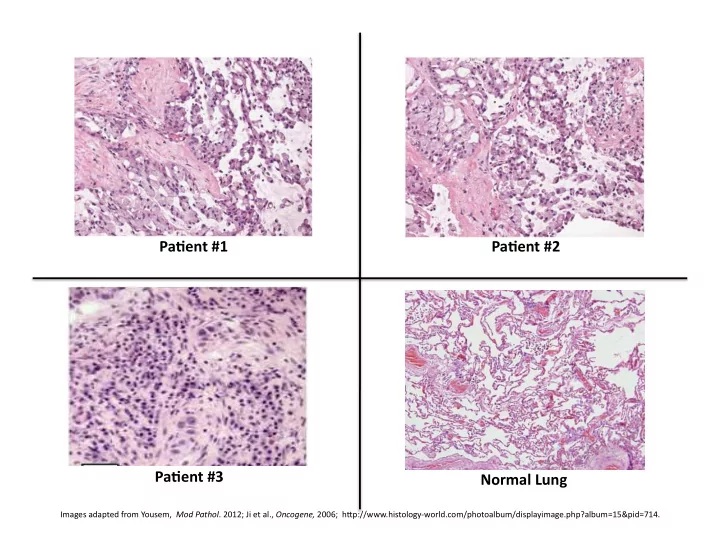
Pa#ent #1 Pa#ent #2 Pa#ent #3 Normal Lung Images - - PowerPoint PPT Presentation
Pa#ent #1 Pa#ent #2 Pa#ent #3 Normal Lung Images adapted from Yousem, Mod Pathol . 2012; Ji et al., Oncogene, 2006;
Images ¡adapted ¡from ¡Yousem, ¡ ¡Mod ¡Pathol. ¡2012; ¡Ji ¡et ¡al., ¡Oncogene, ¡2006; ¡ ¡h;p://www.histology-‑world.com/photoalbum/displayimage.php?album=15&pid=714. ¡
Protein ¡structures ¡adapted ¡from ¡Protein ¡Databank ¡(PDB) ¡h;p://www.rcsb.org/pdb/home/home.do ¡
(which ¡is ¡a ¡form ¡of ¡EGFR ¡that ¡is ¡only ¡present ¡in ¡cancer) ¡
(an ¡enzyme ¡that ¡replicates ¡DNA, ¡and ¡is ¡acQve ¡in ¡all ¡ growing ¡& ¡dividing ¡cells) ¡
1) Fill in this table with whether each treatment would work, or not work, to treat each kitchen-related problem: In ¡a ¡kitchen ¡with ¡an ¡
coffee ¡ ¡maker ¡ In ¡a ¡kitchen ¡with ¡an ¡
¡ Use ¡a ¡lid ¡ Use ¡a ¡rubber ¡stopper ¡ Turn ¡off ¡power ¡to ¡the ¡ whole ¡kitchen ¡ 2) Which is the best way to treat a kitchen with an out-of-control coffee maker? 3) Which is the best way to treat a kitchen with an out-of-control blender? 4) Which treatment works to treat the
yields other negative side effects to the kitchen?
Images adapted from Koivunen J P et al. Clin Cancer Res, 2008.
*Gene A has been dyed red and Gene B has been dyed green. If both genes come together at the same location due to a change in the DNA, then the area appears yellow.
Pa#ent ¡#1 ¡ ¡ Pa#ent ¡#2 ¡ ¡ Pa#ent ¡#3 ¡ ¡ Normal ¡lung ¡ Pa#ent ¡#1 ¡ ¡ Pa#ent ¡#2 ¡ ¡ Pa#ent ¡#3 ¡ ¡ Normal ¡lung ¡
Data adapted from Jänne et al., Clin Cancer Res. 2006; Jackman et al., Clin Cancer Res. 2009; Shaw et al, Nat Rev Drug Disc. 2011; Mok et al., New Eng J
Data adapted from Pao et al., Lancet Oncology 2011.