P3 & P4 Parents Seminar Mathematics Strategies for Model - - PDF document

p3 p4 parents seminar mathematics strategies for model
SMART_READER_LITE
LIVE PREVIEW

P3 & P4 Parents Seminar Mathematics Strategies for Model - - PDF document

P3 & P4 Parents Seminar Mathematics Strategies for Model Drawing 27 Feb 2016 Springdale Primary School 1 Objectives At the end of this session, parents will be able to: Understand the rationale of using the model approach in


slide-1
SLIDE 1

Springdale Primary School

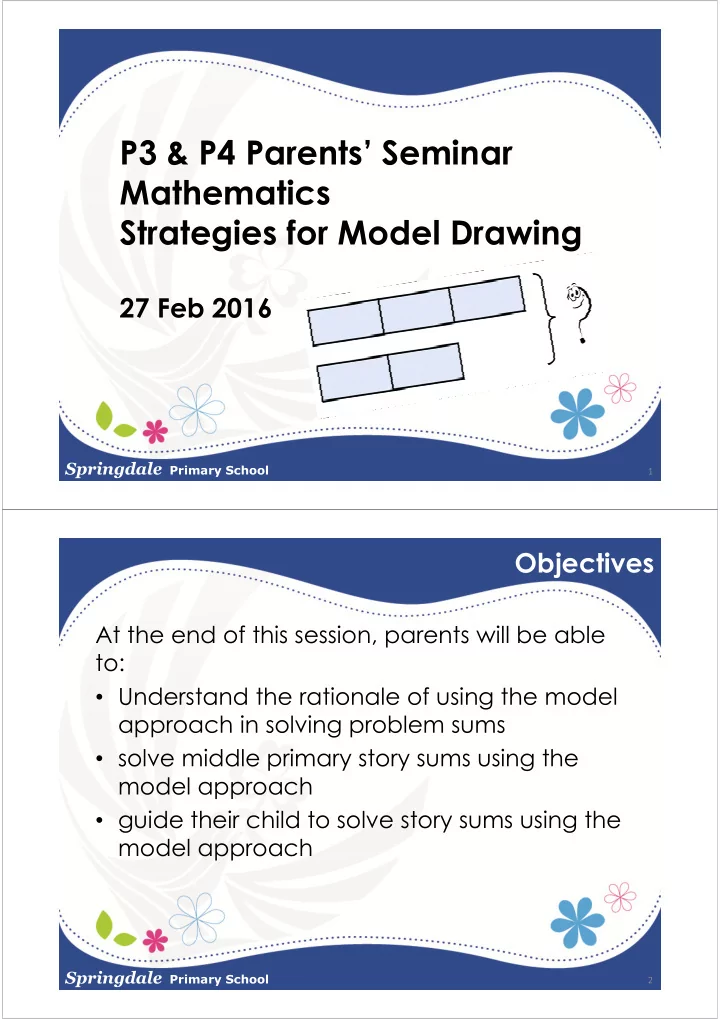
P3 & P4 Parents’ Seminar Mathematics Strategies for Model Drawing

27 Feb 2016

1

Springdale Primary School

Objectives

At the end of this session, parents will be able to:

  • Understand the rationale of using the model

approach in solving problem sums

  • solve middle primary story sums using the

model approach

  • guide their child to solve story sums using the

model approach

2

slide-2
SLIDE 2

Springdale Primary School

Outline

  • Why? (Introduction to model method)
  • What? (Explanation of different types
  • f model)
  • How? (Hands-on practice with drawing
  • f model)
  • How? (Home support for your child)

3

Springdale Primary School

Curriculum Framework

4

slide-3
SLIDE 3

Springdale Primary School

Problem-solving Process

  • Understanding the Problem

– Look for given information – Visualize the information – Organize the information – Connect the information

  • Devising a Plan (Strategy)
  • Carrying out the Plan (Strategy)

– Use computational skills – Use geometrical skills – Use logical reasoning

  • Reflecting

– Check reasonableness – Improve of the method used – Seek alternative solutions – Extend the solution to other problems

5

Springdale Primary School

Processes – Thinking Skills

  • Thinking skills are skills that are used in a

thinking process, such as – Classifying – Comparing – Analysing parts and whole – Identifying patterns and relationships – Induction – Deduction – Generalising – Spatial visualisation

6

slide-4
SLIDE 4

Springdale Primary School

Processes – Heuristics

  • Heuristics are problem-solving strategies

when the solution to the problem is not

  • bvious. These include

– making a guess (e.g. trial and error/guess and check, making a supposition) – walking through the process (e.g. acting it

  • ut, working backwards)

– using a representation (e.g. drawing a diagram, tabulating) – changing the problem (e.g. simplifying the problem, considering special cases)

7

Springdale Primary School

Using a Representation

  • Representations allow students to

– reflect on them; – modify them; and – link them to suitable problem-solving strategies

  • Representations include

– Picture – Model – Diagram – Table/List

8

slide-5
SLIDE 5

Springdale Primary School

Mathematics Syllabus

Primary 1 and 2 Primary 3 and 4 Primary 5 and 6

  • Whole Number
  • Money, Measures

& Measuration

  • Fractions
  • Whole Number
  • Money, Measures

& Measuration

  • Fractions
  • Decimals
  • Whole Number
  • Money, Measures

& Measuration

  • Fractions
  • Decimals
  • Ratio & Proportion
  • Percentage
  • The model method is one of the most frequently

used problem-solving heuristics throughout primary school.

9

Springdale Primary School

Mathematics Syllabus

  • In secondary school, the

model is morphed to that

  • f the algebraic method.

http://www.math.harvard.edu/~engelw ar/MathE305/Singapore%20Model%20M ethod%20Text.pdf

10

slide-6
SLIDE 6

Springdale Primary School

Mathematics Syllabus

  • In the international scene,

the model method is synonymous to that of Singapore Mathematics.

http://math.nie.edu.sg/ame/matheduc /tme/tmeV6_2/05- Yan%20KC%20Final%20version.pdf

11

Springdale Primary School

Features of Model Drawing

  • Simplify the problem.
  • Visualize the problem from abstract to

concrete.

  • Make sense of and manipulate the

information pictorially.

  • Length of the rectangular bars is drawn

in relation to one another.

12

slide-7
SLIDE 7

Springdale Primary School

Features of Model Drawing

  • The available information is recorded
  • nto the models.
  • Question marks are used to indicate the

unknown information.

  • Translate the problem into mathematics

steps.

13

Springdale Primary School

Procedure of Model Drawing

Phase Action Questions

WHOLE Read the whole problem sum Have I read the whole sum? PART Read the sum line by line What do I know? Can I draw a diagram to show what I know? What do I not know? Can I draw a diagram to show what I do not know? LINK Read what you have written and drawn How can I link up whatever I have drawn? How can I solve the problem?

14

slide-8
SLIDE 8

Springdale Primary School

Types of Model

  • Part-whole Model
  • Comparison Model
  • Before-after Model

  • Modification of model

15

Springdale Primary School

Part-Whole Model Part Part Whole

16

slide-9
SLIDE 9

Springdale Primary School

Part-Whole Model Part Part Whole

17

Springdale Primary School

Examples

  • 1. A container with 2 packets of milk has a mass of 1 200 g.

The same container with 4 packets of milk has a mass of 2 200 g. What is the mass of the empty container?

1 200 2 200

milk container milk milk container milk milk milk

?

18

slide-10
SLIDE 10

Springdale Primary School

Examples

  • 2. 3 shirts and 1 dress cost $84.

3 shirts and 3 dresses cost $132. Find the cost of a dress.

132 84

?

19

Springdale Primary School

Examples

  • 3. I am thinking of 3 numbers.

Number A and Number B adds up to 49. Number B and Number C adds up to 57. Number A and Number C adds up to 64. What are the 3 numbers?

49

B A C A

64

B C

57

20

slide-11
SLIDE 11

Springdale Primary School

Comparison Model Comparison X Y

21

Springdale Primary School

Comparison Model Comparison X Y

22

slide-12
SLIDE 12

Springdale Primary School

Examples

  • 4. Aaron is 28 years older than Ben.

Ben is 4 years older than Carl. If their total age is 84 years, what is Aaron’s age?

28 Aaron Ben Carl 84 ? 4 4

23

Springdale Primary School

Examples

  • 5. Aaron has thrice the number of marbles Ben has.

Carl has twice the number of marbles Aaron has. If Carl has 60 more marbles than Ben, how many marbles does Aaron have?

Aaron Ben Carl ? 60

24

slide-13
SLIDE 13

Springdale Primary School

Examples

  • 6. The sum of 2 numbers is 1 568.

The difference between them is 580. What is the greater number?

580 Big Small 1 568 ?

25

Springdale Primary School

Examples

  • 7. The difference between 2 numbers is 2 480.

The greater number is 5 times as big as the smaller number. What is the sum of the 2 numbers?

Big Small ? 2 480

26

slide-14
SLIDE 14

Springdale Primary School

Examples

8.

  • f the sales from potatoes is as much as
  • f the sales

from tomatoes. The sales from the potatoes is $500 less than the sales from tomatoes. Find the total sales from the potatoes and tomatoes.

Potatoes Tomatoes ? 500

27

Springdale Primary School

Examples

  • 9. At a concert, there were twice as many girls as boys.

The number of adults is

  • f the number of girls. There

are 360 fewer adults than girls. How many people were at the concert?

Girls Boys Adults 360 ?

28

slide-15
SLIDE 15

Springdale Primary School

Before-After Model

  • A basic change situation involves

3 elements

– the initial value of a quantity – the change, which can be an increase or decrease, and – The final value of the quantity

  • 2 models are drawn for comparison.
  • It is not always the case when the

before model is drawn first.

29

Springdale Primary School

Examples

  • 10. Aaron had 5 times as many marbles as Ben. After Aaron

gave 72 marbles to Ben, they each had the same number

  • f marbles. How many marbles did Aaron had at first?

Aaron Ben ? 72 Aaron Ben

BEFORE AFTER

30

slide-16
SLIDE 16

Springdale Primary School

Examples

  • 11. Aaron had 6 times as much money as Ben at first. When

their mother gave them $300 each, Aaron has 3 times as much money as Ben now. How much money did they have at first?

Aaron Ben ? ? Aaron Ben

BEFORE AFTER

300 300 300 300

31

Springdale Primary School

Examples

  • 12. Class A had
  • the number of pupils in Class B. After 14 pupils

were transferred out from Class A, Class A had

  • the number
  • f pupils in Class B. How many pupils were there in both

classes altogether in the beginning? A B

?

BEFORE AFTER

A B

14

32

slide-17
SLIDE 17

Springdale Primary School

Hands-on Session

Now it is your turn. :)

33

Springdale Primary School

A Final Word

What Makes Model-drawing Difficult?

  • Knowledge Factors

– Linguistic knowledge – Algorithmic knowledge – Conceptual knowledge – Schematic knowledge

http://repository.nie.edu.sg/jspui/bitstream/10497/132/1/ME-2-1-93.pdf

34

slide-18
SLIDE 18

Springdale Primary School

A Final Word

What Makes Model-drawing Difficult?

  • Affective factors

– Interest and motivation – Confidence – Perseverance

http://repository.nie.edu.sg/jspui/bitstream/10497/132/1/ME-2-1-93.pdf

35

Springdale Primary School

A Final Word

Common Model-drawing Pitfalls

  • Incorrect representation of the story sum
  • Incomplete representation of the story

sum

  • Transfer error

36

slide-19
SLIDE 19

Springdale Primary School

A Final Word

Resources for Model-drawing

  • Facebook group – “Maths Model Method

– Singapore”

  • http://www.teach-kids-math-by-model-

method.com/

  • http://citeseerx.ist.psu.edu/viewdoc/dow

nload?doi=10.1.1.555.5563&rep=rep1&ty pe=pdf

37

Springdale Primary School

Q & A THANK YOU

38