P15482: Breadfruit Shredder Brittany Griffin, Samantha Huselstein, - - PowerPoint PPT Presentation

p15482 breadfruit shredder brittany griffin samantha
SMART_READER_LITE
LIVE PREVIEW

P15482: Breadfruit Shredder Brittany Griffin, Samantha Huselstein, - - PowerPoint PPT Presentation

P15482: Breadfruit Shredder Brittany Griffin, Samantha Huselstein, Andrew Beckmann, Patrick Connolly, Alan Kryszak Overview Background Concept Summary Final Design Testing Results and Recommendations What is a Breadfruit?


slide-1
SLIDE 1

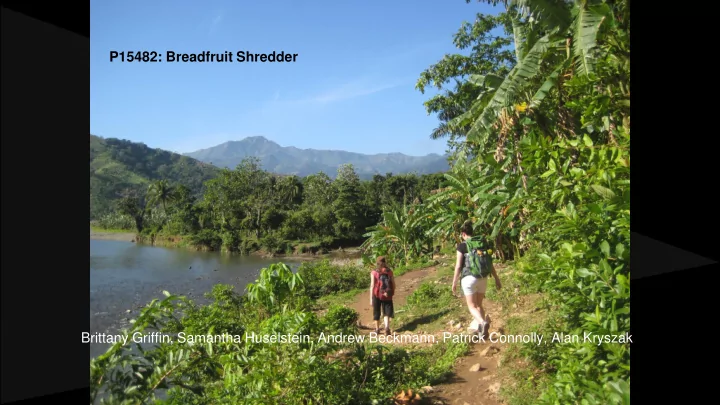
P15482: Breadfruit Shredder Brittany Griffin, Samantha Huselstein, Andrew Beckmann, Patrick Connolly, Alan Kryszak
slide-2
SLIDE 2

Overview

  • Background
  • Concept Summary
  • Final Design
  • Testing
  • Results and Recommendations
slide-3
SLIDE 3

What is a Breadfruit?

  • Nutrient rich tropical fruit
  • High in Carbohydrates, dietary fiber,

Vitamin C, Potassium

  • Member of the fig family
  • Starchy, similar to a potato
  • Common Haitian preparations:
  • Fufu* (similar to mashed potatoes)
  • Frying (similar to fried green plantains)
  • Boiled
slide-4
SLIDE 4

Helping Haitian Farmers

  • KGPB Farmers identified breadfruit as one the the most

wasted agricultural products in the area

  • Short shelf life (1-3 days)
  • Summer harvest season
  • Hard to transport, store, and preserve
  • Solution must be low cost and have no energy cost

Converting breadfruit into flour addresses these problems and it was our team’s challenge to do it at low cost and low energy!

slide-5
SLIDE 5

Project Goals

  • Flour producing process = 3 parts
  • Shredding
  • Drying
  • Grinding
  • Working prototype(s) that shreds breadfruit

to be dried and grinds dried breadfruit pieces

slide-6
SLIDE 6

Customer Requirements of Highest Importance

Category Requirement Feasibility Uses available resources Feasibility Minimizes water usage Cost No energy cost Cost Low maintenance cost Ease of Use Can be used by adult breadfruit farmer Safety Provides barrier to hazardous parts Safety Does not contaminate food Profit Provides flour that can be used to make fufu

slide-7
SLIDE 7

Architecture

slide-8
SLIDE 8

Functional Decomp

slide-9
SLIDE 9

Concept Generation

Brainstorming Benchmarking

slide-10
SLIDE 10

Concept Selection

Pugh Analysis Selection Criteria

  • Doesn’t use electricity
  • Available in Haiti
  • Easy to maintain/sharpen
  • Effort required to operate
  • Easy to understand
  • Within budget

Bonus: Peels and cores breadfruit

slide-11
SLIDE 11

Feasibility

  • Prototyping
  • Question: Will our blade design work?
  • Created Mock-up blades from Al
  • Also used horizontal mill tooling
  • Results: Works well! 3 teeth seemed to work

better and would be easier to manufacture

  • Deflection of Plastic Blades
  • Question: Can we save cost by using plastic

blades?

  • Results: We are not sure if they will be

strong enough. Would be a huge risk.

Al Prototype Mill tooling Plastic blade deflection

slide-12
SLIDE 12

Feasibility

Shear pin calculations

  • Question: Can we have a shear pin that will

allow breadfruit to be shredded but protect the blades?

  • Results: Yes, but we needed to increase the size of the pin and

get more durable keys for the shafts

Fatigue Life of Shafts

Question: Will this need to be repaired in Haiti? Results: Safety factor of ~300, therefore, will not break within its useful life

slide-13
SLIDE 13

And then there was one...

  • Cost Analysis
  • Shredder budget ~ $600
  • Grinder budget ~ $325
  • Problems: shipping cost not accounted for, no room

for error in manufacturing, risky grinder design, rollers would need to be replaced for grinder design (before shipping to Haiti), does not include hopper or stand

  • Project Plan
  • Over 100 parts to be made for shredder alone!
  • No time to build 2 machines in one semester

Photo Credit: UMICH Breadfruit Grinder Team

slide-14
SLIDE 14

Final Design

Final Design

slide-15
SLIDE 15

Final Design Details

  • Materials
  • Non-corrosive, highly durable
  • Shear Pin
  • Fail-safe, protect blades and shaft keys
  • Hopper
  • Provide safety, holds up to 6 breadfruit (peeled and cored)
  • Stand
  • Comfortable for person around average Haitian height
  • Braced for stability
  • Holds 5 gal bucket
  • Can place cinder blocks to help hold it down
slide-16
SLIDE 16

Design Changes/Difficulties

Design Difficulties

  • Bending Guards

Accurately

  • Tight Clearance

Between Blades

  • Properly Building

Welded Parts

Design Changes

  • Shear Pin Diameter
  • Hopper Size
  • Stand Cross Braces
  • Key stock Material
  • Shaft Size for Blades
slide-17
SLIDE 17

Other Problems Overcome...

slide-18
SLIDE 18

Testing

  • Shear Pin Test
  • Interference
  • Operating Metrics
  • Assembly Timing
  • Shredder Yield
slide-19
SLIDE 19

Shear Pin Results

Conclusion: The result of the shear pin test above shows that all shear pins sheared at values less than the Thigh value of 11,697 psi. Therefore no damage will be done to the system and only the shear pin will need to be replaced.

slide-20
SLIDE 20

Interference Results

  • Interference testing was performed

throughout the build process.

  • All parts were measured to meet

Drawing Specifications.

  • Blades and spacers were precision

ground in pairs to ensure no interference between parallel shafts.

  • Blades have .003” Clearance (Less

than a piece of paper!)

slide-21
SLIDE 21

Operation Metrics Results

Conclusions: All operating metrics met their target values. Average of ~71.2 breadfruit per hour. Cleaning met the marginal time. Recommendations:

  • Cut breadfruit into eighths instead of quarters. (Does not need re-adjusting in hopper to get

caught in blades)

  • Feeding shreds through twice will make smaller more uniform shreds (will save on drying

time)

  • Use tube/bottle brush instead of toothbrush (Plastic of toothbrush was shaved off by blades)
  • Look into sending a squirt bottle for faster cleaning
slide-22
SLIDE 22

Assembly Timing Results

Conclusion: All set up, disassemble, and reassemble times were below target

  • values. Moving entire assembly can be done in a quick and efficient manner.

Recommendations: Redo test with more people to make sure we continuously meet specs

slide-23
SLIDE 23

Shredder Yield Results

Conclusion: Shredder Yielded ~98.3% of input breadfruit by weight. Almost all of breadfruit was shredded leaving on only 1.7% of breadfruit left in shredder. Recommendation: By running the shredder in reverse for 3-4 turns, the remaining breadfruit can be retrieved and can be reprocessed through the blades.

slide-24
SLIDE 24

Project Evaluation

slide-25
SLIDE 25

Project Plan versus Actual

  • Task tracker was used to

determine when tasks needed to be completed versus when they were actually completed.

  • Tasks were completed on

average .13 and .75 days in advance for MSD I and MSD II respectively.

slide-26
SLIDE 26

Budget Evaluation

Proposed Budget vs Actual Budget

Vendor Description Amount Charged Speedy Metals

  • Misc. parts

$360.48 McMaster

  • Misc. parts

$163.39 BDI Express

  • Misc. parts

$95.43 Klein Steel Angle Iron $41.10 ePlastics Black acetal sheet $76.98 Curbell Polycarbonate sheet $30.00 Lowe’s Paint $27.50 Wegmans Breadfruit $96.58 Remaining Balance $108.54 Total Spent $891.46

slide-27
SLIDE 27

Recommendations for Future

In Haiti:

  • Teach about shear pin function
  • Teach about hopper function (in regards to safety)
  • Collect Feedback from Farmers
  • Shredder specific - What do you like? What do you not like? How
  • ften do you use the shredder?
  • Is flour being used by KGPB farmers?
  • Does your family use breadfruit flour?
  • Are the women selling the flour in the market?
  • Is there a part of the flour process that could be better?
slide-28
SLIDE 28

Recommendations for Future

If new shredder is needed:

  • For 2nd iteration of MSD
  • Easier to manufacture
  • Look into cheaper materials to use
  • More thorough analysis on plastics
  • Look into using less/lighter material
  • Ability to use with manual AND motor power
  • Implement any other design changes based on feedback from

KGPB farmers

slide-29
SLIDE 29

What we learned

  • Feedback helps
  • Peer reviews and +/delta
  • Risk Assessment
  • Identifying where things can

go wrong helped us avoid problems

  • Communication
  • Work Breakdown Structure
  • GroupMe
  • Documentation
  • Machining skills
  • Problem solving skills
  • Design processes/skills
  • Presentation skills

What we would do differently:

  • Handle to pick up shredder
  • Paint sooner (time to cure)
  • Change finger bolts to

countersunk for better locating

  • Turn shaft nuts from scratch
  • GroupMe communication sooner

(beginning of MSDI)

  • Check drawings more closely
  • More than 1 person in charge of

CAD

  • Better use of our WBS
slide-30
SLIDE 30

MSD Improvements

  • Better use of MSD I class time
  • Lectures online and in class were repetitive
  • MSD I storage space
  • More experts in the machine shop
  • Weekend hours for the machine shop
  • More emphasis on prototyping
  • Better matching of skills to project
  • More team-to-team feedback
slide-31
SLIDE 31

Questions?

Photo Credit: Phil Medalie (Imagine RIT Photos), Rob Stevens (Haiti pictures), and MSD Team