
SLIDE 1
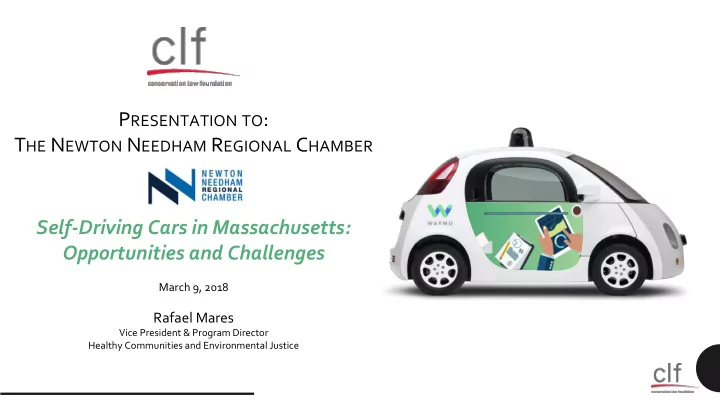
PRESENTATION TO: THE NEWTON NEEDHAM REGIONAL CHAMBER Self-Driving Cars in Massachusetts: Opportunities and Challenges
March 9, 2018
Rafael Mares
Vice President & Program Director Healthy Communities and Environmental Justice
P RESENTATION TO : T HE N EWTON N EEDHAM R EGIONAL C HAMBER - - PowerPoint PPT Presentation
P RESENTATION TO : T HE N EWTON N EEDHAM R EGIONAL C HAMBER Self-Driving Cars in Massachusetts: Opportunities and Challenges March 9, 2018 Rafael Mares Vice President & Program Director Healthy Communities and Environmental Justice T ODAY
March 9, 2018
Rafael Mares
Vice President & Program Director Healthy Communities and Environmental Justice
2
LIDAR UNIT Constantly spinning, it uses laser beams to generate a 360-degree image of the car’s surroundings. CAMERAS Uses parallax from multiple images to find the distance to various objects. Cameras also detect traffic lights and signs, and help recognize moving
RADAR SENSORS Measure the distance from the car to obstacles. MAIN COMPUTER (LOCATED IN TRUNK) Analyzes data from the sensors, and compares its stored maps to assess current conditions. ADDITIONAL LIDAR UNITS
HOW A CAR DRIVES ITSELF
3
SAE Level 0 (e.g., 2018 Kia Rio LX, most classic cars)
SAE Level 1 (e.g., Honda Civic with adaptive cruise control, most modern cars)
environment and performs the rest of the driving task SAE Level 2 (e.g., Tesla “Autopilot,” Volvo “Pilot Assist”)
instances, but the human driver must be ready to take back control when the automated system requests SAE Level 3 (e.g., 2019 Audi A8 Traffic Jam Pilot)
control, but the automated system can operate only in certain environments and under certain conditions SAE Level 4 (e.g., Ford Fusion Hybrid Autonomous Research Vehicle)
SAE Level 5 (e.g., Waymo)
4
Jan 2017 || nuTonomy tested the first autonomous vehicle in MA 2018 || Tesla to release fully autonomous vehicles 2020 || Toyota, Ford, Audi, and Waymo to release fully autonomous vehicles 2021 || According to Mobileye, fully autonomous vehicles to be widely used in cities 2023 || According to Mobileye, fully autonomous vehicles to be widely used in all settings BMW to release fully autonomous vehicles
5
Increased Mobility: Door-to-Door Service at cost close to a subway ticket. More Space: (1) Reduced need for parking lots and garages; (2) narrower lanes on streets. Extra Time and Productivity: Instead of driving, people can work, read, watch movies, sleep Fewer Accidents: (1) 94% of accidents are as a result of human error; (2) 10% of accidents are a result of distracted driving; (3) AVs will be better drivers than us.
6
7
Traffic: studies estimate VMT increase of 37% to 90%.
Accessibility to non-drivers Increased willingness to travel longer distance Diversion from the MBTA Zombie vehicles
Downfall of the T?: Low-cost driving will pull riders who can afford it away from the T, leaving behind those who cannot Air Pollution and Climate Change: an increase in VMT, continued use of the internal combustion engine, and private ownership a disastrous combination for air quality and GHG emissions Revenue: change in the revenue that municipalities and the Commonwealth can expect from traditional transportation funding sources such as speeding tickets, parking fees and tickets, and motor vehicle sales and gas taxes Employment: people who drive will lose jobs: In 2015 there were 1.8 million truck drivers in the US. In 2015 an additional 2 million people drove vehicles for a living (e.g. taxis, ambulances)
Fuels Tax: gas tax, special fuels (diesel), etc. ($756M)
Motor Vehicle Sales Tax: 6.25% of sales (or book price value) ($789M) Tolls: Metropolitan Highway System and Western Turnpike ($427M) RMV Fees: License, title, and registration fees. ($511M) Moving Violation: speeding tickets. ($24M)
TOLL
8
Parking: Street Parking Parking Permits Parking Violations Fines: Moving Violations Excise Tax: $25 per thousand is assessed annually upon the value of the vehicle by the community where the motor vehicle is customarily garaged.
9
Parking: reduced need for parking.
AVs can park closer together and let each other out AVs can circle the block or drive home
Zero-Emissions Vehicles: introduction of electric AVs.
MA Goal: 300,000 vehicles by 2025 Currently: 11,000 ZEVs
Sharing: introduction of ride-sharing (v. ride-hailing).
10
Congestion: Increased traffic will cost consumers, businesses, and government between $375M to $750M (at 20%) annually and $3.7B/year (at 100%). With ride-sharing these costs can be avoided and congestion could be lowered. Greenhouse Gases: In the short term, GHG will cost an estimated $28M annually. In the longer term an increase in GHG will cost about $113M per year. These costs can also be avoided and GHG can be reduced with ZEVs and ride-sharing. Air pollution: Another $30M/year in costs can be expected in the short term from air pollution and $144M/year at 100% market penetration. This is also avoidable. Safety: $660M annual (at 20%) and $3.3B (at 100%) in expected benefits. Road Maintenance: $10 to $42M at 100% in cost, unless there is widespread ride-sharing.
11
Fuels Tax:
Will be slightly higher as a result of increase in VMT (at 20% market penetration). Significantly increased (at 100%), unless there is extensive ride-sharing. If fleet is electric, fuels tax will decrease (at 20%) and plummet (at 100%).
MV Sales Tax:
Pulled up due to higher cost (private ownership). Pulled down due to reduction in vehicles (ride-sharing), but larger turn over mitigates or makes up for it.
Tolls:
Increase due to higher VMT (at 20%). Large increase (at 100%). Small increase for ride-sharing.
RMV fees:
Increase (private ownership). Decrease (ride-sharing).
Moving violations:
Significant decrease (at 20%). Elimination (at 100%).
12
Overall: Parking revenue will decline. Urban: Short-term loss; long-term balance
Major sources of motor vehicle-related revenue are street parking and parking fines (52-60%). Boston and nearby cities will see significant decline (e.g., $35M or 27% of motor vehicle-related revenue in Boston at 20% market penetration). After high penetration of AVs, opportunities for increase in property taxes because fewer parking garages will be needed. Rural/Suburban: Less impact expected, because parking revenue is small (3% to 16%) compared to urban municipalities.
13
Overall: Excise tax largely dependent on private ownership rate.
é AVs will be more expensive in the beginning (but this impact will largely disappear as additional costs of technology decline). ê If more AVs are used in ride-sharing (but would be balanced out due to larger turnover of vehicles). é If more AVs are owned privately or used for ride-hailing (could impact different municipalities differently).
Urban: Excise tax is smaller source of motor vehicle-related revenue (25%
Rural/Suburban: Excise tax is larger source of motor vehicle funding (84% to 97%), but may not see large decline in excise tax, because private ownership of AVs more likely.
14
No tradeoff necessary between different economic impacts (e.g., can improve safety, traffic, and GHG at the same time). Tradeoff between negative fiscal and positive economic impacts can be avoided (e.g., replace gas tax and reap benefits from electric vehicles). AV analyses need to keep benefits of self-driving technology separate from independent improvements in automobile technology (e.g., fuel economy, electric vehicles, sharing, and safety). Huge difference in fiscal and economic impacts between ride-hailing and ride sharing. An increase in VMT, continued use of the ICE and private ownership a disastrous combination for air quality and GHG emissions. MBTA budget could take hit if low-cost driving pulls riders who can afford it away from the T, leaving behind those who cannot.
15
Limits on Zero-Occupancy Vehicles: Restrict distance zombie vehicles can travel. Zero-Emissions Vehicles: Incentivize electric vehicles. Real Sharing: Providing incentives for ride-sharing (over ride-hailing and private ownership). Replacing the Gas Tax: introduce mileage-based fees. Bridge for Parking Revenue: cities need to replace parking revenue in short term. Job training: large-scale programs to retrain drivers.
16
Rafael Mares Vice President and Program Director Healthy Communities and Environmental Justice Conservation Law Foundation 62 Summer Street Boston, MA 02110 P: 617-850-1739 E: rmares@clf.org For a thriving New England
17