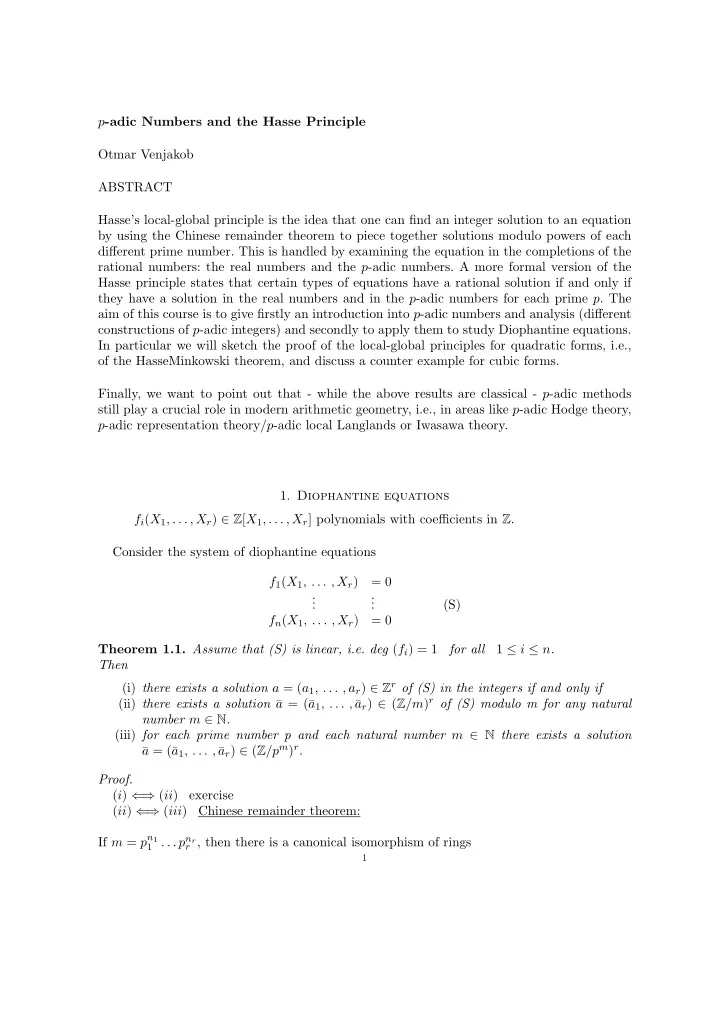
SLIDE 1 p-adic Numbers and the Hasse Principle Otmar Venjakob ABSTRACT Hasse’s local-global principle is the idea that one can find an integer solution to an equation by using the Chinese remainder theorem to piece together solutions modulo powers of each different prime number. This is handled by examining the equation in the completions of the rational numbers: the real numbers and the p-adic numbers. A more formal version of the Hasse principle states that certain types of equations have a rational solution if and only if they have a solution in the real numbers and in the p-adic numbers for each prime p. The aim of this course is to give firstly an introduction into p-adic numbers and analysis (different constructions of p-adic integers) and secondly to apply them to study Diophantine equations. In particular we will sketch the proof of the local-global principles for quadratic forms, i.e.,
- f the HasseMinkowski theorem, and discuss a counter example for cubic forms.
Finally, we want to point out that - while the above results are classical - p-adic methods still play a crucial role in modern arithmetic geometry, i.e., in areas like p-adic Hodge theory, p-adic representation theory/p-adic local Langlands or Iwasawa theory.
fi(X1, . . . , Xr) ∈ Z[X1, . . . , Xr] polynomials with coefficients in Z. Consider the system of diophantine equations f1(X1, . . . , Xr) = 0 . . . . . . (S) fn(X1, . . . , Xr) = 0 Theorem 1.1. Assume that (S) is linear, i.e. deg (fi) = 1 for all 1 ≤ i ≤ n. Then (i) there exists a solution a = (a1, . . . , ar) ∈ Zr of (S) in the integers if and only if (ii) there exists a solution ¯ a = (¯ a1, . . . , ¯ ar) ∈ (Z/m)r of (S) modulo m for any natural number m ∈ N. (iii) for each prime number p and each natural number m ∈ N there exists a solution ¯ a = (¯ a1, . . . , ¯ ar) ∈ (Z/pm)r. Proof. (i) ⇐ ⇒ (ii) exercise (ii) ⇐ ⇒ (iii) Chinese remainder theorem: If m = pn1
1 . . . pnr r , then there is a canonical isomorphism of rings 1
SLIDE 2 2
Z/m
∼ =
− →
r
Z/pni
i
a mod m − → (a mod pni
i )i
- Fix a prime p and consider the projective system
. . . → Z/p3Z ։ Z/p2Z ։ Z/pZ a mod p3 → a mod p2 → a mod p Zp := lim ← −
n
Z/pnZ :=
Z/pn | an+1 ≡ an mod pn for all n ∈ N
- is called ring of p-adic integers with
(an) + (bn) := (an + bn) (an) · (bn) := (an bn) Zp is compact (Tychonoff!). Fact 1.2. Any N ∈ N has a unique p-adic expansion N = a0 + a1p + . . . + anpn with ai ∈ {0, 1, . . . , p − 1} (use successively division by p with rest N = a0 + pN1 N1 = a1 + pN2 . . . Nn−1 = an−1 + pNn Nn = an Z
ι
→ Zp N → (N mod pn)n∈N With increasing n we see more “digits”, more ai, of our expansion. N = a0 + a1p + . . . + anpn. ι is injective: if N ≡ 0 mod pn, i.e. pn|N for n arbitrary, then N = 0 must hold. Copying decimal numbers 0, 1 2 3 4 . . .
∞
ai10−i, ai ∈ {0, . . . , 9} can we make sense to expression like
SLIDE 3 3
(p = 3) 1 + 3 + 32 + 33 + . . .
+∞
aipi, ai ∈ {0, 1, . . . , p − 1} pi − 1 p − 1 , i → ∞ Definition 1.3. vp(a) =
, if a = pnu = 0, (p, u) = 1 ∞ a = 0 vp : Q − → Z (p-adic valuation) | · |p: Q − → R≥0 (p-adic norm) | a |p:=
, a = 0 , a = 0 “a is small if and only if pn|a for n big” Lemma 1.4. For all x, y ∈ Q we have (i) vp(xy) = vp(x) + vp(y) and |xy|p = |x|p|y|p, (ii) vp(x + y) ≥ min(vp(x), vp(y)) and |x + y|p ≤ max(|x|p, |y|p), (iii) if vp(x) = vp(y) (respectively |x|p = |y|p) in (ii), then “=” holds. Example 1.5. With respect to | · |p the sequence an = pn converges against 0
p − 1 − → −1 p − 1
R = (Q, | · |∞)∧ is the completion with respect to (w.r.t.) usual absolute value |·|∞, e.g. constructed via space
SLIDE 4 4
Definition 1.6. Qp := (Q, | · |p)∧ := {(xn)n|xn ∈ Q, Cauchy-sequence w.r.t. | · |p} / ∼ (xi)i∈N ∼ (yi)i∈N :⇐ ⇒ |xi − yi|p → 0 for i → ∞, i.e., where xi − yi is a p-adic zero-sequence The operations on Cauchy-sequences (xn) · (yn) := (xn · yn) (xn) + (yn) := (xn + yn) induce the structure of a field on Qp! | · |p and vp extend naturally to Qp: |(xn)|p := lim
n→∞ |xn|p,
vp((xn)) := lim
n→∞ vp(xn)
(the latter becomes stationary, if (xn) is not a zero-sequence!) In particular, Qp is a normed topological space. Theorem 1.7. (p-adic version of Bolzano-Weierstraß) Qp is complete, i.e. each Cauchy-sequence in Qp converges in Qp. Any bounded sequence has a accumulation point. Any closed and bounded subset of Qp is compact. Warning: Qp is not ordered like (R, ≥)! Theorem 1.8. (Ostrowski) Any valuation on Q is equivalent to | · |∞ or | · |p for some prime p.
:⇔ they define the same topology on Q ⇔ | · |1 = | · |s
2 for some s ∈ R>0)
(i) Zp = {x ∈ Qp| |x|p ≤ 1} and Z ⊂ Zp is dense. (ii) Zp is a discrete valuation ring (dvr), i.e. Zp \ Z×
p = pZp, where Z× p = {x ∈ Qp| |x|p =
1} denotes the group of units of Zp. Theorem 1.10. There are a canonical isomomorphisms Z × Z×
p ∼
= Q×
p , (n, u) → pnu,
Z×
p ∼
= µp−1 × (1 + pZp), 1 + pZp ∼ =
if p = 2; {±1} × (1 + 4Z2) ∼ = {±1} × Z2,
SLIDE 5 5
Corollary 1.11. There is a canonical isomorphism Q×
p ∼
=
if p = 2; Z × Z/2 × Z2,
Corollary 1.12. a = pnu ∈ Q×
p with u ∈ Z× p is a square in Q× p , if and only if the following
conditions hold: (1) n is even, (2) ¯ u is a square in F×
p ,
if p = 2; u ≡ 1 mod 8Z2, p = 2.
- 2. Conics, quadratic forms and residue symbols
2.1. Conics. Consider the conic (C) ax2 + by2 = c (a, b, c ∈ Q×) When is C(Q) := {(x, y) ∈ Q2 | ax2 + by2 = c} non empty, i.e. when does C have a rational point? Without loss of generality we may assume: c = 1 Define (a, b)∞ =
if a > 0 or b > 0 −1 if a < 0 and b < 0 Property: (a, b)∞ = 1 ⇐ ⇒ There exists (x, y) ∈ R2 such that ax2 + by2 = 1 Now let p be a prime number. Aim: To define similarly (−, −)p : Q× × Q× − → {±1} such that the following holds (a, b)p = 1 ⇐ ⇒ There exists (x, y) ∈ Q2
p such that ax2 + by2 = 1
SLIDE 6 6
2.2. Quadratic reciprocity law. p odd F×
p /(F× p )2
∼ = {±1} a →
p
p
⇔ There exists x ∈ Z s.t. x2 ≡ a mod p Otherwise
p
Theorem 2.1. Let p = q be odd primes. (1) (Quadratic reciprocity law) q p
p−1 2 q−1 2
p q
(2) (first supplementary law) −1 p
p−1 2
=
p ≡ 1 mod 4; −1, p ≡ 3 mod 4. (3) (second supplementary law) 2 p
p2−1 8
=
p ≡ 1, 7 mod 8; −1, p ≡ 3, 5 mod 8. Define the Hilbert symbol ( , )p : Q×
p × Q× p −
→ {±1} as follows: For a, b ∈ Q×
p write
a = piu, b = pjv (i, j ∈ Z, u, v ∈ Z×
p , (u, p) = (v, p) = 1)
and put r = (−1)ijajb−i = (−1)ijujv−i ∈ Z×
p
p odd: (a, b)p := r p
r p
- where r denotes the image of r under the modp reduction
− : Z× p → F× p .
p = 2 (a, b)2 := (−1)
r2−1 8
· (−1)
u−1 2 · v−1 2
Proposition 2.2. For v ∈ V and a, b, c ∈ Q× we have (1) (a, b)v = (b, a)v (2) (a, bc)v = (a, b)v(a, b)v,
SLIDE 7 7
(3) (a, −a)v = 1 and (a, 1 − a)v = 1 if a = 1, (4) if p = 2 and a, b ∈ Z×
p , then
(a) (a, b)v = 1, (b) (a, pb) =
p
(5) if a, b ∈ Z2, then (a) (a, b)2 =
if a or b ≡ 1 mod 4; −1,
(b) (a, 2b)2 =
if a or a + 2b ≡ 1 mod 8; −1,
Proposition 2.3. For a, b ∈ Q×
p the following conditions are equivalent:
(1) (a, b)v = 1 (2) there exist x, y ∈ Q×
p such that ax2 + by2 = 1.
Set Q∞ := R and V := {p|prime} ∪ {∞} Theorem 2.4. (Hilbert product formula) a, b ∈ Q×. Then (a, b)v, v ∈ V , is equal to 1 except for a finite number of v, and we have
(a, b)v = 1 Consider the cone C : ax2 + by2 = 1 ; a, b ∈ Q× Theorem 2.5. The following statements are equivalent: (i) C(Q) = ∅, (ii) C(Qv) = ∅ for all v ∈ V , (iii) (a, b)v = 1 for all v ∈ V .
- 3. Generalisation to quadratic forms of higher rank
Let W be finite dimensional vector space over field k. Definition 3.1. A function Q : W → k is called quadratic form on W if (i) Q(ax) = a2Q(x) for a ∈ k, x ∈ W and (ii) (x, y) → Q(x + y) − Q(x) − Q(y) define a bilinear form.
SLIDE 8 8
(W, Q) is called quadratic space. If char(k) = 2, setting < x, y >:= 1 2{Q(x + y) − Q(x) − Q(y)} defines a symmetric bilinear form, the scalar product associated with Q, such that Q(x) =< x, x > {quadratic forms}
1:1
← → {symmetric bilinear forms} Q → < , > Matrix of Q: W =
n
⊕
i=1kei ∼
= kn, A = (aij) with aij =< ei, ej > is symmetric and for x = xiei we have Q(x) =
aijxixj = txAx
- d(Q), the image of det(A) in k×/(k×)2 ∪ {0}, is called discriminant of Q.
- rk(Q), the rank of A, is called rank of Q.
- Q is called non-degenerate, if rk(Q) = n holds
- whence d(Q) ∈ k×/(k×)2
.
- Q represents a ∈ k, if there exists 0 = w ∈ W such that Q(w) = a.
- (Q′, kn) and (Q, kn) are equivalent, Q′ ∼ Q, if there exists S ∈ GLn(k) such that
Q′x = Q(Sx) for all x ∈ kn
A′ = tSAS. Remark 3.2. (i) X1X2 ∼ X2
1 − X2 2, because (X1 + X2)(X1 − X2) = X2 1 − X2 2,
(ii) aX2
1 ∼ bX2 1 ⇔ a = bc2 for some c ∈ k×,
SLIDE 9
9
(iii) Q(X1, . . . , Xn) ∼ Q(Xπ(1), . . . , Xπ(n)) for any π ∈ Sn (symmetric group on n ele- ments), (iv) If Q ∼ Q′, then Q represents a ∈ k if and only if Q′ does. Proposition 3.3. (Q, kn), a ∈ k× (i) If Q represents a, then Q ∼ aX2
1 +G(x2, . . . , xn) for some quadratic space (G, kn−1).
(ii) Q ∼ a1X2
1 + . . . + anX2 n =:< a1, . . . , an > for some ai ∈ k.
(iii) If Q is non-degenerate and represents 0, then Q(W) = k, i.e. it represents each a ∈ k. (iv) Let Q be non-degenerate. Then Q represents a if and only if Q(X1, . . . , Xn) − aX2
n+1
represents 0. (v) Let Q be non-degenerate. If Q represents 0, than Q ∼ X1X2 + G(X3, . . . , Xn) for some quadratic space (G, kn−2). (X1X2, k2) (and any quadratic space equivalent to it) is called hyperbolic space. For quadratic spaces (Q, kn), (Q′, km) let (Q ⊥ Q′, kn+m) be the quadratic space defined by (Q ⊥ Q′)(X1, . . . , Xn+m) = Q(X1, . . . , X1) + Q′(Xn+1, . . . , Xn+m) Theorem 3.4. (Witt’s cancelation theorem) For (Q, kn), (Q′, kn), (G, km) quadratic spaces it holds Q ⊥ G ∼ Q′ ⊥ G ⇒ Q ∼ Q′ Corollary 3.5. If Q is non-degenerate, then (uniquely up to equivalence) Q ∼ G1 ⊥ G2 ⊥ . . . ⊥ Gm ⊥ H with Gi hyperbolic and H does not represent 0. 3.1. Quadratic forms over the reals. Let (Q, Rm) be of rk(Q) = n ≤ m then
SLIDE 10 10
Q ∼ X2
1 + . . . + X2 r − (Y 2 1 + . . . + Y 2 s )
=< 1, . . . , 1
−1, . . . − 1
0, . . . , 0 > r times s times =< a1, . . . an > with r + s = n and (r, s) is the signature of Q. Q is called definite, if r = 0 or s = 0 indefinite,
ε(Q) :=
(ai, aj)∞ = (−1)
s(s−1) 2
=
if s ≡ 0, 1 mod 4 −1 if s ≡ 2, 3 mod 4 d(Q) = (−1)s =
if s ≡ 0 mod 2 −1 if s ≡ 1 mod 2 3.2. Quadratic forms over Fq. q = pt, Fq field of q elements Proposition 3.6. (Q, Fm
q ) of rk(Q) = n
(i) Q represents F×
q and Fq, if n ≥ 2 and n ≥ 3, respectively.
(ii) If Q is non-degenerate, then Q ∼ < 1, . . . , 1, 1 > if d(Q) ∈ (F×
q )2
< 1, . . . , 1, a >
i.e. rk(Q) and d(Q) determine the equivalence class of Q uniquely. 3.3. Quadratic forms over Qp. For Q ∼< a1, . . . , an > the Hilbert symbol ε(Q) :=
(ai, aj)p is well defined!
SLIDE 11 11
Theorem 3.7. (Q, kn) non-degenerate, d = d(Q), ε = ε(Q) Then Q represents 0 ⇔ (i) n = 2 and d = −1 in k×/(k×)2 (ii) n = 3 and (−1, −d)p = ε (iii) n = 4 and either d = 1 or d = 1 and ε = (−1, −1)p (iv) n ≥ 5 Corollary 3.8. Q represents a ∈ k×/(k×)2 if and only if (1) n = 1 and a = d, (2) n = 2 and (a, d) = ε, (3) n = 3 and either a = −d or a = −d and (−1, −d) = ε, (4) n ≥ 4. Theorem 3.9. The equivalence class of Q is uniquely determined by its invariants rk(Q), d(Q), ε(Q). 3.4. Quadratic forms over Q. (Q, Qn) non-degenerate quadratic space Q ∼< a1, . . . , an > has invariants
- d(Q) = a1, · . . . · an ∈ Q×/(Q×)2
- Consider the quadratic form Qv over Qv induced from Q via Q ֒
→ Qv dv(Q) := d(Qv) image of d(Q) in Q×
v /(Q× v )2
εv(Q) := ε(Qv) =
(ai, aj)v (⇒
v∈V
εv(Q) = 1)
Theorem 3.10. (Hasse-Minkowski) Q represents 0 ⇔ Qv represents 0 for all v ∈ V. Corollary 3.11. Let a be in Q×. Q represents a ⇔ Qv represents a for all v ∈ V Theorem 3.12. (Classification) (Q, Qn), (Q′, Qn) Q ∼ Q′ ⇔ Qv ∼ Q
′
v for all v ∈ V
⇔ d(Q) = d(Q′), (r, s) = (r′, s′) and εv(Q) = εv(Q′) for all v ∈ V. Remark 3.13. d = d(Q), ǫv = ǫv(Q) and (r, s) satisfy the following relations: (1) εv = 1 for almost all v ∈ V and
v∈V εv = 1,
(2) εv = 1 if n = 1 of if n = 2 and if the image dv of d in Q×
v /(Q× v )2 equals −1,
(3) r, s ≥ 0 and r + s = n, (4) d∞ = (−1)s,
SLIDE 12 12
(5) ε∞ = (−1)
s(s−1) 2
. Conversely: Proposition 3.14. If the above relations are satisfied for d, (εv)v∈V , and (r, s) then there exists a quadratic form Q which has the corresponding invariants.
- 4. Failure of local-global principal and generalisations
Theorem 4.1. (Lind, Reichardt) X4 − 17 = 2Y 2 has solutions in R, Qp all p, but not in Q! (see [2] § 3.5)
- cohomological interpretation:(see [4, chapter X])
Over a field k the first Galois cohomology group (with non-abelian coefficients) H1(k, On) classifies isomorphism classes of non-degenerate quadratic forms of rank n over k. Theorem 3.12 translates as follows: The canonical global to local map H1(Q, On) ֒ →
H1(Qv, On) is injective! This is not true in general for connected linear algebraic groups G instead of On.
Br(k) = H2(k, (ksep)×) classifies classes of central simple algebras (finite dimensional k- algebras, isomorphic to Mn(D) for some division algebra D with center k and some n) over k; A is equivalent to A′ per definition if D ∼ = D′ over k. Class field theory leads to the injectivity of the canonical global to local map Br(Q) ֒ →
Br(Qv)
- elliptic curves, Selmer/Tate-Shafarevich group (see [5, §X.3])
Let E be an ellipic curve over a field k (char(k) = 0) and E(¯ k) its points over an algebraic
H1(k, E(¯ k)) classifies equivalence classes of homogeneous spaces for E/k (a homogeneous space is a smooth curve C/k with a transitive algebraic group action of E on C defined over k) The canonical global to local map H1(Q, E(¯ Q)) →
H1(Qv, E(Qv)) is in general not injective, its kernel X(Q, E) is called Tate-Shafarevich group. Tate has conjectured that it is ‘at least’ finite. We have the following fact:
SLIDE 13
13
A homogeneous space C/k for E/k is in the trivial equivalence class, i.e., equivalent to E/k, if and only if C(k) is non-empty, i.e., C has a k-rational point.
SLIDE 14 14
I.
∞
(−5)i and expand −1, 2
3, − 2 3 (5-adically).
- 2. Find the inverse of 4 in Z/34Z.
- 3. For n = a0 + a1p · · · ar−1pr−1 ≥ 0 in its p-adic expansion show that
vp(n!) =
∞
n pi
p − 1, where [x] denotes the Gauss symbol, i.e. largest integer less than or equal to x, and s := a0 + a1 + · · · ar−1.
- 4. a ∈ Z with a ≡ ±1 mod 5. Show that there exist a square root of a in Q5.
- 5. Show that −1 has a square root in Qp if and only if p ≡ 1 mod 4.
- 6. Show that if p = 2, there exist exactly 3 quadratic extensions of Qp. Determine them
for p = 5.
= Z[[X]]/(X − p), where Z[[X]] denotes the ring of formal power series
- ver Z.
- 8. Show that a p-adic number a = ∞
ν=−m aνpν is in Q if and only if the sequence aν is
periodic for ν big enough.
- 9. Show that an integral p-adic number a = ∞
ν=0 aνpν is a unit in Zp if and only if
a0 = 0. II.
- 1. Let p be a prime number. Show the following
(i) X2 = −2 has a solution in Qp ⇔ p ≡ 1, 3 mod 8. (ii) X2 + Y 2 = −2 has a solution in Qp ⇔ p = 2. (iii) X2 + Y 2 + Z2 = −2 has a solution in Qp for any p.
- 2. Prove proposition 3.3.
- 3. Prove the following theorem of Gauß: A natural number n is the sum of three quare
numbers, if n = 4a(8b+7) for all integers a, b ≥ 0. To this end assume the (non-trivial) fact that the natural number n is the sum of three square numbers in Z if and only if it is the sum of three square numbers in Q.
SLIDE 15
15
References
[1] K. Kato, N. Kurokawa, T. Saito, Number Theory I - Fermat’s Dream, Translations of Mathematical Monographs 186, AMS [2] A. Schmidt, Einf¨ uhrung in die algebraische Zahlentheorie, Springer [3] J.P. Serre, A course in arithmetic, Springer [4] J.P. Serre, Local fields, Springer [5] J.H. Silverman, The arithmetic of elliptic curves, Springer