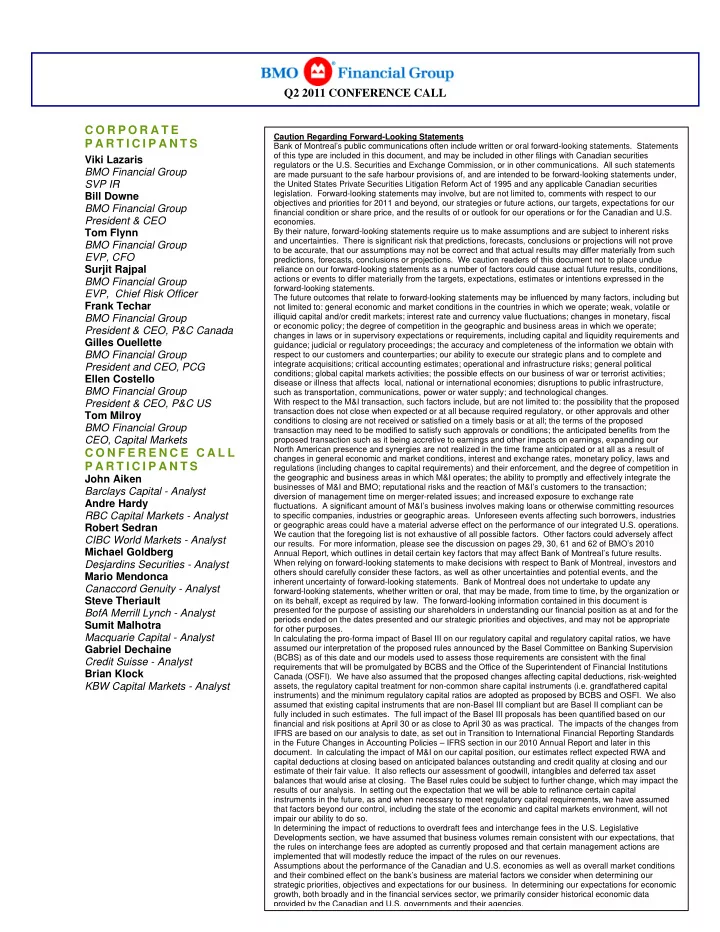
SLIDE 1 C O R P O R A T E P A R T I C I P A N T S
Viki Lazaris BMO Financial Group SVP IR Bill Downe BMO Financial Group President & CEO Tom Flynn BMO Financial Group EVP, CFO Surjit Rajpal BMO Financial Group EVP, Chief Risk Officer Frank Techar BMO Financial Group President & CEO, P&C Canada Gilles Ouellette BMO Financial Group President and CEO, PCG Ellen Costello BMO Financial Group President & CEO, P&C US Tom Milroy BMO Financial Group CEO, Capital Markets
C O N F E R E N C E C A L L P A R T I C I P A N T S
John Aiken Barclays Capital - Analyst Andre Hardy RBC Capital Markets - Analyst Robert Sedran CIBC World Markets - Analyst Michael Goldberg Desjardins Securities - Analyst Mario Mendonca Canaccord Genuity - Analyst Steve Theriault BofA Merrill Lynch - Analyst Sumit Malhotra Macquarie Capital - Analyst Gabriel Dechaine Credit Suisse - Analyst Brian Klock KBW Capital Markets - Analyst
Q2 2011 CONFERENCE CALL
Caution Regarding Forward-Looking Statements Bank of Montreal’s public communications often include written or oral forward-looking statements. Statements
- f this type are included in this document, and may be included in other filings with Canadian securities
regulators or the U.S. Securities and Exchange Commission, or in other communications. All such statements are made pursuant to the safe harbour provisions of, and are intended to be forward-looking statements under, the United States Private Securities Litigation Reform Act of 1995 and any applicable Canadian securities
- legislation. Forward-looking statements may involve, but are not limited to, comments with respect to our
- bjectives and priorities for 2011 and beyond, our strategies or future actions, our targets, expectations for our
financial condition or share price, and the results of or outlook for our operations or for the Canadian and U.S. economies. By their nature, forward-looking statements require us to make assumptions and are subject to inherent risks and uncertainties. There is significant risk that predictions, forecasts, conclusions or projections will not prove to be accurate, that our assumptions may not be correct and that actual results may differ materially from such predictions, forecasts, conclusions or projections. We caution readers of this document not to place undue reliance on our forward-looking statements as a number of factors could cause actual future results, conditions, actions or events to differ materially from the targets, expectations, estimates or intentions expressed in the forward-looking statements. The future outcomes that relate to forward-looking statements may be influenced by many factors, including but not limited to: general economic and market conditions in the countries in which we operate; weak, volatile or illiquid capital and/or credit markets; interest rate and currency value fluctuations; changes in monetary, fiscal
- r economic policy; the degree of competition in the geographic and business areas in which we operate;
changes in laws or in supervisory expectations or requirements, including capital and liquidity requirements and guidance; judicial or regulatory proceedings; the accuracy and completeness of the information we obtain with respect to our customers and counterparties; our ability to execute our strategic plans and to complete and integrate acquisitions; critical accounting estimates; operational and infrastructure risks; general political conditions; global capital markets activities; the possible effects on our business of war or terrorist activities; disease or illness that affects local, national or international economies; disruptions to public infrastructure, such as transportation, communications, power or water supply; and technological changes. With respect to the M&I transaction, such factors include, but are not limited to: the possibility that the proposed transaction does not close when expected or at all because required regulatory, or other approvals and other conditions to closing are not received or satisfied on a timely basis or at all; the terms of the proposed transaction may need to be modified to satisfy such approvals or conditions; the anticipated benefits from the proposed transaction such as it being accretive to earnings and other impacts on earnings, expanding our North American presence and synergies are not realized in the time frame anticipated or at all as a result of changes in general economic and market conditions, interest and exchange rates, monetary policy, laws and regulations (including changes to capital requirements) and their enforcement, and the degree of competition in the geographic and business areas in which M&I operates; the ability to promptly and effectively integrate the businesses of M&I and BMO; reputational risks and the reaction of M&I’s customers to the transaction; diversion of management time on merger-related issues; and increased exposure to exchange rate
- fluctuations. A significant amount of M&I’s business involves making loans or otherwise committing resources
to specific companies, industries or geographic areas. Unforeseen events affecting such borrowers, industries
- r geographic areas could have a material adverse effect on the performance of our integrated U.S. operations.
We caution that the foregoing list is not exhaustive of all possible factors. Other factors could adversely affect
- ur results. For more information, please see the discussion on pages 29, 30, 61 and 62 of BMO’s 2010
Annual Report, which outlines in detail certain key factors that may affect Bank of Montreal’s future results. When relying on forward-looking statements to make decisions with respect to Bank of Montreal, investors and
- thers should carefully consider these factors, as well as other uncertainties and potential events, and the
inherent uncertainty of forward-looking statements. Bank of Montreal does not undertake to update any forward-looking statements, whether written or oral, that may be made, from time to time, by the organization or
- n its behalf, except as required by law. The forward-looking information contained in this document is
presented for the purpose of assisting our shareholders in understanding our financial position as at and for the periods ended on the dates presented and our strategic priorities and objectives, and may not be appropriate for other purposes. In calculating the pro-forma impact of Basel III on our regulatory capital and regulatory capital ratios, we have assumed our interpretation of the proposed rules announced by the Basel Committee on Banking Supervision (BCBS) as of this date and our models used to assess those requirements are consistent with the final requirements that will be promulgated by BCBS and the Office of the Superintendent of Financial Institutions Canada (OSFI). We have also assumed that the proposed changes affecting capital deductions, risk-weighted assets, the regulatory capital treatment for non-common share capital instruments (i.e. grandfathered capital instruments) and the minimum regulatory capital ratios are adopted as proposed by BCBS and OSFI. We also assumed that existing capital instruments that are non-Basel III compliant but are Basel II compliant can be fully included in such estimates. The full impact of the Basel III proposals has been quantified based on our financial and risk positions at April 30 or as close to April 30 as was practical. The impacts of the changes from IFRS are based on our analysis to date, as set out in Transition to International Financial Reporting Standards in the Future Changes in Accounting Policies – IFRS section in our 2010 Annual Report and later in this
- document. In calculating the impact of M&I on our capital position, our estimates reflect expected RWA and
capital deductions at closing based on anticipated balances outstanding and credit quality at closing and our estimate of their fair value. It also reflects our assessment of goodwill, intangibles and deferred tax asset balances that would arise at closing. The Basel rules could be subject to further change, which may impact the results of our analysis. In setting out the expectation that we will be able to refinance certain capital instruments in the future, as and when necessary to meet regulatory capital requirements, we have assumed that factors beyond our control, including the state of the economic and capital markets environment, will not impair our ability to do so. In determining the impact of reductions to overdraft fees and interchange fees in the U.S. Legislative Developments section, we have assumed that business volumes remain consistent with our expectations, that the rules on interchange fees are adopted as currently proposed and that certain management actions are implemented that will modestly reduce the impact of the rules on our revenues. Assumptions about the performance of the Canadian and U.S. economies as well as overall market conditions and their combined effect on the bank’s business are material factors we consider when determining our strategic priorities, objectives and expectations for our business. In determining our expectations for economic growth, both broadly and in the financial services sector, we primarily consider historical economic data provided by the Canadian and U.S. governments and their agencies.
SLIDE 2 Q2 2011 – BMO Financial Group - Earnings Conference Call – May 25, 2011
Non-GAAP Measures Bank of Montreal uses both GAAP and non-GAAP measures to assess performance. Readers are cautioned that earnings and other measures adjusted to a basis
- ther than GAAP do not have standardized meanings under GAAP and are unlikely to be comparable to similar measures used by other companies. Reconciliations
- f GAAP to non-GAAP measures as well as the rationale for their use can be found in Bank of Montreal’s Second Quarter 2011 Report to Shareholders and 2010
Annual Report, all of which are available on our website at www.bmo.com/investorrelations. Examples of non-GAAP amounts or measures include: productivity and leverage ratios; revenue and other measures presented on a taxable equivalent basis (teb); amounts presented net of applicable taxes; core net income and core productivity ratio which exclude impaired loans, Visa litigation and acquisition integration costs; as well as adjusted net income, revenues, earnings per share and other adjusted measures which excludes the impact of certain items. Bank of Montreal provides supplemental information on combined business segments to facilitate comparisons to peers. 2
SLIDE 3 Q2 2011 – BMO Financial Group - Earnings Conference Call – May 25, 2011
P R E S E N T A T I O N Viki Lazaris - BMO Financial Group - SVP of IR Thank you. Good afternoon everyone and thanks for joining us today. Our agenda for today’s investor presentation is as follows: We will begin the call with remarks from Bill Downe, BMO’s CEO followed by presentations from Tom Flynn, the bank’s Chief Financial Officer and Surjit Rajpal, our Chief Risk Officer. After their presentations we will have a short question and answer period where we will take questions from pre-qualified analysts. To give everyone an opportunity to participate, please keep it to one or two questions and then requeue. Also with us this afternoon to take questions are BMO’s business unit heads – Tom Milroy from BMO Capital Markets, Gilles Ouellette from the Private Client Group, Frank Techar, Head of P&C Canada and Ellen Costello from P&C U.S.. At this time, I caution our listeners by stating the following on behalf of those speaking today. Forward- looking statements may be made during this call. They are subject to risks and uncertainties. Actual results could differ materially from forecasts, projections, or conclusions in the forward-looking statements. Information about material factors that could cause results to differ, and the material factors and assumptions underlying these forward-looking statements, can be found in our annual MD&A and our Second Quarter 2011 Report to Shareholders. With that said, I will hand things over to Bill. Bill Downe - BMO Financial Group - President & CEO Thank you, Viki, and good afternoon everyone. As noted, my comments may include forward-looking statements. BMO’s second quarter results were very good; we delivered net income of $800 million and earnings per share of $1.34. Somewhat slower revenue growth in some businesses was balanced by strong revenue growth in others, and we generated a solid 5.5% increase in total revenue from a year ago. We continue to demonstrate progress across the Bank and we’re confident that this good performance will be sustained through the second half of the year. Year-to-date, net income is ahead 12%, revenue growth is 8.1%, and we’re executing well against our strategic priorities supported by the investments we are making in the business. Our plans to integrate Marshall & Ilsley with Harris Bank are on track as we move towards closing. We have a clear view of the opportunities and how to capitalize on them across the breadth of our business and we are confident about the results we’ll generate with the addition of M&I. I’ll speak more on this topic shortly. ROE continues to improve sequentially and reached 16.7% in the second quarter on a strong capital
- base. In the quarter our Basel II Common Equity ratio strengthened to 10.67%.
Provisions for credit losses continued their overall improving trend, down significantly both from last year and from Q1. Specific PCL’s were 42 bps of average net loans and acceptances compared to 59 bps in
3
SLIDE 4 Q2 2011 – BMO Financial Group - Earnings Conference Call – May 25, 2011
the second quarter of 2010. Impaired loan formations were also down significantly, both year-over-year and compared to the first quarter. Surjit will provide more colour on credit later in the call. As we anticipated this quarter, expenses grew faster than revenues. This short-term negative operating leverage reflects significant investments in people, premises, and technology that allow us to deliver a customer experience that is both distinctive -- and distinctly BMO, in person, on line and on the phone. What we offer is differentiated -- an advantage in growing the business. We are adding front-line staff, increasing training, enhancing technology and distribution, and developing educational tools for retail clients. As an example, in the last year we’ve added over 700 employees in customer-facing retail areas including new branches, our client contact centre, specialized sales force and other programs to support strategic growth priorities. As a result, total bank expenses in the second quarter -- on an adjusted basis -- were 9.2% above the year ago level and in line with management’s expectations for the first half of the year. These expenditures will continue to drive improvement in both the top-line and customer loyalty scores across
I should note that we’re very closely monitoring movements in the economy and in each of our Groups, to ensure that our spending level remains in step with our business and economic forecasts. We remain committed to achieving medium-term operating leverage of 1.5% on an adjusted basis. I will now touch briefly on the performance of our business groups … Tom will provide more details later in the call. P&C Canada’s net income was $401 million, with solid revenue growth attributable to volume increases across most products. On an actual credit loss basis, the group’s net income was up 16%, with losses improving year-over-year in consumer and commercial portfolios. Expenses were elevated in the quarter as expected due to investment in the business, but we expect the rate of expense growth will moderate in the coming quarters. Importantly, we’ve maintained productivity in the low 50’s as we have advanced our strategic agenda. P&C US revenue rose 11% in US dollar terms, lifted by last year’s acquisition, higher deposit balances and improved spreads. Reported net income was down slightly from last year but up 4.1% from a year ago on a core basis. Private Client Group results were affected by the unusually high claims in the reinsurance business masking excellent operating performance from our other wealth businesses. Net income, excluding insurance, increased 41% compared to last year and 24% from Q1. BMO Capital Markets net income was a healthy $235 million, with an ROE of 21.4%. Q2 results were lower year-over-year, reflecting a decline from a very strong trading environment in 2010, somewhat
- ffset by higher M&A and debt underwriting this year.
Since we announced the acquisition of M&I in December, I’ve been out meeting with M&I employees and customers and so has the senior management team. These meetings have confirmed our confidence in how good we believe this acquisition will be for our customers and shareholders. We’ve connected with around 3,000 M&I employees -- in Indianapolis, Madison, Wassau, Minneapolis, St. Louis, Kansas City, Phoenix, Sarasota and Milwaukee - and with customers from across M&I’s business. This is a high quality customer base and I can tell you that the reaction to BMO has been very positive. This is evident in M&I’s customer retention numbers, which have been good. Employee turnover remains low. M&I employees are energized by the potential offered by expanded markets and capabilities, as well as the benefits of being part of a strong organization. They’re excited
4
SLIDE 5 Q2 2011 – BMO Financial Group - Earnings Conference Call – May 25, 2011
about joining a company that – like M&I – puts a high priority on customer loyalty; they can’t wait to get started and are thinking ahead already about the opportunities. This week, American Banker, in its annual survey of bank reputation, ranked Harris number one among the largest Bank Holding companies with material retail presence in the US. It is notable that both Harris at #1 and M&I at #6, were ranked prominently in this measure of public perception of banking. In 2010, our combined personal, commercial and wealth management businesses in the U.S. reported $185 million in earnings on an expected loss basis. For the first full quarter in 2011 after completion of the acquisition, we expect a positive contribution from M&I excluding integration costs. In the medium term, our aspiration is that these combined businesses will generate a billion dollars in earnings annually. We are working towards closing in the third quarter. An important milestone was achieved last week, when M&I’s shareholders voted overwhelmingly to approve the transaction. We’re looking forward to adding these new BMO shareholders. We continue to refine our expectations with respect to capital requirements. Our Basel III estimated pro forma Common Equity Ratio including M&I, remains strong at 6.9% as at April 30, 2011. We have also been working hard on synergies and now expect to deliver cost synergies in excess of $300 million – an increase of $50 million over our target. And we are continuing to challenge the
- rganization -- to increase the ultimate realized expense synergy.
As you may have seen, we introduced the name for our U.S. retail business …‘BMO Harris Bank’. We’ve had a positive response in the market since the introduction. This business is being positioned to mirror
- ur Canadian model and organizational structure.
One of the attributes of the Harris Bank has been its similarity to Canada in terms of employee culture and customer orientation. This is also evident across M&I and is contributing to a spirit of collaboration as integration planning teams work together. We look forward to announcing the closing of the transaction before the end of our third quarter. And now, I’ll pass it over to Tom to take you through our second quarter financial results in more detail. Tom Flynn - BMO Financial Group - CFO Thanks Bill and good afternoon. Some of my comments may be forward looking, please note the Caution Regarding Forward Looking Statements at the beginning of the presentation. I’ll start with the Financial Highlights on slide 8. BMO reported net income of $800 million, up 7.5% from last year. Earnings per share were $1.34 and return on equity increased to 16.7%. Pre-provision pre-tax earnings were $1.2 billion. This was a good quarter with earnings at a new high for the bank. We are introducing adjusted results this quarter and moving away from cash EPS. Adjustments will include items such as amortization of acquisition-related intangibles, acquisition related costs and changes in the general allowance. This positions us for reporting results clearly in future quarters after the acquisition of M&I. Adjusted net income and EPS were $804 million and $1.35, respectively in the quarter. Net adjustments this quarter were very small at $4 million or 1 cent per share. Adjustments, all on an after-tax basis, include amortization of acquisition-related intangibles of $9 million, M&I integration planning costs of $17 million, a charge to revenue for hedging foreign currency risk on the M&I acquisition of $8 million, and a
5
SLIDE 6 Q2 2011 – BMO Financial Group - Earnings Conference Call – May 25, 2011
$30 million release of the general allowance. Except for the amortization of acquisition-related intangibles, all adjustments were booked in Corporate. Year-over-year, adjusted revenue was up 5.9% and adjusted expenses grew 9.2%. As Bill noted, credit costs improved meaningfully in the quarter. Results were impacted by unusually high reinsurance claims from the tragic earthquakes in Japan and New Zealand. This reduced earnings by $47 million after tax or 8 cents a share. BMO’s capital position strengthened in the quarter, increasing by 52 basis points for the Common Equity Ratio and 80 basis points for the Tier 1 Capital Ratio. Turning to slide 9, I’ll touch briefly on the drivers of revenue growth. Net interest income was $1.6 billion, up $98 million or 6.4% year over year. We had solid growth in our retail businesses driven by higher average earning assets and in Corporate Services. Quarter-over-quarter, net interest income was essentially flat, with decreases in Capital Markets and P&C Canada partially offset by increases in the Private Client Group and Corporate. Second quarter revenue was reduced by the impact of fewer days relative to Q1. Total bank net interest margin excluding trading was up 11 basis points year over year. There was a modest increase in P&C Canada driven by higher spreads in personal lending, and solid increases in P&C US and PCG from higher spreads and volumes on loans and deposits. Quarter-over-quarter, total bank net interest margin excluding trading was up 8 basis points. The increase was driven by higher volumes in PCG, improved deposit spreads and product mix in P&C U.S., and higher net interest income in Corporate partially offset by lower net interest margin in P&C Canada due to continued low interest rates in a competitive environment and to changing mix. Non-interest revenue was $1.6 billion, up 4.6% from a year ago largely due to growth in securitization revenues, securities commissions, and healthy increases in mutual fund revenues and underwriting and advisory fees. These were partially offset by lower trading revenues, which were strong last year, and the earthquake-related reinsurance claims. Quarter-over-quarter non-interest revenue was down 7% due to lower trading and insurance revenues. The weaker U.S. dollar reduced revenue by 1.0 percent quarter over quarter and 1.6% year-over-year. Moving to slide 10, year-over-year expenses increased $193 million or 10.5%. On an adjusted basis expenses were up 9.2%. As Bill mentioned, expenses have increased given strategic investments we are making to support our focus on improving the customer experience, and to drive top line growth. These investments relate to initiatives largely in our P&C businesses such as increasing the front line sales force, expanding the distribution network and on-line technology enhancements. In addition, higher performance-based compensation and the impact of acquisitions, including the Rockford-based bank and M&I integration planning costs increased expenses year over year. Quarter-over-quarter expenses decreased $23 million or 1.1% and were flat after adjusting for the impact
- f the weaker U.S. dollar. Increases in some areas including M&I integration planning costs of $25 million
were offset by lower employee compensation, largely due to the annual cost of stock-based compensation for employees eligible to retire that is expensed in the first quarter.
6
SLIDE 7 Q2 2011 – BMO Financial Group - Earnings Conference Call – May 25, 2011
To summarize on the expense side, the Bank continues to invest in and deliver on its strategic priorities. At the same time, as we move forward we are focused on an appropriate relationship between revenue and expense growth. Slide 11 details capital and risk weighted assets. Our common equity ratio increased 52 basis points to a very strong 10.67%. The improvement was driven by growth in shareholders equity and a $6.6 billion decrease in RWA. Lower RWA resulted from the impact of the strengthening Canadian dollar and lower non-retail RWA, reflecting in part a continued reduction in non-core activities. The pro forma Basel III common equity ratio and Tier 1 Capital ratio are very strong at 8.6% and 11.5% respectively. After incorporating the estimated capital consequences of the pending M&I acquisition capital remains
- strong. The bank’s pro-forma Basel II Common Equity and Tier 1 Capital Ratios would be approximately
9.4% and 11.9%, respectively. On a Basel III basis, the pro forma Common Equity Ratio is estimated to be 6.9% after including M&I, up from 6.4% in Q1. Our pro forma common equity ratio is well-aligned with the Basel III threshold of 7%. Moving now to slide 14, P&C Canada net income of $401 million increased 1.7% year over year. Higher revenue, driven by volume growth across most products and an improved net interest margin, was partially offset by higher expenses and higher credit losses based on BMO’s expected loss methodology. Quarter-over-quarter results were reduced by the three fewer days in the quarter and lower spreads. Net interest margin decreased 7 basis points due to continued low interest rates, in a competitive environment, resulting in lower mortgage, commercial loan and term deposit spreads. Margin decline was also attributable to the impact of unfavourable product mix. Expenses increased $7 million or 0.7% quarter-over-quarter primarily due to higher initiative spending and employee costs, partially offset by the impact of fewer days. Year-to-date, the productivity ratio is 51.7%. Loan growth was solid, with personal loans up 6.6% and commercial loans up 7.1% year over year. Moving to Slide 16, P&C US net income of US $43 million was down $2 million from a year ago. Organic revenue growth was offset by higher provision for credit losses and an increase in the impact of impaired
- loans. Year-over-year the inclusion of the Rockford acquisition increased revenue by $19 million and
expenses by $15 million. Net income increased 4.6% in source currency quarter-over-quarter. Revenue increased 1.0% driven by increased spreads, which offset the impact of lower balances. Turning to slide 17, Private Client Group net income was $101 million, down $14 million or 13% from a year ago. As noted earlier, net income was impacted by $47 million after-tax in reinsurance claims from the earthquakes in Japan and New Zealand. Earnings in PCG, excluding Insurance, were up $29 million or 41%, as we continue to see growth across
- ur wealth businesses. Revenue increased 15% driven by higher assets under management and
administration, up $35 billion or 14% in source currency. This includes $5 billion from the closing of the Lloyd George Management acquisition in the quarter. Turning to Slide 19, BMO Capital Markets’ delivered net income of $235 million in the second quarter, down $25 million or 9.4% from results in the strong market environment of a year ago. ROE was good at 21%.
7
SLIDE 8 Q2 2011 – BMO Financial Group - Earnings Conference Call – May 25, 2011
Revenue declined 9% largely due to lower trading revenues from the high levels last year. This was partially offset by stronger advisory fees and increased securities commissions and debt-underwriting fees. Quarter-over-quarter net income was down 8% (sic), from a strong first quarter. Revenue declined 1% due to lower trading revenue in a more challenging trading environment. Year to date, Capital Market’s earnings were $492 million, up 4%, and ROE at 21.6%. Lastly on Slide 21, Corporate net income was $21 million, up $91 million year-over-year. Provision for credit losses was better by $86 million, including the $42 million reduction in the general allowance. Revenues were $148 million better than a year ago, primarily due to higher interest from the settlement of certain income tax matters, lower teb adjustments with the operating groups, the unfavourable impact of hedging activities in Q2 2010, and higher securitization-related revenues largely related to a credit card securitization. Expenses were $88 million higher year-over-year due to higher technology investment spending, M&I integration planning costs and higher employee expenses. In conclusion, we are pleased with the results. We delivered another good quarter of earnings, an ROE
- f 16.7% and capital continues to be very strong. With that I’ll turn it over to Surjit.
Surjit Rajpal - BMO Financial Group - EVP and Chief Risk Officer Thanks Tom and good afternoon. Before I begin I draw your attention to the caution regarding forward-looking statements. First, let me say that from a Risk perspective our performance this quarter was good. We are pleased with the positive trends that are evident both with impaired formations and with provisions in Canada and the
- US. This reflects economic conditions in general, including an easing of problem asset levels. The pace
- f economic recovery is slow and therefore we expect there will be some quarterly variability within the
- verall positive trend. Looking now in more detail, I will start with slide 26, where we provide a breakdown
- f our loan portfolio. The portfolio is well diversified both geographically and by portfolio segment. 78% of
loans are in Canada and 17% in the US. P&C Consumer represents 64% of the Canadian portfolio and
Our US portfolio mix is 44% consumer, and 56% Commercial and Corporate. The U.S consumer portfolios are relatively evenly spread across first mortgages, home equity and auto loans. The US C&I portfolio is well diversified and is performing reasonably. The weakness in the US Commercial Real Estate sector remains a drag on the overall speed of economic recovery and is a sector we continue to focus on very closely. While there are signs of improvement, it will clearly take time for this sector to fully recover. This portfolio is approximately US$2.8 billion.
8
SLIDE 9
Q2 2011 – BMO Financial Group - Earnings Conference Call – May 25, 2011
On Slide 27 we provide information on impaired loan formations. Formations were $147 million for the quarter, showing good improvement from $283 million in the first quarter and $366 million in the second quarter of 2010. Canadian formations were $39 million, down $120 million from the first quarter, with the largest decreases experienced in Manufacturing and Commercial Real Estate. The US portfolio continues to account for the majority of formations at $108 million but is down significantly from $163 million in the first quarter. The Commercial Mortgage and Consumer sectors accounted for the largest portion of the decrease. Gross impaired loan balances were down at $2.8 billion compared to $3.1 billion in the first quarter. Slide 28 details the provision for credit losses in each business. The consolidated specific provision was $187million, down from $248 million last quarter and $249 million a year ago. Total provisions, at $145 million, include a $42 million reduction in our general allowance. Moving now to the business segment details that are shown in the table to the right, P&C Canada provisions were moderately lower quarter over quarter but down significantly from a year ago. P&C US provisions were also down this quarter, benefitting from lower provisions in Commercial Real Estate/Investor Owned and Residential Mortgages. There were no net provisions in the Capital Markets portfolio this quarter. Turning to Slide 29, we provide a segmentation of the specific provision by geography and sector. The Canadian provision was $98 million, down from $116 million last quarter and $139 million a year ago. The consumer loan and credit card segments continue to be the largest drivers of Canadian provisions at 40% and 35% of the total respectively. The US provision was $90 million, a reduction from $132 million last quarter and $123 million a year ago. The retail sector accounts for just over half of the US Specific Provision To conclude, I know all of you are very interested in the progress we are making in Risk with the M&I integration planning and the opportunities that lie ahead as we move beyond close of the transaction. I expect much more to come on that during our third quarter call in August and I am looking forward to updating you then. That concludes my presentation and we can now move on to the Q & A.
9
SLIDE 10 Q2 2011 – BMO Financial Group - Earnings Conference Call – May 25, 2011
Q U E S T I O N A N D A N S W E R Operator (Operator Instructions) John Aiken from Barclays Capital. John Aiken - Barclays Capital - Analyst Good afternoon. Quick question on lending volume growth within Canadian P&C. Outside of the $1.3 billion, $1.4 billion in card that was securitized, we are actually starting to see lending volumes decline. I was wondering if you could give us a little sense as to what's going on specifically with the Canadian retail in commercial portfolios, please? Frank Techar - BMO Financial Group - President & CEO, Personal and Commercial Banking Canada, BMO Financial Group Yes, John, it's Frank. First thing I'd like to say is that in P&C Canada, we had a really solid quarter again this quarter. And as you've noted, that was on the back of just really good solid balance sheet growth, generally in line with our expectations. To your point, we are seeing a bit of a slowdown in the consumer loan volumes. I don't think this is a surprise to anyone. We've been talking about it for the last couple of quarters. And in particular, we've seen a slowdown in our credit card activity, not only the transaction volumes, but also in the revolving balances that our customers are holding. So there's definitely a change in customer preferences going on, on the consumer side of the business. On the commercial side, the volume growth for loans has been really strong again this quarter for us, in excess of 7%. And we're still really optimistic about our ability to compete, and the activity levels in the marketplace seem to be holding up. I think we've talked in previous quarters about this being a bit of a business-led recovery coming out of the recession, and we continue to see that playing out in our business. John Aiken - Barclays Capital - Analyst Thanks, Frank. And I know there was a lot of commentary in the prepared remarks about expenses and spending on initiatives was in line with plan. But we've seen 3 quarters where P&C Canada has actually had negative operating leverage. How much capacity do you have to pull back on expenses if we start to see revenue growth continue to moderate like we have over the last little while? Frank Techar - BMO Financial Group - President & CEO, Personal and Commercial Banking Canada, BMO Financial Group Yes, I think you're right, John. The elevated expense growth levels that we've seen over the last few quarters have been planned. I think I've been pretty clear about that, that was the intent. We are investing in our business, and we are really confident in our strategy and our ability to execute against that. So our plan for the future is to continue to invest in the business. I think you will have seen over the last couple of quarters that the expense growth has moderated a little
- bit. I think we were over 12% back in Q3, in the high 8% last quarter, and now we're down to 8%. My
10
SLIDE 11
Q2 2011 – BMO Financial Group - Earnings Conference Call – May 25, 2011
expectation is we'll see a little bit of moderation in our expense growth as we go through Q3 and Q4. And we're always looking at the top line, and trying to keep that relationship on some solid footing. I will just be clear that the expectation for this year, for this fiscal year, is we're likely to end up in a negative operating leverage position. And the objective for us for this year in P&C Canada was to maintain our productivity ratio in the low 50%s, and so far year to date, we've been able to do that. And I'd expect we'll end up there at year end, as well. Operator Andre Hardy from RBC Capital Markets. Andre Hardy - RBC Capital Markets - Analyst Good afternoon. I have a question, probably for Bill Downe. I was surprised that you kept the guidance for the possibility of a share issue of up to $400 million, given capital ratios are better than expected, and a pro forma everything ratio that is almost where OSFI wants you to be in almost 2 years. So can you talk about why you kept the language in your press release, please? Bill Downe - BMO Financial Group - President & CEO, BMO Financial Group Sure, Andre. Thanks for the question. We are encouraged by the capital levels. And as you know, we've provided a lot more granular view around capital and Basel III as we've come through the period since the end of the fourth quarter. We're relatively close to confirming when the closing date is. And we would prefer to confirm the final conclusion on capital when we conclude that date, but it's a relatively short period of time now. Andre Hardy - RBC Capital Markets - Analyst But are you signaling anything by leaving that text in there, or it shows we don't want to change anything until it's closing? Bill Downe - BMO Financial Group - President & CEO, BMO Financial Group No, we are not signaling anything. Andre Hardy - RBC Capital Markets - Analyst Okay, quick one for Frank Techar on margins. I understand the reasons you've mentioned why the margins came down sequentially. Do you expect them to stay at these levels, or some of these trends to reverse in upcoming quarters? Frank Techar - BMO Financial Group - President & CEO, Personal and Commercial Banking Canada, BMO Financial Group Yes, thanks, Andre. I think I'd start on the margin question by just saying that in the last couple of quarters, we were really expecting to see some softening in margins. And as you know, we didn't in the P&C business, and this quarter we did. I think I talked in previous quarters about the fact that we are
11
SLIDE 12 Q2 2011 – BMO Financial Group - Earnings Conference Call – May 25, 2011
going to see some volatility based on a couple of factors. So this quarter, there were a couple of anticipated spread drivers that changed a bit more than we expected. And this really gets to your question. The first one being the competitive pressure is heating up a bit more than we would have expected. And we're seeing that probably play out the most on the commercial business. And my expectation is, going forward, we will continue to see that. And from our perspective, we feel good about our ability to compete. We saw good volume growth again this quarter. And as you know, we've been investing in this business, not only adding sales force, but in other areas as well, and so we're highly confident that we can compete
The second thing that happened, and I touched on this briefly already, is we are seeing change in customer preferences, in particular with credit cards. And with that higher spread product, we're just not seeing the volumes as we would have anticipated. So the mix, in our balance sheet at least, is changing, and I wouldn't expect that to change as we go through the next couple of quarters. My expectations would be that customers aren’t going to change their preferences in the near term. I think they are listening to the conversation that's playing out in the public space about consumer debt levels. And they're still feeling conservative at this point in time. And then the last thing on spreads is, I think we would have all anticipated a bit of relief from a rate increase perspective. And because interest rates have remained very low, we're still seeing customer preferences focused on lower-spread variable-rate mortgages when we would have anticipated this perhaps would have changed by this point in the year. So there are a number of factors that have just added up in Q2, and we're seeing that volatility for BMO play out in this quarter. Andre Hardy - RBC Capital Markets - Analyst And by the sounds of it, until interest rates rise, you're not expecting a big change in your margins? Frank Techar - BMO Financial Group - President & CEO, Personal and Commercial Banking Canada, BMO Financial Group I wouldn't anticipate it, Andre. I think I would hold to the comments that I've had in previous quarters; We'll see some volatility moving around the levels that we're at, at this point. Operator Robert Sedran from CIBC. Robert Sedran - CIBC World Markets - Analyst Good afternoon. I note the revised synergies from the M&I transaction, but unless I missed it, I didn't notice any difference in the expected accretion or dilution. Has any of that changed, or are we expecting the pre-synergy view to have come down to offset the greater synergies that you're now expecting? Tom Flynn - BMO Financial Group - EVP, CFO It's Tom Flynn. Our synergy expectation for the second year would be modestly higher than it was when we announced the transaction. And then we talked about roughly 2%, 2.5% accretion, and we would be a little higher than that currently, based in part on synergies and in part on a lower equity raise.
12
SLIDE 13 Q2 2011 – BMO Financial Group - Earnings Conference Call – May 25, 2011
Robert Sedran - CIBC World Markets - Analyst So still being dilutive in the first year? Tom Flynn - BMO Financial Group - EVP, CFO Mildly. Robert Sedran - CIBC World Markets - Analyst And just to follow-up on the reinsurance business. Bill, a couple years ago, you'd talked about changing the risk profile of the Bank, so that shareholders were exposed more to risks that involve client-facing and franchise-building businesses. When I think about earthquakes on the other side of the world, how does the reinsurance business fit with that philosophy? And just following up on that, we've had a bit of a bad run in North America with tornadoes and wildfires and various floods. Does BMO have any exposure to any of that? Bill Downe - BMO Financial Group - President & CEO, BMO Financial Group I'll let Gilles Ouellette respond to the second part of your question, Rob. The first part of it is, it's entirely consistent with the customer-facing businesses. It's complementary to the creditor-life business. And it's really bounded by a limit to the loss that can occur in any period that is consistent with the size of the business. The incidence of the earthquake, the 2 earthquakes, were extraordinary in terms of the historic view. But the loss was within the tolerance we have for the business. And I'll let Gilles speak a little more specifically. Gilles Ouellette - BMO Financial Group - President and CEO, Private Client Group, BMO Financial Group Yes, Rob, this is a business we've been in for more than 20 years. We reinsure life, property and
- casualty. And as Bill mentioned, this is a business that complements our creditor insurance. It's a cyclical
business, but over the long cycle, we have this business returning in excess of the industry returns, which are drawing around 14%. And what happened in this tragic event over the last quarter, these two events, the one in Japan and the one in New Zealand, they represent 2 of the top 9 industry losses. It's
- unprecedented. We've never seen anything like that. But as far as this business, obviously we don't like
the kind of volatility, we're not used to this kind of volatility, but this is the first time it's happened. We're going to look at the business, but generally speaking over the life of the cycle, we're comfortable with the business. Robert Sedran - CIBC World Markets - Analyst So, Gilles, it sounds like the Q3 impact from whatever may have happened in this quarter doesn't sound like it's material?
13
SLIDE 14 Q2 2011 – BMO Financial Group - Earnings Conference Call – May 25, 2011
Gilles Ouellette - BMO Financial Group - President and CEO, Private Client Group, BMO Financial Group No, it isn't. Operator Michael Goldberg from Desjardins Securities. Michael Goldberg - Desjardins Securities - Analyst
- Thanks. Question about the operating leverage. Can you give us some examples of how the investment
spending that you're doing is paying off, or how you expect it to pay off? And also, while you indicate that you expect your operating expenses to moderate, you also set a medium-term objective of getting back to a positive operating leverage of about 1.5%. How long is it until the medium term? Bill Downe - BMO Financial Group - President & CEO, BMO Financial Group I'm going to let Frank, Michael, provide you with a couple of examples. I think you and I have answered this question before about when the medium term is. It's in the 2- or 3- to 5-year range, but it's not a wait and see. We have a view around the pattern of expense going forward, and we're quite thoughtful about the rate at which we schedule those expenses. And maybe, Frank, you can talk a little bit about a couple of the areas. And I think I referred to some of them in my introductory comments where we're seeing some of the benefits. Frank Techar - BMO Financial Group - President & CEO, Personal and Commercial Banking Canada, BMO Financial Group Yes, thanks, Michael. I'll start by saying, if you ask a question about medium term, I might look back a couple years, as well, because for the last 2 years the P&C Canada business, we've had operating leverage in excess of 5%. So we've talked about a 3% medium-term target for P&C Canada, and we've exceeded that for a couple of years. And I think we've been clear about the fact that this is the year we're going to invest. And so we're going to have a result that's going to be materially different from what we've seen over the last couple. And I think that's consistent with where we are relative to our strategy. So I'd say negative operating leverage is not going to be the norm going forward, but, for this year, we are committed to continuing to invest in the business, and we're going to stay the course. Relative to the other part of your question about some examples where we are seeing some benefits, I'll just pause on the FTE side of the business. We have added over the course of the last year over 1,000 people in P&C Canada. The vast majority of those are front-line-facing resources. So, mortgage specialists, financial planners, commercial account managers, contact center people, as Bill mentioned earlier, core bankers in our branches. We do have, and continue to have, the smallest distribution
- network. And so adding these resources clearly is going to pay off for us in the future, as we continue to
ramp up. I'll just give you 1 example that's occurred in the quarter relative to a specific initiative that's been pretty visible in the marketplace. Smart Steps for Parents, which we're pretty proud of. In 1 month, we had 80,000 unique visits to that site, which, as you know, doesn't have a lot of direct top-line growth potential in the offer itself. But it's consistent with our customer promise, and we think will help us in the future
14
SLIDE 15 Q2 2011 – BMO Financial Group - Earnings Conference Call – May 25, 2011
relative to the growth of the business. This is something that our customers have been asking for, for a long time, help with teaching their children about money early on. And we're the first ones in the marketplace to provide it, and we think it is going to be a huge success going forward. Not only with the parents, but with children as they start their banking business, hopefully with BMO. Operator Mario Mendonca from Canaccord Genuity. Mario Mendonca - Canaccord Genuity - Analyst Good afternoon. First a question on capital. This comes from page 23 of the supplement. Tom, when you were talking, or maybe it was Surjit, about the decline in RWA, you referred to currency and the run off of that non-core book. I want to understand this $5.5 billion or so decline in corporate including specialized lending, about halfway down the page. That certainly can't all be currency. And secondly, would that tie into any other balance sheet line item that would show a similar decline? Tom Flynn - BMO Financial Group - EVP, CFO It's Tom, Mario. I'll start it, and Surjit may want to jump in. The decline really has 2 parts. Currency is a significant part of it, and the other part of it relates to the reduction in a few larger exposures that we had in the portfolio, one of which in particular had a higher risk weighting attached to it. So I wouldn't say it's reflective of the performance of the overall portfolio for that half of what drove the result. It was more tied to a relatively small number of exposures. Mario Mendonca - Canaccord Genuity - Analyst And certain exposures that were particularly capital intensive. Tom Flynn - BMO Financial Group - EVP, CFO In the higher risk weighted exposure. Mario Mendonca - Canaccord Genuity - Analyst So would you say currency was about half of that then? Tom Flynn - BMO Financial Group - EVP, CFO Roughly. Mario Mendonca - Canaccord Genuity - Analyst
- Okay. A different type of question, then, perhaps for Frank. When you were talking about the decline in
credit card, you referred to customer behavior and a few other things. And those were interesting
- comments. Could you just speak to whether you think this is an industry phenomena, or if there's anything
15
SLIDE 16 Q2 2011 – BMO Financial Group - Earnings Conference Call – May 25, 2011
in the quarter that might specifically relate to BMO? Or do you really feel that this is something we'll see across the industry? Frank Techar - BMO Financial Group - President & CEO, Personal and Commercial Banking Canada, BMO Financial Group Yes, that’s a little bit of one of those trick questions, Mario. But our view is that this is an industry
- phenomena. We believe that customers have been paying attention to this debate. We believe that
they're feeling like they're not out of the woods yet relative to their financial situations and the economy, and the growth in the economy in general. And post-holiday season, we saw a change in the usage on
- ur credit cards, and we've seen a clear change on the revolving balances. And we don't think it's us. So
we'll find that out as we go through the next few months. Operator Steve Theriault from Bank of America. Steve Theriault - BofA Merrill Lynch - Analyst Thanks very much. Start with a question for Ellen, if I could. Ellen, last quarter you said you expected the NIM to be relatively stable due to pricing pressure, and I think less loan repricing. But again the NIM was up quite substantially this quarter. Can you talk to how the NIM has developed versus your expectations, and talk to us about your outlook for the remainder of the year? Ellen Costello - BMO Financial Group - President & CEO of P&C Banking US and Harris Financial Corp. Thanks for the question, Steve. I do think the longer-term outlook is for it to be flat and under some pressure for 2 reasons. Pricing pressure in the commercial loan market, and also in the consumer side, especially in direct auto. But Frank also touched on this, the low interest rates are a factor. What happened in this quarter is we had a drop in some low-yielding loans that we exited. You might notice the balance sheet is down to $11.7 billion from $12.1 billion last quarter. And those low-yielding assets and the new originations that we had contributed to that lift mostly on the loan side. The other half
- f the equation is our deposit mix changed as we've been pursuing more core deposits, which bring us
better spread into the net interest margin. So those are the 2 big factors. Steve Theriault - BofA Merrill Lynch - Analyst Is there substantially more lower-yielding assets to drop off? Ellen Costello - BMO Financial Group - President & CEO of P&C Banking US and Harris Financial Corp. I think we're close to done on that, but something we've been working on to improve the yields on the
- verall portfolio through this last cycle.
16
SLIDE 17 Q2 2011 – BMO Financial Group - Earnings Conference Call – May 25, 2011
Steve Theriault - BofA Merrill Lynch - Analyst
- Okay. And just something else, I noticed the last 4 quarters, the ATM count in the US is down. Is that just
rationalizing post-Amcore, or is there something else of interest going on there? Ellen Costello - BMO Financial Group - President & CEO of P&C Banking US and Harris Financial Corp. Actually it should be up. There might be a problem with the number. We'll take a look at it and come back to you. Steve Theriault - BofA Merrill Lynch - Analyst Okay, I'll circle back. For Tom Flynn probably, there's obviously a lot of noise in the corporate services line this quarter and most quarters, but can you refresh us on what you might consider a reasonable run rate of earnings drag in corporate services, maybe excluding the credit loss component? Tom Flynn - BMO Financial Group - EVP, CFO
- Sure. Corporate moves around, as you've said, partly because of credit, and partly just generally because
- f what is in there. This was a particularly good quarter for the segment. And I'd look at something like
negative $50 million to negative $100 million as being a more typical number for what we would expect. Operator Sumit Malhotra from Macquarie Capital. Sumit Malhotra - Macquarie Capital - Analyst Good afternoon. First one is a numbers question for Tom Flynn, as well. A lot of talk obviously on the decline in the Canadian banking net interest margin, but top of the house, NIM actually up about 8 basis points quarter over quarter. Maybe comes back to corporate services again. This line has been very
- volatile. And I think there's some commentary here about interest on a tax refund or something to that
- extent. How much of the $75 million quarter-over-quarter improvement in NII this quarter related to what
seems to be a one-time type item? Tom Flynn - BMO Financial Group - EVP, CFO Yes, the consolidated bank margin was up quarter over quarter and year over year, as well. The biggest driver of that was from corporate, as your question went to. And ballpark, half of the change quarter over quarter, a little less than half of the change quarter over quarter, would have related to the better performance in corporate. Sumit Malhotra - Macquarie Capital - Analyst And is that specifically that 1 item you flagged in the report to shareholders?
17
SLIDE 18
Q2 2011 – BMO Financial Group - Earnings Conference Call – May 25, 2011
Tom Flynn - BMO Financial Group - EVP, CFO Yes, it is. Sumit Malhotra - Macquarie Capital - Analyst Okay, thank you for that. And then this one is probably for Bill or Ellen. Looking at the M&I results, if I go back, it's been about 6 months since the acquisition was announced. We've seen the loan portfolio for M&I decline by about 11%. And I realize there's a couple things going on. Obviously, you've talked about the difficult environment to grow the loan book in the US, some repositioning on the part of the Company. So I'll offer some of my own caveats, but then I'll turn it over to you. When you see a double-digit decline in 6 months for a company that you're on the verge of acquiring, does that concern you, and if not, why? Bill Downe - BMO Financial Group - President & CEO, BMO Financial Group Sumit, thanks for the caveats up front. The focus around portfolio management at M&I is on the commercial real estate book. And in that regard, I think they've been effective in the management. And the numbers are consistent with what we would have expected. I also think that from a customer retention perspective, they've done well. The customer loyalty there is very, very deep, and the feedback that we've had has been positive. So on the commercial lending side, I think it's more driven by customer need than anything else. But until we close, I think it's hard to open new customer relationships. And we're looking forward to -- hopefully within the month, being a little more proactive in seeking new business. But it isn't inconsistent with the strategy around the management of commercial real estate or our expectations. Sumit Malhotra - Macquarie Capital - Analyst So to the same extent then, if they're managing that credit side of things, 6 months ago we talked about a $4.7 billion gross mark on the credit book, net of the allowance, which has remained relatively the same. Any changes in your thoughts on the credit outlook for the Company? Bill Downe - BMO Financial Group - President & CEO, BMO Financial Group The experience that they've shown quarter to quarter, again, is consistent with our expectations. And we haven't seen anything that would cause us to be uncomfortable with the mark that we said on December 17 we thought was appropriate. Operator Gabriel Dechaine from Credit Suisse. Gabriel Dechaine - Credit Suisse - Analyst Good afternoon. Just a follow-up on that line of questioning. Maybe the reason you didn't increase your dilution forecast for the deal, was because the additional synergies that you're expecting from the deal
18
SLIDE 19 Q2 2011 – BMO Financial Group - Earnings Conference Call – May 25, 2011
you're going to plow that back into branding or whatever, because of maybe some market share losses in Wisconsin? Bill Downe - BMO Financial Group - President & CEO, BMO Financial Group Where I thought you were going, I was going to ask Tom to answer the question around dilution. But no, I think that, as I said to Sumit, the asset declines were pretty consistent with what we would have
- expected. In our integration planning is an appropriate level of marketing and promotion that has to go
with both the closing, to reassure customers that the high quality experience they have will be continued. But also there is a significant amount of built-in expense around the brand name and the attendant
- signage. And so I think, once again, the planning that we're doing is confirming what our initial
expectations would be. And I would say the only difference is that I would say we would be less defensive in our feeling about the traction that the combined bank is going to have in the market than we might have been 4 or 5 months ago before we had a chance to be in the market and talking to customers. In my opening remarks, I made the comment that we've had a very positive response in the media, in local markets. We've had a positive response in town halls, with employees. And in our own marketing in those states, by BMO marketing people, has confirmed that the customer response is very strong. So I think it's in line, and as I said, we're comfortable with it. Gabriel Dechaine - Credit Suisse - Analyst I'll maybe just ask you to look in your crystal ball or whatever. When you look at the business you're acquiring, and then I see the 2% sequential decline in loans, admittedly there was a bit of a one-timer there in the US, but when would you expect or hope to see on a pro forma basis your loans in the US start to grow? Mid-2012? Late 2012? Or sooner? Bill Downe - BMO Financial Group - President & CEO, BMO Financial Group I know that Tom Flynn has answered this question on previous calls about asset levels. And the extent to which we see continuing recovery in the US, that growth in the core commercial book, both BMO and M&I's customer base, will be positive and hopefully will essentially offset the intended decline in the commercial real estate book. So I think we'll get 2 benefits. 1, I think we'll see better returns from those loans as that older commercial real estate book comes down and new commercial credits come in, but the quality of the underlying book with better diversification will be there. So going into 2012, we're very much forward-looking, and I'm expecting the year will be a good one. Operator Brian Klock from KBW. Brian Klock - KBW Capital Markets - Analyst Good afternoon. Maybe a follow-up. You guys have talked about it a little bit, a question for Ellen on the US loan portfolio, and maybe it's partly for Tom, as well. Part of the reduction in the US footprint, there was a $3 billion drop in end-of-period balances in the US, with half of that coming out of the Capital Markets group and the other half coming out of the Harris, mostly P&C consumer loan portfolio. Maybe add some more color to make sure I understand what drove that large decrease in Capital Markets. And
19
SLIDE 20 Q2 2011 – BMO Financial Group - Earnings Conference Call – May 25, 2011
is there anything in the consumer that's related to just how much that's related to the Amcore run off versus other just weak demand for consumer loans in the US? Ellen Costello - BMO Financial Group - President & CEO of P&C Banking US and Harris Financial Corp. Thanks for the question, Brian, and I'll start and then pass it over to Tom. On the consumer side, what you're seeing is, and it's probably true of many of our competitors, any new originations that we have coming in on the mortgage side are being unsold, so they are not staying on our balance sheet. And so that, plus regular amortization that you would expect on those books, is bringing the level of outstandings
- down. We have been consistently originating enough to offset the declines in our indirect auto book, and I
expect that that pace will moderate a little bit. But otherwise, those are the reasons on the consumer side. On the commercial side, I touched on some of the low-yielding exit clients that we had moved out of the
- portfolio. We have a very strong pipeline of originations of new customers, customers establishing
banking facilities ahead of need, anticipated growth. And so we are confident in the second half that we're going to see some lift in loan outstandings from that activity. Brian Klock - KBW Capital Markets - Analyst Maybe just one follow-up question for Surjit. Thinking about the significant improvement in GIL formations in the quarter, there was the negative general provision, excluding that, the specific provisions are down after being somewhere in the neighborhood of $250 million for the last 3, 4 quarters. Do you think we can reset that specific provision to a much lower level given where the NPL or the GIL numbers are coming in today? Surjit Rajpal - BMO Financial Group - Chief Risk Officer Yes, let me tell you, we've said in the past, and I think I said it in my formal remarks as well, that while we see the economic recovery, it's a little slow. And so we will observe some variability quarter to quarter. This quarter was really a good quarter. And if you look at page 31 on the supplementary package, that gives you a breakdown of where our PCLs are. And there is an element of variability that gets introduced when you have a commercial and corporate business. And I think I mentioned to you in the Capital Market side, we've had absolutely no PCLs for a long time. In fact, for at least 4 quarters in a row we've had nothing at all from that side. So there will be an element of
- variability. I would say yes, we do see it improving in the future, but with the caution that there will be
variability. Operator Andre Hardy from RBC Capital Markets. Andre Hardy - RBC Capital Markets - Analyst Thank you. I just wanted to follow-up with Gilles Ouellette on reinsurance. Can you please help us understand what kind of trigger points there might be before you're exposed to catastrophes? Or attachment points, is a better word for it.
20
SLIDE 21 Q2 2011 – BMO Financial Group - Earnings Conference Call – May 25, 2011
Gilles Ouellette - BMO Financial Group - President and CEO, Private Client Group, BMO Financial Group Yes, Andre, the business we're in has relatively low attachment points. And so in the last few years, every year we have obviously an allowance for these, in the last few years we've been able to absorb the losses and not really feel it through the P&L. It's just that this year, as I mentioned earlier, this was 2 of the top 9 catastrophes of all time, which is why we've had a major hit. But generally speaking, in past years there have been incidents every quarter or every second quarter, and even though it's gone through our P&L, we haven't really felt it. Andre Hardy - RBC Capital Markets - Analyst But is there something you can give us, maybe if cumulative catastrophes in a year exceed, I don't know, $20 billion, $40 billion, that's when BMO's reserves would prove to be too low? Gilles Ouellette - BMO Financial Group - President and CEO, Private Client Group, BMO Financial Group We have a cap on these. Each one of these treaties has a cap. And for this year, for example, this year in worst case there might be, and this is not based on the events that happened, but rather on prospective events, there might be another $40 million. But that's the maximum, and for a variety of reasons, unlikely to happen. Does that help you? Andre Hardy - RBC Capital Markets - Analyst It helps me understand the tail risk, thank you for that. But I'm trying to understand better when your reserves might not be enough. I can follow up offline, if you prefer. Gilles Ouellette - BMO Financial Group - President and CEO, Private Client Group, BMO Financial Group Okay, probably. Thanks, Andre. Operator Thank you. And there are no further questions registered at this time. I would like to turn the meeting back
Viki Lazaris - BMO Financial Group - SVP IR Thank you. Thanks, everyone, for joining us today, and if you have any further questions, please give us a call in the IR department. Have a great afternoon.
21