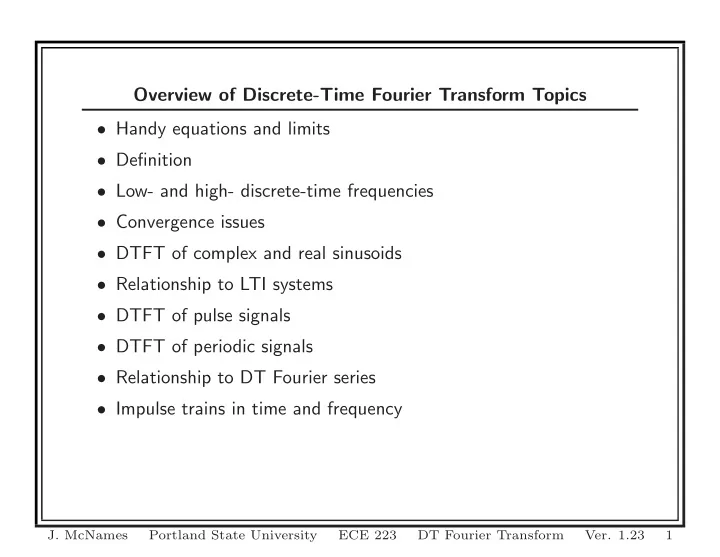
Overview of Discrete-Time Fourier Transform Topics Handy equations - - PowerPoint PPT Presentation

overview of discrete time fourier transform topics handy
SMART_READER_LITE
LIVE PREVIEW

Overview of Discrete-Time Fourier Transform Topics Handy equations - - PowerPoint PPT Presentation

Overview of Discrete-Time Fourier Transform Topics Handy equations and limits Definition Low- and high- discrete-time frequencies Convergence issues DTFT of complex and real sinusoids Relationship to LTI systems DTFT of


slide-1
SLIDE 1

Overview of Discrete-Time Fourier Transform Topics

  • Handy equations and limits
  • Definition
  • Low- and high- discrete-time frequencies
  • Convergence issues
  • DTFT of complex and real sinusoids
  • Relationship to LTI systems
  • DTFT of pulse signals
  • DTFT of periodic signals
  • Relationship to DT Fourier series
  • Impulse trains in time and frequency
  • J. McNames

Portland State University ECE 223 DT Fourier Transform

  • Ver. 1.23

1

slide-2
SLIDE 2

Handy Equations

  • n=0

an = 1 1 − a, |a| < 1

N−1

  • n=0

an = 1 − aN 1 − a

N−1

  • n=M

an = aM − aN 1 − a

  • n=0

nan = a 1 − a, |a| < 1

N

  • n=−N

an = a(N+0.5) − a−(N+0.5) a0.5 − a−0.5 You should be able to prove all of these.

  • J. McNames

Portland State University ECE 223 DT Fourier Transform

  • Ver. 1.23

2

slide-3
SLIDE 3

Handy Limits lim

N→∞

sin

  • Ω(N ± 1

2)

  • sin(Ω 1

2)

= +2π

+∞

  • ℓ=−∞

δ(Ω − 2πℓ) lim

N→∞

cos

  • Ω(N ± 1

2)

  • cos(Ω 1

2)

= ±2π

+∞

  • ℓ=−∞

δ(Ω − π − 2πℓ) lim

N→∞

cos

  • Ω(N ± 1

2)

  • sin(Ω 1

2)

= lim

N→∞

sin

  • Ω(N ± 1

2)

  • cos(Ω 1

2)

=

  • First is roughly analogous to a sinc function
  • All are periodic functions of frequency Ω with fundamental period
  • f 2π
  • J. McNames

Portland State University ECE 223 DT Fourier Transform

  • Ver. 1.23

3

slide-4
SLIDE 4

Orthogonality Defined Two non-periodic power signals x1[n] and x2[n] are orthogonal if and

  • nly if

lim

N→∞

1 2N + 1

N

  • n=−N

x1[n]x∗

2[n] = 0

  • J. McNames

Portland State University ECE 223 DT Fourier Transform

  • Ver. 1.23

4

slide-5
SLIDE 5

Orthogonality of Complex Sinusoids Consider two (possibly non-harmonic) complex sinusoids x1[n] = ejΩ1n x2[n] = ejΩ2n Are they orthogonal? lim

N→∞

1 2N + 1

N

  • n=−N

x1[n]x∗

2[n] = lim N→∞

1 2N + 1

N

  • n=−N

ejΩ1ne−jΩ2n = lim

N→∞

1 2N + 1

N

  • n=−N

ej(Ω1−Ω2)n =

  • 1

Ω1 − Ω2 = 2πℓ Otherwise

  • J. McNames

Portland State University ECE 223 DT Fourier Transform

  • Ver. 1.23

5

slide-6
SLIDE 6

Importance of Orthogonality Suppose that we know a signal is composed of a linear combination of non-harmonic complex sinusoids x[n] = 1 2π π

−π

X(ejΩ) ejΩn dΩ How do we solve for the coefficients X(ejΩ)? lim

N→∞ N

  • n=−N

x[n]e−jΩon = lim

N→∞ N

  • n=−N

1 2π π

−π

X(ejΩ) ejΩn dΩ

  • e−jΩon

= 1 2π π

−π

X(ejΩ)

  • lim

N→∞

1 2N + 1

N

  • n=−N

ejΩne−jΩon

  • dΩ
  • J. McNames

Portland State University ECE 223 DT Fourier Transform

  • Ver. 1.23

6

slide-7
SLIDE 7

Workspace = 1 2π π

−π

X(ejΩ)

  • lim

N→∞ N

  • n=−N

ej(Ω−Ωo)n

  • dΩ

= 1 2π π

−π

X(ejΩ)

  • lim

N→∞

ej(Ω−Ωo)(N+0.5) − e−j(Ω−Ωo)(N+0.5) ej(Ω−Ωo)0.5 − e−j(Ω−Ωo)0.5

  • dΩ

= 1 2π π

−π

X(ejΩ)

  • lim

N→∞

sin[(Ω − Ωo)(N + 0.5)] sin[(Ω − Ωo)0.5]

  • dΩ

= 1 2π π

−π

X(ejΩ) 2π

  • ℓ=−∞

δ(Ω − Ωo ± 2πℓ) dΩ = π

−π

X(ejΩ) δ(Ω − Ωo) dΩ = X(ejΩo)

  • J. McNames

Portland State University ECE 223 DT Fourier Transform

  • Ver. 1.23

7

slide-8
SLIDE 8

Definition F {x[n]} = X(ejΩ) =

+∞

  • n=−∞

x[n] e−jΩn F−1 X(ejΩ)

  • =

x[n] = 1 2π

X(ejΩ) ejΩn dΩ

  • Denote relationship as x[n]

FT

⇐ ⇒ X(ejΩ)

  • Why use this odd notation for the transform?
  • Wouldn’t X(Ω) be simpler than X(ejΩ)?
  • Answer: this awkward notation is consistent with the z-transform

X(z) =

+∞

  • n=−∞

x[n]z−n X(ejΩ) = X(z)|z=ejΩ

  • This also enables us to distinguish between the DT & CT Fourier

transforms

  • J. McNames

Portland State University ECE 223 DT Fourier Transform

  • Ver. 1.23

8

slide-9
SLIDE 9

Mean Squared Error F {x[n]} = X(ejΩ) =

+∞

  • n=−∞

x[n] e−jΩn ˆ x[n] = 1 2π

X(ejΩ) ejΩn dΩ MSE =

+∞

  • n=−∞

|x[n] − ˆ x[n]|2

  • Like the Fourier series, it can be shown that X(ejΩ) minimizes the

MSE over all possible functions of Ω

  • Like the DTFS, the error converges to zero
  • Note: this isn’t in the text
  • J. McNames

Portland State University ECE 223 DT Fourier Transform

  • Ver. 1.23

9

slide-10
SLIDE 10

Observations X(ejΩ) =

+∞

  • n=−∞

x[n]e−jΩn x[n] = 1 2π

X(ejΩ) ejΩn dΩ

  • Called the analysis and synthesis equations, respectively
  • Recall that ejΩn = ej(Ω+ℓ2π)n, for any pair of integers ℓ and n
  • Thus, X(ejΩ) is a periodic function of Ω with a fundamental

period of 2π

  • Unlike the DT Fourier series, the frequency Ω is continuous
  • Thus the DT synthesis integral can be taken over any continuous

interval of length 2π

  • J. McNames

Portland State University ECE 223 DT Fourier Transform

  • Ver. 1.23

10

slide-11
SLIDE 11

Comments X(ejΩ) =

+∞

  • n=−∞

x[n]e−jΩn x[n] = 1 2π

X(ejΩ) ejΩn dΩ

  • X(ejΩ) describes the frequency content of the signal x[n]
  • x[n] can be thought of as being composed of a continuum of

frequencies

  • X(ejΩ) represents the density of the component at frequency Ω
  • J. McNames

Portland State University ECE 223 DT Fourier Transform

  • Ver. 1.23

11

slide-12
SLIDE 12

Discrete-Time Harmonics

−1 1 0.0 π Equivalence of Discrete−Time Harmonics −1 1 0.2 π −1 1 0.4 π −1 1 0.6 π −1 1 0.8 π −10 −8 −6 −4 −2 2 4 6 8 10 −1 1 1.0 π

  • J. McNames

Portland State University ECE 223 DT Fourier Transform

  • Ver. 1.23

12

slide-13
SLIDE 13

MATLAB Code

function [] = Harmonics(); close all; n = -10:10; t = -10:0.01:10; w = [0:0.2:1]*pi; nw = length(w); FigureSet(1,’LTX’); for cnt = 1:length(w), subplot(nw,1,cnt); h = plot([min(t) max(t)],[0 0],’k:’,t,cos(t*w(cnt)),’b’,t,cos(t*(w(cnt)+2*pi)),’r’); hold on; h = stem(n,cos(n*w(cnt))); set(h(1),’Marker’,’.’); set(h(1),’MarkerSize’,5); set(h,’Color’,’k’); hold off; ylabel(sprintf(’%3.1f \\pi’,w(cnt)/pi)); ylim([-1.05 1.05]); box off; if cnt==1, title(’Equivalence of Discrete-Time Harmonics’); end; if cnt~=nw, set(gca,’XTickLabel’,’’); end; end; AxisSet(8); print -depsc Harmonics;

  • J. McNames

Portland State University ECE 223 DT Fourier Transform

  • Ver. 1.23

13

slide-14
SLIDE 14

Discrete-Time Frequency Concepts

  • Recall that ej(Ω+ℓ2π)n = ejΩn
  • If seemingly very high-frequency discrete-time signals,

cos ((Ω + ℓ2π)n), are equal to low-frequency discrete-time signals, cos(Ωn), what does low- and high-frequency mean in discrete-time?

  • Note that the units of Ω are radians per sample
  • A sinusoid with a frequency of 0.1 radians per sample is the same

as one with a frequency of (0.1 + 2π) radians per sample

  • Recall that cos(πn) = (−1)n
  • No DT signal can oscillate “faster” between two samples
  • No DT signal can oscillate “slower” than 0 radians per sample
  • Thus

– Ω = π = ℓ(π + 2π) is the highest perceivable DT frequency – Ω = 0 = ℓ(2π) is the lowest perceivable frequency

  • J. McNames

Portland State University ECE 223 DT Fourier Transform

  • Ver. 1.23

14

slide-15
SLIDE 15

Discrete-Time Frequency Concepts Continued

1 1

Ω Ω X(ejΩ) X(ejΩ) −4π −4π −3π −3π −2π −2π −π −π π π 2π 2π 3π 3π 4π 4π

  • Low frequencies are those that are near 0
  • High frequencies are those near ±π
  • Intermediate frequencies are those in between
  • Note that the highest frequency, π radians per sample is equal to

0.5 cycles per sample

  • We will encounter this concept again when we discuss sampling
  • J. McNames

Portland State University ECE 223 DT Fourier Transform

  • Ver. 1.23

15

slide-16
SLIDE 16

Example 4: Unit Impulse Find the Fourier transform of x[n] = δ[n].

  • J. McNames

Portland State University ECE 223 DT Fourier Transform

  • Ver. 1.23

16

slide-17
SLIDE 17

Convergence X(ejΩ) =

+∞

  • n=−∞

x[n]e−jΩn x[n] = 1 2π

X(ejΩ)ejΩn dΩ

  • Sufficient conditions for the convergence of the discrete-time

Fourier transform of a bounded discrete-time signal: (any one of the following are sufficient) – Finite duration: There exists an N such that x[n] = 0 for |n| > N – Absolutely summable:

  • n=−∞

|x[n]| < ∞ – Finite energy:

  • n=−∞

|x[n]|2 < ∞

  • The synthesis equation always converges
  • There is no Gibb’s phenomenon in the time domain
  • J. McNames

Portland State University ECE 223 DT Fourier Transform

  • Ver. 1.23

17

slide-18
SLIDE 18

Example 5: Inverse of Impulse Train Sketch the following impulse train and find the inverse Fourier transform. X(ejΩ) = 2π

  • ℓ=−∞

δ(Ω − Ω0 − 2πℓ)

  • J. McNames

Portland State University ECE 223 DT Fourier Transform

  • Ver. 1.23

18

slide-19
SLIDE 19

Example 5: Workspace

  • J. McNames

Portland State University ECE 223 DT Fourier Transform

  • Ver. 1.23

19

slide-20
SLIDE 20

Example 6: Constant Find the Fourier transform of x[n] = 1.

  • J. McNames

Portland State University ECE 223 DT Fourier Transform

  • Ver. 1.23

20

slide-21
SLIDE 21

Example 6: Workspace

  • J. McNames

Portland State University ECE 223 DT Fourier Transform

  • Ver. 1.23

21

slide-22
SLIDE 22

Convergence Revisited X(ejΩ) =

+∞

  • n=−∞

x[n]e−jΩn x[n] = 1 2π

X(ejΩ)ejΩn dΩ

  • The DTFT is said to converge if X(ejΩ) is finite for all Ω
  • We’ve now seen two examples where the DTFT was infinite at

specific frequencies

  • In these cases the DTFT didn’t converge
  • But we were able to represent the transform with impulses

δ(Ω − Ω0) anyway

  • The use of impulses enables us to represent signals that contain

periodic elements including constants and sinusoids

  • J. McNames

Portland State University ECE 223 DT Fourier Transform

  • Ver. 1.23

22

slide-23
SLIDE 23

Fourier Transform & Transfer Functions Y (ejΩ) = M

k=0 bke−jΩk

1 + N

k=1 ake−jΩk X(ejΩ) = H(ejΩ) X(ejΩ)

  • The time-domain relationship of y[n] and x[n] can be complicated
  • In the frequency domain, the relationship of Y (ejΩ) to X(ejΩ) of

LTI systems described by difference equations simplifies to a rational function of ejΩ

  • The numerator/denomenator sums are not Fourier series
  • For real systems, H(ejΩ) is usually a rational ratio of two

polynomials

  • H(ejΩ) is the discrete-time transfer function
  • Specifically, the transfer function of an LTI system can be defined

as the ratio of Y (ejΩ) to X(ejΩ)

  • Same story as the continuous-time case
  • J. McNames

Portland State University ECE 223 DT Fourier Transform

  • Ver. 1.23

23

slide-24
SLIDE 24

Example 7: Relationship to DT LTI Systems Suppose the impulse response h[n] is known for an LTI DT system. Derive the relationship between a sinusoidal input signal and the

  • utput of the system.
  • J. McNames

Portland State University ECE 223 DT Fourier Transform

  • Ver. 1.23

24

slide-25
SLIDE 25

Example 7: Workspace

  • J. McNames

Portland State University ECE 223 DT Fourier Transform

  • Ver. 1.23

25

slide-26
SLIDE 26

Example 8: Decaying Exponential Find the Fourier transform of h[n] = anu[n] where |a| < 1. Sketch the transform over a range of −3π to 3π for a = 0.5 and a = −0.5.

  • J. McNames

Portland State University ECE 223 DT Fourier Transform

  • Ver. 1.23

26

slide-27
SLIDE 27

Example 8: Workspace

  • J. McNames

Portland State University ECE 223 DT Fourier Transform

  • Ver. 1.23

27

slide-28
SLIDE 28

Example 9: First-Order Filter a = 0.5

−8 −6 −4 −2 2 4 6 8 −0.5 0.5 1 x[n] Fourier Transform of (0.5)n u[n] −9.4248 −6.2832 −3.1416 3.1416 6.2832 9.4248 1 2 |X(ejω)| −9.4248 −6.2832 −3.1416 3.1416 6.2832 9.4248 −50 50 ∠ X(ejω) (o) Frequency (rad/sample)

  • J. McNames

Portland State University ECE 223 DT Fourier Transform

  • Ver. 1.23

28

slide-29
SLIDE 29

Example 10: First-Order Filter a = −0.5

−8 −6 −4 −2 2 4 6 8 −0.5 0.5 1 x[n] Fourier Transform of (−0.5)n u[n] −9.4248 −6.2832 −3.1416 3.1416 6.2832 9.4248 1 2 |X(ejω)| −9.4248 −6.2832 −3.1416 3.1416 6.2832 9.4248 −50 50 ∠ X(ejω) (o) Frequency (rad/sample)

  • J. McNames

Portland State University ECE 223 DT Fourier Transform

  • Ver. 1.23

29

slide-30
SLIDE 30

Example 10: MATLAB Code

%function [] = FirstOrder(); close all; w = -3*pi:6*pi/1000:3*pi; n = -8:8; figure; FigureSet(1,’LTX’); a = 0.5; x = (a.^n).*(n>=0); X = 1./(1-a*exp(-j*w)); Y = 1./(exp(-j*w/2).*2.*sin(w/2)); subplot(3,1,1); h = stem(n,x,’b’); set(h(1),’MarkerFaceColor’,’b’); set(h(1),’LineWidth’,0.001); set(h(1),’MarkerSize’,2); set(h(2),’LineWidth’,0.6); set(h(3),’Visible’,’Off’); ylabel(’x[n]’); title(sprintf(’Fourier Transform of (%3.1f)^n u[n]’,a)); xlim([min(n) max(n)]); ylim([-0.55 1.06]); box off; AxisLines; subplot(3,1,2); h = plot(w,abs(X),’r’); set(h,’LineWidth’,0.6); ylabel(’|X(e^{j\omega})|’); xlim([-3*pi 3*pi]); ylim([0 2.2]); set(gca,’XTick’,[-3:3]*pi); box off; grid on;

  • J. McNames

Portland State University ECE 223 DT Fourier Transform

  • Ver. 1.23

30

slide-31
SLIDE 31

AxisLines; subplot(3,1,3); h = plot(w,angle(X)*180/pi,’r’); set(h,’LineWidth’,0.6); ylabel(’\angle X(e^{j\omega}) (^o)’); xlabel(’Frequency (rad/sample)’); xlim([-3*pi 3*pi]); set(gca,’XTick’,[-3:3]*pi); box off; grid on; AxisLines; AxisSet(8); print -depsc FirstOrderLowpass; figure; FigureSet(1,’LTX’); a = -0.5; x = (a.^n).*(n>=0); X = 1./(1-a*exp(-j*w)); subplot(3,1,1); h = stem(n,x,’b’); set(h(1),’MarkerFaceColor’,’b’); set(h(1),’LineWidth’,0.001); set(h(1),’MarkerSize’,2); set(h(2),’LineWidth’,0.6); set(h(3),’Visible’,’Off’); ylabel(’x[n]’); title(sprintf(’Fourier Transform of (%3.1f)^n u[n]’,a)); xlim([min(n)-0.5 max(n)+0.5]); ylim([-0.55 1.06]); box off; AxisLines; subplot(3,1,2); h = plot(w,abs(X),’r’); set(h,’LineWidth’,0.6); ylabel(’|X(e^{j\omega})|’); xlim([-3*pi 3*pi]);

  • J. McNames

Portland State University ECE 223 DT Fourier Transform

  • Ver. 1.23

31

slide-32
SLIDE 32

ylim([0 2.2]); set(gca,’XTick’,[-3:3]*pi); box off; grid on; AxisLines; subplot(3,1,3); h = plot(w,angle(X)*180/pi,’r’); set(h,’LineWidth’,0.6); ylabel(’\angle X(e^{j\omega}) (^o)’); xlabel(’Frequency (rad/sample)’); xlim([-3*pi 3*pi]); set(gca,’XTick’,[-3:3]*pi); box off; grid on; AxisLines; AxisSet(8); print -depsc FirstOrderHighpass;

  • J. McNames

Portland State University ECE 223 DT Fourier Transform

  • Ver. 1.23

32

slide-33
SLIDE 33

Example 11: Pulse Find the Fourier transform of the following pulse signal. Sketch the transform over a range of −3π to 3π for N = 5, 10, & 100 and N = 8. pN[n] =

  • 1

|n| ≤ N |n| > N

  • J. McNames

Portland State University ECE 223 DT Fourier Transform

  • Ver. 1.23

33

slide-34
SLIDE 34

Example 11: Workspace

  • J. McNames

Portland State University ECE 223 DT Fourier Transform

  • Ver. 1.23

34

slide-35
SLIDE 35

Example 12: Pulse Transform for N = 5

−9.4248 −6.2832 −3.1416 3.1416 6.2832 9.4248 −2 2 4 6 8 10 P(ejω) Fourier Transform of p5[n]

  • J. McNames

Portland State University ECE 223 DT Fourier Transform

  • Ver. 1.23

35

slide-36
SLIDE 36

Example 13: Pulse Transform for N = 10

−9.4248 −6.2832 −3.1416 3.1416 6.2832 9.4248 5 10 15 20 P(ejω) Fourier Transform of p10[n]

  • J. McNames

Portland State University ECE 223 DT Fourier Transform

  • Ver. 1.23

36

slide-37
SLIDE 37

Example 14: Pulse Transform for N = 100

−9.4248 −6.2832 −3.1416 3.1416 6.2832 9.4248 50 100 150 200 P(ejω) Fourier Transform of p100[n]

  • J. McNames

Portland State University ECE 223 DT Fourier Transform

  • Ver. 1.23

37

slide-38
SLIDE 38

Example 14: MATLAB Code

function [] = Pulse(); close all; s = 1e-4; w = s:s:3*pi; w = [-w(length(w):-1:1) w]; N = [5 10 100]; for c1=1:length(N), figure; FigureSet(1,’LTX’); X = sin(w*(N(c1)+0.5))./sin(w/2); h = plot(w,X,’LineWidth’,0.4); ylabel(’P(e^{j\omega})’); title(sprintf(’Fourier Transform of p_{%d}[n]’,N(c1))); xlim([-3*pi 3*pi]); ylim(1.05*[min(X) max(X)]); set(gca,’XTick’,[-3:3]*pi); box off; grid on; AxisSet(8); print(’-depsc’,sprintf(’Pulse%03d’,N(c1))); end;

  • J. McNames

Portland State University ECE 223 DT Fourier Transform

  • Ver. 1.23

38

slide-39
SLIDE 39

Example 15: Periodic Discrete Time Signals Find the Fourier transform of the following periodic signal. x[n] =

  • k=<N>

X[k]ejkΩon where Ω = 2π

N for some integer N.

  • J. McNames

Portland State University ECE 223 DT Fourier Transform

  • Ver. 1.23

39

slide-40
SLIDE 40

Example 15: Workspace

  • J. McNames

Portland State University ECE 223 DT Fourier Transform

  • Ver. 1.23

40

slide-41
SLIDE 41

Example 16: Relationship to Fourier Series Suppose that we have a periodic signal ˜ x[n] with fundamental period

  • N. Define the truncated signal x[n] as follows.

x[n] =

  • ˜

x[n] n0 + 1 ≤ n ≤ n0 + N

  • therwise

Determine how the Fourier transform of x[n] is related to the discrete-time Fourier series coefficients of ˜ x[n] Recall that ˜ X[k] = 1 N

  • n=<N>

˜ x[n]e−jk(2π/N)n

  • J. McNames

Portland State University ECE 223 DT Fourier Transform

  • Ver. 1.23

41

slide-42
SLIDE 42

Example 16: Workspace

  • J. McNames

Portland State University ECE 223 DT Fourier Transform

  • Ver. 1.23

42

slide-43
SLIDE 43

Summary of Key Concepts

  • X(ejΩ) is a periodic function of Ω with a fundamental period of

  • Two discrete-time complex exponentials with frequencies that

differ by a multiple of 2π are equal: ejΩn = ej(Ω+ℓ2π)n

  • The highest perceivable discrete-time frequency is π radians per

sample

  • The lowest perceivable discrete-time frequency is 0 radians per

sample

  • The analysis equation may or may not converge, the synthesis

equation always converges

  • Quasi-periodic signals have a DTFT that consists of impulses at

multiples of the fundamental frequency

  • The DTFT enables us to analyze and understand systems

described by difference-equations more thoroughly

  • J. McNames

Portland State University ECE 223 DT Fourier Transform

  • Ver. 1.23

43