Overview, Lessons Learned and Best Practices Derived from - - PowerPoint PPT Presentation

overview lessons learned and best practices derived from
SMART_READER_LITE
LIVE PREVIEW

Overview, Lessons Learned and Best Practices Derived from - - PowerPoint PPT Presentation

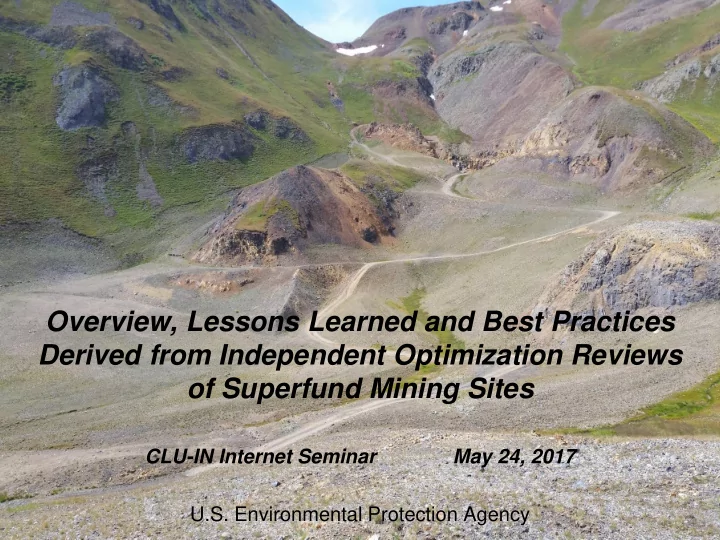
Overview, Lessons Learned and Best Practices Derived from Independent Optimization Reviews of Superfund Mining Sites CLU-IN Internet Seminar May 24, 2017 U.S. Environmental Protection Agency Introduction Welcome Webinar


slide-1
SLIDE 1

Overview, Lessons Learned and Best Practices Derived from Independent Optimization Reviews

  • f Superfund Mining Sites

CLU-IN Internet Seminar May 24, 2017 U.S. Environmental Protection Agency

slide-2
SLIDE 2

Introduction

  • Welcome
  • Webinar Logistics
  • Presenters
  • Kirby Biggs; EPA OSRTI TIFSD
  • Jody Edwards, P.G.; Tetra Tech
  • >15 nations attending!

5/9/2017 U.S. Environmental Protection Agency 2

slide-3
SLIDE 3

Webinar Outline

  • Status of Mine Sites in USA
  • What is Optimization?
  • EPA National Optimization Strategy
  • Optimization Mine Sites Initiative
  • Lessons Learned
  • Mine Site Characterization Best Practices
  • Optimization Review Case Studies
  • Summary
  • Questions

Elizabeth Mine, VT

5/9/2017 U.S. Environmental Protection Agency 3

slide-4
SLIDE 4

Mine Sites Status in USA

slide-5
SLIDE 5

Abandoned Hardrock Mine Sites

  • Estimated 100,000 – 500,000

abandoned mine land (AML) sites

  • Less than 500 AML sites documented
  • 139 AMLs on NPL or being addressed by

Superfund Alternative Approach

  • Internal and external collaboration to

address sites efficiently and effectively

  • EPA National Mining Team
  • Federal Mining Dialogue
  • Abandoned Uranium Mines Workgroup
  • Increasing collaboration with state, tribal

and private partners

  • Specialty focus of EPA optimization

review program

5/9/2017 U.S. Environmental Protection Agency 5

slide-6
SLIDE 6

EPA National Mining Team

Key Functions

  • Support mine related policy and regulatory issues
  • Provide technical information and site-specific assistance
  • n Superfund sites
  • Improve EPA management of mining issues
  • Support Federal Mining Dialogue and other federal

coordination activities

  • Support Optimization Studies at Mine sites

5/9/2017 6

slide-7
SLIDE 7

Federal Mining Dialogue (FMD)

  • Principals
  • Department of the Interior
  • Department of Agriculture
  • EPA
  • Additional Participants
  • Department of Energy
  • Department of Justice
  • US Army Corps of Engineers
  • Office of Management and Budget
  • ASTSWMO
  • Open exchange of information on

common challenges

  • Coordinating on development and

publication of Best Practices

5/9/2017 U.S. Environmental Protection Agency 7

slide-8
SLIDE 8

Abandoned Uranium Mine (AUM) Sites

  • 4,200+ sites identified, many more not

inventoried

  • Many reside on tribal and federal

lands

  • Mine site sizes vary but most are

large, remote, and difficult to access

  • 37 large mines located in six states
  • Places to dispose waste is a

challenge

  • Collaborative efforts to address sites

5/9/2017 U.S. Environmental Protection Agency 8

slide-9
SLIDE 9

What is Optimization?

slide-10
SLIDE 10

EPA’s Definition of Optimization

10

Systematic site review by a team

  • f independent technical experts,

performed at any phase of a cleanup process, to identify opportunities to improve remedy protectiveness, effectiveness and cost efficiency, and to facilitate progress toward site completion.

5/9/2017 U.S. Environmental Protection Agency 10

slide-11
SLIDE 11

Applies to Any Site, Program or Remedy

Types of Sites / Programs Example Types of Remedies Evaluated

  • DNAPL sites
  • Dry cleaners
  • Gas stations
  • Industrial facilities
  • Landfills
  • MGP sites
  • Mines / Mining districts
  • Petroleum sites
  • Sediment sites
  • Wood treating sites
  • CERCLA/Superfund
  • RCRA
  • State VCUP
  • Brownfields
  • Federal Facilities
  • Tribal
  • Groundwater extraction & treatment
  • Air sparging / Soil vapor extraction
  • Non-aqueous phase liquid recovery
  • Biosparging
  • In situ thermal remediation
  • In situ chemical oxidation
  • In situ bioremediation
  • Sediment capping
  • Permeable reactive barriers (PRB)
  • Constructed wetlands
  • Landfill gas collection
  • Surface water diversion/collection/treatment
  • Monitored natural attenuation (MNA)

Investigation > Feasibility Study > Design > Remedial Action > LTMO > O&M

slide-12
SLIDE 12

Examples of Technical Support

  • Programmatic support
  • Strategic planning support
  • Systematic project planning (SPP) facilitation
  • CSM development
  • Project Life Cycle CSM
  • https://clu-in.org/download/remed/csm-life-cycle-fact-sheet-final.pdf
  • High-resolution site characterization (HRSC)
  • 3-dimensional data visualization and analysis (3DVA)
  • Dynamic work strategy (DWS) development
  • Third-party technical review of site work plans and reports
  • Specialty characterization technology and sampling methods

expertise

5/9/2017 U.S. Environmental Protection Agency 12

slide-13
SLIDE 13
  • Engagement
  • Scoping
  • Project kick-off
  • Document / data acquisition and

review

  • Site visit and interviews
  • Data analysis
  • Preliminary findings
  • Reporting
  • Lessons learned compilation

Typical Site Visit Agenda

  • Introductions
  • CSM
  • Remedy effectiveness/protectiveness
  • Extraction/injection systems
  • Treatment components
  • Costs
  • Environmental footprint reduction
  • Site closure
  • Debrief

Typical Optimization Review Process

Requires expert level, multidiscipline review team members

5/9/2017 U.S. Environmental Protection Agency 13

slide-14
SLIDE 14

Sites That May Benefit From Optimization

  • Sites with:
  • Protectiveness concerns
  • Technological challenges
  • CSM data gaps; high site uncertainties
  • High costs for remedial activities
  • Interim remedies
  • Sites not meeting Remedial Action Objectives (RAO)
  • Sites scheduled for five-year reviews (FYR)
  • Sites in long-term remedial action (LTRA) and/or nearing
  • perations and maintenance (O&M) transfer to States

5/9/2017 U.S. Environmental Protection Agency 14

slide-15
SLIDE 15

Focus of Optimization Reviews

  • Remedial goals
  • Maximize value of existing site documents and data
  • Conceptual site model (CSM)
  • Remedy performance
  • Protectiveness
  • Cost-effectiveness
  • Site completion / closure strategy
  • Environmental footprint

5/9/2017 U.S. Environmental Protection Agency 15

slide-16
SLIDE 16

Other Benefits of Optimization

  • Site team and management provided with valuable

3rd-party perspective

  • Provides path forward strategy
  • Leverages adaptive management methods for flexibility
  • Helps build consensus among site stakeholders
  • Helps address community concerns
  • Balances technical input from site contractors
  • Accelerates schedule for site closure
  • Facilitates transfer of LTRA sites to States
  • Cross-pollinates expertise among sites and site teams

5/9/2017 U.S. Environmental Protection Agency 16

slide-17
SLIDE 17

EPA Optimization Resources

  • Two locations for online resources
  • www.cluin.org/optimization
  • www.epa.gov/superfund/cleanup-optimization-superfund-sites
  • Remediation Optimization: Definition, Scope and Approach
  • www.cluin.org/optimization/pdfs/OptimizationPrimer_final_June2013.pdf
  • Site-specific optimization review reports
  • www.clu-in.org/optimization/reports.cfm

5/9/2017 U.S. Environmental Protection Agency

slide-18
SLIDE 18

EPA National Optimization Strategy

slide-19
SLIDE 19

History of EPA Optimization Review Program

Year Key Milestones

1997 Site optimization reviews initiated by EPA 1999 EPA-USACE-USAF collaboration on review practices 2000 Pilot project – applied USACE RSE optimization process at 4 P&T sites in LTRA phase 2001 Pilot project expansion – reviews at 16 additional P&T sites in LTRA phase 2002 Development of guidance documents; internet seminars to address lessons learned 2003 Diversification of site type (other than P&T); reviews performed earlier project phases 2004 ‘Optimization Action Plan’ formalized optimization for Superfund Fund-lead LTRA sites 2004–2005 Pilot project in Region 3 for streamlined approach to optimization reviews 2010 After 150 sites reviewed, EPA directs development of National Optimization Strategy 2010–2012 Strategy developed by national EPA workgroup (HQ / Regions / Office of R&D) 2012 Formal release of “National Strategy to Expand Superfund Optimization Practices from Site Assessment to Site Completion”; Sept 12, 2012 2012–2013 Development of standard operating procedures (SOP) and other technical resources 2017 224 optimization reviews performed to date USA-wide 2017+ Expansion and training of optimization review resources; inclusion in new EPA contracts

slide-20
SLIDE 20

EPA National Optimization Strategy

Issued September 28, 2012

■ Systematic site review by a team of independent technical experts… ■ Performed at any phase of a cleanup process… ■ Identify opportunities to improve remedy protectiveness, effectiveness and cost efficiency… ■ Facilitate progress toward site completion.

EPA’s National Strategy to Expand Superfund Optimization Practices from Site Assessment to Site Completion (2012) 5/9/2017 U.S. Environmental Protection Agency 20

slide-21
SLIDE 21

Completed Optimization and Technical Support Events

EPA Region Number of Events 1997-2010 Number of Events 2011-2016 Total Events 1997 to Date % per Region 1 10 13 23 10 % 2 12 14 26 12 % 3 18 8 26 12 % 4 11 4 15 7 % 5 12 4 16 7 % 6 5 16 21 9 % 7 7 15 21 9 % 8 4 19 23 10 % 9 6 21 27 12 % 10 10 16 26 12 % TOTAL 95 130 224 100 %

5/9/2017 U.S. Environmental Protection Agency 21

slide-22
SLIDE 22

National Optimization Progress Report

DRAFT Optimization Review Results

  • Overall optimization program expanded
  • ~ 50 ongoing optimization events per year
  • ~ 20 optimization events completed per year
  • Reviews during all Superfund pipeline phases
  • Pre-remedial action = ~ 35%
  • Remedial action = ~ 51%
  • Operations and maintenance = ~ 14%
  • Evaluation of recommendations implemented
  • 61 sites reviewed between 2010 and 2015 were evaluated
  • 64% implemented, in progress, or planned
  • 15% under consideration
  • 16% declined
  • Key results for all sites
  • 68% > improvements to the CSM
  • 60% > streamlined or improved monitoring
  • 39% > improved system engineering
  • 36% > change in remedial approach
  • Technical support completed for 25 events
  • HRSC, 3DVA , Project Life Cycle CSMs, Environmental footprint analysis

5/9/2017 U.S. Environmental Protection Agency 22

slide-23
SLIDE 23

Optimization Mine Sites Initiative

slide-24
SLIDE 24

History of Mining Site Optimization

Year Key Milestones Mid-2000’s Mine site optimization reviews initiated at request of EPA Regions 2012 National Optimization Strategy released 2015 OSRTI evaluates results of 16 mining site pilot 2015 Mine Sites Initiative begins under National Optimization Strategy 2016 Focused reviews to support work at sites with fluid hazards 2017+ Mine site reviews ongoing focus of optimization program

5/9/2017 U.S. Environmental Protection Agency 24

slide-25
SLIDE 25

Overview of Mine Sites Optimization Efforts

Mine Site Optimization Reviews to Date

Optimization Metric Total to Date Locations Events 51 Sites and Mining Districts 34 Individual Mine Workings and OUs 99 Type of Support Optimization Reviews 24 Technical Support 13 Focused Technical Reviews 14 Activity Status Completed 30 In Progress 17 Pending 4

slide-26
SLIDE 26

Mining Sites Reviewed

  • Mining Sites Initiative Optimization

Reviews

  • Barker Hughesville, MT
  • Black Butte, OR
  • Bunker Hill, CA
  • Carpenter Snow Creek, MT
  • Carson River Mercury, NV
  • Central City/Clear Creek, CO
  • French Gulch/Wellington-Oro, CO
  • Gilt Edge, SD
  • Homestake Mining Co., NM
  • Iron King, AZ
  • Lava Cap Mine, CA
  • Silver Bow Creek/Butte, MT
  • Standard Mine, CO
  • Sulphur Bank, CA
  • Summitville Mine, CO
  • Tar Creek, OK
  • Focused Technical Reviews
  • Capt. Jack Mill, CO
  • Elizabeth Mine, VT
  • Gold King Mine, CO
  • Klau Buena Vista, CA
  • Rico Argentine/St. Louis Tunnel, CA
  • Standard Mine, CO
slide-27
SLIDE 27

Lessons Learned

Mining Sites Pilot

  • Sites with older remedies present more opportunities to optimize
  • Sites with high remediation costs often most complex, but present greater
  • pportunities for cost savings
  • Monitoring data collection and analysis can be a significant cost
  • CSMs beneficial for reducing uncertainty in large, complex sites
  • Important data gaps can arise in any project stage
  • Primary remedies at pilot sites include active MIW treatment
  • Treating MIW costly and often does not address source cleanup
  • Alternative water quality criteria may be potential option for specific sites
  • Institutional controls (IC) may be applicable when mine waste can not be

effectively removed or contained

  • Technical capabilities of project personnel important to project success

(Continued) 5/9/2017 U.S. Environmental Protection Agency 27

slide-28
SLIDE 28

Lessons Learned

Mining Sites Pilot

  • Use existing site attributes for remedial benefits
  • Evaluate these opportunities during RI to support FS or RD stages
  • Example: Monitor constituent levels before/after flow through existing wetlands
  • Reduce labor costs through automation of MIW treatment systems
  • Examples: Installation of auto-samplers; automating water treatment controls
  • Improve MIW capture via drains and flow control within mine workings
  • Example: Consider MIW from bedrock fractures, mineral veins and seeps
  • Improve WTP efficiency and lower costs through reduction of inflows
  • Example: Modify surface water drainage to bypass openings in workings
  • Low discharge requirements can require costly treatment methods
  • Particularly for sites with long-term MIW treatment needs
  • Passive treatment systems require low MIW discharge and space
  • Adequate area and/or suitable topography may not exist

5/9/2017 U.S. Environmental Protection Agency 28

slide-29
SLIDE 29

Lessons Learned

Mining Sites Pilot

Small Footprint Passive Treatment System Balaklala Mine, CA 5/9/2017 29

slide-30
SLIDE 30

Lessons Learned

MIW-Focused Technical Reviews

  • Confirm MIW conditions and potential

volume at risk of release prior to conducting invasive work

  • Confirm existing capacity to capture and

treat potential MIW releases

  • Conduct Failure Mode & Effects Analyses

(FMEA) on planned work activities to assess potential risks and consequences

  • Mitigate risk or provide contingency to

contain and treat potential MIW releases

  • Develop contingency, notifications and

emergency action plans (CNEAP)

Elizabeth Mine, VT 5/9/2017 U.S. Environmental Protection Agency 30

slide-31
SLIDE 31

Site Characterization Best Practices

slide-32
SLIDE 32

Best Practices: Underground Workings

  • Preventing sudden, uncontrolled fluid

mining waste releases

  • MIW, saturated sediments/sludge
  • Applies to investigation, rehabilitation

and remedial activities

  • Extensive technical review by federal

agencies and states

  • Formal independent peer review
  • USGS
  • PADEP, WVDEC
  • NOVAGOLD Resources
  • Colorado School of Mines, U.Nevada-Reno

5/9/2017 U.S. Environmental Protection Agency 32

slide-33
SLIDE 33

Best Practices Development Partners

Contributing U.S. Federal Agencies

  • Department of the Interior (DOI)
  • Office of Surface Mining, Reclamation and Enforcement (OSMRE)
  • U.S. Geological Survey (USGS)
  • Bureau of Reclamation (BOR)
  • Environmental Protection Agency (EPA)
  • Department of Labor
  • Mine Safety and Health Administration (MSHA)
  • Department of Transportation (DOT)
  • Federal Highways Administration (FHWA)
  • Interstate Technical Group on Abandoned Underground Mines
  • Department of Homeland Security (DHS)
  • Federal Emergency Management Agency (FEMA)
  • Department of Agriculture
  • U.S. Forest Service (USFS)

5/9/2017 U.S. Environmental Protection Agency 33

slide-34
SLIDE 34

Key Best Practices for MIW

Initial Assessment Activities

  • Conduct initial site screening
  • Document and data review
  • Identify data gaps
  • Conduct site Visit
  • Develop MIW CSM
  • Visualization of mine workings and MIW

conditions

  • Evaluate MIW pooling attributes
  • Hydrogeologic
  • Hydrologic
  • Geochemical
  • Geotechnical
  • Develop qualitative water balance
  • Inflows - outflows

5/9/2017 U.S. Environmental Protection Agency 34

slide-35
SLIDE 35

Example Simplified MIW CSM

Standard Mine, CO

slide-36
SLIDE 36
  • Plan and conduct minimally invasive measurement

activities

  • Geophysical studies, tracer studies
  • Groundwater/MIW pooling water levels
  • Surface water flows and water quality
  • Example downhole measurements
  • Water elevations using pressure transducers
  • MIW flow metering
  • Visual inspection using video
  • 3-D laser mapping of workings
  • Develop detailed water balance
  • Calculate / estimate hydrostatic conditions

Key Best Practices for MIW

Field Investigation Activities

5/9/2017 U.S. Environmental Protection Agency 36

slide-37
SLIDE 37
  • Plan and conduct invasive measurement activities
  • Drilling using blow-out preventers
  • Downhole measurement through boreholes
  • Monitoring well installation and sampling
  • Examples of drilling-related failure modes
  • MIW releases through drilled boreholes
  • Collapses or cave-ins within workings
  • Ground failure from weight of drilling equipment
  • Ground liquefaction from drilling vibration

Key Best Practices for MIW

Field Investigation Activities

5/9/2017 U.S. Environmental Protection Agency 37

slide-38
SLIDE 38
  • Conduct Failure Mode and Effects Analysis (FMEA)
  • Qualitative or quantitative depending on available data
  • Multi-discipline team with diverse expertise and knowledge
  • One or more with prior FMEA experience
  • Identify potential failure modes and related elements
  • Triggering event(s)
  • Likelihood of occurrence
  • Consequences and severity
  • Receptors
  • Determine actions to eliminate or reduce failures

Key Best Practices for MIW

FMEA

5/9/2017 U.S. Environmental Protection Agency 38

slide-39
SLIDE 39

Example FMEA Worksheet

Qualitative

Failure Mode Failure Mode Description Factors Making Failure Mode More / Less Likely Likelihood of Occurrence Consequences Risk Matrix

5/9/2017 U.S. Environmental Protection Agency 39

slide-40
SLIDE 40

Practices for MIW

FMEA Risk Matrix

  • Matrix Axes
  • Consequence & Likelihood
  • Color-coded risk levels
  • Red – Extreme Risk
  • Orange / orange-red – High Risk
  • Yellow – Moderate Risk
  • Green – Tolerable Risk
  • Blue – Low to negligible Risk
  • Risk levels provide basis for

risk mitigation activities

5/9/2017 U.S. Environmental Protection Agency 40

slide-41
SLIDE 41

Key Best Practices for MIW

CNEAP

  • Develop CNEAP
  • Contingency > Existing site infrastructure that would auto-

manage MIW release (e.g., existing retention basin)

  • Notifications > For emergency response agencies and

downstream receptors; dependent on severity of event

  • Emergency Action > Other actions taken if a release were to
  • ccur (e.g., site worker mustering locations)
  • CNEAP content directly supported by FMEA results
  • Designate CNEAP as governing document for

managing, monitoring and response to potential MIW releases

  • Work plans, HASPs, plans and specifications, etc.

5/9/2017 U.S. Environmental Protection Agency 41

slide-42
SLIDE 42
  • Collect and evaluate data
  • Correlate MIW pooling water levels and discharge location(s)
  • Update detailed water balance
  • Update MIW CSM
  • Identify needed mitigations
  • Example – pre-draining MIW prior to work activities
  • Report findings to required parties
  • Plan and implement mitigation efforts
  • Perform FMEA
  • Update CNEAP

Key Best Practices for MIW

Data Evaluation and Reporting

5/9/2017 U.S. Environmental Protection Agency 42

slide-43
SLIDE 43

Reference Guide to Treatment Technologies for Mining-Influenced Water

  • Addresses 7 passive / 9 active technologies
  • Summary of 7 additional technologies
  • On-line searchable library of technologies
  • Technology discussions include:
  • Technology description
  • Constituents treated
  • Operations
  • Long-term maintenance
  • System limitations
  • Costs
  • Effectiveness
  • Living resource; update in process
  • Handbook for Treatment Technologies for Mining

Wastes and Mining-Influenced Water

  • Updates the MIW guide and expands the state of

knowledge to include mining waste www.cluin.org/mining

5/9/2017 U.S. Environmental Protection Agency 43

slide-44
SLIDE 44

Optimization Review Case Studies

slide-45
SLIDE 45

Bonita Peak Mining District

Site Information

  • Optimization review and technical support for RI planning
  • Newly listed Superfund site in Silverton, CO area
  • 48 mines located in three adjacent, high-altitude drainage basins
  • Animas River / Cement Creek / Mineral Creek
  • Downstream confluence into Animas River
  • “One government” project team
  • US EPA
  • US Bureau of Land Management (BLM)
  • US Forest Service (USFS)
  • Colorado Department of Public Health and Environment (CDPHE)
  • Colorado Division of Reclamation Mining and Safety (DRMS)
  • Approximately 40 project team members
  • Program and project management
  • Technical, legal and communications

5/9/2017 U.S. Environmental Protection Agency 45

slide-46
SLIDE 46

Bonita Peak Mining District

Site Information

5/9/2017 U.S. Environmental Protection Agency 46

slide-47
SLIDE 47

Bonita Peak Mining District

Challenges

  • High diversity in mine site characteristics
  • Portals located along river/creeks and steep terrain up to 12,000 feet MSL
  • Active MIW pooling and discharges; hydraulic interconnectivity
  • Direct sourcing to surface water from anthropogenic and natural sources
  • Receptor diversity and issues
  • Downstream receptors – water quality impacts
  • Residents – impact to lives and economic livelihoods
  • Thriving ATV and 4WD adventure tours – direct exposure to tailings dust
  • Hikers and mountain bikers – direct exposure to impacted drinking water
  • Historic sites – preservation requirements
  • Tribal – impacts to cultural use
  • Additional issues
  • Various funding levels/mechanisms and program requirements for each agency
  • Mixed land ownership – government, tribal, corporate, private
  • Mines easily accessible to nearly inaccessible
  • Short work season due to lengthy snow season

5/9/2017 U.S. Environmental Protection Agency 47

slide-48
SLIDE 48

Bonita Peak Mining District

Technical Support Activities

  • Conducted 1-week site visit reconnaissance
  • Facilitated objective-focused, strategic planning effort
  • Identified >350 action items during two meetings and one prior meeting
  • Developed Excel database matrix as collaborative management tool
  • Strategic-, programmatic- and project-level activity planning and tracking
  • Proposed use of an integrated strategy for key site activities
  • Enabled immediate planning for taking action on obvious site concerns
  • Requires additional evaluation for regulatory process and funding

Bonita Peak Mining District, CO 5/9/2017 U.S. Environmental Protection Agency 48

slide-49
SLIDE 49

Lava Cap Mine Superfund Site

Site Information

LOCATION

  • Sierra Nevada foothills; western Nevada County, CA
  • Approximately 33 acres in semi-rural, residential area

MINE TYPE

  • Gold and silver from underground workings
  • Initiated in 1861 and continued sporadically until 1943
  • Mine-related arsenic contamination in nearby drinking water wells

CLEANUP STATUS

  • Remedial design stage; Record of Decision (ROD) signed Sept. 2008
  • Interim remedy for Groundwater Operable Unit (OU)
  • Construction of public water supply line to affected residences
  • Further study required to assess interactions between fractured bedrock

aquifer and surface water

TWO OPTIMIZATION REVIEWS: IMPOUNDMENT FOCUS; MIW FOCUS

5/9/2017 U.S. Environmental Protection Agency 49

slide-50
SLIDE 50

Lava Cap Mine Superfund Site

Key Optimization Review Findings

DAM SAFETY

  • Unregulated earth-rock embankment dam
  • Holds tailings and other wastes
  • Spillway inadequate for minimum flood flow

and has deteriorated concrete components

DAM CHARACTERIZATION

  • Approximately eight decades of operation and

modifications

  • Dam stability and composition not well-defined
  • r documented

SEEPAGE FROM DAM

  • Active seepage from former mine workings
  • Source of surface water contamination

5/9/2017 U.S. Environmental Protection Agency 50

slide-51
SLIDE 51

Lava Cap Mine Superfund Site

Key Review Recommendations

EMBANKMENT PLAN

  • Conduct further investigations to support

development of more realistic embankment model of dam stability

  • Perform stability analysis

PREVENT SEEPAGE

  • Identify seepage outlet
  • Quantify conditions to design mitigation
  • Install conduit plug to reduce seepage

REDUCE CONSTRUCTION ACTIVITY

  • Use stability analysis as basis for developing

closure alternatives that more efficiently satisfy dam safety requirements

ESTIMATED 30 YEAR COST SAVINGS: $5.6M

5/9/2017 U.S. Environmental Protection Agency 51

slide-52
SLIDE 52

Summitville Mine Superfund Site

Site Information

LOCATION

  • San Juan Mountains south of Del Norte, CO
  • 11,500 feet above sea level; ~2 miles east of the Continental Divide

MINE TYPE

  • Gold, copper and silver mining from underground workings and open pit
  • Initiated ~1870 and continued into the 1990s

CLEANUP STATUS

  • Remedial Action stage
  • Several actions implemented to reduce MIW discharge
  • Detoxifying, capping and revegetating a cyanide heap leach pad
  • Removing waste rock piles and filling the mine pits
  • Plugging adits and underground mine entrances
  • Expanding water runoff holding ponds and operating on-site WTP
  • In preparation stages for transfer to State of Colorado

TWO OPTIMIZATION REVIEWS: WHOLE SITE FOCUS; STATE TRANSFER FOCUS

5/9/2017 U.S. Environmental Protection Agency 52

slide-53
SLIDE 53

Summitville Mine Superfund Site

Site Information

5/9/2017 U.S. Environmental Protection Agency 53

slide-54
SLIDE 54

Summitville Mine Superfund Site

Key Optimization Review Findings

MINE POOL

  • Elevated MIW pool water level
  • Hydraulic potential may affect migration of impacted groundwater through

bedrock and subsequent discharge to surface water

PUMP & TREAT CAPTURE ZONE

  • High seasonal variability in groundwater flow
  • Uncaptured seeps and groundwater discharges impacting river

REMEDY OPERATION

  • Remedy operating costs significantly high compared to similar sites

WTP

  • Current and planned remedies anticipated to require operation in perpetuity
  • Will result in high total costs

5/9/2017 U.S. Environmental Protection Agency 54

slide-55
SLIDE 55

Summitville Mine Superfund Site

Key Review Recommendations

LOWER MINE POOL ELEVATION

  • Evaluate options for maintaining lower water level in mine pool
  • Reduce effects of hydraulic potential on groundwater migration and discharge

CONDUCT COMPREHENSIVE HYDROGEOLOGIC EVALUATION

  • Determine if planned interceptor trench along the northern boundary of the site

will provide the expected capture of impacted groundwater and surface water

REDUCE MONITORING PROGRAM

  • Evaluate need for continued extensive surface water sampling and analysis

REDUCE SNOW REMOVAL

  • Eliminate potentially unnecessary seasonal maintenance snow removal

ADDRESS PERPETUAL WTP OPERATION

  • Consider remedial approaches that will not require perpetual water treatment

ESTIMATED 30 YEAR COST SAVINGS: $13.8M

5/9/2017 U.S. Environmental Protection Agency 55

slide-56
SLIDE 56

Central City/Clear Creek Site

Site Information

LOCATION

  • Gilpin and Clear Creek Counties, CO
  • Consists of 400 mile2 watershed

MINE TYPE

  • Gold and silver
  • Initiated in the mid-1800s and continued until the 1940’s
  • Most mines in watershed were underground mines
  • Site’s Argo Tunnel is major source of MIW discharge

CLEANUP STATUS

  • Remedial Action stage
  • Remedies at the site’s four operable units (OUs) focus on water

treatment and source control

  • Simultaneous design, construction and operation activities

5/9/2017 U.S. Environmental Protection Agency 56

slide-57
SLIDE 57

Central City/Clear Creek Site

Site Information

5/9/2017 U.S. Environmental Protection Agency 57

slide-58
SLIDE 58

Central City/Clear Creek Site

Key Optimization Review Findings

COLLECTION SYSTEM AND TREATMENT/CAPACITY

  • MIW collection system and 180 gpm WTP overwhelmed during high flows
  • f groundwater and surface water
  • Untreated water discharged to Clear Creek

WTP PERFORMANCE

  • Poor lime quality causes blockages and system failures
  • Results in discharge standards not being met

WEATHER

  • Weather conditions impact system performance and worker safety

OPERATIONS

  • WTP is attended less than half the day; operated remotely via laptop

EFFLUENT FILTERS

  • Post-clarifier gravity filters commonly become clogged as WTP backwash

systems do not function properly; this requires filters to be bypassed

5/9/2017 U.S. Environmental Protection Agency 58

slide-59
SLIDE 59

Central City/Clear Creek Site

Key Review Recommendations

CONTAIN GROUNDWATER

  • Determine need for complete contaminated groundwater collection and

treatment as well as blowout prevention to avoid untreated discharges

NEW FILTER SYSTEM

  • Install new automated filter presses to replace existing presses that require

manual sludge movement

IMPROVE LIME DELIVERY

  • Improve the lime delivery system to prevent blockages

COMPRESSED AIR RELIABILITY

  • Provide additional compressed air capacity to improve system functionality
  • Essential for filter presses, waste evacuation pumps and other equipment

CONSIDER DEVELOPING ON-SITE REPOSITORY

  • To avoid the costs of disposing filter press solids at off-site landfill

ESTIMATED 30 YEAR COST SAVINGS: $7.7M

5/9/2017 U.S. Environmental Protection Agency 59

slide-60
SLIDE 60

Gilt Edge Mine Superfund Site

Site Information

LOCATION

  • 360-acre mining disturbed area near Lead, SD
  • Headwaters of cold-water fisheries and municipal water supplies of the

northern Black Hills

MINE TYPE

  • Gold, copper and tungsten
  • initiated in 1876 and continued until late 1990s
  • Open pit mining and cyanide heap-leach operations
  • Prior mine exploration activities from various mining companies

CLEANUP STATUS

  • Remedial Action stage
  • Interim remedies being undertaken at all three OUs while further study and

final remedies are selected

  • WTP being operated as an interim remedy while a permanent water

treatment remedy is evaluated and selected

5/9/2017 U.S. Environmental Protection Agency 60

slide-61
SLIDE 61

Gilt Edge Mine Superfund Site

Site Information

Anchor Hill Pit Extensive MIW Collection & Conveyance System

5/9/2017 U.S. Environmental Protection Agency 61

slide-62
SLIDE 62

Gilt Edge Mine Superfund Site

Key Optimization Review Findings

WTP

  • Three collection facilities capture and treat a significant portion of MIW
  • Continued MIW releases to surface water from un-captured seeps
  • WTP treats up to 325 gpm MIW to near S. Dakota surface water quality standards (SDSWQS)

EFFLUENT EXCEEDANCES

  • Waiver allows selenium and total dissolved solids (TDS) discharge above SDSWQS
  • Cadmium exceeds SDSWQS chronic standard in creek and periodically exceeds effluent

discharge limitations at WTP

  • Effluent periodically exceeds SDSWQS 30-day average conductivity standard

WTP OPERATIONS

  • WTP staffed 7 days per week, 24 hours per day with a total of 10 full-time staff
  • Plans exist to modify or replace WTP

POWER AND FUEL COSTS

  • Electricity costs approximately $151,000 per year, for ~434 kilowatt electrical power demand
  • Fuel costs of $79,000 per year and propane heating costs of about $24,000 per year

SAMPLING AND ANALYTICAL COST

  • Approximately $125,000 per year for 352 samples and laboratory and reporting costs

5/9/2017 U.S. Environmental Protection Agency 62

slide-63
SLIDE 63

Gilt Edge Mine Superfund Site

Key Review Recommendations

PRETREATMENT

  • Implement pretreatment for remaining high-sulfate MIW in pits

MIW COLLECTION

  • Upgrade Hoodoo Gulch collection facility

REDUCE STAFFING LEVELS

  • Eliminate overnight staffing, reduce labor force and operate in batch mode
  • Reduce vehicle leases for snow removal

REDUCE SAMPLING FREQUENCY

  • Evaluate current monitoring requirements to identify savings that can be

achieved by removing unnecessary or outdated monitoring requirements

KEEP EXISTING WTP

  • Do not change existing WTP
  • Regularly evaluate collection system pumping requirements

ESTIMATED 30 YEAR COST SAVINGS: $23.7M

5/9/2017 U.S. Environmental Protection Agency 63

slide-64
SLIDE 64

Gilt Edge Mine Superfund Site

Implemented Recommendations

  • Installed SCADA*/Automation system; completed in the spring of 2016
  • Cost approximately $950,000
  • Remote operation and monitoring of MIW collection facilities and WTP
  • Labor required for full time monitoring of collection facilities reduced
  • Overall site operations costs reduced
  • From between $2M to $2.2M per year to approximately $1.5M per year
  • Payback for investment will be approximately 2 years
  • Additional reductions from changes in contractor and contract

mechanism

  • Large to small business contractor
  • Cost reimbursable to fixed price contract
  • Outsourced oversight to U.S. Army Corps of Engineers

5/9/2017 U.S. Environmental Protection Agency 64

*SCADA = supervisory control and data acquisition

slide-65
SLIDE 65

Summary

  • Optimization program standard EPA

business practice

  • Standard process provides consistent

review outcomes

  • Reviews improving performance of

mine sites nationwide

  • Improved effectiveness / protectiveness
  • Solutions to complex site problems
  • Increased stakeholder collaboration
  • Advance progress toward closure
  • Reduced costs
  • Lessons learned driving innovation in

best practices for mine site characterization and remediation

Shasta Lakes Mining District, CA

5/9/2017 U.S. Environmental Protection Agency 65

slide-66
SLIDE 66

Questions

Kirby Biggs

National Optimization Coordinator

Office of Superfund Remediation and Technology Innovation biggs.kirby@epa.gov (703) 823-3081

Jody Edwards, P.G.

Principal Hydrogeologist Optimization Services Leader

Tetra Tech Inc. (802) 288-9485 jody.edwards@tetratech.com

5/9/2017 U.S. Environmental Protection Agency 66