
SLIDE 1
WIR SCHAFFEN WISSEN – HEUTE FÜR MORGEN
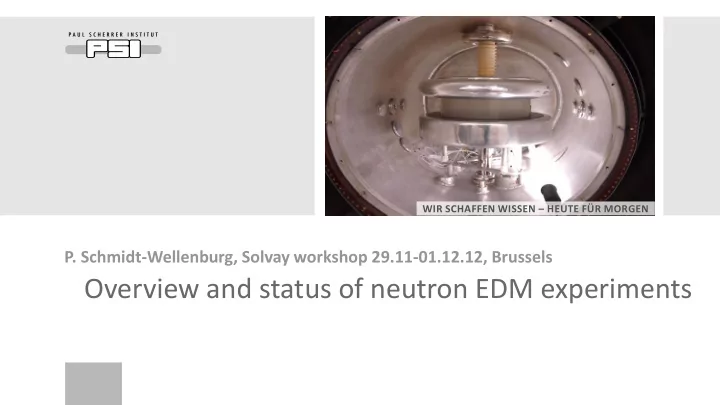
Overview and status of neutron EDM experiments
- P. Schmidt-Wellenburg, Solvay workshop 29.11-01.12.12, Brussels
Overview and status of neutron EDM experiments A brief history of - - PowerPoint PPT Presentation
WIR SCHAFFEN WISSEN HEUTE FR MORGEN P. Schmidt-Wellenburg, Solvay workshop 29.11-01.12.12, Brussels Overview and status of neutron EDM experiments A brief history of nEDM searches -19 Neutron EDM Upper Limit [ e cm] 10 -20 10 ORNL,
WIR SCHAFFEN WISSEN – HEUTE FÜR MORGEN
1950 1960 1970 1980 1990 2000 2010 2020 10
10
10
10
10
10
10
10
10
10
10
10
Standardmodel calculations
ORNL, Harvard MIT, BNL LNPI Sussex, RAL, ILL
Neutron EDM Upper Limit [ecm] Year of Publication Supersymmetry predictions
RAL-Sussex-ILL dn < 3 x 10–26 e cm (90% C.L.)
C.Baker et al. PRL(2006) 131801 J.M. Pendlebury et al., PRD 92 (2015) 092003
Smith, Purcell, Ramsey dn < 5 x 10–20 e cm
PR 108 (1957) 120
First Last ~ 50 years “n-EDM has killed more theories than any other single experiment”
J.M. Pendlebury 1936-2015
𝑊mag = −𝜈n Ԧ 𝜏. 𝐶 Δ𝐹𝑛𝑏 = ℏ𝜕𝑀 = 2𝜈𝑜𝐶 with: 𝜈𝑜 = 1
2ℏ𝛿𝑜
𝑊edm = −𝑒n Ԧ 𝜏. 𝐹 Δ𝐹𝑓𝑒𝑛 = ℏ𝜕𝑓𝑒𝑛 = 2𝑒𝑜𝐹
For parallel electric and magnetic fields the precession frequencies add up and for anti-parallel fields the frequencies have to be subtracted. The precession frequency difference of the two cases can be measured:
HOW ???
ℏ𝜕⇈ = ℏ 𝜕𝑀 + 𝜕𝑓𝑒𝑛 = 2 𝜈𝑜𝐶 + 𝑒𝑜𝐹 ℏ𝜕↿⇂ = ℏ 𝜕𝑀 − 𝜕𝑓𝑒𝑛 = 2 𝜈𝑜𝐶 − 𝑒𝑜𝐹 ℏ 𝜕⇈ − 𝜕↿⇂ = 4 𝑒𝑜𝐹
Sensitivity: Visibility of resonance T Time of free precession N Number of neutrons E Electric field strength 𝜏 𝑒n = ℏ 2𝛽𝑈𝐹 𝑂
+ + + + + + + + + + + + + +
B
l = 2m
𝑈 = 𝑚 𝑤 ≈ 0.015s; 𝛽 > 0.9; 𝐹 = 100kV cm ; ሶ 𝑂 = 1 × 10⁶s−1
Dominant systematic effect: 𝐶𝑤 = − 𝒘 × 𝑭 𝑑2 final result: 𝜏 𝑒𝐨 = 1.5 × 10⁻²⁴𝑓cm due to misalignment of 0.1 mrad Dres et al., PRD 15(1977 77) 9 1 day
𝜏 = 1×10⁻²⁴𝑓cm 𝜌/2 𝜌/2
𝜏 𝑒n = ℏ 2𝛽𝐹 𝑂𝑈3/2
σ d NT
2 n 3/
1
Storage properties are material dependent
Magnetic ∼60 neV/T Gravity 102 neV/m Strong VF V neV 350 Nb VF
4He
C.A. Baker et al., PLA308(2003)67 PSW, J. Bossy et al.,PRC92(2015)024002
macro cross section differential flux UCN lifetime in medium
𝜐D2 ≈ 25ms 𝜐 4He ≈ 200s
8
𝜏 𝑒n = ℏ 2𝛽𝐹 𝑂𝑈3/2
𝛽 𝑈 = e−Γ2𝑈 − 𝛿𝑜
2𝑨 2𝑈2
2 ⋅ 𝑒ℎ2 eff
Afach et al.,PRD92(2015)052008 Afach et al.,PRL115(2015)162502
𝜏 𝑒n = ℏ 2𝛽𝐹 𝑂𝑈3/2
n n
Statistical accuracy of a magnetometer correcting for a change in B should be better than the neutron sensitivity per cycle:
B
0 1μT
n
𝜀𝐶 < 100fT
magnetometers (CsM/HgM/XeM…)
Measured simultaneously (n2EDM) Measured as sequence (nEDM) Co-magnetometer (mercury, xenon,3He) Corrections for differences of mean magnetic- field gradient Corrections for changes of the mean magnetic field Magnetic shield (active, passive) Minimal residual fields + Stability: higher order gradients Small residual fields + Stability paramount !! Efforts TUM TRIUMF(2) PNPI PSI(2) SNS LANL(2) LANL PSI(1) finished TRIUMF(1) Non-UCN searches Crystal EDM (ILL&PNPI), beam EDM (F. Piegsa, ESS)
𝑒n = ℏΔ𝜕 − 2𝜈n 𝐶↿
↾− 𝐶↿ ⇂
2(𝐹↿
↾− 𝐹↿ ⇂)
≈ ℏΔ𝜕 4|𝐹| +++++++ +++++++
Location of the nEDM experiment UCNA UCNτ
UCN density sufficient for a several x 10-27 e-cm nEDM experiment
SD2 UCN source
courtesy: Ito Takeyasu
LANL collaboration: LANL, Indiana Univ., Univ of Kentucky,
Page 15
courtesy: Skyler Degenkolb
ILL/TUM effort: Berkley, ILL, Jülich, LANL, Michigan, MSU, NCSU, PTB, RAL, TUM, UIUC, Yale
Page 16
delivered and tested
“converter cryostat”
to be delivered soon
SuperSUN stage I (without magnet)
design in progress
SuperSUN stage II (with magnet)
feasibility study in progress
Converter volume: 12 litres UCN production rate: 105 s-1 (E < 230 neV) Saturated UCN number: 4×10⁶ (stage I, Fomblin spectrum) 2×10⁷ (stage II, polarized, E < 230 neV)
courtesy: Oliver Zimmer
Redesign to reduce costs (7/17) Smaller shield house Non-modular 3He system & smaller building
courtesy: Brad Filippone
cryogenic prototype & dressed spin design advanced
system with LHe & TBP (need 6 PE at least)
Full-scale operation in 2022
courtesy: Brad Filippone
courtesy: Anatolii Serebrov
new scheme
Page 20
WWR-M reactor
Use neutron source’s intrinsic pulses Fixed installation Lenght: 50m Τ d𝑂 d𝑢 > 100 MHz
courtesy: F. Piegsa
Japan-Canada collaboration Spallation-driven He-II UCN source connected to RT nEDM experiment. First UCN Nov 2017! Congratulations Goal sensitivity (statistics): δdn ~ 10-27 e-cm (2019-2022)
Unique UCN source technology with world- leading potential. 129Xe/199Hg dual-species comagnetometer to cancel false EDM’s.
UCN source courtesy: Rüdiger Picker
Project Status Sensitivity goal (E-27 ecm) Schedule (start data-taking) LANL 2017:UCN source upgrade finished UCN density sufficient for O(1) 2019 TUM-ILL TUM apparatus moves to ILL O(0.1) 2019 PNPI At PNPI 2020 PNPI: 0.5 PNPI later SNS Critical component demonstration concluded 0.2 2022 TRIUMF 2017: first UCN 2-3 years for experiment O(1) 2019 PSI Phase(1) data-taking concluded Phase(2) construction Phase 1: O(10) Phase 2: O(1) Phase(2): 2020 ESS Demonstration phase at ILL O(0.1) ? 2025
Bison et al., PR C 95(2017)045503
?
TRIUMF Colloquium 2017-10-12
50 25
TRIUMF Colloquium 2017-10-12
50 26
TRIUMF Colloquium 2017-10-12
50 27
Spallation target En~MeV D2O moderator Neutrons thermalized to 25 meV
Main shutter UCN storage volume Neutron guide to experiments UCN convertor (solid D2 @ 5K) 590 MeV 2.2 mA
Golub, R. & Pendlebury, J. M PLA (1975 75)133 Anghel, et. al NIMA (2009) 09) 272
TRIUMF Colloquium 2017-10-12
50 28
TRIUMF Colloquium 2017-10-12
50 29
TRIUMF Colloquium 2017-10-12
50 30
* 2
u d u d
N α N N N
TRIUMF Colloquium 2017-10-12
50 31
B0 ≈ 1μT τ = 140s
¼ wave plate linear polarizer Hg lamps PM polarization cell HgO source
TRIUMF Colloquium 2017-10-12
50 32
TRIUMF Colloquium 2017-10-12
50 33
54362 cycles (exclude runs with issues) 𝜏 = 0.94 × 10⁻²⁶ecm
TRIUMF Colloquium 2017-10-12
50 34
34
13,8% 83,1% 3,0% unblinded blinded can't be used
2.5% Issues which do not allow to use all data (no HV reversal, too short runs,…) A total of 54333 cycles to analyze
TRIUMF Colloquium 2017-10-12
50 35
→ Run both codes on fully un-blinded data → publish.
TRIUMF Colloquium 2017-10-12
50 36
1,3 1,9 1 1,4 1
4,7
Change in %
TRIUMF Colloquium 2017-10-12
50 37
gluonic fermionic Nick Ayres Michal Rawlik
arXiv:1504.07551v2 [hep-ph] Graham Rajendran PRD88, 035023 (2013)
TRIUMF Colloquium 2017-10-12
50 38
TRIUMF Colloquium 2017-10-12
50 39
Three “data sets”:
(parallel but pointing in different directions) Requirements for signal:
and phase shift of 𝜌 between both set
TRIUMF Colloquium 2017-10-12
50 40
First experimental limits
40 times better limit
https://PhysRevX.7.041034
TRIUMF Colloquium 2017-10-12
50 41
𝜏 𝑒n < 1 × 10⁻²⁷
TRIUMF Colloquium 2017-10-12
50 42
Physikalisch Technische Bundesanstalt, Berlin
Universität Bern, Bern
University of Sussex, Brighton
Laboratoire de Physique Corpusculaire, Caen
Institute of Physics, Jagiellonian University, Cracow
Henryk Niedwodniczanski Inst. Of Nucl. Physics, Cracow
Département de physique, Université de Fribourg, Fribourg
Laboratoire de Physique Subatomique et de Cosmologie, Grenoble
Katholieke Universiteit, Leuven
University of Kentucky, Lexington
Centre de Spectrométrie Nucléaire et de Spectrométrie de Masse, Orsay
Paul Scherrer Institut, Villigen
Eidgenössische Technische Hochschule, Zürich
also at: 1Paul Scherrer Institut, 2Eidgenössische Technische Hochschule
TRIUMF Colloquium 2017-10-12
50 45
We show that Big Bang Nucleosynthesis (BBN) significantly constrains axion-like dark matter. The axion acts like an oscillating QCD θ angle that redshifts in the early Universe, increasing the neutron–proton mass difference at neutron freeze-out. An axion-like particle that couples too strongly to QCD results in the underproduction
parameter space that would be covered by proposed searches for a time-varying neutron EDM. The QCD axion does not couple strongly enough to affect BBN. The supernova bound arises, as too strong coupling would result in lots of axions produced in supernovae which, in turn, would cause it to cool faster than observed. The "Galaxies" bound is dashed. If axions make up all of the dark matter, they need to be heavier than this so that they can reproduce observed distribution of dark matter (rotational curves). If they are only a part of dark matter, they can be lighter.
TRIUMF Colloquium 2017-10-12
50 46
A fRF
RF /
/ fHg
Hg
𝑩↑ ෩ 𝑺 = ഥ 𝑩↑ + ഥ 𝜷 cos(𝛁(෩ 𝑺 − 𝑺𝟏)) 𝑩↓ ෩ 𝑺 = ഥ 𝑩↓ + ഥ 𝜷 cos(𝛁(෩ 𝑺 − 𝑺𝟏))
TRIUMF Colloquium 2017-10-12
50 47
Earth rotation frequency correction : B-gradient fluctuation correction :
n n n Hg n i i
h f f d E f R f
2
TRIUMF Colloquium 2017-10-12
50 48
𝐹 ∦ 𝐶 𝐹 ⇈ 𝐶 𝐹 = 0
TRIUMF Colloquium 2017-10-12
50 49
𝑆 = 𝑔
UCN
𝑔
H g
= 𝛿n 𝛿Hg 1 ∓ 𝜖𝐶 𝜖𝑨 Δℎ 𝐶0 + 𝐶2⊥ 𝐶0 2 ∓ 𝜀Earth + 𝜀Hg−lightshift
UCN
199Hg
𝛿H
g
2 𝜌 ≈ 8 Hz/μT 𝛿n 2 𝜌≈ 30 Hz/μT + further sys.
TRIUMF Colloquium 2017-10-12
50 50
𝑤×𝐹 𝑑2
... ( )
x x z z y x y z
v yv B B E c xv yv B E z B c v v E c v B θ θ θ
4 2 2 2 4
2 2
adiabatic (UCN) non - adiabatic (Hg)
TRIUMF Colloquium 2017-10-12
50 51
nEDM strategy
Afach et al., EPJD(2015)69:225
TRIUMF Colloquium 2017-10-12
50 52
Pag
courtesy: Ito Takeyasu
Parameters V alues E(kV/cm) 12.0 N(per cell) 39 100 Tfree (s) 180 Tduty (s) 300 α 0.8 σ/day/cell (10-26 e-cm) 5.7 σ/day (10-26 e-cm) (for double cell) 4.0 σ/year* (10-27 ecm) (for double cell) 2.1 90% C.L./year* (10-27 ecm) (for double cell) 3.4
50 cm diameter cell The estimate for E, Tfree, Tduty, and α is based on what has been achieved by
The estimate for N is based on the actual detected number of UCN from
holding time of 180 s. Further improvements are expected (new switcher and new detector).
* “year” = 365 live days. In practice, it will take 5 calendar years to achieve this with 50% data taking efficiency and nominal LANSCE accelerator operation schedule
TRIUMF Colloquium 2017-10-12
50 53
with
TRIUMF Colloquium 2017-10-12
50 54
1 2 … 7 8 … 15 16
±132kV Current accuracy: 𝜏 𝑨 ≈ 10pT/cm
TRIUMF Colloquium 2017-10-12
50 55
*J.M. Pendlebury et al., PRD 92 (2015) 092003 **C.-Y. Seng,PRC(2015)025502
BSM + 𝑒n CKM < 3 × 10⁻²⁶𝑓cm*
Naive dimensional analysis
𝑛𝑟 Λ2 𝛽 4𝜌 sin𝜚CP ෨
𝐺
𝑓 𝑤 𝛽 4𝜌 𝑤 Λ 2
sin𝜚CPyqF g q q
Ψ
φ
loop dim-6 operator 𝑔(𝑛𝜒, 𝑛Ψ) 𝑛𝑟 ≡ 𝑤𝑧𝑟
TRIUMF Colloquium 2017-10-12
50 56
56/23
CP odd vertex Standard Model nEDM: 10-30 e·cm > dn >10-32 e·cm
Khriplovich PLB109(1982) & PLB173 (1986)
TRIUMF Colloquium 2017-10-12
50 57
Bison et al., PR C 95(2017)045503
?
TRIUMF Colloquium 2017-10-12
50 58
Standard operating Pulse Norm Pulse
UCN Counts /s VAT
Cascade Detector
VAT
1m glass tube
steel flanges
UCN
2016 : 4.4 million
TRIUMF Colloquium 2017-10-12
50 59
𝑆 = 𝑔
UCN
𝑔
H g
= 𝛿n 𝛿Hg 1 ∓ 𝜖𝐶 𝜖𝑨 Δℎ 𝐶0 + 𝐶2⊥ 𝐶0 2 ∓ 𝜀Earth + 𝜀Hg−lightshift
UCN
199Hg
𝛿H
g
2 𝜌 ≈ 8 Hz/μT 𝛿n 2 𝜌≈ 30 Hz/μT
Measure EDM as function of R & take care of systematics
TRIUMF Colloquium 2017-10-12
50 60
Afach et al., J. Appl. Phys. 116, 084510 (2014)
TRIUMF Colloquium 2017-10-12
50 61
d
26
TRIUMF Colloquium 2017-10-12
50 62
TRIUMF Colloquium 2017-10-12
50 63
TRIUMF Colloquium 2017-10-12
50 64
4He
C.A. Baker et al., PLA308(2003)67 PSW, J. Bossy et al.,PRC92(2015)024002
macro cross section differential flux UCN lifetime in medium
𝜐D2 ≈ 25ms 𝜐 4He ≈ 200s