Outline Static Analysis: Overview, Syntactic Analysis and Abstract - - PowerPoint PPT Presentation
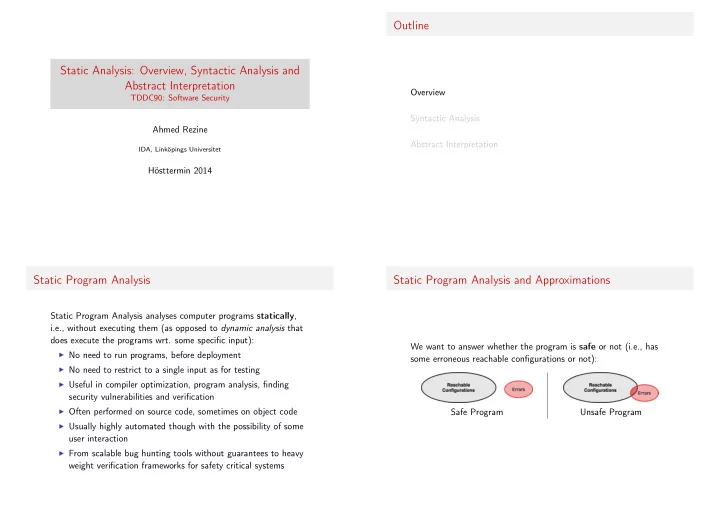
Outline Static Analysis: Overview, Syntactic Analysis and Abstract Interpretation Overview TDDC90: Software Security Syntactic Analysis Ahmed Rezine Abstract Interpretation IDA, Linkpings Universitet Hsttermin 2014 Static Program
Static Program Analysis and Approximations
■ Finding all configurations or behaviours (and hence errors) of
arbitrary computer programs can be easily reduced to the halting problem of a Turing machine.
■ This problem is proven to be undecidable, i.e., there is no
algorithm that is guaranteed to terminate and to give an exact answer to the problem.
■ An algorithm is sound in the case where each time it reports
the program is safe wrt. some errors, then the original program is indeed safe wrt. those errors
■ An algorithm is complete in the case where each time it is
given a program that is safe wrt. some errors, then it does report it to be safe wrt. those errors
Static Program Analysis and Approximations
■ The idea is then to come up with efficient approximations and
algorithms to give correct answers in as many cases as possible. Over-approximation Under-approximation
Static Program Analysis and Approximations
■ A sound analysis cannot give false negatives ■ A complete analysis cannot give false positives
False Positive False Negative
These Two Lectures
These two lectures on static program analysis will briefly introduce different types of analysis:
■ This lecture:
■ syntactic analysis: scalable but neither sound nor complete ■ data flow analysis and abstract interpretation sound but not
complete
■ Next lecture:
■ symbolic executions: complete but not sound ■ inductive methods: may require heavy human interaction in
proving the program correct
Administrative Aspects:
■ There will be two lab sessions ■ These might not be enough and you might have to work more ■ You will need to write down your answers to each question on
a draft.
■ you will need to demonstrate (individually) your answers in one
- f the lab sessions on a computer for me (for group A) or Ulf
(group B).
■ Once you get the green light, you can write your report in a
pdf form and send it (in pairs) to me or Ulf.
■ You will get questions in the final exam about these two
lectures.
Outline
Overview Syntactic Analysis Abstract Interpretation
Automatic Unsound and Incomplete Analysis
■ Tools such as the open source Splint or the commercial
Clockworck and Coverity trade guarantees for scalability
■ Not all reported errors are actual errors (false positives) and
even if the program reports no errors there might still be uncovered errors (false negatives)
■ A user needs therefore to carefully check each reported error,
and to be aware that there might be more uncovered errors
Unsound and Incomplete analysis: Splint
■ Some tools are augmented versions of grep and look for
- ccurrences of memcpy, pointer dereferences ...
■ The open source Splint tool checks C code for security
vulnerabilities and programming errors.
■ Splint does parse the source code and looks for certain
patterns such as:
■ unused method parameters ■ loop tests that are not modified by the loop, ■ variables used before definitions, ■ null pointer dereference ■ over writing allocated structures ■ and many more ...
Unsound and Incomplete analysis: Splint
Pointer dereference
... return *s; // warning about dereference
- f
possibly null pointer s ... if(s!= NULL) return *s; // does not give warnings because s was checked
Undefined variables:
extern int val (int *x); int dumbfunc (int *x, int i) { if (i > 0) return *x; // Value *x used before definition else return val (x); // Passed storage x not completely defined }
Unsound and Incomplete analysis: Splint
■ Still, the number of false positives remains very important,
which may diminish the attention of the user since splint looks for “dangerous” patterns
■ An important number of flags can be used to enable, inhibit or
- rganize the kind of errors Splint should look for
■ Splint gives the possibility to the user to annotate the source
code in order to eliminate warnings
■ Real errors can be made quite with annotations. In fact real
errors will remain unnoticed with or without annotations
Outline
Overview Syntactic Analysis Abstract Interpretation
Abstract Interpretation
■ Suppose you have a program analysis that captures the
program behavior but that is inefficient or uncomputable (e.g. enumerating all possible values at each program location)
■ You want an analysis that is efficient but that can also
- ver-approximate all behaviors of the program (e.g. tracking
- nly key properties of the values)
The sign example
■ Consider a language where you can multiply (✂), sum (+) and
substract () integer variables.
■ If you are only interested in the signs of the variables values,
then you can associate, at each position of the program, a subset of ❢+❀ 0❀ ❣, instead of a subset of ❩, to each variable
■ For an integer variable, the set of concrete values at a location
is in P(❩). Concrete sets are ordered with the subset relation ✈c on P(❩). We can associate ❩ to each variable in each location, but that is not precise. We write S1 ✈c S2 to mean that S1 is more precise than S2.
■ We approximate concrete values with an element in
P(❢❀ 0❀ +❣). For instance, ❢0❀ +❣ means the variable is larger
- r equal than zero. For A1❀ A2 in P(❢❀ 0❀ +❣), we write
A1 ✈a A2 to mean that A1 is more precise than A2.
The sign example: concrete and abstract lattices
■ A pair (Q❀ ✖) is a lattice if each pair p❀ q in Q has
■ a greatest lower bound p ✉ q wrt. ✖ (aka meet), and ■ a least upper bound p t q wrt. ✖ (aka join)
■ (P(❩)❀ ✈c) and (P(❢❀ 0❀ +❣)❀ ✈a) are lattices
Concrete lattice Abstract lattice (P(❩)❀ ✈c) (P(❢❀ 0❀ +❣)❀ ✈a)
■ For any S ✷ P(❩), ❢❣ ✈c S ■ If A1 = ❢❀ 0❣ and A2 = ❢0❀ +❣, then A1 ✉a A2 = ❢0❣ and
A1 ta A2 = ❢❀ 0❀ +❣
The sign example: Galois connections
■ (☛❀ ✌) is a Galois connection if, for all S ✷ P(❩) and
A ✷ P(❢❀ 0❀ +❣), ☛(S) ✈a A iff S ✈b ✌(A)
■ E.g. here, ☛(S) = ❢+❣ if S ✒ ❢i❥i ❃ 0❣ and ✌(A) = ❢i❥i ✔ 0❣
if A is ❢❀ 0❣
■ Interestingly: S ✈c ✌ ✍ ☛(S) and ☛ ✍ ✌(A) ✈a A for any
concrete and abstract elements S❀ A. Concrete lattice A Galois connection Abstract lattice
The sign example: abstract transformers
Let A❀ B be two abstract elements. ✡
- +
- {+}
{0} {-} {0} {0} {0} + {-} {0} {+} A ✡ B =
❬
a✷A❀b✷B
a ✡ b ✟
- +
- {-}
{-} {-,0,+} {-} {0} {+} + {-,0,+} {+} {+} A ✟ B =
❬
a✷A❀b✷B
a ✟ b
- +
++ {-,0} {+} {+} A++ = ❙
a✷A a++
- +
- {-}
{-} {0,+} A = ❙
a✷A a
Example 1
while(x >0){ if(x >0){ x--; }else{ x++; } assert(x >=0); } . // x: {-,0,+} while(x > 0){ // x: {} if(x > 0){ // x: {} x--; // x: {} }else{ // x: {} x++; // x:{} } // x: {} assert(x >= 0); // x: {} } // x: {} // x: {-,0,+} while(x > 0){ // x: {+} if(x > 0){ // x: {+} x--; // x: {0 ,+} }else{ // x: {} x++; // x: {} } // x: {0 ,+} assert(x >= 0); // x: {0 ,+} } // x: {-,0}
Example 2
while(x!=0){ assert(x!=0); if(x >0){ x,y=x--,1; }else{ x,y=x++,-1; } assert(y!=0); } . // x: {-,0,+}; y: {-,0,+} while(x != 0){ // x: {-,0,+}; y: {-,0,+} assert(x!=0); // x: {-,0,+}; y: {-,0,+} if(x > 0){ // x: {+}; y: {-,0,+} x,y=x--,1; // x: {}; y: {} }else{ // x: {0 ,+}; y: {-,0,+} x,y=x++,-1; // x:{}; y: {} } // x: {}; y: {} assert(y!=0); // x: {}; y: {} } // x: {0}; y: {-,0,+} // x: {-,0,+}; y: {-,0,+} while(x != 0){ // x: {-,0,+}; y: {-,0,+} assert(x!=0); // x: {-,0,+}; y: {-,0,+} if(x > 0){ // x: {+}; y: {-,0,+} x,y=x--,1; // x: {0 ,+}; y: {+} }else{ // x: {-,0}; y: {-,0,+} x,y=x++,-1; // x:{-,0,+}; y: {-} } // x: {-,0,+}; y: {-,0,+} assert(y!=0); // x: {-,0,+}; y: {-,0,+} } // x: {0}; y: {-,0,+}
Example 3: more precise abstract domain
while(x!=0){ assert(x!=0); if(x >0){ x,y=x--,1; }else{ x,y=x++,-1; } assert(y!=0); } . // x: {-,0,+}; y: {-,0,+} while(x != 0){ // x: {-,+}; y: {-,0,+} assert(x!=0); // x: {-,+}; y: {-,0,+} if(x > 0){ // x: {+}; y: {-,0,+} x,y=x--,1; // x: {}; y: {} }else{ // x: {+}; y: {-,0,+} x,y=x++,-1; // x:{}; y: {} } // x: {}; y: {} assert(y!=0); // x: {}; y: {} } // x: {0}; y: {-,0,+} // x: {-,0,+}; y: {-,0,+} while(x != 0){ // x: {-,+}; y: {-,0,+} assert(x!=0); // x: {-,+}; y: {-,0,+} if(x > 0){ // x: {+}; y: {-,0,+} x,y=x--,1; // x: {0 ,+}; y: {+} }else{ // x: {-}; y: {-,0,+} x,y=x++,-1; // x:{-,0}; y: {-} } // x: {-,0,+}; y: {-,+} assert(y!=0); // x: {-,0,+}; y: {-,+} } // x: {0}; y: {-,0,+}
Example 4: interval domain
[a❀ b] ✈ [c❀ d] iff c ✔ a and b ✔ d [a❀ b] t [c❀ d] is [inf ❢a❀ c❣❀ sup❢b❀ d❣] [a❀ b] ✉ [c❀ d] is [sup❢a❀ c❣❀ inf ❢b❀ d❣]
x,y=0 ,0; while(x!=100){ x,y=x++,y++; } assert(x==100); assert(y==100); . // x:[-oo ,+oo], y:[-oo ,+oo] x,y=0 ,0; // x:[0,0], y:[0 ,0] while(x!=100){ // x:[0,0], y:[0 ,0] x,y=x++,y++; // x:[0,1], y:[0 ,1] } // x:[], y:[] assert(x==100); // x:[], y:[] assert(y==100); // x:[], y:[] // x:[-oo ,+oo], y:[-oo ,+oo] x,y=0 ,0; // x:[0,0], y:[0 ,0] while(x!=100){ // x:[0,1], y:[0 ,1] x,y=x++,y++; // x:[0,2], y:[0 ,2] } // x:[], y:[] assert(x==100); // x:[], y:[] assert(y==100); // x:[], y:[]
Example 4: interval domain, widening
[0❀ 0]❀ [0❀ 1]❀ [0❀ 2]❀ [0❀ 3]✿✿✿✿ would take 100 steps to converge. Sometimes too many steps. For this use some widening operator r. Intuitively, an acceleration that ensures termination
x,y=0 ,0; while(x!=100){ x,y=x++,y++; } assert(x==100); assert(y==100); . // x:[-oo ,+oo], y:[-oo ,+oo] x,y=0 ,0; // x:[0,0], y:[0 ,0] while(x!=100){ // x:[0 ,99] , y:[0 ,+oo] x,y=x++,y++; // x:[0 ,100] , y:[0 ,+oo] } // x:[], y:[] assert(x==100); // x:[], y:[] assert(y==100); // x:[], y:[] // x:[-oo ,+oo], y:[-oo ,+oo] x,y=0 ,0; // x:[0,0], y:[0 ,0] while(x!=100){ // x:[0 ,99] , y:[0 ,+oo] x,y=x++,y++; // x:[0 ,100] , y:[0 ,+oo] } // x:[100 ,100] , y:[0 ,+oo] assert(x==100); // x:[100 ,100] , y:[0 ,+oo] assert(y==100); // x:[100 ,100] , y:[0 ,+oo]