Outline Paper presentation Ultra-Portable Devices Introduction - - PowerPoint PPT Presentation

outline
SMART_READER_LITE
LIVE PREVIEW

Outline Paper presentation Ultra-Portable Devices Introduction - - PowerPoint PPT Presentation

Outline Paper presentation Ultra-Portable Devices Introduction Paper: Related work Wake-Up-Frame Xiaolei Shi, Thomas Sturm, et al. Wake-Up-Frame Scheme for Ultra Low Power Transceivers. Comparison Globecom (vol. 6), pp.


slide-1
SLIDE 1

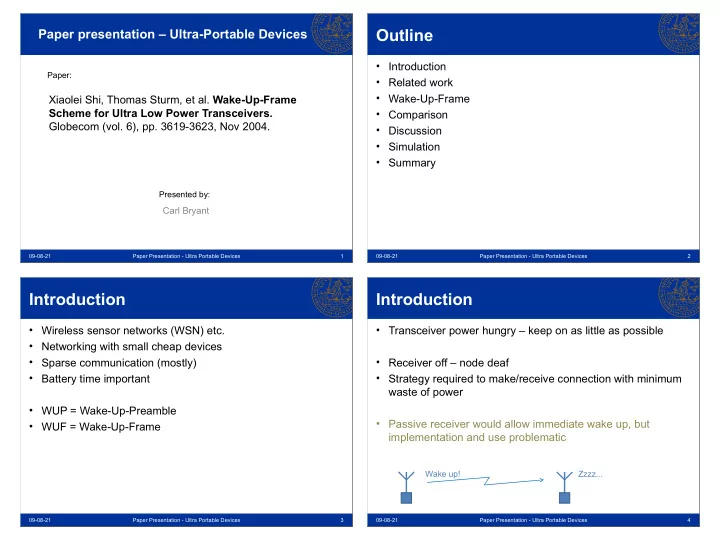
Paper presentation – Ultra-Portable Devices

Paper: Presented by:

Xiaolei Shi, Thomas Sturm, et al. Wake-Up-Frame Scheme for Ultra Low Power Transceivers. Globecom (vol. 6), pp. 3619-3623, Nov 2004.

Carl Bryant

09-08-21 1 Paper Presentation - Ultra Portable Devices

Outline

  • Introduction
  • Related work
  • Wake-Up-Frame
  • Comparison
  • Discussion
  • Simulation
  • Summary

09-08-21 2 Paper Presentation - Ultra Portable Devices

Introduction

  • Wireless sensor networks (WSN) etc.
  • Networking with small cheap devices
  • Sparse communication (mostly)
  • Battery time important
  • WUP = Wake-Up-Preamble
  • WUF = Wake-Up-Frame

09-08-21 Paper Presentation - Ultra Portable Devices 3

Introduction

  • Transceiver power hungry – keep on as little as possible
  • Receiver off – node deaf
  • Strategy required to make/receive connection with minimum

waste of power

  • Passive receiver would allow immediate wake up, but

implementation and use problematic

09-08-21 Paper Presentation - Ultra Portable Devices 4

Wake up! Zzzz...

slide-2
SLIDE 2

Related work

  • WiseMAC*
  • Transmission is preceeded by a long preamble

(Wake-Up-Preamble, WUP)

  • Receiver periodically wakes up to check for transmission
  • Transmission detected from signal strength
  • Sampling schedule piggybacked on last received packet to

allow shorter WUP in subsequent communication

09-08-21 Paper Presentation - Ultra Portable Devices 5 *El-Hoiydi, A.; Decotignie, J.-D., "WiseMAC: an ultra low power MAC protocol for the downlink of infrastructure wireless sensor networks," Computers and Communications, 2004. Proceedings. ISCC 2004. Ninth International Symposium on , vol.1, no., pp. 244-251 Vol.1, 28 June-1 July 2004 (among Nafiseh’s presentation papers)

Related work

  • Limitations:
  • Broadcasts must still use full length WUP
  • Clock instability will degrade sync. over time
  • Listening nodes must stay awake the full duration of the

WUP, even those not addressed

09-08-21 Paper Presentation - Ultra Portable Devices 6

Wake-Up-Frame

  • Idea: Replace preamble with smarter transmission containing

more information

  • Pretransmission is divided into many short frames each

containing a MAC frame and remaining duration of WUF

  • Allows listening nodes to make early wake/sleep desicion
  • Allows recipient to sleep until data is transmitted
  • Additional idea: Use different data rate for pretransmission
  • Data rate detection supposedly fast and easy
  • Complements signal strength detection to minimize

unneccesary wakeups

09-08-21 Paper Presentation - Ultra Portable Devices 7

Comparison, WUP/WUF

09-08-21 Paper Presentation - Ultra Portable Devices 8

  • Hardware example for comparison
slide-3
SLIDE 3

Comparison, WUP

09-08-21 Paper Presentation - Ultra Portable Devices 9

’Worst’ case – receiver sleeps just before start of WUP Determines shortest WUP required for certain detection

Comparison, WUP

09-08-21 Paper Presentation - Ultra Portable Devices 10

Receiver wakes up early – long wait Receiver fully on while waiting – wasted power

Comparison, WUF

09-08-21 Paper Presentation - Ultra Portable Devices 11

Receiver waking up early can go back to sleep Receiving node saves power

Discussion

  • Succeeds in making listening nodes work less, but transmitting

node still needs to work the full WUF duration (long pretransmission also limits channel capacity).

  • Introducing duplex would allow receiver to send ACK as suggested

in XMAC*

  • Does WUF still have any use?
  • Broadcasting
  • For a node with good power supply a long transmission matters less
  • Different pretransmission data rate useful?

09-08-21 Paper Presentation - Ultra Portable Devices 12 *Michael Buettner, Gary V. Yee et. al. “X-MAC: a short preamble MAC protocol for duty-cycled wireless sensor networks”, SenSys '06: Proceedings of the 4th international conference on Embedded networked sensor systems (2006), pp. 307-320 (among Nafiseh’s papers)

slide-4
SLIDE 4

Discussion

  • Paper argues that power savings increase with increased

traffic.

  • For frequent traffic a WiseMAC based WUP scheme would

have up to date sampling schemes, reducing wasted power

  • Incidentally the authors later got another paper adding this

feature to the WUF scheme*

09-08-21 Paper Presentation - Ultra Portable Devices 13 *Xiaolei Shi; Stromberg, G., "SyncWUF: An Ultra Low-Power MAC Protocol for Wireless Sensor Networks," Mobile Computing, IEEE Transactions on , vol.6, no.1, pp.115-125, Jan. 2007

Simulation

  • Simulations of different scenarios to judge if WUF has

noticable advantage over WUP

  • Data packets generated by a Poisson process with arrival

rate λ (packets/s)

  • Data frames @ 100kbit/s, WUF @ 70kbit/s
  • Caution: Unknow if WUP scheme includes sampling schedule

information

09-08-21 Paper Presentation - Ultra Portable Devices 14

Simulation

  • 3V, 1000mAh battery assumed

09-08-21 Paper Presentation - Ultra Portable Devices 15

Simulation

09-08-21 Paper Presentation - Ultra Portable Devices 16

Power consumption without traffic

slide-5
SLIDE 5

Simulation

09-08-21 Paper Presentation - Ultra Portable Devices 17

Master-Slave, unicast

Simulation

09-08-21 Paper Presentation - Ultra Portable Devices 18

Master-Slave, broadcast

Simulation

09-08-21 Paper Presentation - Ultra Portable Devices 19

Peer-To-Peer communication in a flat topology

Simulation

09-08-21 Paper Presentation - Ultra Portable Devices 20

Peer-To-Peer, unicast

slide-6
SLIDE 6

Simulation

09-08-21 Paper Presentation - Ultra Portable Devices 21

Peer-To-Peer, broadcast

Summary

  • Paper builds on Wake-Up-Signal type network with duty-

cycled reception, like WiseMAC

  • Unnecessary listening is avoided by including additional

information and by making the pretransmission distinct

  • Simulations seem to indicate significant potential savings
  • There may be solutions that improve on this, but this scheme

may still have merit for broadcasting and transmission from ’high power’ nodes

  • Using different data rate for pretransmission might have

general use

09-08-21 22 Paper Presentation - Ultra Portable Devices 09-08-21 Paper Presentation - Ultra Portable Devices 23