
SLIDE 1
Outline
- A. Introduction
- B. Single Agent Learning
- C. Game Theory
- D. Multiagent Learning
- E. Future Issues and Open Problems
SA3 – C1
Overview of Game Theory
- Models of Interaction
– Normal-Form Games – Repeated Games – Stochastic Games
- Solution Concepts
SA3 – C2
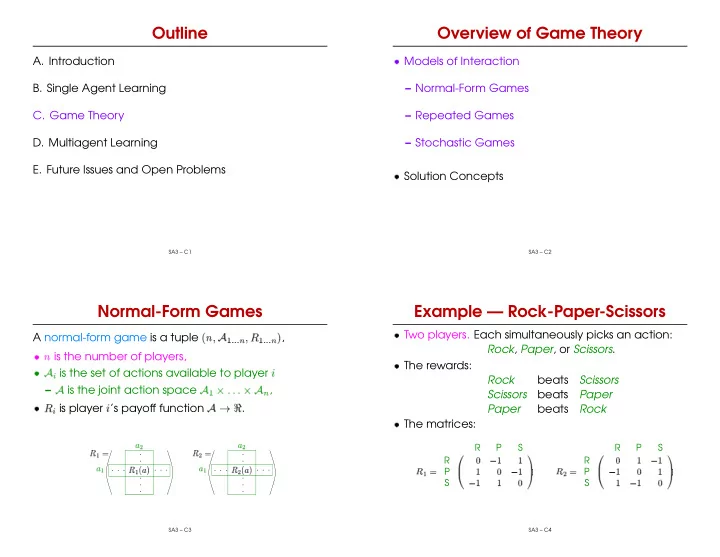
Normal-Form Games
A normal-form game is a tuple
✁ ✂☎✄ ✆✞✝✠✟ ✟ ✟ ✡ ✄ ☛ ✝ ✟ ✟ ✟ ✡ ☞,
- ✂
is the number of players,
- ✆✍✌
is the set of actions available to player
✎–
✆is the joint action space
✆ ✝ ✏✒✑ ✑ ✑ ✏ ✆ ✡,
- ☛✓✌
is player
✎’s payoff function
✆ ✔ ✕.
. . . . . . . . . . . . . . . . . . . . . .
✖ ✗ ✖ ✘ ✖ ✘ ✖ ✗ ✙ ✘ ✚ ✙ ✗ ✛ ✖ ✜ ✙ ✘ ✛ ✖ ✜ ✙ ✗ ✚SA3 – C3
Example — Rock-Paper-Scissors
- Two players. Each simultaneously picks an action:
Rock, Paper, or Scissors.
- The rewards:
Rock beats Scissors Scissors beats Paper Paper beats Rock
- The matrices:
R P S
✦ ✧ ★R
✩ ✪P
✪S
✪ ★ ✩ ✪ ✩ ✪ ✪ ★ ✫ ✬ ✢✤✭ ✥R P S
✦ ✧ ★R
✪P
✩ ✪S
✩ ✪ ★ ✪ ✪ ✩ ✪ ★ ✫ ✬SA3 – C4