
10/17/17 1
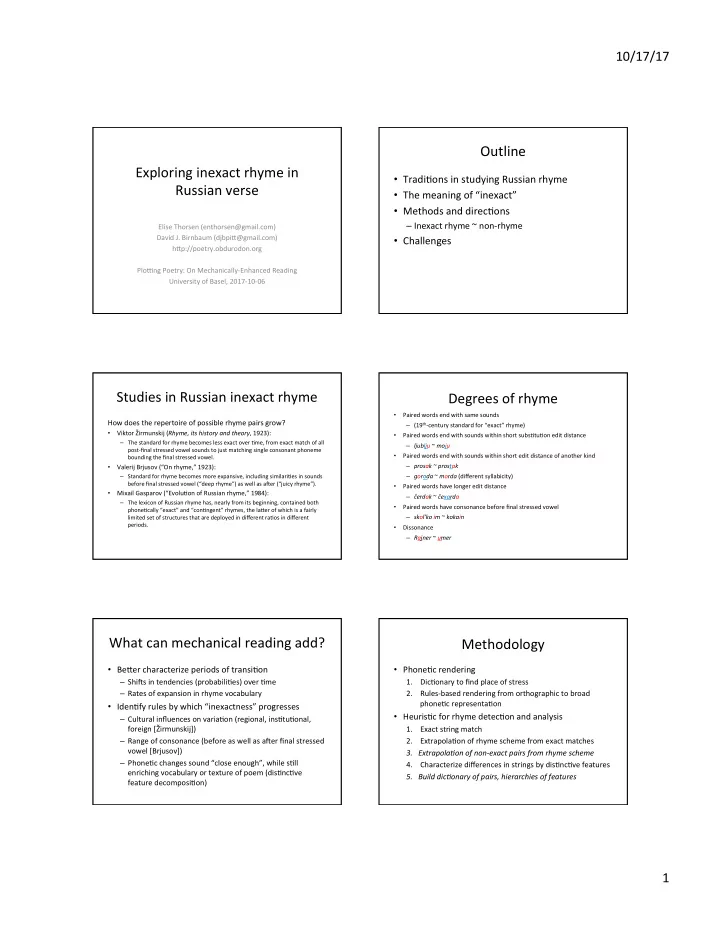
Exploring inexact rhyme in Russian verse
Elise Thorsen (enthorsen@gmail.com) David J. Birnbaum (djbpiE@gmail.com) hEp://poetry.obdurodon.org PloHng Poetry: On Mechanically-Enhanced Reading University of Basel, 2017-10-06
Outline
- TradiQons in studying Russian rhyme
- The meaning of “inexact”
- Methods and direcQons
– Inexact rhyme ~ non-rhyme
- Challenges
Studies in Russian inexact rhyme
How does the repertoire of possible rhyme pairs grow?
- Viktor Žirmunskij (Rhyme, its history and theory, 1923):
– The standard for rhyme becomes less exact over Qme, from exact match of all post-final stressed vowel sounds to just matching single consonant phoneme bounding the final stressed vowel.
- Valerij Brjusov (“On rhyme,” 1923):
– Standard for rhyme becomes more expansive, including similariQes in sounds before final stressed vowel (“deep rhyme”) as well as aaer (“juicy rhyme”).
- Mixail Gasparov (“EvoluQon of Russian rhyme,” 1984):
– The lexicon of Russian rhyme has, nearly from its beginning, contained both phoneQcally “exact” and “conQngent” rhymes, the laEer of which is a fairly limited set of structures that are deployed in different raQos in different periods.
Degrees of rhyme
- Paired words end with same sounds
– (19th-century standard for “exact” rhyme)
- Paired words end with sounds within short subsQtuQon edit distance
– ljublju ~ moju
- Paired words end with sounds within short edit distance of another kind
– prosak ~ prostak – goroda ~ morda (different syllabicity)
- Paired words have longer edit distance
– čerdak ~ čexarda
- Paired words have consonance before final stressed vowel
– skolʹko im ~ kokain
- Dissonance
– Rajner ~ umer
What can mechanical reading add?
- BeEer characterize periods of transiQon
– Shias in tendencies (probabiliQes) over Qme – Rates of expansion in rhyme vocabulary
- IdenQfy rules by which “inexactness” progresses
– Cultural influences on variaQon (regional, insQtuQonal, foreign [Žirmunskij]) – Range of consonance (before as well as aaer final stressed vowel [Brjusov]) – PhoneQc changes sound “close enough”, while sQll enriching vocabulary or texture of poem (disQncQve feature decomposiQon)
Methodology
- PhoneQc rendering
- 1. DicQonary to find place of stress
- 2. Rules-based rendering from orthographic to broad
phoneQc representaQon
- HeurisQc for rhyme detecQon and analysis
- 1. Exact string match
- 2. ExtrapolaQon of rhyme scheme from exact matches
- 3. Extrapola>on of non-exact pairs from rhyme scheme
- 4. Characterize differences in strings by disQncQve features
- 5. Build dic>onary of pairs, hierarchies of features