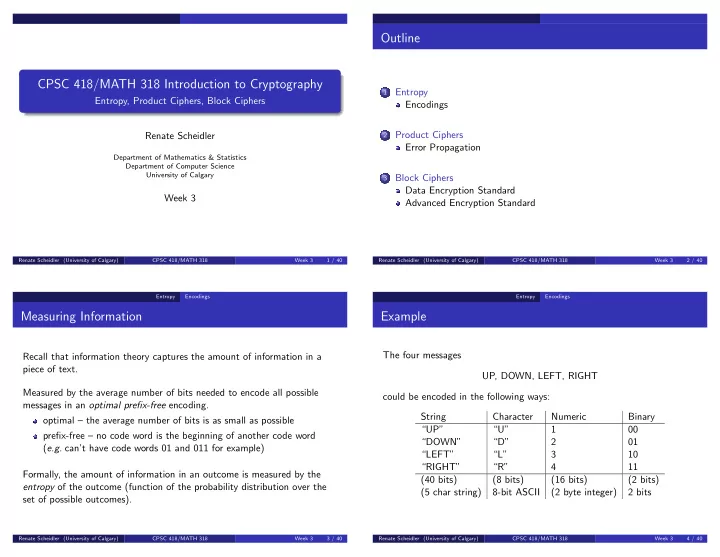
Outline CPSC 418/MATH 318 Introduction to Cryptography Entropy 1 - - PowerPoint PPT Presentation

outline cpsc 418 math 318 introduction to cryptography
SMART_READER_LITE
LIVE PREVIEW

Outline CPSC 418/MATH 318 Introduction to Cryptography Entropy 1 - - PowerPoint PPT Presentation

Outline CPSC 418/MATH 318 Introduction to Cryptography Entropy 1 Entropy, Product Ciphers, Block Ciphers Encodings Product Ciphers Renate Scheidler 2 Error Propagation Department of Mathematics & Statistics Department of Computer


slide-1
SLIDE 1

CPSC 418/MATH 318 Introduction to Cryptography

Entropy, Product Ciphers, Block Ciphers Renate Scheidler

Department of Mathematics & Statistics Department of Computer Science University of Calgary

Week 3

Renate Scheidler (University of Calgary) CPSC 418/MATH 318 Week 3 1 / 40

Outline

1

Entropy Encodings

2

Product Ciphers Error Propagation

3

Block Ciphers Data Encryption Standard Advanced Encryption Standard

Renate Scheidler (University of Calgary) CPSC 418/MATH 318 Week 3 2 / 40 Entropy Encodings

Measuring Information

Recall that information theory captures the amount of information in a piece of text. Measured by the average number of bits needed to encode all possible messages in an optimal prefix-free encoding.

  • ptimal – the average number of bits is as small as possible

prefix-free – no code word is the beginning of another code word (e.g. can’t have code words 01 and 011 for example) Formally, the amount of information in an outcome is measured by the entropy of the outcome (function of the probability distribution over the set of possible outcomes).

Renate Scheidler (University of Calgary) CPSC 418/MATH 318 Week 3 3 / 40 Entropy Encodings

Example

The four messages UP, DOWN, LEFT, RIGHT could be encoded in the following ways: String Character Numeric Binary “UP” “U” 1 00 “DOWN” “D” 2 01 “LEFT” “L” 3 10 “RIGHT” “R” 4 11 (40 bits) (8 bits) (16 bits) (2 bits) (5 char string) 8-bit ASCII (2 byte integer) 2 bits

Renate Scheidler (University of Calgary) CPSC 418/MATH 318 Week 3 4 / 40

slide-2
SLIDE 2

Entropy Encodings

Coding Theory

In the example, all encodings carry the same information (which we will be able to measure), but some are more efficient (in terms of the number of bits required) than others. Note: Huffmann encoding can be used to improve on the above example if the directions occur with different probabilities. This branch of mathematics is called coding theory (and has nothing to do with the term “code” defined previously).

Renate Scheidler (University of Calgary) CPSC 418/MATH 318 Week 3 5 / 40 Entropy Encodings

Entropy

Definition 1

Let X be a random variable taking on the values X1, X2, . . . , Xn with a probability distribution p(X1), p(X2), . . . , p(Xn) where

n

  • i=1

p(Xi) = 1 The entropy of X is defined by the weighted average H(X) =

n

  • i=1

p(Xi)=0

p(Xi) log2

  • 1

p(Xi)

  • = −

n

  • i=1

p(Xi)=0

p(Xi) log2 (p(Xi)) .

Renate Scheidler (University of Calgary) CPSC 418/MATH 318 Week 3 6 / 40 Entropy Encodings

Intuition

An event occurring with probability 1/2n can be optimally encoded with n bits. An event occurring with probability p can be optimally encoded with log2(1/p) = − log2(p) bits. The weighted sum H(X) is the expected number of bits (i.e. the amount of information) in an optimal encoding of X (i.e. one that minimizes the number of bits required). If X1, X2, . . . , Xn are outcomes (e.g. plaintexts, ciphertexts, keys)

  • ccurring with respective probabilities p(X1), p(X2), . . . , p(Xn), then

H(X) is the average amount of information required to represent an

  • utcome.

Renate Scheidler (University of Calgary) CPSC 418/MATH 318 Week 3 7 / 40 Entropy Encodings

Example 1

Suppose n = 1 (only one outcome). Then p(X1) = 1 ⇐ ⇒ 1 p(X1) = 1 ⇐ ⇒ log2 1 p(X1) = 0 ⇐ ⇒ H(X) = 0 . No information is needed to represent the outcome (you already know with certainly what it’s going to be). In fact, for arbitrary n, H(X) = 0 if and only of pi = 1 for exactly one i and pj = 0 for all j = i.

Renate Scheidler (University of Calgary) CPSC 418/MATH 318 Week 3 8 / 40

slide-3
SLIDE 3

Entropy Encodings

Example 2

Suppose n > 1 and p(Xi) > 0 for all i. Then 0 < p(Xi) < 1 (i = 1, 2, . . . , n) 1 p(Xi) > 1 log2

  • 1

p(Xi)

  • > 0,

hence H(X) > 0 if n > 1. If there are at least 2 outcomes, both occurring with nonzero probability, either one of the outcomes needs information to be represented.

Renate Scheidler (University of Calgary) CPSC 418/MATH 318 Week 3 9 / 40 Entropy Encodings

Example 3

Suppose there are two possible outcomes which are equally likely: p(heads) = p(tails) = 1 2, H(X) = 1 2 log2(2) + 1 2 log2(2) = 1 . So either outcome needs 1 bit of information (heads or tails).

Renate Scheidler (University of Calgary) CPSC 418/MATH 318 Week 3 10 / 40 Entropy Encodings

Example 4

Suppose we have p(UP) = 1 2, p(DOWN) = 1 4, p(LEFT) = 1 8, p(RIGHT) = 1 8 . Then H(X) = 1 2 log2(2) + 1 4 log2(4) + 1 8 log2(8) + 1 8 log2(8) = 1 2 + 2 4 + 3 8 + 3 8 = 14 8 = 7 4 = 1.75 . An optimal prefix-free (Huffman) encoding is UP = 0, DOWN = 10, LEFT = 110, RIGHT = 111 . Because UP is more probable than the other messages, receiving UP is more certain (i.e. encodes less information) than receiving one of the other

  • messages. The average amount of information required is 1.75 bits.

Renate Scheidler (University of Calgary) CPSC 418/MATH 318 Week 3 11 / 40 Entropy Encodings

Example 5

Suppose we have n outcomes which are equally likely: p(Xi) = 1/n. H(X) =

n

  • i=1

1 n log2 n = log2(n) . So if all outcomes are equally likely, then H(X) = log2(n). If n = 2k (e.g. each outcome is encoded with k bits), then H(X) = k.

Renate Scheidler (University of Calgary) CPSC 418/MATH 318 Week 3 12 / 40

slide-4
SLIDE 4

Entropy Encodings

Applications

For a plaintext space M, H(M) measures the uncertainty of plaintexts. Gives the amount of partial information that must be learned about a message in order to know its whole content when it has been distorted by a noisy channel (coding theory) or hidden in a ciphertext (cryptography) For example, consider a ciphertext C = X$7PK that is known to correspond to a plaintext M ∈ M = {“heads”,“tails”} in a fair coin toss. H(M) = 1, so the cryptanalyst only needs to find the distinguishing bit in the first character of M, not all of M.

Renate Scheidler (University of Calgary) CPSC 418/MATH 318 Week 3 13 / 40 Entropy Encodings

Extremal Entropy

Recall that the entropy of n equally likely outcomes (i.e. each occurring with probability 1/n) is log2(n). This is indeed the maximum:

Theorem 1

H(X) is maximized if and only if all outcomes are equally likely. That is, for any n, H(X) = log2(n) is maximal if and only if p(Xi) = 1/n for 1 ≤ i ≤ n. H(X) = 0 is minimized if and only if p(Xi) = 1 for or exactly one i and p(Xj) = 0 for all j = i. Intuitively, H(X) decreases as the distribution of messages becomes increasingly skewed.

Renate Scheidler (University of Calgary) CPSC 418/MATH 318 Week 3 14 / 40 Entropy Encodings

Minimal Entropy – Proof

Proof.

If one probability is 1, say p(X1) = 1, and all the others are 0, then H(X) = −p(X1) log2(p(X1)) = −1 · 0 = 0 . Conversely: H(X) = 0 ⇒ p(Xi) log2(p(Xi)) = 0 for each i with p(Xi) > 0 ⇒ log2(p(Xi)) = 0 for each i with p(Xi) > 0 ⇒ p(Xi) = 1 for each i with p(Xi) > 0 , but since all probabilities sum to one, this means there can only be one non-zero probability which is 1.

Renate Scheidler (University of Calgary) CPSC 418/MATH 318 Week 3 15 / 40 Entropy Encodings

Maximal Entropy – Proof Sketch

Proof sketch, n = 1 and n = 2.

Case n = 1: this is Example 1: p(X1) = 1 ⇐ ⇒ H(X) = 0. Case n = 2: “If” part is Example 3: p(X1) = p(X2) = 1 2 = ⇒ H(X) = log2(2) = 1 . “Only if” part is Problem 4 on Assignment 1. Put p(X1) = p > 0. Then p(X2) = 1 − p > 0, so H(X) = −p log2(p) − (1 − p) log2(1 − p) . Use calculus to show that as a function of p, H has a maximum iff p = 1/2. (Note that the derivative of log2(x) is 1/(x ln(2)), not 1/x.)

Renate Scheidler (University of Calgary) CPSC 418/MATH 318 Week 3 16 / 40

slide-5
SLIDE 5

Entropy Encodings

Maximal Entropy – Proof Sketch (Cont’d)

Proof, arbitrary n.

See Theorem 3.6 an its proof, pp. 72-73, of Paterson-Stinson. Applies Jensen’s inequality for concave functions (Theorem 3., p. 72 of Stinson-Paterson) to log2.

Renate Scheidler (University of Calgary) CPSC 418/MATH 318 Week 3 17 / 40 Entropy Encodings

Entropy of Keys

For a key space K, H(K) measures the amount of partial information that must be learned about a key to actually uncover it (e.g. the number of bits that must be guessed correctly to recover the whole key). For a k-bit key, the best scenario is that all k bits must be guessed correctly to know the whole key (i.e. no amount of partial information reveals the key, only full information does). Entropy of the random variable on the key space should be maximal. By Theorem 1, this happens exactly when each key is equally likely. Best strategy to select keys in order to give away as little as possible is to choose them with equal likelihood (uniformly at random). Cryptosystems are assessed by their key entropy, which ideally should just be the key length in bits (i.e. maximal).

Renate Scheidler (University of Calgary) CPSC 418/MATH 318 Week 3 18 / 40 Entropy Encodings

Example: Plaintext Versus Key Entropy

M = {pass, fail} (NOT an optimal plaintext encoding!) C = K = {0, 1}1,000,000 (bit strings of length one million) For each key K, the encryptions of pass and fail under K differ by at least one bit (since encryptions are injective). Knowledge of the value of such a distinguishing bit for every encryption makes it possible to deduce the correct plaintext from any

  • ciphertext. For example, if an attacker intercepts the ciphertext

C = 010110 · · · 111001 and has knowledge that the 3rd bit of the encryption of fail under the (unknown) key that was used is 1, then she knows that C is the encryption of pass (without knowing which key was used). So on average, one bit of information (about a ciphertext) reveals the entire plaintext. H(M) = 1, even though H(K) may be as much as 1,000,000.

Renate Scheidler (University of Calgary) CPSC 418/MATH 318 Week 3 19 / 40 Entropy Encodings

Lessons Learned from Previous Example

The security level (i.e. key entropy) of a cryptosystem may not tell the whole story in some applications and may in fact convey a false sense of security. (See also Problem 2 on Assignment 1.) Small message spaces are problematic (more later). The concept of indistinguishability is crucial in the contect of security (more later).

Renate Scheidler (University of Calgary) CPSC 418/MATH 318 Week 3 20 / 40

slide-6
SLIDE 6

Product Ciphers

Product Ciphers

Shannon also introduced the idea of product ciphers (multiple encryption):

Definition 2 (Product cipher)

The product of two ciphers is the result of applying one cipher followed by the other. AKA superencipherment and various other names. Note: All modern symmetric key ciphers in use are product ciphers.

Renate Scheidler (University of Calgary) CPSC 418/MATH 318 Week 3 21 / 40 Product Ciphers

Properties of Product Ciphers

If different ciphers are used in a product cipher, ciphertexts of one cipher need to have the correct format to be plaintexts for the next cipher to be applied. This is composition of encryption maps. Applying a product cipher potentially increases security. E.g. n-fold encryption with one cipher and n keys potentially corresponds to a cipher that has n times longer keys. Of course it also results in a loss of speed by a factor of n, but this might be worth it for added security.

Renate Scheidler (University of Calgary) CPSC 418/MATH 318 Week 3 22 / 40 Product Ciphers

Caveat

Be careful with this reasoning!

Note 1

The product of two substitution ciphers is a substitution cipher. The product of two transposition ciphers is a transposition cipher. Such ciphers are closed under encryption, so multiple encryption under different keys provides no extra security: E.g. double encryption EK1(EK2(M)) = EK3(M) for a third key K3.

Renate Scheidler (University of Calgary) CPSC 418/MATH 318 Week 3 23 / 40 Product Ciphers

Confusion and Diffusion

Shannon suggested applying two simple (substitution) ciphers with a fixed mixing transformation (transposition) in between to diffuse language redundancy into long-term statistics and confuse the cryptanalyst by obscuring the relationship between the ciphertext and the key.

Definition 3 (Confusion)

Make the relationship between the key and ciphertext as complex as possible (accomplished by applying substitutions or S-boxes).

Definition 4 (Diffusion)

Dissipate the statistical properties of the plaintext across the ciphertext (accomplished by applying transpositions or P-boxes).

Renate Scheidler (University of Calgary) CPSC 418/MATH 318 Week 3 24 / 40

slide-7
SLIDE 7

Product Ciphers

Examples of Historic Product Ciphers

ADFGX/ADFGVX Ciphers – employed by the Germans in WW I Hayhanen Cipher Reino Hayanen was KGB officer who defected to the US in 1957 and solved the hollow nickel espionage case for the FBI (who couldn’t break the cipher!) This led to arrest of Russian spy Rudolph Abel and the 1961 prisoner exchange of Abel for US Air Force pilot Francis Powers whose U-2 spy plane was shot down over Russia in 1960 Inspired Steven Spielberg’s 2015 movie Bridge of Spies (which portrayed Hayhanen rather unfavourably)

Renate Scheidler (University of Calgary) CPSC 418/MATH 318 Week 3 25 / 40 Product Ciphers

Examples of Modern Product Ciphers

Example 5

IBM’s Lucifer system uses permutations (transpositions) on large blocks for the mixing transformation, and substitution on small blocks for confusion. Lucifer’s designer H. Feistel originally wanted to call the product cipher “Dataseal”. IBM instead shortened the term demonstration cipher to “Demon.” Later, it was changed to Lucifer, because it retained the “evil atmosphere”

  • f Demon, and (more or less) contained the word cipher.

Renate Scheidler (University of Calgary) CPSC 418/MATH 318 Week 3 26 / 40 Product Ciphers

Lucifer: P-boxes and S-boxes

Since Lucifer was set up in hardware, they called the chips which did the permutation “P-boxes” and those that did the substitution “S-boxes.”

1 1 P−box 1 2 3 4 5 6 7 HIGH−TO−LOW BASE TRANSFORMER LOW−TO−HIGH BASE TRANSFORMER 1 2 3 4 5 6 7 2 =8 n 2 =8 n S−box 1 1 1 1 n=3 n=3

The Lucifer system simply consisted of a number of P and S boxes in alternation.

Renate Scheidler (University of Calgary) CPSC 418/MATH 318 Week 3 27 / 40 Product Ciphers

Diffusion in Lucifer

1 1 1 1 1 1 1 1 1 1 1 1 S S S S S S S S S S S S S S S S S S S S S S S S S P P P P P P

The thicker lines in the graphic indicate ‘1’ bits. The first ‘1’ input bit dissipates over the entire ciphertext.

Renate Scheidler (University of Calgary) CPSC 418/MATH 318 Week 3 28 / 40

slide-8
SLIDE 8

Product Ciphers Error Propagation

Error Propagation

Definition 6 (Error Propagation)

The degree to which a change in the input leads to changes in the output.

Definition 7 (Avalanche Effect)

Changing one input bit leads to significant changes in the output (e.g. half the output bits flip). Good error propagation is a desirable property of a cryptosystem (a user can easily tell if a message has been modified). Not necessarily good for decryption though (where one might want one error in the process to still lead to a mostly correct decryption).

Renate Scheidler (University of Calgary) CPSC 418/MATH 318 Week 3 29 / 40 Block Ciphers

Block Ciphers

All modern ciphers in use are block ciphers (although not necessarily used as such — we’ll talk about modes of operation of block ciphers later).

Definition 8 (Block cipher)

Encrypts plaintext blocks of some fixed length to ciphertext blocks of some fixed (possibly different) length. Usually, a message M will be larger than the plaintext block length, and must hence be divided into a series of sequential message blocks M1, M2, . . . , Mn of the desired length. A block cipher operates on these blocks one at a time. May need to pad last block Mn to the block length

Renate Scheidler (University of Calgary) CPSC 418/MATH 318 Week 3 30 / 40 Block Ciphers

Examples of Block Ciphers

Example 9

The shift cipher is a block cipher where the blocks consists of one character (i.e. 8 bits on 32-bit architecture, 16 bits on 64-bit architecture). Two main block ciphers in use today: Data Encryption Standard (DES)

Obsolete (key space too small) Still used in legacy code as triple encipherment (3DES)

Advanced Encryption Standard (AES)

Renate Scheidler (University of Calgary) CPSC 418/MATH 318 Week 3 31 / 40 Block Ciphers Data Encryption Standard

NIST

NIST: National Institute of Standards and Technology Everything about NIST’s cryptographic standards, recommendations, and guidance can be found at the NIST cryptographic standards and guidelines website https://csrc.nist.gov/projects/ cryptographic-standards-and-guidelines. Extremely useful website for both practitioners and scholars of cryptography. There is a link on the “references” page on the course website. NIST Publications: Older designation: FIPS (Federal Information Processing Register) Newer designation: SP (Special Publication)

All the crypto publications appear under SP 800

Renate Scheidler (University of Calgary) CPSC 418/MATH 318 Week 3 32 / 40

slide-9
SLIDE 9

Block Ciphers Data Encryption Standard

Data Encryption Standard (DES)

Described in FIPS 46, 46-2, 46-3 (see also docs on “handouts” page) Developed by IBM around 1972 in secret (based on Lucifer), with input from NSA Block cipher that encrypts 64-bit plaintext blocks to 64-bit ciphertext blocks using 64-bit keys.

Note that 8 of the key bits are parity bits, resulting in 56 actual bits of the key.

So M = C = {0, 1}64 and K = {0, 1}56. Algorithm consists of 16 rounds of permutations and substitutions DESKey(M) = IP−1(S16(S15(. . . (S2(S1(IP(M)))) . . . )))

Renate Scheidler (University of Calgary) CPSC 418/MATH 318 Week 3 33 / 40 Block Ciphers Data Encryption Standard

Multiple DES Encryption

What about multiple DES encryptions? Does this foil exhaustive attacks due to longer key sizes? Campbell and Wiener (1992) proved that DES is not closed, so multiple DES encryptions/decryptions could potentially provide additional security. size of the group generated by all the keys (i.e. the number of distinct encryptions obtained by applying repeated DES encryptions) has been shown to have size at least 102499 ≈ 28302. (Estimated number of atoms in the universe: 2240.) Later, we will show that on double encryption is essentially no more secure than single encryption (but twice as slow). What about three DES encryption? 3DES (triple DES) is still used.

Renate Scheidler (University of Calgary) CPSC 418/MATH 318 Week 3 34 / 40 Block Ciphers Data Encryption Standard

Triple DES

Use three successive DES operations: C = DESK1(DES−1

K2 (DESK3(M)))

See NIST Special Publication SP 800-67. Advantages: Same as single key if K2 = K1 or K2 = K3. Exhaustive search has complexity 2112 via the meet-in-the-middle attack (see next week), but with a 168-bit key and a factor of 3 in speed. Can use K1 = K3 with no loss of security. No other known practical attacks. The main disadvantage is that 3-DES is three times slower than single key DES while only doubling the key size.

Renate Scheidler (University of Calgary) CPSC 418/MATH 318 Week 3 35 / 40 Block Ciphers Data Encryption Standard

Skipjack and the Clipper Chip

After DES became obsolete, the United States National Security Agency (NSA) wanted to take control of the cipher standard selection process Proposed the Skipjack Algorithm implemented on the Clipper Chip Standardized by NIST as Escrowed Encryption Standard (EES) in

  • Feb. 1994 (see FIPS 185).

The details of Clipper and Skipjack were initially classified and kept secret. Due to the secrecy and wide distrust of the NSA in the US and abroad, this cipher never caught on in the public sector.

Renate Scheidler (University of Calgary) CPSC 418/MATH 318 Week 3 36 / 40

slide-10
SLIDE 10

Block Ciphers Advanced Encryption Standard

AES Competition

In 1997, NIST initiated a world-wide process of candidate submission and evaluation for the Advanced Encryption Standard to replace DES. The process was completely transparent and public! Requirements: possible key sizes of 128, 192, and 256 bits plaintexts and ciphertexts of 128 bits should work on a wide variety of hardware (from Smart Cards to PCs) fast secure world-wide royalty-free availability (!)

Renate Scheidler (University of Calgary) CPSC 418/MATH 318 Week 3 37 / 40 Block Ciphers Advanced Encryption Standard

Selection Criteria

Candidates were selected according to: security – resistance against all known attacks cost — speed and code compactness on a wide variety of platforms simplicity of design Most important: public evaluation process series of three conferences: algorithms, attacks, evaluations presented and discussed 21 submissions from all over the world evaluated during 1998-1999 final selection done by NIST

Renate Scheidler (University of Calgary) CPSC 418/MATH 318 Week 3 38 / 40 Block Ciphers Advanced Encryption Standard

The Winner: Rijndael

Rijndael (pronounced “Reign Dahl” or “Rhine Dahl”, but NOT “Region Deal” was chosen by NIST. Inventors: Vincent Rijmen and Joan Daemen. Standardized as AES in 2001 (FIPS 197) See also docs on “handouts” page). The Rijndael algorithm uses two different types of arithmetic: Arithmetic on bytes (8 bit vectors—actually, elements of the finite field GF(28) of 256 elements) 4-byte vectors (actually polynomial operations over GF(28)).

Renate Scheidler (University of Calgary) CPSC 418/MATH 318 Week 3 39 / 40 Block Ciphers Advanced Encryption Standard

Rijndael - Round Overview

The algorithm uses addition, multiplication, and inversion on bytes as well as addition and multiplication of 4 byte vectors. Rijndael is a product cipher, but NOT a Feistel cipher like DES. Instead, it has three layers per round: a linear mixing layer (ShiftRows, transposition, and MixColumns, a linear transformation; for diffusion over multiple rounds) a non-linear layer (SubBytes, substitution, done with an S-box) a key addition layer (AddRoundKey, X-OR with key)

Renate Scheidler (University of Calgary) CPSC 418/MATH 318 Week 3 40 / 40