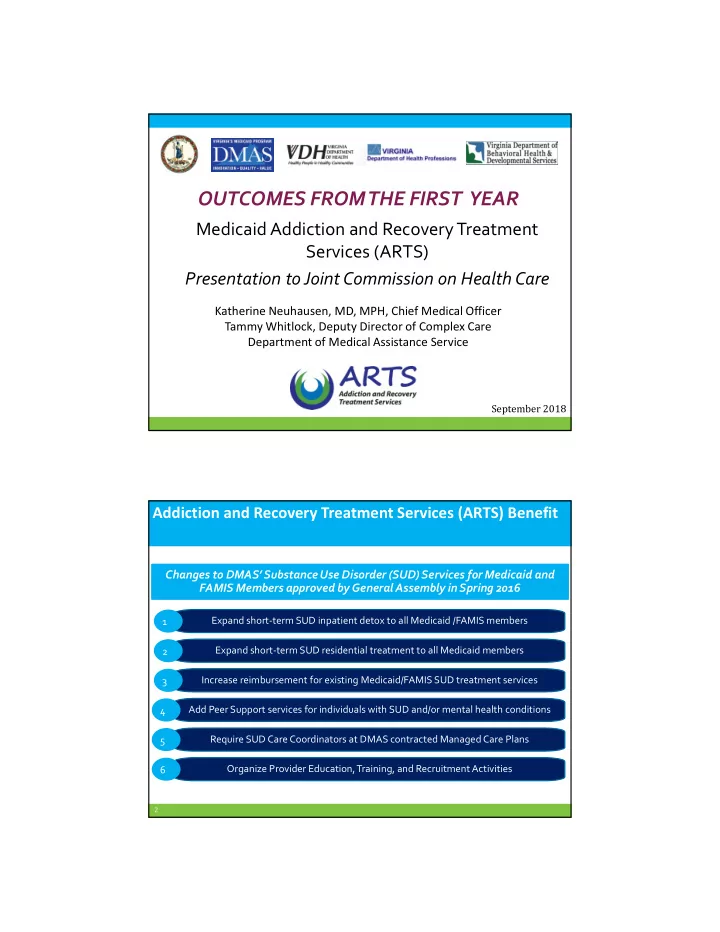
OUTCOMES FROM THE FIRST YEAR Medicaid Addiction and Recovery - - PDF document

outcomes from the first year
SMART_READER_LITE
LIVE PREVIEW

OUTCOMES FROM THE FIRST YEAR Medicaid Addiction and Recovery - - PDF document

OUTCOMES FROM THE FIRST YEAR Medicaid Addiction and Recovery Treatment Services (ARTS) Presentation to Joint Commission on Health Care Katherine Neuhausen, MD, MPH, Chief Medical Officer Tammy Whitlock, Deputy Director of Complex Care


slide-1
SLIDE 1

OUTCOMES FROM THE FIRST YEAR

September 2018

Katherine Neuhausen, MD, MPH, Chief Medical Officer Tammy Whitlock, Deputy Director of Complex Care Department of Medical Assistance Service

Medicaid Addiction and Recovery Treatment Services (ARTS) Presentation to Joint Commission on Health Care

Addiction and Recovery Treatment Services (ARTS) Benefit

Changes to DMAS’ Substance Use Disorder (SUD) Services for Medicaid and FAMIS Members approved by General Assembly in Spring 2016

Expand short-term SUD inpatient detox to all Medicaid /FAMIS members Expand short-term SUD residential treatment to all Medicaid members Increase reimbursement for existing Medicaid/FAMIS SUD treatment services Add Peer Support services for individuals with SUD and/or mental health conditions Require SUD Care Coordinators at DMAS contracted Managed Care Plans Organize Provider Education, Training, and Recruitment Activities 1 2 3 5 4 6

2

slide-2
SLIDE 2

3

General Fund Appropriation for ARTS Benefit

State FY GF NGF Total SFY 2017 $2.6 million $2.6 million $5.2 million SFY 2018 $8.4 million $8.4 million $16.8 million

Addiction and Recovery Treatment Services (ARTS):

Transforming the Delivery System of Medicaid SUD Services

Addiction and Recovery Treatment Services (ARTS):

Transforming the Delivery System of Medicaid SUD Services

Inpatient Detox Residential Treatment Partial Hospitalization Intensive Outpatient Programs Opioid Treatment Program Office-Based Opioid Treatment Case Management Peer Recovery Supports

Effective July 1, 2017

Effective April 1, 2017

ARTS creates a fully integrated physical and behavioral health continuum of care

4

  • All ARTS services are covered by managed care plans
  • Magellan continues to cover community-based substance use disorder treatment services

for fee-for-service members

slide-3
SLIDE 3

SUD Transformation 1115 Demonstration Waiver

  • Allows Virginia to draw down federal matching funds for

IMDs – SUD residential treatment facilities > 16 beds

  • Resulted in significant increase in number and size of

SUD residential treatment facilities

  • Requires Virginia to implement national American

Society of Addiction Medicine (ASAM) to create evidence-based continuum of addiction treatment

  • Requires robust independent waiver evaluation –

partnering with Virginia Commonwealth University

Approved by CMS in December 2016

5

American Society of Addiction Medicine (ASAM) Continuum

6

slide-4
SLIDE 4

7

Preferred Office-Based Opioid Treatment (OBOT) Provider – Interdisciplinary Care Team Preferred Office-Based Opioid Treatment (OBOT) Provider – Interdisciplinary Care Team

  • Member
  • Buprenorphine-waivered practitioner (physician, NP or PA)
  • Licensed credentialed addiction treatment professionals (e.g., LCSW,

LPC, licensed clinical psychologist, etc.)

  • Nurse

Required Core Team Members

  • Pharmacists
  • Peer Recovery Specialists
  • Substance Use Care Coordination
  • This can be designated team member whose only function is to

perform care coordination or a team member such as the nurse or LCSW who performs dual roles in the clinic.

Optional Team Members

Increases in Addiction Providers Due to ARTS Increases in Addiction Providers Due to ARTS

Over 440 new Addiction Treatment Provider Sites in Medicaid

8

Addiction Provider Type # of Providers before ARTS # of Providers after ARTS % Increase in Providers Inpatient Detox (ASAM 4.0) Unknown 103 NEW Residential Treatment (ASAM 3.1, 3.3, 3.5, 3.7) 4 94 ↑ 2250% Partial Hospitalization Program (ASAM 2.5) 16 NEW Intensive Outpatient Program (ASAM 2.1) 49 136 ↑178% Opioid Treatment Program 6 39 ↑ 550% Preferred Office-Based Opioid Treatment Provider 89 NEW

slide-5
SLIDE 5

VCU Evaluation: Outcomes from First Year of ARTS VCU Evaluation: Outcomes from First Year of ARTS

  • More than 20,000 members have

Opioid Use Disorder (OUD)

  • About 30,000 members have
  • ther Substance Use Disorder

including Alcohol Use Disorder and other legal/illegal drugs

  • OUD diagnoses increased by 15%

during first year

  • 2/3 members with OUD are

female

  • Members with OUD are

disproportionately white and ages 45 and older and more likely to have gained eligibility as an adult with a disability

Characteristics of Members

9

VCU Evaluation: Outcomes From First Year of ARTS VCU Evaluation: Outcomes From First Year of ARTS

More Medicaid members are receiving treatment for all Substance Use Disorders (SUD) and Opioid Use Disorder (OUD)

10

Before ARTS

(Apr 2016-Mar 2017)

After ARTS

(Apr 2017-Mar 2018)

% Change

↑57%

Members with SUD receiving treatment Members with OUD receiving treatment 15,703 24,615

↑48%

10,092 14,917

slide-6
SLIDE 6

VCU Evaluation: Outcomes from First Year of ARTS VCU Evaluation: Outcomes from First Year of ARTS

ARTS Increased SUD Treatment in All Regions

11

VCU Evaluation: Outcomes From First Year of ARTS VCU Evaluation: Outcomes From First Year of ARTS

Increase in total number of Substance Use Disorder Outpatient Providers

Before ARTS

(Apr 2016-Mar 2017)

After ARTS

(Apr 2017-Mar 2018)

% Change

↑173%

Total number of SUD Outpatient Providers Physicians NP Counselors and SW Other 1,087 2,965 By Provider Type 261 1,571 25 188 300 457 501 749

↑502% ↑652% ↑52% ↑50%

12

slide-7
SLIDE 7

VCU Evaluation: Outcomes From First Year of ARTS VCU Evaluation: Outcomes From First Year of ARTS

Increase in total number of Opioid Use Disorder Outpatient Providers

13

Before ARTS

(Apr 2016-Mar 2017)

After ARTS

(Apr 2017-Mar 2018)

% Change

↑137%

Total number of OUD Outpatient Providers Physicians NP Counselors and SW Other 570 1,352 By Provider Type 128 586 13 66 142 236 287 464

↑358% ↑408% ↑66% ↑62%

VCU Evaluation: Outcomes From First Ten Months of ARTS VCU Evaluation: Outcomes From First Ten Months of ARTS

Fewer Emergency Department visits related to Substance Use Disorder (SUD) and Opioid Use Disorder (SUD)

14

Before ARTS

(Apr 2016-Jan 2017)

After ARTS

(Apr 2017-Jan 2018)

% Change

↓14%

ED Visits Related to SUD ED Visits Related to OUD 5,016 21,445

↓25%

2 3,756 24,962

slide-8
SLIDE 8

VCU Evaluation: Outcomes From First Ten Months of ARTS VCU Evaluation: Outcomes From First Ten Months of ARTS

Fewer inpatient hospitalizations related to Substance Use Disorder (SUD) and Opioid Use Disorder (SUD)

15

Before ARTS

(Apr 2016-Jan 2017)

After ARTS

(Apr 2017-Jan 2018)

% Change

↓4%

Hospitalizations Related to SUD Hospitalizations Related to OUD 3,520 12,650

↓6%

2 3,315 13,182

VCU Evaluation: Decrease in ED Visits Due to ARTS Program VCU Evaluation: Decrease in ED Visits Due to ARTS Program

0.0% 5.0% 10.0% 15.0% 20.0% 25.0% 30.0% 35.0% 40.0%

Q1 Q2 Q3 Q4 Q1 Q2 Q3 Q4

Probability of an Emergency Department Visit

ARTS

Without ARTS

Members with OUD Members without SUD

16

slide-9
SLIDE 9

0.0% 5.0% 10.0% 15.0% 20.0% 25.0% 30.0%

Q1 Q2 Q3 Q4 Q1 Q2 Q3 Q4

Probability of an acute inpatient hospitalization

ARTS Members without SUD Members with OUD

Without ARTS

VCU Evaluation: Decrease in Inpatient Hospitalizations Due to ARTS Program VCU Evaluation: Decrease in Inpatient Hospitalizations Due to ARTS Program

17

VCU Evaluation: Outcomes From First Year of ARTS VCU Evaluation: Outcomes From First Year of ARTS

Decrease in total number of prescriptions and members with prescriptions for opioid pain medications

18

Before ARTS

(Apr 2016-Mar 2017)

After ARTS

(Apr 2017-Mar 2018) % Change

↓27%

Total number of prescriptions for

  • pioid pain

medications Number of members who received prescriptions 549,442 399,678 115,096

↓17%

137,847

slide-10
SLIDE 10

Implementation of CDC Guideline for Prescribing Opioids for Chronic Pain (FFS) Implementation of CDC Guideline for Prescribing Opioids for Chronic Pain (FFS)

19 61,020 14,917 265,715 57,728 $122,594 $36,564

50,000 100,000 150,000 200,000 250,000 300,000

Decrease in Opioid Pills, Cost & Days Supply

CCC Plus Implementation – FFS Members in LTC transitioned to MCO Reductions 59% Quantity 51% Payment 58% Days Supply

_____Quantity (# pills) _____Payment ______Days Supply

Implementation of CDC Guidelines in FFS

Implementation of CDC Guideline for Prescribing Opioids for Chronic Pain (MCO) Implementation of CDC Guideline for Prescribing Opioids for Chronic Pain (MCO)

20 665,619 308,055 2,648,760 1,210,766 $1,409,573 $699,241

500,000 1,000,000 1,500,000 2,000,000 2,500,000 3,000,000

Decrease in Opioid Pills, Cost & Days Supply Implementation of CDC Guidelines in MCOs “new starts only” CDC Guidelines Applied to All Members Reductions 54% quantity 51% payment 54% days supply

_____Quantity (# pills) _____Payment ______Days Supply

slide-11
SLIDE 11

New Medication Assisted Treatment (MAT) Requirement for ARTS Providers from CMS New Medication Assisted Treatment (MAT) Requirement for ARTS Providers from CMS

21

  • Centers for Medicare and Medicaid Services requirement for

Virginia’s 1115 SUD transformation waiver

  • Effective December 1, 2018, ARTS Intensive Outpatient

Programs, Partial Hospitalization Programs, and Residential Treatment Services providers shall ensure that Medicaid and FAMIS enrolled members with Opioid Use Disorder admitted to any of these programs have access to evidence-based MAT, including buprenorphine.

  • The use of MAT has shown reductions in the overdose death

rate of 75% compared to no MAT.

  • DMAS requires that discharge planning shall document realistic

plans for the continuity of MAT services with an in-network Medicaid provider.

Collaboration with Sister Agencies Collaboration with Sister Agencies

22

  • Virginia Department of Health
  • Trained over 850 providers in Addiction Disease Management
  • Project ECHO ARTS Preferred OBOT Learning Collaborative
  • Project ECHO buprenorphine waiver training
  • Department of Behavioral Health and Developmental Services
  • Trained over 400 providers in ASAM criteria
  • Trained over 1,000 Peer Recovery Support Specialists
  • Department of Health Professions
  • Boards of Medicine, Nursing, and Dentistry implemented opioid

prescribing regulations based on CDC Opioid Prescribing Guideline

  • Department of Corrections
  • Offering Project ECHO buprenorphine waiver training to DOC staff
  • Collaborating on MAT Summit for DOC clinicians and staff
slide-12
SLIDE 12

Why ARTS is Achieving These Outcomes Why ARTS is Achieving These Outcomes

Critical Elements for Successful ARTS Implementation

23

  • 1. Intensive stakeholder engagement – collaborated with

DBHDS, VDH, DHP, MCOs, and providers to design and implement ARTS based on clinical evidence

  • 2. Transformation of the Medicaid benefit and services

using national ASAM criteria

  • 3. Increased Medicaid reimbursement for evidence-based

treatment

  • 4. Innovative Value-Based Payment to support integrated

behavioral health and primary care