Out line Communicat ion Symbolic Nat ur al Language Processing - - PDF document

out line
SMART_READER_LITE
LIVE PREVIEW

Out line Communicat ion Symbolic Nat ur al Language Processing - - PDF document

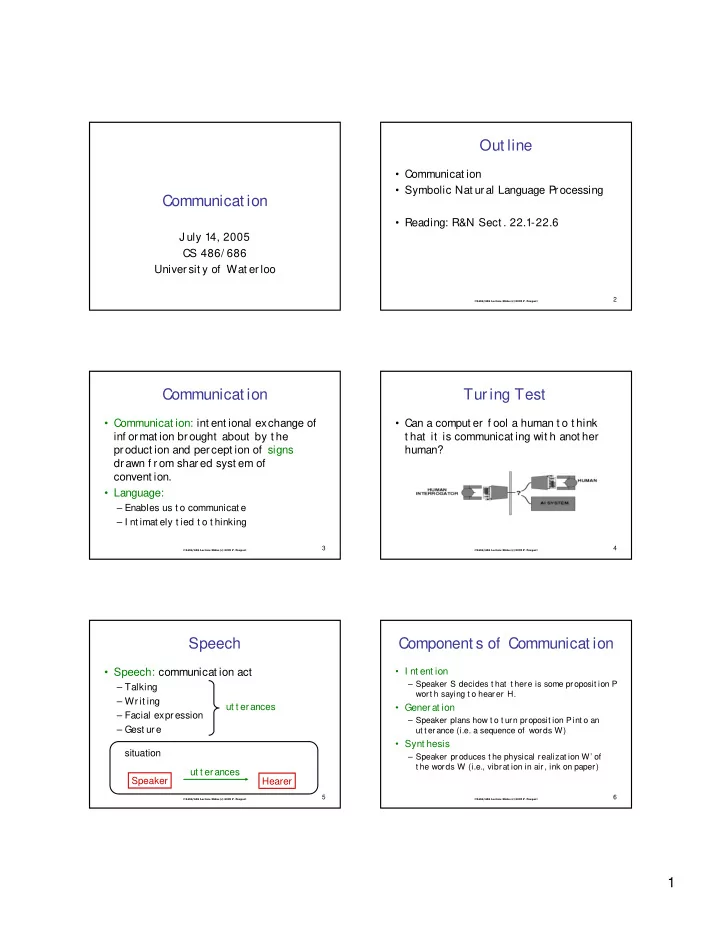
Out line Communicat ion Symbolic Nat ur al Language Processing Communicat ion Reading: R&N Sect . 22.1-22.6 J uly 14, 2005 CS 486/ 686 Univer sit y of Wat erloo 2 CS486/686 Lecture Slides (c) 2005 P. Poupart Communicat ion


slide-1
SLIDE 1

1

Communicat ion

J uly 14, 2005 CS 486/ 686 Univer sit y of Wat erloo

CS486/686 Lecture Slides (c) 2005 P. Poupart

2

Out line

  • Communicat ion
  • Symbolic Nat ur al Language Processing
  • Reading: R&N Sect . 22.1-22.6

CS486/686 Lecture Slides (c) 2005 P. Poupart

3

Communicat ion

  • Communicat ion: int ent ional exchange of

inf ormat ion brought about by t he product ion and percept ion of signs drawn f rom shared syst em of convent ion.

  • Language:

– Enables us t o communicat e – I nt imat ely t ied t o t hinking

CS486/686 Lecture Slides (c) 2005 P. Poupart

4

Turing Test

  • Can a comput er f ool a human t o t hink

t hat it is communicat ing wit h anot her human?

CS486/686 Lecture Slides (c) 2005 P. Poupart

5

Speech

  • Speech: communicat ion act

– Talking – Writ ing – Facial expression – Gest ure ut t erances Speaker Hearer ut t erances situation

CS486/686 Lecture Slides (c) 2005 P. Poupart

6

Component s of Communicat ion

  • I nt ent ion

– Speaker S decides t hat t here is some proposit ion P wort h saying t o hearer H.

  • Generat ion

– Speaker plans how t o t urn proposit ion P int o an ut t erance (i.e. a sequence of words W)

  • Synt hesis

– Speaker produces t he physical realizat ion W’ of t he words W (i.e., vibrat ion in air, ink on paper)

slide-2
SLIDE 2

2

CS486/686 Lecture Slides (c) 2005 P. Poupart

7

Component s of Communicat ion

  • Percept ion

– Hearer perceives physical realizat ion W’ as W2 and decodes it as t he words W2 (i.e., speech recognit ion, opt ical charact er recognit ion)

  • Analysis

– Hearer inf ers W2 has possible meanings P

1, P 2, …

, P

n

– Three part s:

  • Synt act ic int erpret at ion
  • Semant ic int erpret at ion
  • Pragmat ic int erpret at ion

CS486/686 Lecture Slides (c) 2005 P. Poupart

8

Component s of Communicat ion

  • Disambiguat ion

– Hearer inf ers t hat speaker int ended t o convey P

i (where ideally P i = P).

  • I ncorporat ion

– Hearer decides t o believe P

i (or not ).

CS486/686 Lecture Slides (c) 2005 P. Poupart

9

Component s of Communicat ion

"The wumpus is dead"

Article Noun The wumpus is dead Verb Adjective NP VP S Tired(Wumpus,Now) Perception: Analysis: (Parsing): (Semantic Interpretation): HEARER

3

L

Alive(Wumpus,S ) Incorporation: TELL( KB, (Pragmatic Interpretation):

3

Tired(Wumpus,S )

3

L L

Disambiguation:

3

L

Alive(Wumpus,S ) Alive(Wumpus,Now) Alive(Wumpus,S )

"The wumpus is dead"

Intention: Generation: Synthesis: SPEAKER

[thaxwahmpaxsihzdehd]

Know(H, Alive(Wumpus,S ))

L

3

CS486/686 Lecture Slides (c) 2005 P. Poupart

10

Dif f icult ies

  • How could communicat ion go wrong?

– I nsincer it y – Speech recognit ion err ors – Ambiguous ut t erance – Dif f erent cont ext s

CS486/686 Lecture Slides (c) 2005 P. Poupart

11

Language

  • For mal language

– Set of st rings of t erminal symbols (words) – St rict rules – E.g., f irst order logic, J ava

  • Nat ur al language

– No st rict def init ion – Chinese, Danish, English, et c.

CS486/686 Lecture Slides (c) 2005 P. Poupart

12

Grammar

  • Grammar specif ies t he composit ional

st r uct ur e of complex messages

  • Each st r ing in a language can be

analyzed/ generat ed by t he grammar

  • A grammar is a set of rewrit e rules

– S NP VP – Art icle t he | a | an | …

slide-3
SLIDE 3

3

CS486/686 Lecture Slides (c) 2005 P. Poupart

13

Grammar Types

  • Regular grammar:

– nont erminal t erminal [nont er minal] – S a S – S b

  • Cont ext f ree grammar (CFG):

– nont erminal anyt hing – S aSb

CS486/686 Lecture Slides (c) 2005 P. Poupart

14

Grammar Types

  • Cont ext sensit ive grammar:

– More t erminals on right -hand side – ASB AAaBB

  • Recursively enumerable grammar:

– No const raint s

CS486/686 Lecture Slides (c) 2005 P. Poupart

15

Lexicon example

  • Noun breeze | glitter | agent
  • Verb is | see | smell | shoot
  • Adj ect ive right | lef t | east | dead
  • Adverb there | nearby | ahead
  • Pronoun me | you | I | it
  • Name John | Mary | Boston
  • Art icle the | a | an

CS486/686 Lecture Slides (c) 2005 P. Poupart

16

Grammar example

  • S NP VP | S Conjunction S
  • NP Pronoun | Name | Noun | Article

Noun | NP PP | NP RelClause

  • VP Verb | VP NP | VP Adjective | VP

PP | VP Adverb

  • PP
  • Preposition PP
  • RelClause
  • that VP

CS486/686 Lecture Slides (c) 2005 P. Poupart

17

Grammat icalit y J udgement s

Grammar Natural language Set of strings

Goal: design grammar to match natural language

agreement

CS486/686 Lecture Slides (c) 2005 P. Poupart

18

Grammat icalit y J udgement s

  • Overgenerat ion examples:

– Me go Bost on. – I smell pit gold wumpus not hing east .

  • Undergener at ion example:

– I t hink t he wumpus is smelly

slide-4
SLIDE 4

4

CS486/686 Lecture Slides (c) 2005 P. Poupart

19

Synt act ic Analysis

  • Parsing: process of f inding a par se t ree

f or a given input st ring

I shoot the wumpus pronoun verb proposition noun NP VP NP S

CS486/686 Lecture Slides (c) 2005 P. Poupart

20

Top-down parsing

  • St art wit h S and search f or a t ree t hat

has st r ing at leaves

I shoot the wumpus pronoun verb proposition noun NP VP NP S

CS486/686 Lecture Slides (c) 2005 P. Poupart

21

Bot t om up parsing

  • St art wit h st r ing and search f or a t ree

t hat has S as root

I shoot the wumpus pronoun verb proposition noun NP VP NP S

CS486/686 Lecture Slides (c) 2005 P. Poupart

22

Parsing ef f iciency

  • Top-down and bot t om up parsing

inef f icient …

– Exponent ial running t ime

  • Alt ernat ive: chart par sing

– Dynamic progr amming – Cubic running t ime

CS486/686 Lecture Slides (c) 2005 P. Poupart

23

Augment ed Grammars

  • Grammars t end t o overgenerat e

– Ex: “me eat apple”

  • Augment gr ammar t o requir e

– Agreement bet ween subj ect and verb

  • Ex: “I smells” vs “I smell”

– Agreement bet ween verb subcat egory and complement

  • Ex: “give t he gold t o me”
  • Ex: “give me t he gold”

CS486/686 Lecture Slides (c) 2005 P. Poupart

24

Parse ambiguit y

  • Some sent ences have many grammat ical

parses

  • Example:

– “Fall leaves f all and spring leaves spring”

slide-5
SLIDE 5

5

CS486/686 Lecture Slides (c) 2005 P. Poupart

25

Semant ic I nt erpret at ion

  • Ext ract meaning f rom ut t erances
  • Tradit ional approach

– Express meaning wit h logic

  • Problem

– Ambiguous semant ics – Ex: “Helicopt er powered by human f lies”

CS486/686 Lecture Slides (c) 2005 P. Poupart

26

Ambiguit y

  • Possible causes:

– Met onymy: f igure of speech in which one

  • bj ect is used t o st and f or anot her

– Met aphor: f igure of speech in which a phrase wit h one lit eral meaning is used t o suggest a dif f erent meaning by analogy – Vagueness – Unknown cont ext

CS486/686 Lecture Slides (c) 2005 P. Poupart

27

Cont ext / Experience

  • Meaning of t en grounded in experience
  • But humans and machines have dif f er ent

experiences because of dif f erent sensors…

  • I s t hat a problem f or nat ur al language

under st anding?

CS486/686 Lecture Slides (c) 2005 P. Poupart

28

Next Class

  • Next Class:
  • Probabilist ic Language Processing
  • Russell and Norvig Ch. 23