
MOL2NET, 2018, 3, doi:10.3390/mol2net-03-xxxx 1
MDPI
MOL2NET, International Conference Series on Multidisciplinary Sciences http://sciforum.net/conference/mol2net-03
Chemical constituents isolated from Mandevilla dardonoi (Apocynaceae) <Francisca Sabrina Vieira Lins>(sabrina@ltf.ufpb.br)a, <Josean Fechine Tavares> (josean@ltf.ufpb.br)b, <Marcelo Sobral da Silva> (marcelosobral.ufpb@gmail.com)c, <José Iranildo Miranda de Melo> (tournefort@gmail.com)d, <George Luis Dias dos Santos> (george@ltf.ufpb.br)e, <Joanda Paolla Raimundo e Silva (joanda@ltf.ufpb.br)f, <Laiane Caline Oliveira Pereira> (laianecaline@ltf.ufpb.br)g, <Lucas Silva Abreu> (lucas.abreu@ltf.ufpb.br)h
a,b,c,e,f,g,h <Federal University of Paraiba> d <State University of Paraiba>
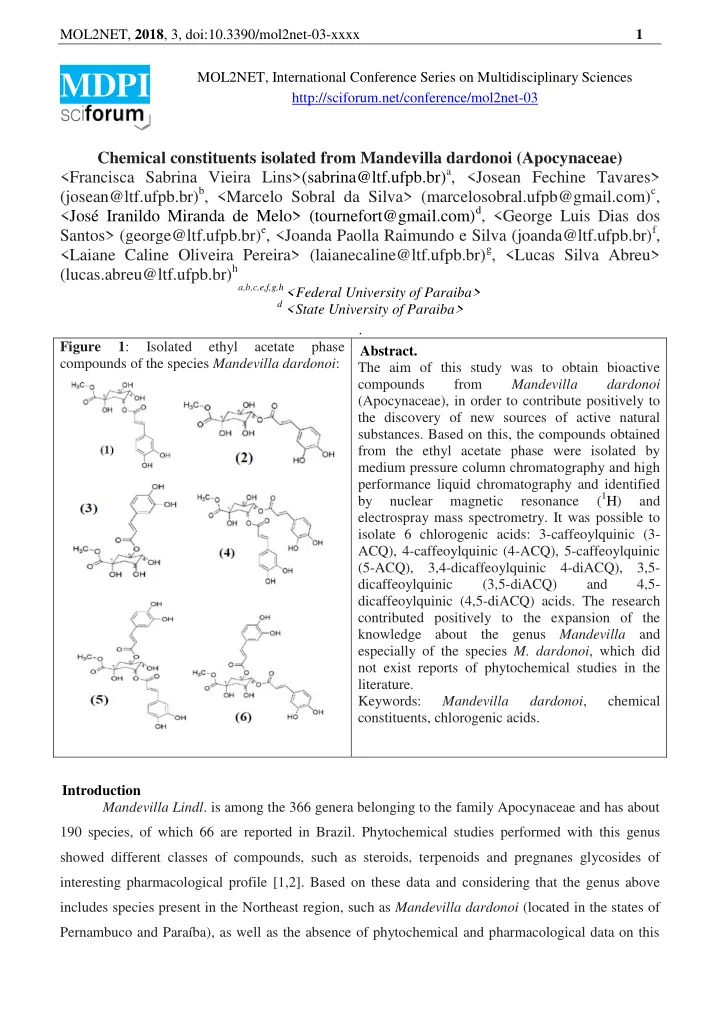
. Figure 1: Isolated ethyl acetate phase compounds of the species Mandevilla dardonoi: Abstract. The aim of this study was to obtain bioactive compounds from Mandevilla dardonoi (Apocynaceae), in order to contribute positively to the discovery of new sources of active natural
- substances. Based on this, the compounds obtained
from the ethyl acetate phase were isolated by medium pressure column chromatography and high performance liquid chromatography and identified by nuclear magnetic resonance (1H) and electrospray mass spectrometry. It was possible to isolate 6 chlorogenic acids: 3-caffeoylquinic (3- ACQ), 4-caffeoylquinic (4-ACQ), 5-caffeoylquinic (5-ACQ), 3,4-dicaffeoylquinic 4-diACQ), 3,5- dicaffeoylquinic (3,5-diACQ) and 4,5- dicaffeoylquinic (4,5-diACQ) acids. The research contributed positively to the expansion of the knowledge about the genus Mandevilla and especially of the species M. dardonoi, which did not exist reports of phytochemical studies in the literature. Keywords: Mandevilla dardonoi, chemical constituents, chlorogenic acids. Introduction Mandevilla Lindl. is among the 366 genera belonging to the family Apocynaceae and has about 190 species, of which 66 are reported in Brazil. Phytochemical studies performed with this genus showed different classes of compounds, such as steroids, terpenoids and pregnanes glycosides of interesting pharmacological profile [1,2]. Based on these data and considering that the genus above includes species present in the Northeast region, such as Mandevilla dardonoi (located in the states of Pernambuco and Paraíba), as well as the absence of phytochemical and pharmacological data on this