
SLIDE 1
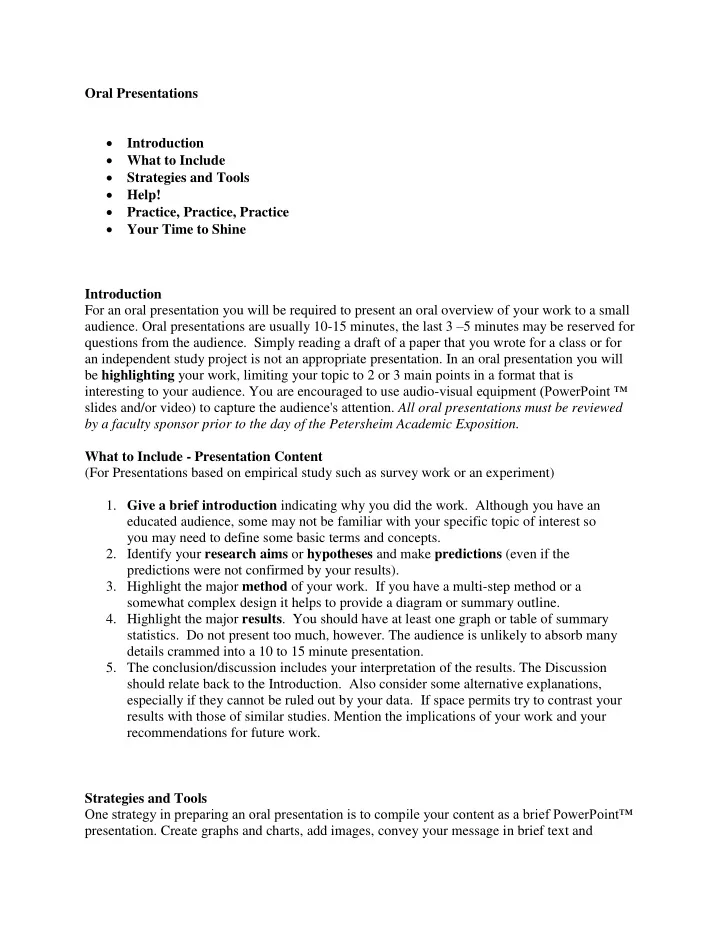
Oral Presentations Introduction What to Include Strategies and Tools Help! Practice, Practice, Practice Your Time to Shine Introduction For an oral presentation you will be required to present an oral overview of your work to a small
- audience. Oral presentations are usually 10-15 minutes, the last 3 –5 minutes may be reserved for
questions from the audience. Simply reading a draft of a paper that you wrote for a class or for an independent study project is not an appropriate presentation. In an oral presentation you will be highlighting your work, limiting your topic to 2 or 3 main points in a format that is interesting to your audience. You are encouraged to use audio-visual equipment (PowerPoint ™ slides and/or video) to capture the audience's attention. All oral presentations must be reviewed by a faculty sponsor prior to the day of the Petersheim Academic Exposition. What to Include - Presentation Content (For Presentations based on empirical study such as survey work or an experiment)
- 1. Give a brief introduction indicating why you did the work. Although you have an
educated audience, some may not be familiar with your specific topic of interest so you may need to define some basic terms and concepts.
- 2. Identify your research aims or hypotheses and make predictions (even if the
predictions were not confirmed by your results).
- 3. Highlight the major method of your work. If you have a multi-step method or a
somewhat complex design it helps to provide a diagram or summary outline.
- 4. Highlight the major results. You should have at least one graph or table of summary
- statistics. Do not present too much, however. The audience is unlikely to absorb many
details crammed into a 10 to 15 minute presentation.
- 5. The conclusion/discussion includes your interpretation of the results. The Discussion
should relate back to the Introduction. Also consider some alternative explanations, especially if they cannot be ruled out by your data. If space permits try to contrast your results with those of similar studies. Mention the implications of your work and your recommendations for future work. Strategies and Tools One strategy in preparing an oral presentation is to compile your content as a brief PowerPoint™
- presentation. Create graphs and charts, add images, convey your message in brief text and