Oral Presentation Rubric Student Name: - - PDF document

oral presentation rubric
SMART_READER_LITE
LIVE PREVIEW

Oral Presentation Rubric Student Name: - - PDF document

Oral Presentation Rubric Student Name: ________________________________________________ Date: _______________________ Class/Preceding: ___________________________________________________ Evaluator Name:


slide-1
SLIDE 1

Oral Presentation Rubric

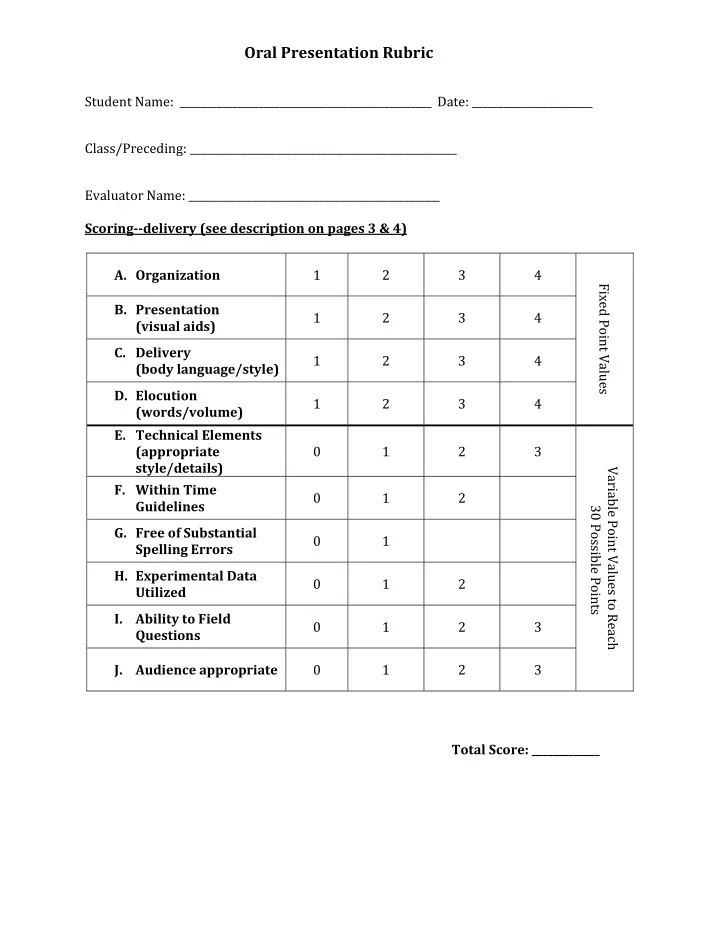
Student Name: ________________________________________________ Date: _______________________ Class/Preceding: ___________________________________________________ Evaluator Name: ________________________________________________ Scoring‐‐delivery (see description on pages 3 & 4)

  • A. Organization

1 2 3 4 Fixed Point Values

  • B. Presentation

(visual aids) 1 2 3 4

  • C. Delivery

(body language/style) 1 2 3 4

  • D. Elocution

(words/volume) 1 2 3 4

  • E. Technical Elements

(appropriate style/details) 1 2 3 Variable Point Values to Reach 30 Possible Points

  • F. Within Time

Guidelines 1 2

  • G. Free of Substantial

Spelling Errors 1

  • H. Experimental Data

Utilized 1 2

  • I. Ability to Field

Questions 1 2 3

  • J. Audience appropriate

1 2 3 Total Score: _____________

slide-2
SLIDE 2

Oral Presentation Rubric

Student Name: ________________________________________________ Date: _______________________ Class/Preceding: ___________________________________________________ Evaluator Name: ________________________________________________ Scoring‐‐content (see description on page 5) Score part 2 _____________________ Score part 1 ____________________ Total score (of 60) _____________________ Total score (of 100) __________________

  • K. Problem

2 4 6 8

  • L. Evaluation of

Experimental Data 2 4 6 8

  • M. Conclusions

2 4 6 8

  • N. Understanding of

topic 2 4 6 8

slide-3
SLIDE 3

Oral Presentation Rubric

Evaluation Rubric Description Fixed Point Value Skills 1 2 3 4 Organization Sequence of information is poor or missing. Audience cannot follow. Presenter does not follow presentation, jumping around. Information is presented in a logical sequence the audience can follow. Information is presented in a logical and interesting sequence. Presentation Presenter does not use appropriate graphics or uses superfluous graphics Presenter uses graphics that rarely support the text and presentation. Presenter uses graphics that relate to the text and presentation. Presenter uses graphics and text that relate and reinforce the ideas presented. Delivery Presenter has poor body language, eye contact, and reads from the slides or notes. Presenter has poor body language, makes some eye contact, and mainly reads from slides or notes. Presenter has professional body language, makes eye contact, but frequently reads from the slides or notes. Presenter has professional body language, makes eye contact, and rarely uses the slides or notes as cues for their presentation Elocution Presenter mumbles, mispronounces words and speaks too softly. Presenter speaks too softly and mispronounces words Presenter speaks at proper volume with a clear voice, while pronouncing most words correctly. Presenter uses proper volume, speaks clearly and uses precise pronunciation of words.

slide-4
SLIDE 4

Oral Presentation Rubric

Technical Elements Major technical difficulties that the presenter should have anticipated Presentation is missing several elements as listed to the left

  • r minor

technical difficulties Presentation is missing one of the technical elements to the left or used inappropriately Technical elements worked (as within control of presenter) and were ready. Presentation contains all references, citations and acknowledgments in appropriate location Within Time Guidelines Far outside the expected window Within the expected window Free of Substantial Spelling Errors? Has numerous spelling errors, such that audience notices Has the rare or

  • ccasional

spelling error Experimental Data Utilized Student did not analyze any data in their presentation or improperly analyzed the data from their research or topic. Student analyzed data properly, but failed to discuss appropriate trends/results from the data,

  • r to connect

data to overall goal of the research/topic. Student analyzed data properly, discussed appropriate trends/results from the data, and connected data to overall goal of the research/topic. Ability to Field Questions Presenter is unable to handle questions Presenter responds well to most questions but flustered by unexpected questions. Presenter confidently responds to questions and shows an ability to think through unexpected questions. Audience appropriateness Presenter did not consider audience frequently assumed knowledge and/or was at level too simple for audience interest

  • ccasionally

assumed knowledge audience did not have presentation was at the right level for audience

slide-5
SLIDE 5

Oral Presentation Rubric

2 4 6 8 Problem topic was not defined problem not well defined Some evidence lacking or inappropriate to problem Problem well defined and evidence to support discussion provided Evaluation of Experimental Data experimental results do not connect to problem most results are not used correctly some results not interpreted correctly results clearly connect to problem and are used appropriately Conclusions most conclusions are not valid some conclusions are not valid for information presented

  • ne

conclusion is not obviously connected but can be explained on questioning conclusions follow logically and

  • bviously

from presentation Understanding of topic presenter showed no understanding

  • f some basic

ideas

  • ne basic

concepts was not understood

  • r many

difficult concepts not understood presenter was uncomfortable with one or two difficult concepts presenter completely understood topic presented