Oral Presentation Program This is a preliminary program and changes - - PowerPoint PPT Presentation

oral presentation program
SMART_READER_LITE
LIVE PREVIEW

Oral Presentation Program This is a preliminary program and changes - - PowerPoint PPT Presentation

Oral Presentation Program This is a preliminary program and changes are still possible. The lates version can always be found at: www.ecmh.eu. Only the first author (=presenter) is mentioned here in the program. In the conference abstract book all


slide-1
SLIDE 1

Thursday Oct 3, 11:00-12:35

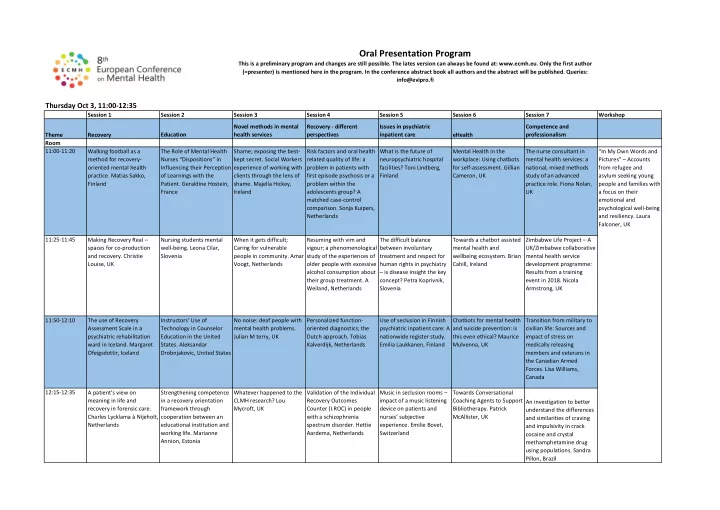
Session 1 Session 2 Session 3 Session 4 Session 5 Session 6 Session 7 Workshop Theme Recovery Education Novel methods in mental health services Recovery - different perspectives Issues in psychiatric inpatient care eHealth Competence and professionalism Room 11:00-11:20 Walking football as a method for recovery-

  • riented mental health
  • practice. Matias Sakko,

Finland The Role of Mental Health Nurses “Dispositions” in Influencing their Perception

  • f Learnings with the
  • Patient. Geraldine Hostein,

France Shame; exposing the best- kept secret. Social Workers experience of working with clients through the lens of

  • shame. Majella Hickey,

Ireland Risk factors and oral health related quality of life: a problem in patients with first episode psychosis or a problem within the adolescents group? A matched case-control

  • comparison. Sonja Kuipers,

Netherlands What is the future of neuropsychiatric hospital facilities? Toni Lindberg, Finland Mental Health in the workplace: Using chatbots for self-assessment. Gillian Cameron, UK The nurse consultant in mental health services: a national, mixed methods study of an advanced practice role. Fiona Nolan, UK “In My Own Words and Pictures” – Accounts from refugee and asylum seeking young people and families with a focus on their emotional and psychological well-being and resiliency. Laura Falconer, UK 11:25-11:45 Making Recovery Real – spaces for co-production and recovery. Christie Louise, UK Nursing students mental well-being. Leona Cilar, Slovenia When it gets difficult; Caring for vulnerable people in community. Amar Voogt, Netherlands Resuming with vim and vigour; a phenomenological study of the experiences of

  • lder people with excessive

alcohol consumption about their group treatment. A Weiland, Netherlands The difficult balance between involuntary treatment and respect for human rights in psychiatry – is disease insight the key concept? Petra Koprivnik, Slovenia Towards a chatbot assisted mental health and wellbeing ecosystem. Brian Cahill, Ireland Zimbabwe Life Project – A UK/Zimbabwe collaborative mental health service development programme: Results from a training event in 2018. Nicola Armstrong, UK 11:50-12:10 The use of Recovery Assessment Scale in a psychiatric rehabilitation ward in Iceland. Margaret Ofeigsdottir, Iceland Instructors’ Use of Technology in Counselor Education in the United

  • States. Aleksandar

Drobnjakovic, United States No noise: deaf people with mental health problems. Julian M terry, UK Personalized function-

  • riented diagnostics; the

Dutch approach. Tobias Kalverdijk, Netherlands Use of seclusion in Finnish psychiatric inpatient care: A nationwide register study. Emilia Laukkanen, Finland Chatbots for mental health and suicide prevention: is this even ethical? Maurice Mulvenna, UK Transition from military to civilian life: Sources and impact of stress on medically releasing members and veterans in the Canadian Armed

  • Forces. Lisa Williams,

Canada 12:15-12:35 A patient’s view on meaning in life and recovery in forensic care. Charles Lycklama à Nijeholt, Netherlands Strengthening competence in a recovery orientation framework through cooperation between an educational institution and working life. Marianne Annion, Estonia Whatever happened to the CLMH research? Lou Mycroft, UK Validation of the Individual Recovery Outcomes Counter (I.ROC) in people with a schizophrenia spectrum disorder. Hettie Aardema, Netherlands Music in seclusion rooms – impact of a music listening device on patients and nurses’ subjective

  • experience. Emilie Bovet,

Switzerland Towards Conversational Coaching Agents to Support

  • Bibliotherapy. Patrick

McAllister, UK An investigation to better understand the differences and similarities of craving and impulsivity in crack cocaine and crystal methamphetamine drug using populations. Sandra Pillon, Brazil

Oral Presentation Program

This is a preliminary program and changes are still possible. The lates version can always be found at: www.ecmh.eu. Only the first author (=presenter) is mentioned here in the program. In the conference abstract book all authors and the abstract will be published. Queries: info@evipro.fi

slide-2
SLIDE 2

Thursday Oct 3, 13:45-14:55

Session 8 Session 9 Session 10 Session 11 Session 12 Session 13 Session 14 Theme Novel methods in mental health services Physical health Evidence based early interventions Multi-cultural approaches Service user involvement Mental health services Mental health services Room 13:45-14:05 An exploration of service user and staff perceptions

  • f the use of drug detection

dogs in acute inpatient

  • wards. Nicola Cotton, UK

From problem to implementation: the introduction of a specialist nursing role to improve the physical health of people diagnosed with mental

  • illness. Brenda Happell,

Australia Promoting evidence-based Early Intervention - Brokering Knowledge for Support Children. Marjo Kurki, Finland Counselors’ Perception of Competence in Therapy with Intercultural Couples. Tilija Drobnjakovic, United States Working together – trained expert by expertise and healthcare professional. Jalmiina Nummelin, Finland Community Mental Health Advocacy / Activitism in

  • Manitoba. Karen J Clements,

Canada Problems and strengths in psychiatric nursing in Poland: current legal regulations and results of

  • survey. Barbara Remberk,

Poland 14:10-14:30 The Impact for the Family of Young Onset Dementia. Nicola Armstrong, UK A study investigating how people with bipolar disorder experience their physical health and increased health

  • risks. Jan Willem de Lange,

Netherlands Systems Change and Service Design in Children and Young People’s Mental health and Wellbeing. Laura Falconer, UK Developing a post graduate programme in mental health nursing in Mongolia (MoMeNT). Fiona Nolan, UK Experts by experience as peer support workers in psychiatric wards. Mikko Ketola, Finland Future of Mental Health. Markus Raivio, Finland Realizing culture change from task-oriented nursing practice to patient-centered

  • nursing. Jennifer Hartman,

Finland 14:35-14:55 Mental health online: user testing for building better web content. Maimu Berezkina, Norway The Health Hut - Integrating Elements of Somatic Health Care of Patients with

  • Schizophrenia. Sari

Laaksonen, Finland How universal, school based prevention programmes can promote resilience and positive mental health. Julie Healy, UK Substance use disorder in young people in Assam, India: using participatory visual methods to understand their experience

  • f risk, resilience and
  • recovery. Siobhan Hugh-

Jones, UK Expert by experience as a member of multiprofessional team – new opportunities to recognize client´s agency and social reality in services. Outi Hietala, Finland Reflections of a public health researcher on community organising, and capturing voices in mental health research. Liam Spencer, UK Challenges of management and implementation of nurse-patient collaboration. Irene Pitkänen, Finland

slide-3
SLIDE 3

Thursday Oct 3, 15:30-16:50

Session 15 Session 16 Session 17 Session 18 Session 19 Session 20 Session 21 Theme Families Best practices Service user involvement Mental health services Adolescents Mental health services International Recovery network Room 15:30-15:50 The influence of gratitude

  • n Australian mental health

caregiving burden: A cross- sectional study. Paul Morrison, Australia Mental Health Service Provision for Adults who are Homeless: Experiences of Front-Line Service

  • Providers. Gerry Devine,

Ireland The Apex of Involvement? Emergent Themes in Research into Co-Production in Adult Recovery Colleges. Karen Bester, UK Planned co-production project with service users, family members and staff, to develop and implement standardised discharge interventions for a mental health service. Zita Flatley, Ireland The addictions of the modern era: selfies and Facebook- the opinion of the youth regarding the

  • issue. Anamaria Ciubara,

Romania Adolescents from the General Public’s Perceptions

  • f Mental Health Services:

An Interpretive Descriptive. John Goodwin, Ireland 15:55-16:15 Non-pharmacological treatments in elderly patients with psychosis: literature review. Milja Niinihuhta, Finland Hospital Housing First Initiative: Preventing Discharge into

  • Homelessness. Cheryl

Forchuk, Canada Enik Recovery college a successful Dutch peer run innovation! Martijn Kole, Netherlands A qualitative analysis of the experiences of participants attending community based Mental Health Recovery

  • Education. Michael O'Neill,

Ireland Differences in coping in young people when exposed to their own symptoms versus a friend’s symptoms

  • f poor mental health. Sofia

Pimenta, UK Adverse Childhood Experiences in Adolescents: Identifying its Impact, and the Clinician’s role in Addressing its Behavioral Manifestation in High School Settings. Cierra Osei-

  • Buapim. United States

16:20-16:50 Supporting Australian Mental Health Service Users: Predictors of Caregiving Burden. Norman Stomski, Australia Community care for people with ‘emotional disturbed behavior’. Ina Boerema, Netherlands How I Survived the Impossible, Became Happy & Now Help Others In Doing The Same. Craig Lewis, Mexico Mental Health Service User Involvement in Nursing

  • Handover. Michael Olasoji,

Australia Children and adolescents with mild/moderate intellectual disability and antipsychotic-induced movement disorders. Rianne Smits, Netherlands Family Wellbeing Project. Frank Reilly, UK Helsinki Recovery invites you to the international Recovery network. Virpi Jaakkola, Finland Are you an expert by experience or a professional who is interested in a recovery-oriented system of care? Then this workshop is just for you! We invite you to a workshop with the aim of establishing an international recovery network, which will allow its members to share recovery experiences, research, good practices and results from different

  • countries. At our workshop,

we will also share our own journey towards a recovery-

  • riented system of care and

a better client experience.

slide-4
SLIDE 4

Friday Oct 4, 11:10-12:20

Session 22 Session 23 Session 24 Session 25 Session 26 Session 27 Session 28 Theme Education Recovery Mental health services Self harm Competence and professionalism Physical health Substance abuse and addictions Room 11:10-11:30 Youth perception towards stigmatization of mental

  • health. Liliana Luca,

Romania On the Path to Recovery – Model for Peer Groups for the Bereaved by Suicide. Reija Tuomisalo, Finland How has the establishment

  • f brief therapy in a short-

term unit afected the work in the outpatient services of a community mental health center? Hilde Våbenø Markussen, Norway Social support prevents adolescents’ self-cutting. Marja-Liisa Rissanen, Finland Power and accountability: how nurses and psychologists interpret their Responsibilities as Clinicians under mental health law. Jennifer Oates, UK How are third year mental health nursing students prepared for proficiency to undertake a comprehensive physical health assessment for patients with mental health conditions and is it applicable in clinical nursing practice? The student

  • narrative. Nicola Lamont,

UK Gambling Disorder and implications for mental health and addictions

  • workers. Mina Hazar,

Canada 11:35-11:55 Exploring the Limits of Mental Health Simulation to Reduce Stigma Among Health Professionals. Abe Oudshoorn, Canada The space of recovery: the case for a reverse Ulysses

  • syndrome. Rosanna

Tarsiero, UK Mindfulness Interventions for Depression and Chronic

  • Pain. Tamara C Holmes,

United States Suicide prevention in adult men: A design thinking

  • approach. Jalila Jbilou,

Canada Addressing the High Turnover Rate among Frontline Workers. Deirdre Williams, United States Use of the Utrecht Somatic Screening Tool from the patient’s perspective. Willeke van der Eijk, Netherlands Keys factors in forming Social Bonds in a Community Addiction

  • Service. Gerard Moore,

Ireland 12:00-12:20 Moving beyond stigmatising and medicalised views of mental illness: student nurse experiences of exploring mental distress in the classroom with experts by experience. Aine Horgan, Ireland Making Recovery Real – spaces for co-production and recovery. Louisa Christie, UK Efficacy Moderators of Cognitive Behavioural Therapy and Interpersonal Psychotherapy for Depression: A Meta-

  • analysis. Aoife Whiston,

Ireland Community organising and 'zero suicide ambition': grass-roots solution to a public health problem. Simon Mason, UK Developing and testing Finnish version of the Therapeutic Engagement Questionnaire (TEQ) in psychiatric in-patient care. Jani Turunen, Finland Integrated care in Substance Use Disorders, a nurse driven program. Laura Reimert, Netherlands

slide-5
SLIDE 5

Friday Oct 4, 13:30-15:05

Session 29 Session 30 Session 31 Session 32 Session 33 Session 34 Session 35 Theme Issues in different clinical settings Service user involvement Best practices Multi-cultural approaches Special session: "Spaces of Mental Health" ECMH 2019 Reflection Room 13:30-13:50 Reflective Understanding of Personality Disorder and Offending Risk. Stuart Thomson, UK Lessons from lived experience - Raising Awareness, Building Confidence and Developing the Capacity to Work Well with People who Attract a Diagnosis of Personal

  • Disorder. Sonya Greaney,

Ireland Addressing Mental Health Problems of Ready Made Garment Workers. Farhtheeba Rahat Khan, Bangladesh Developing a training programme for mental health professionals to enhance medication adherence in Black, Asian and Minority Ethnic Service

  • Users. Laurie Dahl, UK

Deconstructing and Construction Spaces for Encounters between Recoverers and "the Others". Markus Vähälä, Finland Early intervention for adolescent mental health: will symptomatic young people engage with digitally delivered, evidence-based self-help in schools? Siobhan Hugh-Jones, UK 13:55-14:15 Experiences of ambulance nurses in emergency care for patients with acute manic and/or psychotic

  • symptoms. Thea

Daggenvoorde, Netherlands “The person isn’t their disorder, they are human”: Nursing students’ experiences of service user taught mental health

  • education. Brenda Happell,

Australia The Art of Leading Without Leading: Work in Progress. Sheila Newcombe, UK PALOMA training is a great tool for improving professionals’ skills on encountering people with refugee background. Katri- Leena Mustonen, Finland MindFrame - an mHealth space to foster power? Malene Terp, Denmark 14:20-14:40 Mental health and wellbeing provision in NI Post-Primary Schools: what are schools doing, and what do they want? Nicole Bond, UK Teaching from the other side: Expert by experience lecturers experiences of teaching mental health nursing students. Fionnuala Manning, Ireland Patient perspective on care pathways and informed shared decision making in the transition between psychiatric hospitalization and the community. Eva Walderhaug Sather, Norway Establishing the centres of excellent on refugee mental health in Finland. Johanna Mäki-Opas, Finland A collective investment in Lived Experience Practice: examining a co-produced steering group within a mental health peer worker

  • project. Victoria Stirrup, UK

14.45-15.05 Nurses’ attitudes towards patients with alcohol abuse in emergency departments. Marita Koivunen, Finland Niilo mobile app – a personal everyday tool for

  • recovery. Pasi Tuominiemi,

Finland Pharmacist on Psychiatric

  • Wards. Hannele Karvinen,

Finland Positive mental health among people living alone in Lapland region in Finland. Pia Solin, Finland Interactive Panel Discussion about "Spaces of Mental Health". Virve Repo, Finland Dialogical session based on participants' experiences during 8th European Conference on Mental Health