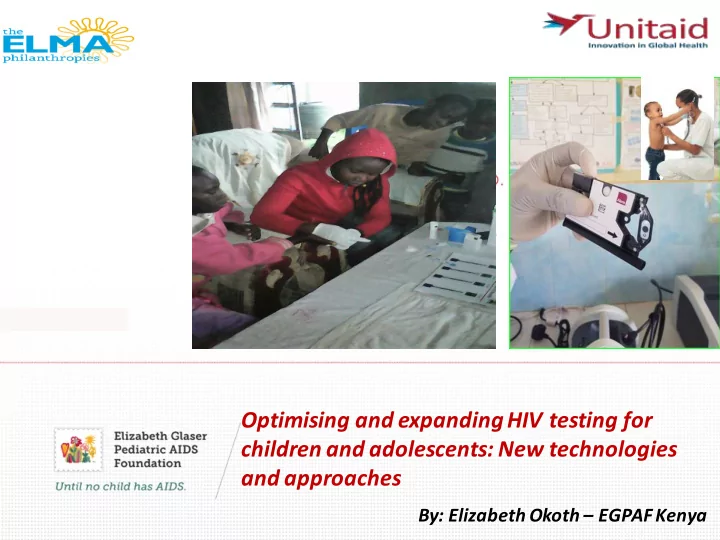
Optimising and expanding HIV testing for children and adolescents: - - PowerPoint PPT Presentation
Optimising and expanding HIV testing for children and adolescents: New technologies and approaches By: Elizabeth Okoth EGPAF Kenya UNITAID & CDC Timiza90 Supported County ELMA, UNITAID, TIMIZA90 Supported Counties: Optimization of
ELMA, UNITAID, TIMIZA90 Supported Counties: UNITAID & CDC Timiza90 Supported County
Purpose: ensure that at-risk infants have timely access to HIV testing through scale-up of POC EID in the context of optimizing existing national EID networks Scale:
- 9 countries
- 4 years (Aug 2015-Jul 2019)
- Estimated 297 POC EID platforms
and up to 320,000 tests
Optimization of EID networks through introduction of POC EID to increase the number of infants tested& initiated on ART
Gaps in Current Early Infant Diagnosis Cascade
200,000 400,000 600,000 800,000 1,000,000 1,200,000 1,400,000 HIV-Exposed Infants in 21 Priority Countries HIV-Exposed Infants Tested HIV-Exposed Infants with Results Returned Infants Diagnosed with HIV Infants Initiated on ART
51% 50% 8.9% 51% Source: On the Fast-Track to an AIDS-Free Generation, UNAIDS, 2016
Country Specific EID Statistics
- PMTCT coverage: 75%
- Infant ART coverage: 76%
- EID coverage at 6 weeks: 68%
- Percent of caregivers receiving EID results: 98%
- Median turn around time for EID results: 56 days
- Country-specific barriers to EID: Delay in return of
test results, EID Coverage
Site Selection Criteria
- Site selection based on assessments of;
– # of EID tests in 2015 – Unmet uptake /need for EID (HIV+ Women- EID tests within 2 months) – Turnaround time (TAT) from sample collection to dispatch of results from testing facility. – Geographic distance considered
Successes
- Piloting POC EID in 3 hub facilities in Homabay
and Turkana
– Over 200 infants have received an EID test with median TAT of 0 days (0-15) for hub sites and 3 days (0-33) for spoke sites
- POC EID data available on national EID Database
- POC EID products included in global Fund
proposal
- Inclusion of POC EID in national policy, strategy
documents
Finding and testing HIV-positive children & adolescents, above 18months to 19yrs
8
Kenya: 98,170 HIV+ children; treatment coverage of 77% 49.8% adolescents know their status Young people (15-24 yrs) contributed 51% of adult new infections (35,776) Contributing factors: Incorrect perception risks on HIV, high risk traits, SGBV and stigma
What we Did & How: Intensive Case Finding
- Project sensitization & capacity building of authorities & HCWs
- Hiring & training HTS Counsellors and Triage Assistants
- Introduced paediatric& adolescent screening tools
- Triage Assistants reorganise client flow for screening and testing
- Scaled up testing of children & adolescents in OPD, IPD, TB,
nutrition clinics, MCH & CWC
- Testing during odd hours, weekend & school holidays
- Routine testing of breast feeding adolescent mothers who were
negative in ANC, L&D
- Buffer RTKs support / redistribution& commodity management TA
9
Intensified Case Finding
Screening by Triage Assistant Odd Hour Testing Sign
1.2% 0.6% 0.3% 0.4% 0.6% 0.6% 0.6% 1.4% 1.0% 0.0% 0.7%
1.6% 1.7% 1.2% 1.5% 3.2% 1.8% 1.5% 2.7% 1.1% 0.7% 1.1% 0.0% 0.5% 1.0% 1.5% 2.0% 2.5% 3.0% 3.5%
200 400 600 800 1000 1200 1400
Smart Testing Tested Q3 % Q3 Positivity % Smart Testing Posivity
Testing Q3 (May – Jul ‘17) Vs 4 Weeks Smart Testing (18 Sept-13th Oct) -Pilot Sites Use of Screening Tool (Smart Testing) Led to higher yield
Scale-up testing of index clients’ families/ contacts
§ Sessions at CC clinics & PSSGs on importance of family testing § Introduced index clients’ contact register and tracing forms § Enhanced contact line listing at enrolment on care § Mop up line listing of contacts of index clients’ missed before project start-up § Line listing family of dead index clients § Testing through door to door and facility including adolescent siblings and within family clinic days § link to test other families within the same homes (if disclosed) § Enhanced team work between the HTS counsellors and CCC staff
INDEX FAMILY / CONTACT TESTING
Tested Tested Positive % Positivity Index Children Testing 23499 333 1.42% Adolescent Siblings Testing 1109 29 2.61% Dead Index family Testing 233 6 2.58% Adolescents partner Testing 32 2 6.25% Testing within Family care Model 271 17 6.27%
Targeted Community Testing and Integrated Campaigns § CHEWs & CHVs orientation § Community sensitization & mobilization/ testing campaigns § Testing in epidemic hotspots: beaches & sugar belts § Integrating testing with MoH immunization & nutrition activities § Testing of OVC
Challenges
- Policy – 15years for consent; No testing in schools
- Stigma
- Facility operation hours
- National tools yet to show disaggregation by refined ages and
service delivery points
- Long TAT for spoke sites due to HCW knowledge on importance
- f result return to caregiver
Best practices/ key lessons
- Smart testing enhances identification of positives
- Index clients case testing enhances identification – different
index clients categories to be used as entry
- Pregnancy is an entry point to testing for adolescent girls
- Targeted community testing better yield than universal testing
- Odd hour testing increases HTS uptake among adolescents
- Multi stakeholder POC EID implementation planning
Acknowledgement :
- Kenya MOH
- EGPAF
- ELMA Philanthropists
- UNITAID
- PEPFAR
- Our Clients